Why is the RWA Boom Failing to Benefit DeFi?

marsbitОпубликовано 2026-05-19Обновлено 2026-05-19

Введение

The rapid growth of the tokenized real-world assets (RWA) market, now nearing $30 billion on-chain, has largely bypassed the DeFi ecosystem. Only about $2.47 billion is actively locked in DeFi protocols, indicating a penetration rate of just 9%. A major barrier is the "permissioned" architecture of most RWA products, like BlackRock's BUIDL fund, which are designed for institutional compliance. They require whitelisting, off-chain settlement, and strict investor accreditation, making them incompatible with open, permissionless DeFi applications like Aave or Uniswap. This is evident in categories like bonds/money market funds ($16.6B on-chain, $920M in DeFi) and tokenized equities ($2.7B on-chain, $78M in DeFi). Notable exceptions are private credit protocols (e.g., Maple Finance, Centrifuge) and assets like Ondo's USDY, which were designed from inception for DeFi composability, allowing them to be used freely as collateral. Morpho and Aave Horizon also demonstrate successful RWA lending integrations. However, industry reports (IOSCO, ECB) warn that growth may remain confined within traditional financial systems due to fragmented regulations, lack of unified standards, and inherent conflicts between DeFi's open logic and compliance requirements like minimum investments and fixed redemption windows. The RWA sector is effectively split into two markets: a compliant, permissioned on-chain finance market and a smaller DeFi-native market focused on composability. For DeFi penetr...

Author: Gino Matos

Compiler: Chopper, Foresight News

Data from DeFiLlama shows that the on-chain tokenized real-world asset (RWA) scale has approached $30 billion. However, only $2.47 billion is shown as the active DeFi Total Value Locked (TVL), which is the actual amount of funds deposited into third-party DeFi platform liquidity pools and participating in the ecosystem's operation.

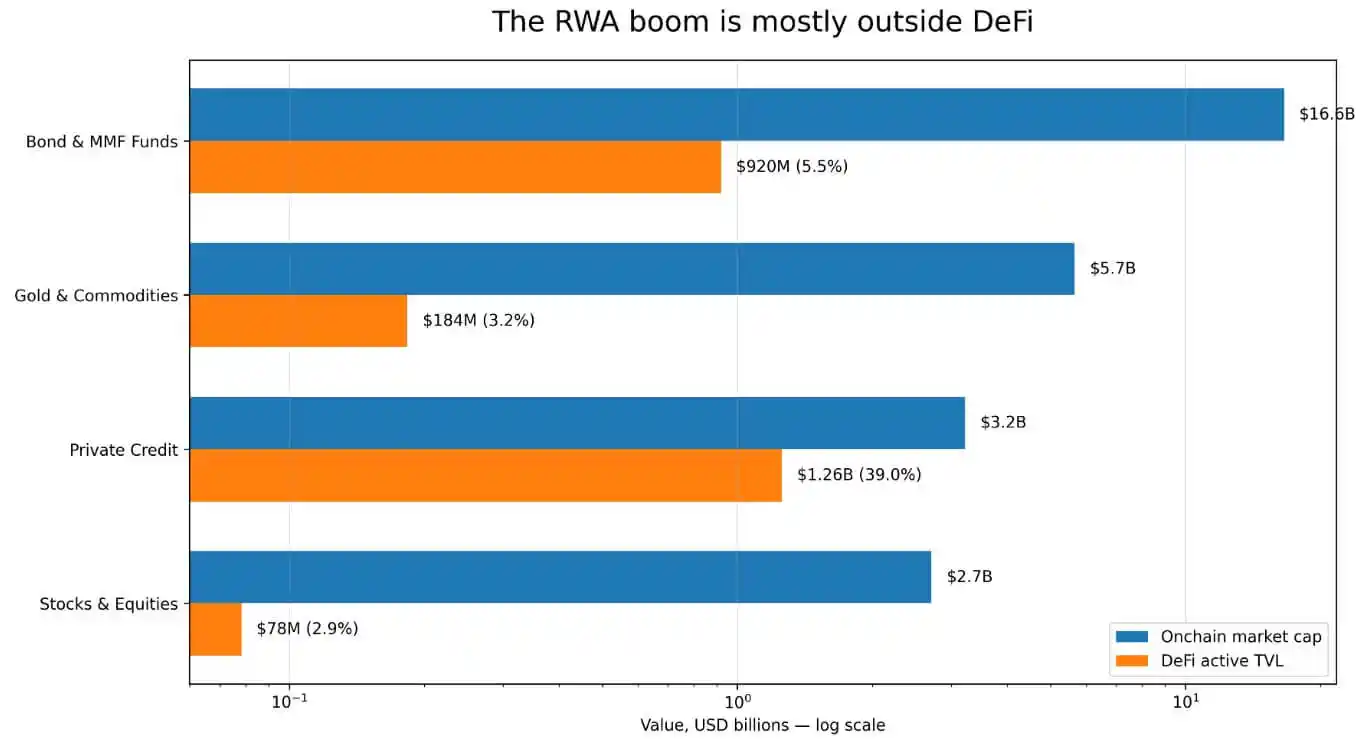
The vast majority of other RWA assets remain outside of scenarios such as lending markets and collateral vaults, which enable free combination and interaction of crypto assets. Bonds and money market funds are the largest RWA category by scale, with an on-chain total exceeding $16.6 billion. Yet, the effective TVL flowing into the DeFi ecosystem is only $920 million. The on-chain scale of gold and commodity assets is $5.7 billion, with only $183.6 million effectively circulating in DeFi. Equity assets have an on-chain scale of $2.7 billion, but the funds that have entered the DeFi market are a mere $78.27 million.

Only the private credit sector stands out: its on-chain scale is $3.226 billion, with a DeFi effective TVL of $1.257 billion, achieving an ecosystem penetration rate of 39%. The reason behind this is that projects like Maple Finance and Centrifuge were designed from the outset as lending financial instruments, making them naturally suited for DeFi application scenarios.

In contrast, tokenized products like US Treasury bond funds, gold assets, and stock assets are designed by their issuers to cater more to institutional custody needs, with their overall architecture aligning with the operational models of traditional compliant funds.

Distribution of On-Chain Market Value and DeFi Active TVL Across Four RWA Categories

Permissioned Architecture Becomes the Biggest Barrier to DeFi Composability

DeFiLlama categorizes the money market fund product BUIDL by BlackRock as a permissioned fund. Its effective TVL within the DeFi ecosystem is only $18.9 million.

The International Organization of Securities Commissions (IOSCO) pointed out in its final report on financial asset tokenization released in November 2025 that BUIDL created a permissioned system on a public blockchain for issuance, custody, secondary trading among qualified investors, dividend distribution, and redemption.

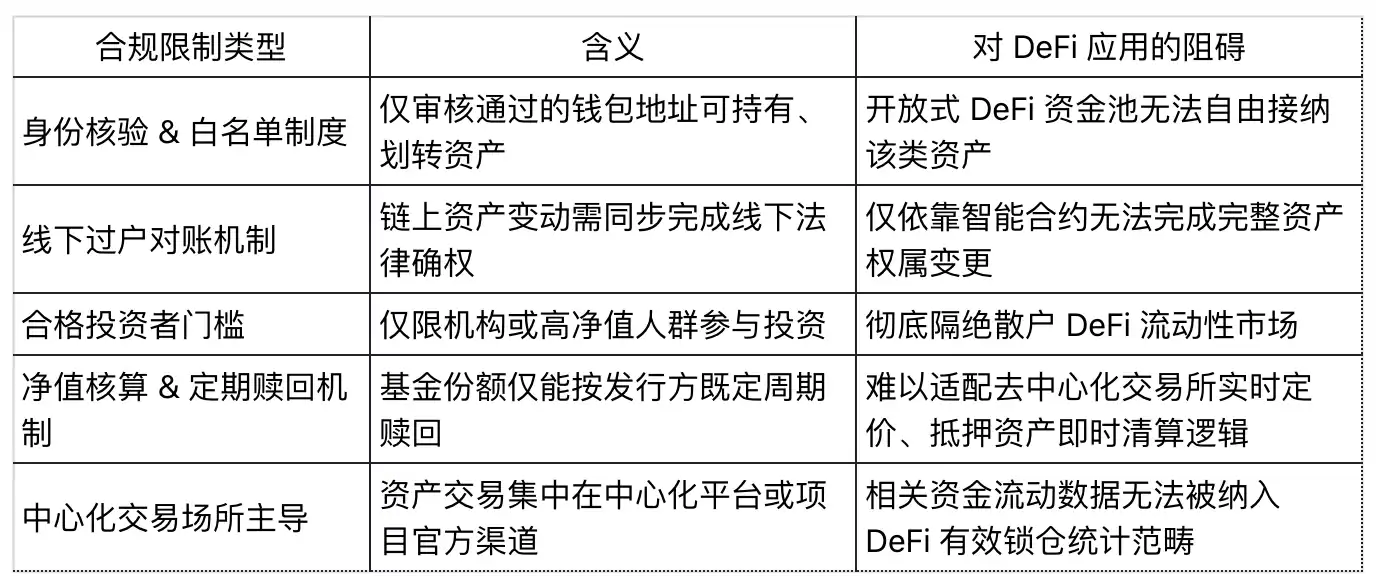
Potential investors must pass the whitelist review on the Securitize platform. Furthermore, on-chain asset transfer actions only attain full legal validity after information verification and confirmation by an offline transfer agent.

This means that BUIDL is essentially a compliant custody infrastructure built atop blockchain channels, primarily serving institutional asset custody and offline account reconciliation needs. Its smart contracts only support interactions from whitelisted addresses. Without using a compliant wrapping layer as an intermediary, they cannot be directly deposited into permissionless, open DeFi protocols like Aave or Uniswap.

In February 2026, BlackRock completed the integration of BUIDL with Uniswap, enabling partial assets to enter trading pools. However, asset access permissions are still controlled by Securitize, limited to qualified investment institutions with a net asset value of no less than $5 million; ordinary market participants still cannot participate.

IOSCO found that the vast majority of tokenized money market funds on the market currently adopt similar operational models. These assets have so far failed to deliver the high secondary market liquidity value previously anticipated by the industry.

RedStone stated bluntly in its tokenization industry report released in March 2026 that the most challenging part of asset tokenization implementation is coordinating a series of complex rules across different jurisdictions and public chain ecosystems, including compliance review, identity verification, trading permission restrictions, risk control sanctions screening, and corporate rights distribution. Looking at the current market, Morpho and Aave Horizon are among the few genuine case studies successfully implementing RWA assets in DeFi applications.

In short, each compliance and access restriction set by project parties further raises the barrier for assets to enter the DeFi ecosystem. Products like US Treasury token bonds and money market funds are themselves designed to meet the regulatory requirements of licensed institutional investors, actively incorporating various permission constraints.

Gold and commodity assets face another practical issue. CoinGecko data shows that in Q1 2026, spot trading volume for tokenized gold reached $90.7 billion, surpassing the total for the entire year of 2025. However, the vast majority of this trading occurs on centralized exchanges. The aforementioned DeFi effective TVL of $183.6 million only represents a tiny fraction circulating within the ecosystem. The enormous trading volume in centralized markets is completely outside the scope of DeFiLlama's data statistics.

Positive Outlook: Highly Compatible Products Have Set Examples

In early 2026, the TVL of Ondo's USDY exceeded $1 billion and has now achieved full coverage across nine public chain ecosystems. The Ondo Global Markets segment, launched in September 2025, focuses on tokenized US stocks and ETF assets for overseas investors. It was designed from the start to support free asset transfer and direct use as DeFi collateral. Currently, the TVL for corresponding assets is $650 million, with cumulative trading volume exceeding $12 billion.

According to RedStone statistics, the RWA deposit scale on the Morpho platform exceeds $620 million, and the total RWA-related asset scale on Aave Horizon is $423.5 million. Both lending protocols have successfully implemented mature RWA collateralized lending models.

These implementation cases fully prove that as long as the design philosophy of permissionless free circulation is upheld from the asset issuance stage, RWA assets can fully achieve composability within the DeFi ecosystem.

During an industry roundtable hosted by DWF Labs in April 2026, projects including Centrifuge, Falcon Finance, and xStocks jointly proposed the view that the RWA sector has now diverged into two major development tracks. The first prioritizes compliance with asset ownership regulations, adhering to a strictly permissioned and controlled path. The second balances compliant issuance standards while enabling secondary market circulation properties, with ecosystem composability as the core design orientation.

Graham Nelson, the person in charge of the Centrifuge project, stated that stringent whitelist access mechanisms mean each participant in a liquidity pool needs to undergo separate qualification reviews, directly blocking the path for assets to enter open DeFi.

The DeRWA solution launched by Centrifuge bypasses this barrier by wrapping the underlying primary issuance assets in a compliant manner while relaxing restrictions on secondary market asset circulation. Artem Tolkachev from Falcon Finance also mentioned that ecosystem composability and flexible exit mechanisms are the key bridges connecting real-world assets with crypto market liquidity.

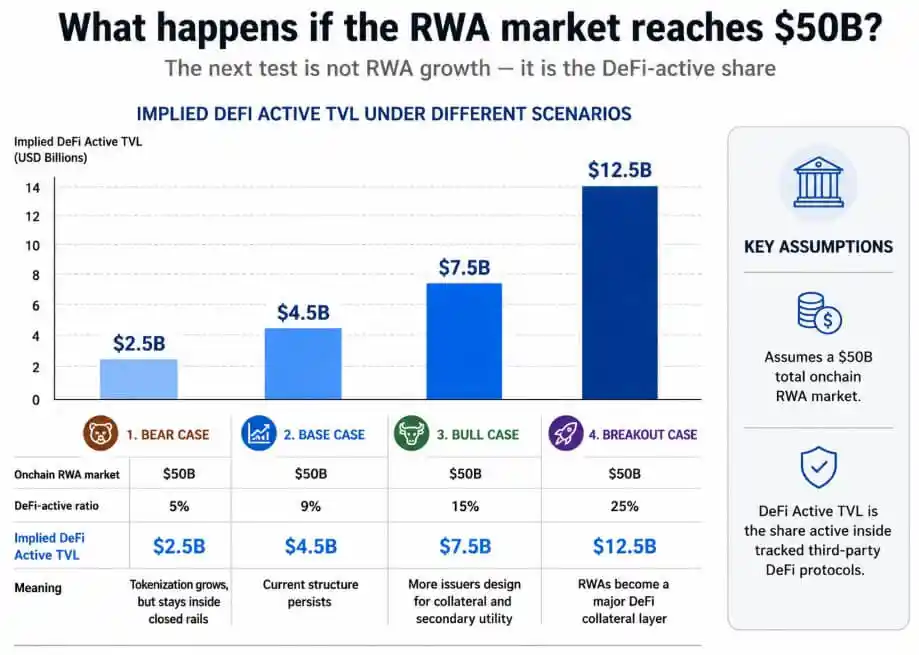
The industry is optimistic that as the overall on-chain RWA asset scale approaches $50 billion, if most projects within the sector shift towards designs compatible with DeFi, the penetration rate of RWA assets in the DeFi ecosystem is expected to break through the current low level of 9%.

Negative Reality: Industry Growth May Be Confined to the Traditional Financial System

Standard Chartered Bank predicts that the global tokenized asset scale will reach $2 trillion by 2028, but it simultaneously warns that this industry boom is likely to be confined within the traditional banking and financial system, with limited growth benefits for the open crypto market.

IOSCO's research in November 2025 also corroborates this point. Constrained by the inherent access barriers and liquidity shortcomings of distributed ledger technology, the current distribution, circulation, and secondary market trading of tokenized assets still heavily rely on traditional financial infrastructure.

The European Central Bank further pointed out in its tokenization industry research report released in April 2026 that the absence of unified global standards for asset tokenization is highly prone to creating isolated asset silos. Different asset systems have their own compliance rules, settlement layers, and access mechanisms, ultimately leading to high concentration of liquidity within closed circles, making interconnection and circulation difficult.

The DeFi penetration rates of 5.5% for bonds and money funds, 3.2% for gold and commodities, and 2.9% for equities directly reflect this fragmented ecosystem pattern.

Most US Treasury tokens and money fund products on the market commonly set minimum investment thresholds, mandatory identity verification, offline asset reconciliation cycles, and fixed redemption windows tied to net asset value. These underlying rules inherently conflict with the operational logic of decentralized exchanges' real-time pricing and permissionless collateral vaults. These constraints are mandatory requirements from the regulatory level and an inevitable choice for asset issuers to adapt to the compliant environment.

Two Markets, One Industry Label

The total on-chain RWA scale of $30 billion and the effective DeFi circulation scale of $2.47 billion, while seemingly belonging to the same RWA sector, actually correspond to two completely separate markets:

  • Compliant On-Chain Financial Market: Primarily consisting of money market funds, US Treasury funds, and institutionally custodied assets. Asset transfer relies on offline transfer agent reconciliation and confirmation, following traditional financial regulations throughout.
  • DeFi Composability Ecosystem Market: Assets can be freely deposited into lending protocols, used as permissionless collateral, and integrated into various automated yield strategies for free circulation.

The chart above predicts the implied DeFi Active TVL under four scenarios in a $50 billion RWA market, ranging from 5% to 25%

The achievement of over $620 million in RWA deposits on Morpho and the circulation of USDY across 9 blockchains is sufficient proof that the second type of market possesses genuine development potential.

To drive the DeFi penetration rate of RWA assets beyond 9%, asset issuers must abandon the 'compliance-system-first' design approach exemplified by BlackRock's BUIDL. Instead, they should adopt underlying architectures that natively support permissionless free circulation.

Currently, $28.56 billion of on-chain RWA assets belong to the permissioned control track. This also means that most current tokenized real-world assets are, in essence, more akin to compliant on-chain traditional financial products, rather than general-purpose collateral assets suitable for open DeFi ecosystems.

Связанные с этим вопросы

QAccording to the article, what is the main reason why most tokenized real-world assets (RWA) have not been successfully integrated into DeFi ecosystems?

AThe main reason is that the majority of RWA products, such as bond and money market funds, are designed with a permissioned architecture from the outset to comply with institutional custody and traditional regulatory requirements. This includes whitelisting, mandatory identity verification, and reliance on offline settlement processes, which creates significant barriers for these assets to be used in permissionless DeFi applications like Aave or Uniswap.

QWhich RWA sector, according to the article, has shown a high degree of integration with DeFi, and what is the key factor for its success?

AThe private credit sector has shown high integration, with a 39% penetration rate into DeFi. The key factor for its success is that projects like Maple Finance and Centrifuge were designed from the beginning as lending financial tools, making them inherently compatible with DeFi application scenarios.

QWhat is the fundamental difference between the two distinct markets identified in the article under the common label of "RWA"?

AThe two distinct markets are: 1) A compliant on-chain financial market, consisting of assets like money market funds and treasuries. These assets rely on offline registrars for transfer validation and follow traditional financial regulations. 2) A DeFi-composable ecosystem market, where assets can be freely deposited into lending protocols, used as collateral, and integrated into various automated yield strategies for permissionless circulation.

QWhat solution is mentioned in the article for bridging the gap between compliant primary issuance of RWAs and their potential for secondary market circulation in DeFi?

AThe article mentions Centrifuge's "DeRWA" solution as an example. It involves creating a compliant wrapper for the underlying primary issuance asset while relaxing restrictions on the secondary market circulation of that wrapped asset, thereby enabling it to be used in open DeFi protocols.

QBased on the article's analysis, what must RWA issuers do to significantly increase the current low DeFi penetration rate of their assets?

ATo significantly increase DeFi penetration beyond the current ~9%, RWA issuers must move away from design philosophies centered on a closed, permissioned compliance system (like BlackRock's BUIDL). Instead, they need to adopt a native, permissionless architecture from the ground up that supports free and unrestricted circulation of assets within DeFi ecosystems.

Похожее

IOSG: After the Number of Developers Halved, Crypto Did Not Die

The crypto development community has undergone a significant transformation, with monthly active developers on GitHub halving from 45K in 2022 to approximately 23K by 2026. This decline is largely attributed to the departure of newcomers, whose roles were often tied to market-driven hype cycles like NFTs and forked DeFi protocols, leading to a 52% churn rate among those with less than a year of experience. However, the core of the industry has strengthened. Established developers with over two years of experience have reached a record high, contributing about 70% of the code. They are consolidating around ecosystems with genuine users and revenue, such as Bitcoin and Solana, while moving away from narrative-driven projects. The talent shift represents a "deleveraging" and an increase in core density. This core group has developed a unique skillset by operating in an environment of "code is law," with zero tolerance for error and no external recourse. They have learned to build trust and functional systems from the ground up without central authorities, as demonstrated by protocols like Uniswap and MakerDAO. These capabilities are now being repriced and leveraged in the AI era. The structural challenges of AI scaling—such as trust, coordination, and verification—mirror those long addressed in crypto. Examples include CoreWeave pivoting from GPU mining to AI compute, OpenSea's founder applying NFT market logic to AI model routing with OpenRouter, and projects like NEAR and Catena Labs transitioning crypto-native architectural and financial insights into AI infrastructure and agent banking. Key areas where crypto-bred skills are directly applicable to AI include: 1. **Compute Aggregation & Optimization**: Using token incentives and cryptographic verification (e.g., Proof of Sampling & Privacy) to create trusted, decentralized GPU networks, as seen with Hyperbolic. 2. **AI Governance & Incentive Design**: Applying economic mechanism design from DAOs and tokenomics to align the goals of multiple, fast-acting AI agents, a direction explored by EigenLayer's EigenCloud. 3. **AI Agent Autonomous Payments**: Leveraging stablecoins and programmable, permissionless blockchains to enable the micro-transactions required for AI agent economies, exemplified by protocols like x402. The role of the crypto builder is evolving from writing smart contracts to designing trust mechanisms for autonomous AI systems. This convergence is reflected in hiring trends at major firms and significant capital allocation from funds like Paradigm and a16z crypto, which are investing at the intersection of crypto and AI. Regional differences exist, with the US favoring foundational protocol innovation and Asia focusing on compliant application-layer integration, but the underlying trend is clear. The industry's "deleveraging" has not signaled its demise but rather a maturation, positioning its core builders to solve critical trust and coordination problems in the age of AI.

marsbit9 мин. назад

IOSG: After the Number of Developers Halved, Crypto Did Not Die

marsbit9 мин. назад

Currency and Stock Market Barometer: Strategy Invested Over $2 Billion to Buy Over 24,800 BTC Last Week; Bitmine's ETH Holdings Increase to 4.37% of Total Supply (May 19)

Crypto & Stock Market Watch: Institutional BTC Buying Surges, ETH Holdings Grow Major listed companies aggressively accumulated Bitcoin last week, with net purchases skyrocketing over 44x to $2.03 billion. Strategy (formerly MicroStrategy) led the charge, spending approximately $2.01 billion to buy 24,869 BTC, bringing its total holdings to 843,738 BTC. Overall, listed firms (excluding miners) now hold 1,113,841 BTC, valued at ~$86.16 billion. On the Ethereum front, Bitmine purchased 71,672 ETH in the past week. It now holds 5,278,462 ETH, worth $11.56 billion and representing 4.37% of ETH's total supply. A significant portion (4,712,917 ETH) is staked, generating an annualized yield of $289 million. Industry leaders note a divergence from the MicroStrategy model, with ETH treasury firms increasingly focusing on staking yields and simpler balance sheets. In traditional markets, Morgan Stanley warns of a potential significant U.S. stock market correction if bond yields and volatility continue rising. Investment giants like Berkshire Hathaway and Bridgewater adjusted portfolios in Q1, with Bridgewater notably increasing its stakes in chipmakers like Nvidia, Broadcom, and Micron while shedding software stocks. Among other crypto-focused public companies, Solana treasury firm Upexi reported a widened net loss of $109 million for its fiscal Q3, driven by a decline in its crypto holdings' value. Meanwhile, Hyperion DeFi, a HYPE token treasury company, reported a Q1 net profit of $8.8 million and increased its HYPE holdings past 2 million tokens.

marsbit10 мин. назад

Currency and Stock Market Barometer: Strategy Invested Over $2 Billion to Buy Over 24,800 BTC Last Week; Bitmine's ETH Holdings Increase to 4.37% of Total Supply (May 19)

marsbit10 мин. назад

24-Year-Old "Wall Street Newcomer" Portfolio Adjustments Revealed: Shorts Chips Heavily in Q1, Bullish on Energy and AI Infrastructure

A 24-year-old Wall Street prodigy, Leopold Aschenbrenner, has disclosed the Q1 portfolio adjustments for his fund, Situational Awareness LP. The fund's assets under management skyrocketed from $5.52 billion to $13.7 billion. The most significant move was a massive bearish bet on the semiconductor sector. The fund established $8.46 billion in put options, targeting chipmakers like NVIDIA ($1.6B in puts) and the VanEck Semiconductor ETF (SMH, $2B in puts). This bearish stance extended to Broadcom, Oracle, AMD, Micron, ASML, Intel, Corning, and TSMC. However, the fund made a selective bullish exception, adding shares and call options for memory chip maker SanDisk. The fund maintained its core bullish thesis on energy and AI infrastructure. Bloom Energy remained its largest long equity holding. It also increased stakes in cryptocurrency mining/data center firms like CleanSpark, Riot Platforms, Applied Digital, and IREN Limited, viewing them as providers of critical ready-to-use infrastructure—land, power, and grid permits—for AI expansion. The 13F filing was submitted one day late. Overall, the fund's strategy involves substantial bearish semiconductor bets while maintaining concentrated, high-volatility investments in selective tech, computing, and infrastructure plays aligned with AI growth.

marsbit28 мин. назад

24-Year-Old "Wall Street Newcomer" Portfolio Adjustments Revealed: Shorts Chips Heavily in Q1, Bullish on Energy and AI Infrastructure

marsbit28 мин. назад

Global Long-Term Bonds Break Down: The Fiscal Illusion of the Low-Interest Era is Collapsing

Global long-term bonds are experiencing a widespread breakdown, as the fiscal illusion of the low-interest-rate era collapses. Sovereign yields are hitting multi-year highs in the US, UK, Japan, and France, signaling a market repricing driven by a common reality: unsustainable debt and deficits outpacing economic growth, compounded by renewed inflationary pressures from energy shocks. The direct trigger is the blockade of the Strait of Hormuz, which has pushed oil prices higher and reignited inflation fears. This squeezes central bank policy space, with expectations shifting from future rate cuts to potential hikes. The core "fiscal Ponzi scheme" is becoming evident—governments rely on new debt to service existing obligations, but as growth lags and borrowing costs rise, investors demand higher yields. Key developments include the US 30-year yield surpassing 5% for the first time since 2007, with tepid auction demand; Japan's 30-year yield reaching 4%, threatening its long-standing low-rate financial system; and political paralysis in the UK and France making meaningful fiscal consolidation unlikely. The marginal buyer for US debt is also shifting from foreign central banks to more price-sensitive private investors. While debt managers may adjust issuance, fundamental drivers—deteriorating fiscal paths, persistent inflation, and constrained central banks—remain. The market is conclusively repricing the end of the low-interest-rate financing model for highly indebted developed economies.

marsbit36 мин. назад

Global Long-Term Bonds Break Down: The Fiscal Illusion of the Low-Interest Era is Collapsing

marsbit36 мин. назад

Following the KelpDAO Hack: $40 Billion in Assets Flee LayerZero, Chainlink Emerges as the Primary 'Beneficiary'

Following a major security breach in April where KelpDAO's bridge using LayerZero was attacked for approximately $292 million, a significant shift is underway in the cross-chain infrastructure landscape. An estimated $40 billion in assets is in the process of migrating or has already migrated from LayerZero to Chainlink's Cross-Chain Interoperability Protocol (CCIP). The attack exploited a single-point-of-failure vulnerability due to KelpDAO's 1-of-1 validator configuration within the LayerZero network. Attackers corrupted RPC nodes and used DDoS attacks to force the system to rely on compromised nodes, allowing fraudulent messages. While LayerZero acknowledged a serious error in allowing its validator network to service high-value transactions with such a configuration, the incident highlighted critical security risks. This triggered a rapid migration wave. Starting with KelpDAO on May 6th, several major protocols—including Solv Protocol, Re, Tydro, Kraken, and Lombard—announced switching their cross-chain infrastructure exclusively to Chainlink CCIP. The combined value of these migrations is estimated to be around $40 billion. This movement followed earlier major adoptions by Coinbase (in late 2025) and Circle (in early 2024). Market sentiment reflected this shift, with LINK's price showing relative stability while ZRO (LayerZero's token) declined significantly. Data indicates a net outflow of approximately $20.1 billion from the LayerZero network over 30 days. The migration is largely driven by perceived security differences. Chainlink CCIP employs a decentralized oracle network as its default consensus layer, featuring multiple independent node operators, a separate Risk Management Network, and built-in safeguards like rate limits. In contrast, LayerZero's highly modular architecture offers flexibility but places more responsibility on application developers to configure security settings, a risk underscored by the KelpDAO incident. LayerZero has since apologized for its communication handling post-attack and stated the protocol itself was not compromised, but rather its Labs DVN's internal RPC was poisoned. An official post-mortem report with external security partners is forthcoming.

marsbit1 ч. назад

Following the KelpDAO Hack: $40 Billion in Assets Flee LayerZero, Chainlink Emerges as the Primary 'Beneficiary'

marsbit1 ч. назад

Торговля

Спот
Фьючерсы
活动图片