Bitcoin is now less volatile than S&P 500 and Nasdaq

CointelegraphPublished on 2022-11-05Last updated on 2022-11-05

Abstract

A rare 2% daily loss for the U.S. dollar index gives Bitcoin and stocks an opportunity for gains, but BTC still undercuts the rest on volatility.

A rare 2% daily loss for the U.S. dollar index gives Bitcoin and stocks an opportunity for gains, but BTC still undercuts the rest on volatility.

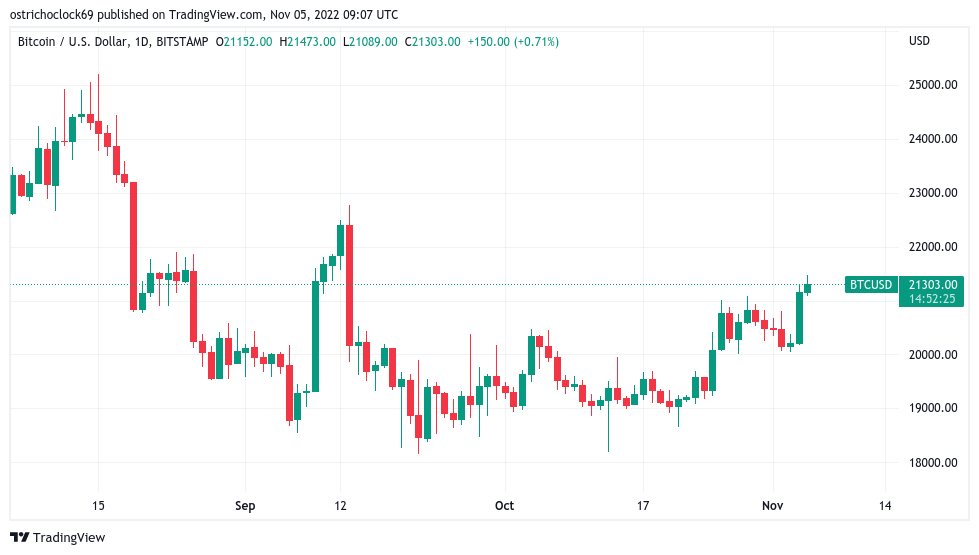
Bitcoin held gains above $21,000 into Nov. 5 as the U.S. dollar posted a rare major daily decline.

BTC/USD 1-day candle chart (Bitstamp). Source: TradingView

Dollar dives 2% as risk assets recover

Data from Cointelegraph Markets Pro and TradingView showed BTC/USD building on prior strength to hit highs of $21,473 on Bitstamp — a new seven-week high.

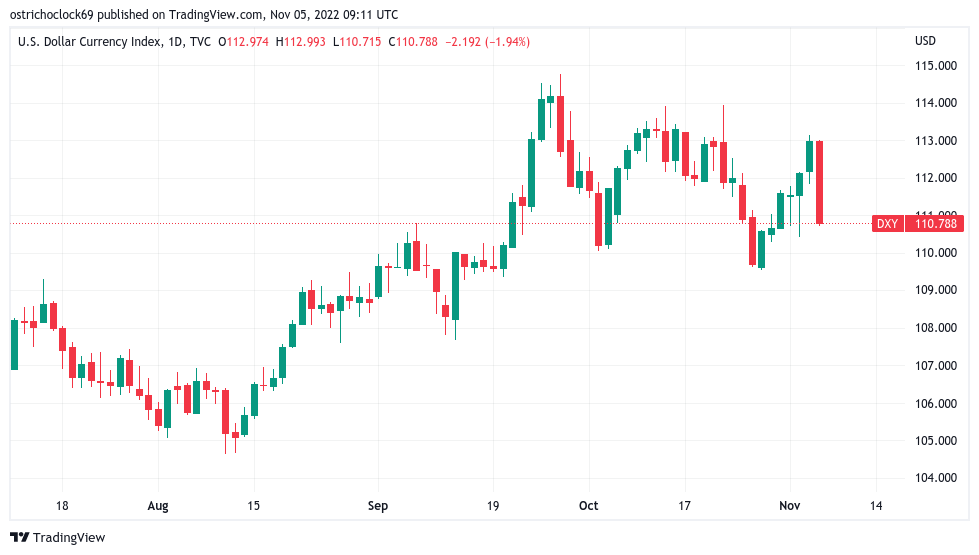
The pair had benefited from the latest United States economic data, while the dollar conversely suffered. The U.S. dollar index (DXY) lost 2% in a day for the first time in years, helping fuel a risk asset rally.

U.S. dollar index (DXY) 1-day candle chart. Source: TradingView

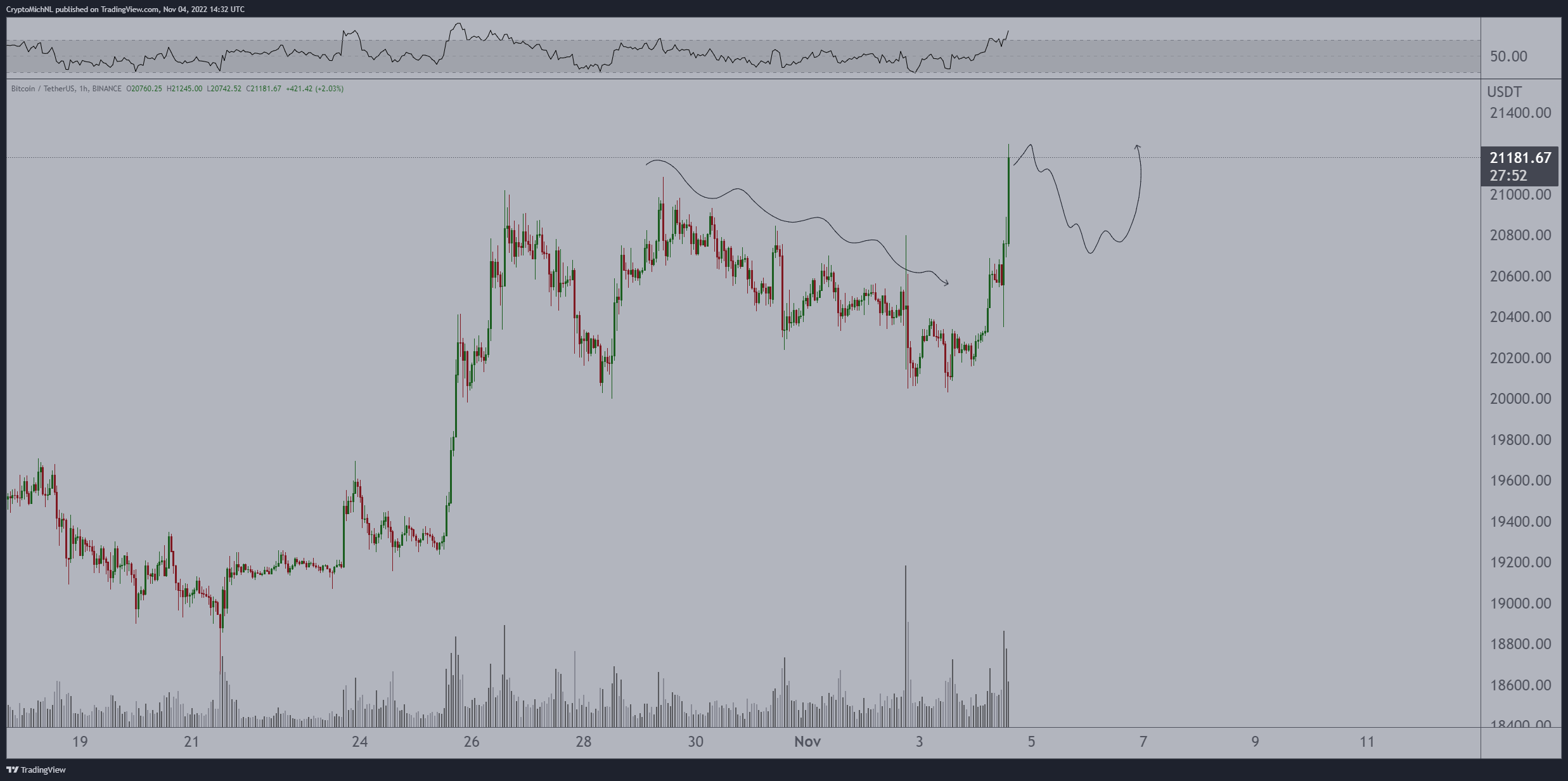
“And, just like that, Bitcoin took out all the highs, volume is increasing and it's back above $21K,” Michaël van de Poppe, CEO and founder of trading firm Eight, commented.

“I'm assuming we'll continue towards $22.5K from here, but have a slight correction before continuing (as we took out all the liquidity). Buy the dip season.”

BTC/USD annotated chart. Source: Michaël van de Poppe/ Twitter

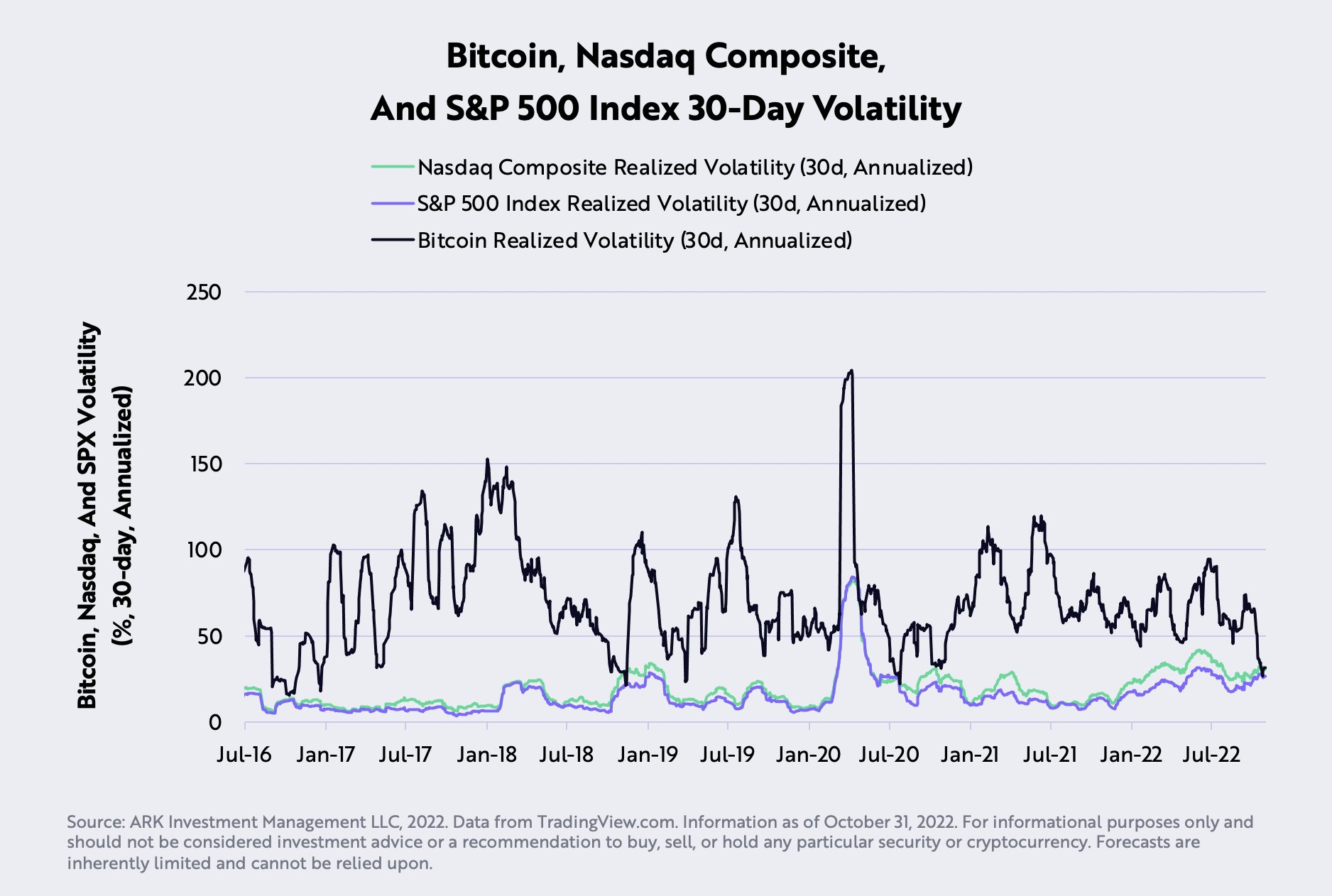
BTC had previously become notorious for its lack of volatility and narrow trading range, helping it beat even stocks for the first time ever.

“For the first time in history, bitcoin is less volatile than both the S&P 500 and Nasdaq,” Yassine Elmandjra, a crypto analyst at ARK Invest, noted, linking to the firm’s latest report, “The Bitcoin Monthly.”

“The last time volatility was this low, bitcoin rose from $9,000 to $60,000 in less than a year.”

Bitcoin vs. S&P500 vs. Nasdaq Composite Index volatility chart. Source: Yassine Elmandjra/ Twitter

Tyler Winklevoss, meanwhile revealed a belief that crypto markets would continue to act as a leading indicator of overall market trajectory, as in 2021.

“Crypto was the first asset class to crash; it will be the first to rise again,” he summarized.

Bitcoin more stable than major fiat currencies

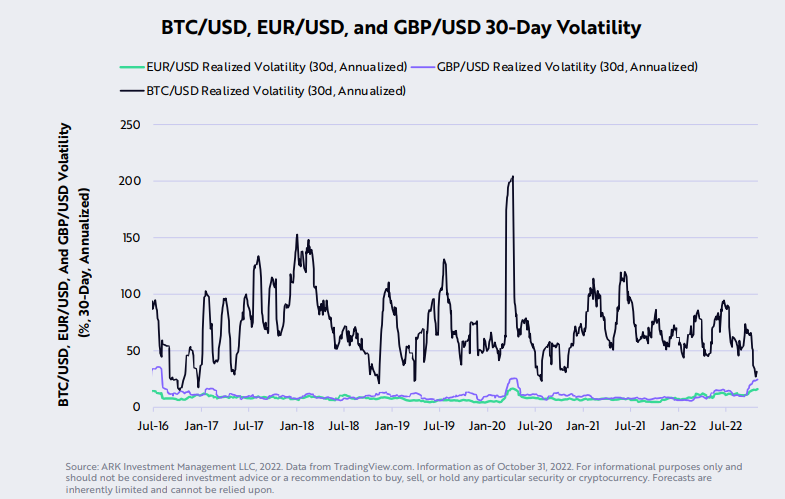
Continuing on the theme of low volatility, ARK’s report, led by well-known analyst David Puell, showed that it was not just stocks being undercut by Bitcoin’s stability.

“Bitcoin’s relative volatility has not only decreased relative to equities, but also to major currency pairs. As macro uncertainty and USD strength have increased, foreign currency pairs have been impacted negatively while bitcoin has been relatively stable,” The Bitcoin Monthly stated.

“Bitcoin’s 30-day realized volatility is nearly equivalent to that of the GBP and EUR for the first time since October 2016. Although Fed hawkishness could continue its volatility, bitcoin’s strength relative to foreign currencies is an encouraging sign.”

BTC/USD volatility vs. EUR, GBP chart (screenshot). Source: ARK Invest

As Cointelegraph reported, another popular analyst, LookIntoBitcoin creator Philip Swift, has forecast the end of the current bear market by the start of 2023.


Trending Cryptos

Related Reads

Soaring Over Tenfold Within the Year: The Frenzy Over SK Hynix Leveraged Products

South China Morning Post The leveraged ETF tracking SK Hynix has surged over tenfold year-to-date, fueled by intense market speculation on the memory chip sector. By June 22, the value of the 'South Korea 2x Long SK Hynix ETF' listed in Hong Kong had skyrocketed by more than 1,061% since the start of the year, while its asset size exploded over twenty times from the end of last year. The rally is driven by AI-driven demand for high-bandwidth memory (HBM), with SK Hynix recently sampling its next-generation HBM4E product. However, industry professionals warn of significant risks. Leveraged ETFs magnify both gains and losses. During a recent market correction, while the underlying SK Hynix stock fell 19.1%, its double-leveraged ETF dropped nearly 38%. Korean regulators noted that such products could theoretically lose 60% in a single day. Additionally, these ETFs face risks like time decay in volatile markets, liquidity spirals during mass redemptions, and extreme price dislocations from market-making failures, as seen in early June when an ETF moved opposite to its underlying stock. The trading is predominantly driven by retail investors, with institutional capital largely absent due to the products' high volatility. Analysts caution that with the semiconductor sector at elevated valuations and facing geopolitical and supply chain uncertainties, leveraged ETFs pose a substantial threat of amplified losses for uninformed investors.

marsbit34m ago

Soaring Over Tenfold Within the Year: The Frenzy Over SK Hynix Leveraged Products

marsbit34m ago

18 Months, Over 50x Surge: KIOXIA's Epic Comeback

KIOXIA, a NAND flash memory giant, staged a dramatic comeback driven by AI demand. After a period of significant losses, a failed merger, and missed HBM opportunities, its 2024 IPO began modestly. However, fueled by explosive demand for AI data storage, its stock price skyrocketed over 50 times within 18 months, making it Japan's most valuable company, surpassing Toyota. Its Q1 FY2026 profit guidance soared 30-fold year-over-year, with 2026 NAND capacity already sold out. Key to its success is its 3D NAND technology, BiCS FLASH. As the inventor of NAND, KIOXIA advanced its technology through generations, reaching over 200 layers by 2023. Key innovations include CBA (CMOS directly Bonded to Array), which separately manufactures control circuits and memory arrays for better performance, and OPS (On Pitch Select Gate) to increase density. The company is now developing high-capacity packages like an 8TB solution stacking 32 dies. Looking beyond NAND, KIOXIA is exploring 3D DRAM with its OCTRAM technology, using oxide semiconductor transistors for ultra-low leakage to reduce power consumption. This fundamental research differs from HBM and represents a long-term bet to extend its 3D expertise from NAND into future DRAM architectures. KIOXIA's story highlights how technological assets and shifting market cycles can rapidly transform a company's fortunes. While questions remain about sustaining growth beyond the current AI boom, its resurgence demonstrates that in semiconductors, being down does not necessarily mean being out.

marsbit44m ago

18 Months, Over 50x Surge: KIOXIA's Epic Comeback

marsbit44m ago

Market Trends in U.S. Stocks (June 23): Peak at Listing? SpaceX Loses Over $800 Billion in Three Days, Tech Stocks Experience Severe Internal Divergence

Stock Market Trends (June 23): Did SpaceX Peak at IPO? The company loses over $800 billion in market value in three days as a sharp divergence unfolds within the tech sector. SpaceX's post-IPO decline of over 20%, falling below its first-day close, reflects a swift market repricing. The catalyst is a clear shift in narrative from "AI platform potential" to concerns over rising capital costs, as its $8.57 billion IPO and subsequent $20 billion debt offering are earmarked for acquisitions and refinancing existing bridge loans rather than de-leveraging. While high-valuation tech stocks like Google, Meta, Amazon, and Microsoft faced pressure, Micron surged nearly 7% to a record high following a strategic supply deal with Anthropic for HBM and memory, highlighting robust, tangible demand in AI infrastructure. The broader market saw funds rotate into more defensive industrial and financial names. Macro factors included a dip in oil prices to a three-month low on news of a US-Iran framework deal, though logistical hurdles for resuming full Strait of Hormuz shipments remain. Key events ahead include Nvidia's shareholder meeting, Micron's earnings, and the May PCE inflation data. The latter will be crucial in determining whether the sell-off in high-valuation growth stocks, which appears to have just begun, will persist.

marsbit54m ago

Market Trends in U.S. Stocks (June 23): Peak at Listing? SpaceX Loses Over $800 Billion in Three Days, Tech Stocks Experience Severe Internal Divergence

marsbit54m ago

Interview with MicroStrategy CEO: Beyond the 32 BTC Selling Stir, 6 Trillion AI Agents are the Ultimate Endgame for Bitcoin

Interview with Strategy CEO: Beyond the 32 BTC Sale, 6 Trillion AI Agents are Bitcoin's Ultimate Endgame Strategy CEO Phong Le discusses the recent sale of 32 BTC, clarifying it was a minor, strategic move to demonstrate operational liquidity and internal process robustness to creditors and rating agencies, not a reaction to market fears. He emphasizes Strategy's disciplined, data-driven decision-making framework involving its board and complex financial modeling, distancing the company from centralized "black box" operations seen elsewhere in crypto. Le outlines the company's resilience and long-term focus, citing the "doing nothing" strategy during the 2022 bear market as a testament to its conviction in Bitcoin's underlying value proposition for global sovereignty and freedom. He reveals that generative AI was instrumental in developing their Stretch (STRC) preferred stock product, cutting development time from years to months. The most visionary part of the discussion centers on Agentic AI. Le envisions a future with 6 trillion autonomous AI agents conducting commerce, particularly in off-world environments like Mars, which would naturally adopt decentralized crypto rails and seek yield-bearing assets like Bitcoin as a core store of value. Finally, Le addresses the STRC product, expressing confidence it will return to its $100 par value through reserve replenishment and the initiation of dividend payments, and dismisses concerns about competition with stablecoins. He concludes by affirming Strategy's philosophy of expanding Bitcoin access through all available means, from self-custody to ETFs, to onboard the next wave of users.

marsbit1h ago

Interview with MicroStrategy CEO: Beyond the 32 BTC Selling Stir, 6 Trillion AI Agents are the Ultimate Endgame for Bitcoin

marsbit1h ago

Trading

Spot
Futures

Hot Articles

What is $BITCOIN

DIGITAL GOLD ($BITCOIN): A Comprehensive Analysis Introduction to DIGITAL GOLD ($BITCOIN) DIGITAL GOLD ($BITCOIN) is a blockchain-based project operating on the Solana network, which aims to combine the characteristics of traditional precious metals with the innovation of decentralized technologies. While it shares a name with Bitcoin, often referred to as “digital gold” due to its perception as a store of value, DIGITAL GOLD is a separate token designed to create a unique ecosystem within the Web3 landscape. Its goal is to position itself as a viable alternative digital asset, although specifics regarding its applications and functionalities are still developing. What is DIGITAL GOLD ($BITCOIN)? DIGITAL GOLD ($BITCOIN) is a cryptocurrency token explicitly designed for use on the Solana blockchain. In contrast to Bitcoin, which provides a widely recognized value storage role, this token appears to focus on broader applications and characteristics. Notable aspects include: Blockchain Infrastructure: The token is built on the Solana blockchain, known for its capacity to handle high-speed and low-cost transactions. Supply Dynamics: DIGITAL GOLD has a maximum supply capped at 100 quadrillion tokens (100P $BITCOIN), although details regarding its circulating supply are currently undisclosed. Utility: While precise functionalities are not explicitly outlined, there are indications that the token could be utilized for various applications, potentially involving decentralized applications (dApps) or asset tokenization strategies. Who is the Creator of DIGITAL GOLD ($BITCOIN)? At present, the identity of the creators and development team behind DIGITAL GOLD ($BITCOIN) remains unknown. This situation is typical among many innovative projects within the blockchain space, particularly those aligning with decentralized finance and meme coin phenomena. While such anonymity may foster a community-driven culture, it intensifies concerns about governance and accountability. Who are the Investors of DIGITAL GOLD ($BITCOIN)? The available information indicates that DIGITAL GOLD ($BITCOIN) does not have any known institutional backers or prominent venture capital investments. The project seems to operate on a peer-to-peer model focused on community support and adoption rather than traditional funding routes. Its activity and liquidity are primarily situated on decentralized exchanges (DEXs), such as PumpSwap, rather than established centralized trading platforms, further highlighting its grassroots approach. How DIGITAL GOLD ($BITCOIN) Works The operational mechanics of DIGITAL GOLD ($BITCOIN) can be elaborated on based on its blockchain design and network attributes: Consensus Mechanism: By leveraging Solana’s unique proof-of-history (PoH) combined with a proof-of-stake (PoS) model, the project ensures efficient transaction validation contributing to the network's high performance. Tokenomics: While specific deflationary mechanisms have not been extensively detailed, the vast maximum token supply implies that it may cater to microtransactions or niche use cases that are still to be defined. Interoperability: There exists the potential for integration with Solana’s broader ecosystem, including various decentralized finance (DeFi) platforms. However, the details regarding specific integrations remain unspecified. Timeline of Key Events Here is a timeline that highlights significant milestones concerning DIGITAL GOLD ($BITCOIN): 2023: The initial deployment of the token occurs on the Solana blockchain, marked by its contract address. 2024: DIGITAL GOLD gains visibility as it becomes available for trading on decentralized exchanges like PumpSwap, allowing users to trade it against SOL. 2025: The project witnesses sporadic trading activity and potential interest in community-led engagements, although no noteworthy partnerships or technical advancements have been documented as of yet. Critical Analysis Strengths Scalability: The underlying Solana infrastructure supports high transaction volumes, which could enhance the utility of $BITCOIN in various transaction scenarios. Accessibility: The potential low trading price per token could attract retail investors, facilitating wider participation due to fractional ownership opportunities. Risks Lack of Transparency: The absence of publicly known backers, developers, or an audit process may yield skepticism regarding the project's sustainability and trustworthiness. Market Volatility: The trading activity is heavily reliant on speculative behavior, which can result in significant price volatility and uncertainty for investors. Conclusion DIGITAL GOLD ($BITCOIN) emerges as an intriguing yet ambiguous project within the rapidly evolving Solana ecosystem. While it attempts to leverage the “digital gold” narrative, its departure from Bitcoin's established role as a store of value underscores the need for a clearer differentiation of its intended utility and governance structure. Future acceptance and adoption will likely depend on addressing the current opacity and defining its operational and economic strategies more explicitly. Note: This report encompasses synthesised information available as of October 2023, and developments may have transpired beyond the research period.

431 Total ViewsPublished 2025.05.13Updated 2025.05.13

What is $BITCOIN

Discussions

Welcome to the HTX Community. Here, you can stay informed about the latest platform developments and gain access to professional market insights. Users' opinions on the price of BTC (BTC) are presented below.

活动图片