Author: Du Qin DQ
Previously, we have deeply analyzed this flash memory giant's regrettable trough period in another article: burdened by the past glory of Toshiba Memory but 'born at the wrong time'; cold-shouldered by the capital markets, leading to a last-minute IPO setback; suffering consecutive huge losses in an industry downturn, and unfortunately missing out on the enormous opportunity of HBM, with even its attempt to seek refuge through a merger with Western Digital falling through... At that time, KIOXIA seemed to have become a 'hot potato' in the eyes of outsiders amid the semiconductor industry reshuffle.
However, just over a year later, KIOXIA staged a comeback that can be described as epic. Driven by the frenzy of AI large models, the market logic for storage underwent a fundamental shift. KIOXIA not only successfully reversed its fortunes but also achieved a dual explosion in both capital markets and technology.
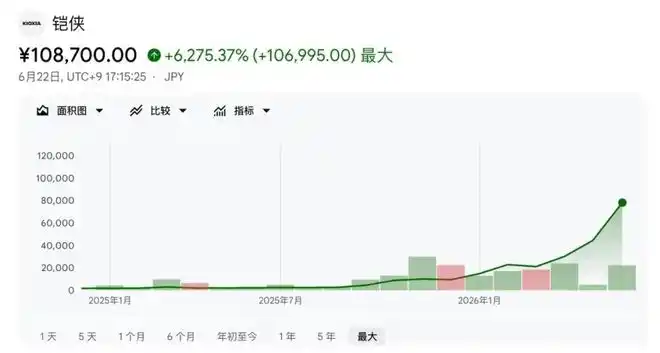
KIOXIA's stock price trend since listing
The Super Myth in the Capital Markets
KIOXIA successfully listed on the Tokyo Stock Exchange at the end of 2024, with its initial market capitalization hovering around only 800 billion yen (approximately $50 billion). However, with the comprehensive explosion of AI storage demand, KIOXIA performed an epic reversal in the 18 months following its listing: its stock price skyrocketed over 50 times within 18 months, rising 8-fold in 2026 alone.
Currently, KIOXIA's market capitalization has exceeded 51 trillion yen (approximately 481 trillion Korean won), repeatedly surpassing Toyota Motor, the symbol of Japanese manufacturing, to become the highest-valued company on the Japanese stock market.
According to KIOXIA's Q1 FY2026 (April–June) earnings forecast, its quarterly operating profit is expected to reach as high as 1.3 trillion yen (approximately $81 billion), a staggering increase of nearly 30 times year-over-year; the quarterly net profit guidance is 869 billion yen, a 48-fold increase year-over-year. The performance of a single quarter surpassed the full-year net profit forecast for FY2025.
As major customers scrambled to sign long-term supply contracts, KIOXIA's 2026 NAND capacity has been completely sold out, and the supply-demand imbalance is expected to persist until 2027. The market anticipates KIOXIA's operating profit margin this year to exceed 60%, setting a record for the highest profitability level in the global memory industry. Furthermore, with market expectations for shareholders to receive returns such as stock splits and dividends, its target stock price is hoped to rise to 200,000 yen.
This wave of soaring value has delivered investment returns beyond imagination to parent company Bain Capital, which held on during the downturn, and indirect major shareholder SK Hynix.
According to the Financial Times, the AI boom has made Bain's 2018 acquisition of Toshiba Memory (now KIOXIA) one of the most profitable private equity deals in history. Bain Capital has realized profits by selling most of its shares, with returns exceeding $150 billion, a near 20x return on investment. Its flagship private equity fund is estimated to have gained over $8 billion in profit.
SK Hynix invested a total of 395 billion yen (approximately 3.9 trillion Korean won at the time) in Toshiba Memory in 2018 through a consortium involving Korea, the US, and Japan, among other forms. Currently, this consortium still holds an 18% stake in KIOXIA. With the surge in KIOXIA's stock price, SK Hynix has seen enormous paper gains, and the market expects the consortium's eventual total profit to far exceed $70 billion.
The former 'hot potato' instantly transformed into a 'super ATM'.
In the past, the benefits of artificial intelligence were mainly concentrated in GPU and HBM companies like NVIDIA and SK Hynix. HBM was the star on the AI training side, while NAND became a scarce resource in AI inference, model storage, data lakes, enterprise SSDs, and nearline storage. The market expects KIOXIA's net profit for FY2027 to reach 2.8389 trillion yen, a 5.1-fold increase compared to the previous year.
3D NAND, The Foundation of KIOXIA's Existence
KIOXIA invented NAND flash memory over 35 years ago. In 2007, KIOXIA introduced BiCS FLASH 3D flash memory, a 3D flash memory technology system centered around vertical stacking, lateral scaling, wafer bonding, select gate optimization, and advanced packaging.
The basic idea of 3D NAND is: unlike 2D NAND, which only shrinks cells on a plane, it stacks memory cells vertically like building a skyscraper. KIOXIA's explanation is vivid: originally it was one floor with limited land area; 3D NAND is equivalent to turning a one-story building into a multi-story apartment, accommodating more 'residents' on the same area.
The core of BiCS FLASH is its batch processing technology. Its general process logic is: first, alternately stack plate-like electrodes and insulating layers; then drill a large number of holes along the vertical direction in one go; next, fill the holes with charge storage films and pillar-like electrodes; the intersection of the plate-like electrode and pillar-like electrode forms a memory cell. This shows that KIOXIA's BiCS FLASH is not the traditional 'create memory cells separately for each added layer,' but rather stacks the structure first, then forms memory cells by 'punching and plugging' through multiple layers at once. Therefore, when the number of layers increases, the manufacturing cost does not rise completely linearly, improving the economic viability of continued stacking for 3D NAND.
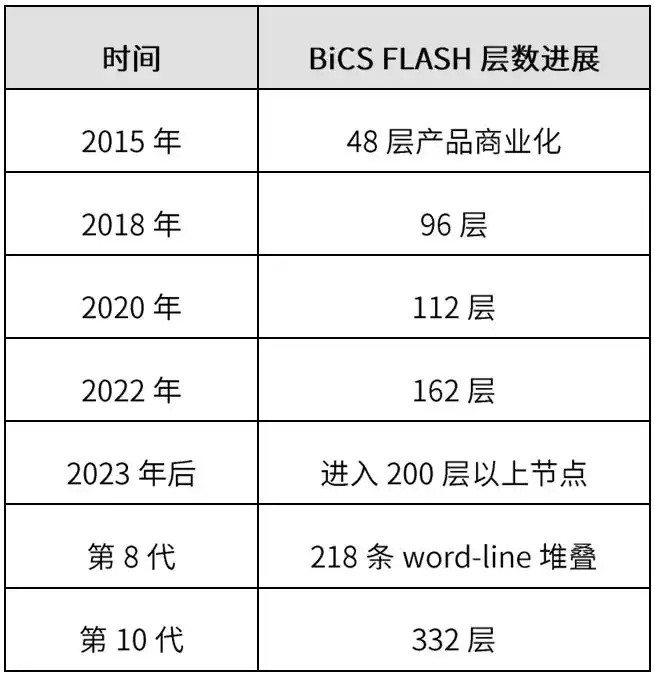
KIOXIA's officially disclosed commercialization timeline for BiCS FLASH is roughly as follows: BiCS FLASH products achieved commercialization with 48 layers in 2015, then progressed to 96 layers, 112 layers, 162 layers; as of March 2023, stacking of over 200 layers has been achieved.
Among these, the 8th-generation BiCS FLASH is a key milestone. KIOXIA states that the 8th-generation product uses 218 word-line stacks, achieves a storage density of 18.3Gb/mm² for the 1Tb TLC product, and supports a 3.2Gbps external data transfer speed, 40μs read time, and 205MB/s programming throughput.
KIOXIA's 8th-generation BiCS FLASH not only jumped from 162 layers to 218 layers but also introduced two key technologies:
CBA (CMOS directly Bonded to Array): CBA can be understood as manufacturing the peripheral CMOS control circuit and the memory array separately, followed by wafer bonding. In the past, CMOS circuits and the memory array were manufactured on the same wafer. However, the optimal process conditions for both are not identical: the memory array may require processes better suited for charge storage and stacked structures, while CMOS circuits focus more on logic control, electrical performance, and speed. Manufacturing them on the same wafer forces compromises.
CBA's approach is: manufacture the CMOS wafer separately, manufacture the memory array wafer separately, optimize the processes for each independently, and finally bond them together with high precision. The benefits are: improved bit density, increased NAND I/O speed, allowing the memory array to use high-temperature processes previously limited by CMOS constraints, and reduced electrical interference between adjacent memory cells.
OPS (On Pitch Select Gate): OPS solves the problem of wasted space within the memory array. In traditional structures, there exist 'dummy' areas between memory cells that are not used for data storage. These areas do not directly contribute to capacity but occupy area. KIOXIA's OPS technology, by rearranging select gates and insulating isolation structures, reduces or eliminates these ineffective areas, allowing more effective memory cells to be placed in the same area. KIOXIA's official explanation states that OPS removes unnecessary dummy regions, enabling more actual memory cells to be placed in the same space, significantly improving storage density.
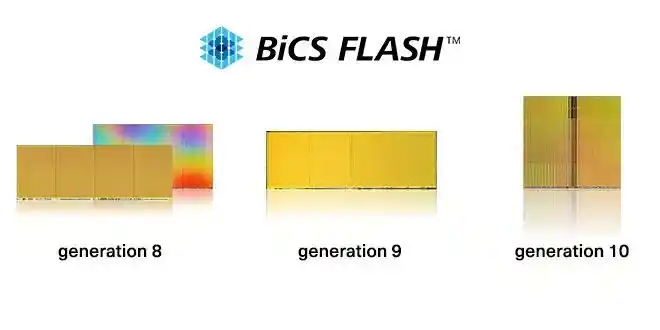
The 9th-generation BiCS FLASH primarily targets 512Gb and 1Tb TLC products, positioned to support applications in the mid-to-low capacity range that require high performance and low power consumption. It continues to use CBA and OPS technologies to improve production efficiency and provide more advanced flash memory solutions. The 9th generation does not follow the route of increasing layer count but emphasizes the balance between performance, power consumption, cost, and production efficiency.
The 10th-generation BiCS FLASH clearly leans more towards future high-capacity, high-performance demands. KIOXIA states that the 10th-generation product uses the same CMOS technology as the 9th generation while increasing the number of memory layers to 332, approximately 1.5 times that of the 8th generation, to enhance bit density and power efficiency.
Beyond front-end manufacturing processes, KIOXIA is also advancing back-end packaging capabilities. Official materials mention that KIOXIA developed a single-package 8TB flash memory, achieved by stacking 32 flash memory dies, each 2Tb, within one package. This relies on advanced back-end processes like wafer thinning, material design, and wire bonding. This 32-die stacking can assemble 32 pieces of 2Tb dies into a package with a height under 2mm, forming an 8TB flash memory solution.
From 3D NAND to 3D DRAM, KIOXIA's New Gambit
KIOXIA is also deploying a secret weapon to break through the single-product-line barrier of being a 'pure NAND vendor.' Why is KIOXIA venturing into 3D DRAM? This is because DRAM has also reached a planar scaling bottleneck similar to what NAND faced. As an established player in 3D NAND, KIOXIA also possesses process-validated advantages.
Continued scaling of traditional DRAM encounters several challenges: storage capacitors become increasingly difficult to shrink, access transistor leakage increases, data retention time shortens, refresh frequency rises, and higher capacity leads to higher refresh power consumption. Imec also mentioned in a technology review that the traditional DRAM 1T1C structure faces scaling, cost, and power efficiency challenges, especially as large capacitors limit the 3D integration path, and smaller transistors lead to more pronounced leakage paths, causing increased refresh power consumption.
In December 2024, KIOXIA announced the development of OCTRAM (Oxide-Semiconductor Channel Transistor DRAM) technology, a new 4F² DRAM composed of oxide semiconductor transistors, offering both high on-current and ultra-low off-current. This achievement was jointly developed by KIOXIA and Nanya Technology and presented at the 2024 IEEE IEDM.
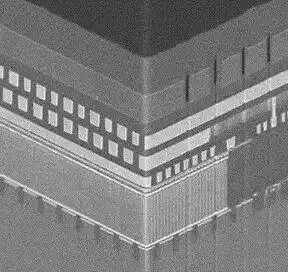
Panoramic view of OCTRAM (Source: KIOXIA, same below)
Traditional DRAM cells are generally 1T1C, meaning one access transistor plus one capacitor. Its problem is: as the cell continues to shrink, the capacitor becomes harder to make, and transistor leakage also increases refresh power consumption. KIOXIA's OCTRAM attempts to reduce leakage through InGaZnO transistors and push the cell structure towards higher density.
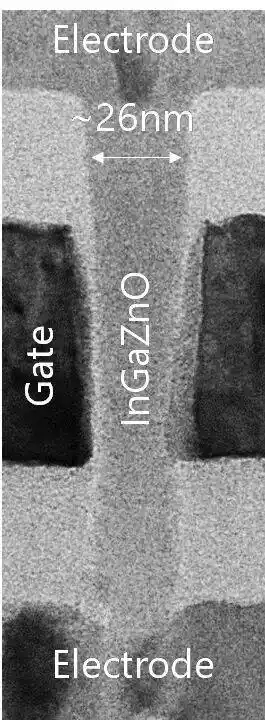
Cross-sectional TEM image of the InGaZnO vertical transistor
Due to its large bandgap and high electron mobility, InGaZnO transistors can theoretically achieve both ultra-low leakage and high on-current. KIOXIA, by optimizing contact electrode materials and spacer thickness, experimentally achieved over 15μA on-current while also realizing ultra-low leakage current below 10⁻¹⁸ A (as shown in the figure below). A significant portion of DRAM power consumption comes from refresh. Lower leakage leads to longer data retention time, reducing refresh pressure. Therefore, the core value of OCTRAM is using low-leakage oxide semiconductor transistors to reduce DRAM refresh power consumption.
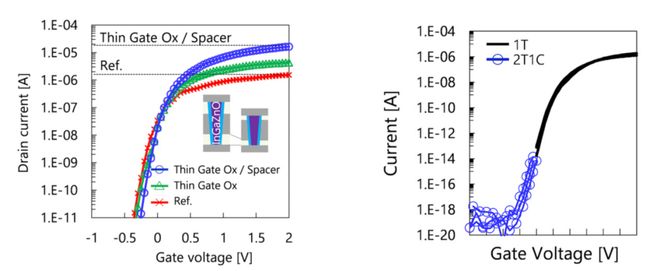
(a) On-current characteristics and (b) Off-current characteristics of the developed InGaZnO transistor
In September 2025, KIOXIA disclosed further reliability research on OCTRAM, focusing on TDDB lifetime issues of sub-25nm Gate-All-Around vertical InGaZnO transistors. TDDB stands for Time-Dependent Dielectric Breakdown. Simply put, it's whether the transistor's insulating layer gradually degrades and eventually fails under long-term electric field stress. KIOXIA stated they found lifetime degradation stems from two factors: intrinsic factors from scaling and extrinsic factors from the manufacturing process. By optimizing the process and reducing extrinsic degradation, KIOXIA achieved a projected TDDB lifetime exceeding 10 years.
In December 2025, KIOXIA announced progress closer to the core of 3D DRAM: developing oxide-semiconductor channel transistors capable of high stacking, having fabricated 8-layer horizontal transistor stacks with on-current exceeding 30μA and off-current below 1 aA, i.e., 10⁻¹⁸ A.
As of now, KIOXIA's 3D DRAM remains in the forefront R&D stage, not yet a commercial product.
KIOXIA is not a traditional DRAM giant, but its accumulated expertise in stacking processes, material integration, and array manufacturing from 3D NAND may give it an entry point in exploring next-generation 3D DRAM. Semiconductor Engineering also analyzed that KIOXIA's 3D DRAM path leverages mature oxide/nitride stacking capabilities from NAND to achieve lower-cost bit scaling, then uses IGZO to replace the channel to reduce thermal degradation issues.
However, one crucial point to emphasize is: KIOXIA's 3D DRAM is not HBM. HBM is packaging-level 3D; it stacks already manufactured DRAM dies to address high-bandwidth needs next to GPUs. KIOXIA's 3D DRAM is device/cell-level 3D; it aims to solve the problem of scaling the DRAM cell itself. Therefore, KIOXIA is not directly chasing HBM but is exploring a more fundamental 3D DRAM device path. If this path matures in the future, it may open a new technology branch for high-capacity, low-power working memory in the AI era.
Although 3D DRAM is still far from true commercialization. It currently resembles more of a future-facing technology ticket than an immediate revenue-contributing product line. But for KIOXIA, the significance of this ticket is not small. In the short term, KIOXIA can capitalize on the NAND recovery driven by AI; in the medium term, it advances high-layer BiCS FLASH; and in the long term, it bets on 3D DRAM, extending its 3D stacking capabilities from NAND to DRAM.
Conclusion
From massive losses and merger deadlock to the super myth of surpassing Toyota to become Japan's top-valued company in 2026, KIOXIA's rollercoaster trajectory is almost filled with the brutality and allure of the semiconductor memory industry. It was once cold-shouldered by capital markets for its single product line and missing the HBM wave, yet amid the tsunami of 'massive data flow' triggered by AI large models, it ushered in its own golden era by steadfastly adhering to NAND flash memory.
KIOXIA's comeback may not yet prove that Japanese semiconductors have truly revived. But at least it demonstrates one thing: in the semiconductor industry, a low point does not necessarily lead to exit. As long as technological assets remain, the realignment of cycles, capital, and demand can at any time bring a forgotten company back to the center of the table.
For KIOXIA, finding a long-term balance between fervent capital追捧 (pursuit) and the冷酷 (harsh) industry cycles moving forward will determine whether this lone sprout carrying the hopes of Japanese semiconductor revival is merely a fleeting flower in the AI supercycle or truly opens a new storage empire of its own.
*Disclaimer: This article was originally written by the author. The content represents the author's personal views. Semiconductor Industry Insights republishes it to convey a different perspective. This does not imply Semiconductor Industry Insights' agreement with or support for this view. If you have any objections, please contact Semiconductor Industry Insights.