Is AI starting to leverage information asymmetry?
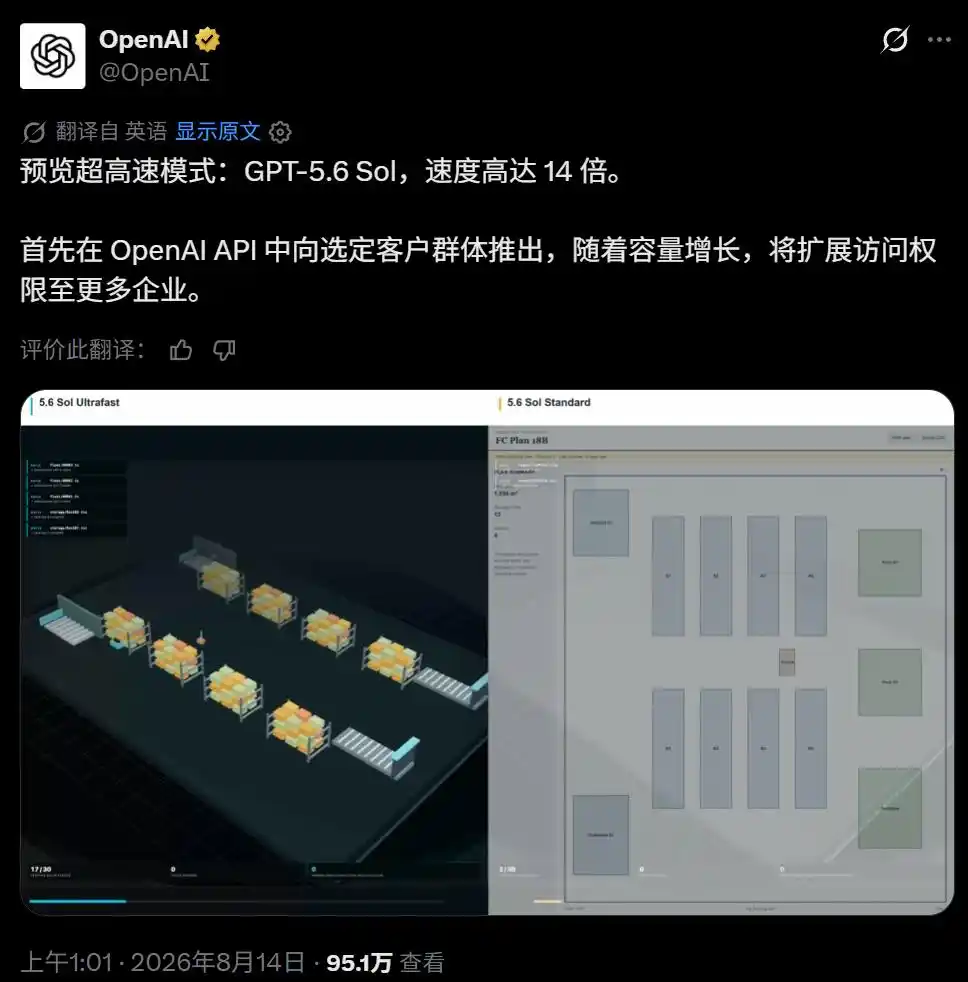
In the early hours of August 14th, OpenAI, in partnership with AI chip manufacturer Cerebras, officially previewed a new service tier called "Ultrafast Mode" for its flagship model GPT-5.6 Sol.
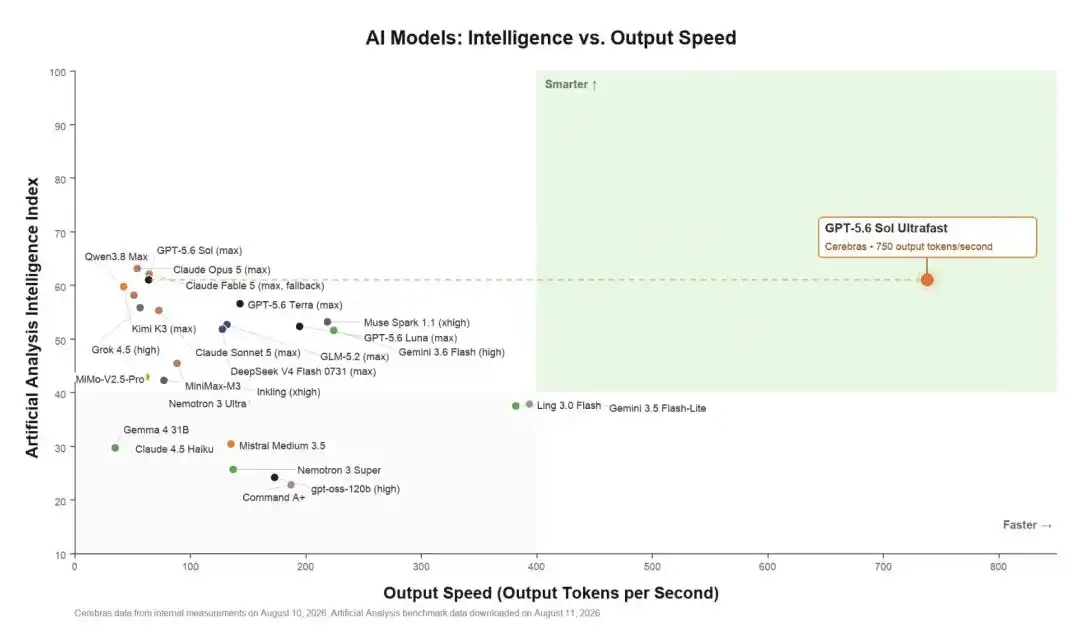
In this mode, the output speed of GPT-5.6 Sol can reach up to 750 tokens/s. Compared to the baseline inference speed of about 53 tokens/s in the current Standard mode, this represents a speed increase of up to 14 times, with no reduction in quality. For perspective, the accelerated GPT-5.6 Sol is 11 times faster than Fable 5 and 5 times faster than Opus 4.8 in its Fast mode.
The Ultrafast mode will be launched first in the OpenAI API and is currently available in a limited preview to some customers.
For this, OpenAI and Cerebras also created a comparison table showing the current speed and intelligence of leading AI large models. GPT-5.6 Sol Ultrafast holds an absolutely leading position:
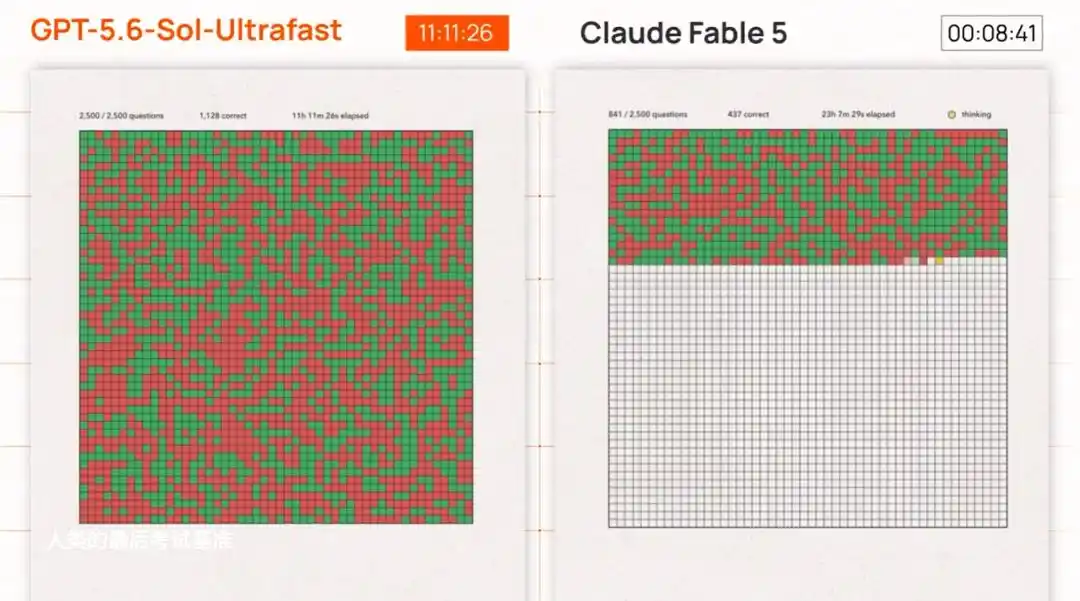
In Cerebras's blog, engineers described tests conducted on the "Humanity's Last Exam" (HLE) benchmark, where they compared the Ultrafast-accelerated model with direct competitors. As we know, HLE is a challenging model benchmark containing 2500 questions, typically only solvable by Ph.D.s in fields like chemistry, economics, and literature.
GPT-5.6 Sol in Ultrafast mode answered all questions in just 11 hours and 11 minutes. In contrast, Claude Fable 5 required 78 hours and 27 minutes—over three days of continuous computation—to reach the same conclusions. GPT's Ultrafast mode completed the frontier of human knowledge in a single workday, achieving nearly 7 times the speed of Claude Fable while maintaining similar accuracy.
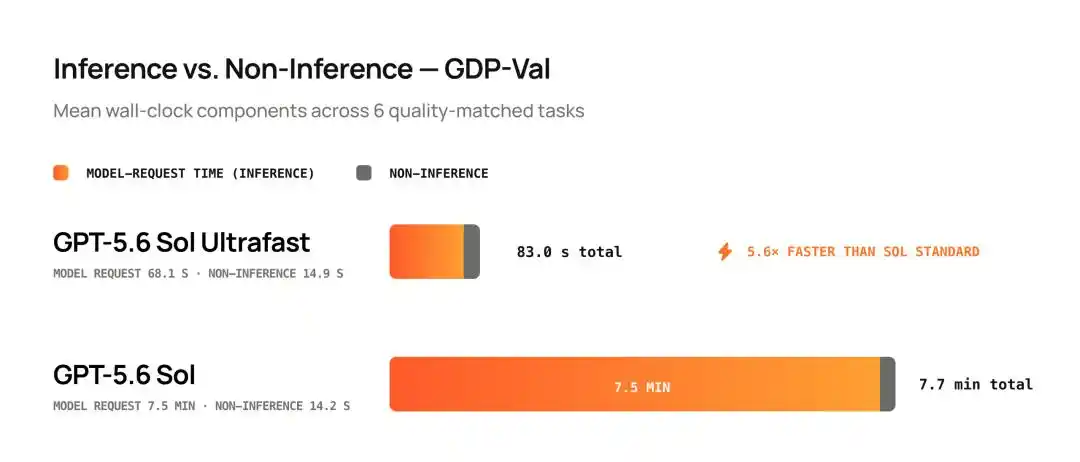
As model capabilities continue to improve, the application scope of fast inference will also expand. GPT-5.6 Sol is OpenAI's best-performing model to date for legal documents, financial models, and engineering reports. On the GDP-Val benchmark (which measures economically valuable knowledge work tasks), Ultrafast achieved a 5.6x end-to-end speed improvement without any drop in quality, fully demonstrating how faster reasoning speeds can accelerate economically valuable work.
Faster AI processing adds significant possibilities to emerging workflows. People can now deploy agents onto the critical path of problems. OpenAI lists some application scenarios for you:
- Incident response and reliability: When critical systems fail, AI analyzes application logs, recent code changes, and engineer reports to identify potential causes and help prepare fixes while the incident is still ongoing.
- Financial research and security: Analyzing market signals, evaluating trades, and identifying suspicious activities in rapidly changing market conditions.
- Customer support and voice: Resolving complex customer issues in real-time, even when finding answers requires multiple steps or systems, without interrupting the conversation.
- Commerce: Answering product questions, checking inventory, personalizing recommendations, and resolving checkout issues while shoppers are still deciding, preventing hesitation from turning into abandoned carts.
- Real-time research and experimentation: Transforming research that previously required overnight processing into interactive work sessions, allowing teams to test ideas, check results, adjust methods, and run another experiment without breaking their workflow.
Internally at OpenAI, developers tested GPT-5.6 Sol in Ultrafast mode. Incident response is an example of using Ultrafast. When an alert triggers, engineers need to build an accurate picture of the incident while systems and evidence are still changing. With Sol-level intelligence, teams can quickly read logs, analyze traces, summarize conversations, determine the next steps for investigation, and assist in preparing or verifying fixes. Ultrafast mode reduces the delay between observing a signal, verifying hypotheses, and choosing the next action, while engineers remain responsible for judgment and deployment.
In research, the OpenAI team uses Ultrafast to quickly search knowledge bases, query data, and rapidly gather, organize, and summarize information from various tools. A common research workflow used to involve team members launching a batch of experiments overnight and reviewing results the next morning. With Ultrafast, the discovery process can be shortened, supporting multiple iterations within a single workday.
The breakthrough of Ultrafast mode lies in breaking the memory bandwidth bottleneck of traditional GPU clusters during the autoregressive decoding stage of large models. Its implementation primarily relies on Cerebras's wafer-scale hardware architecture.
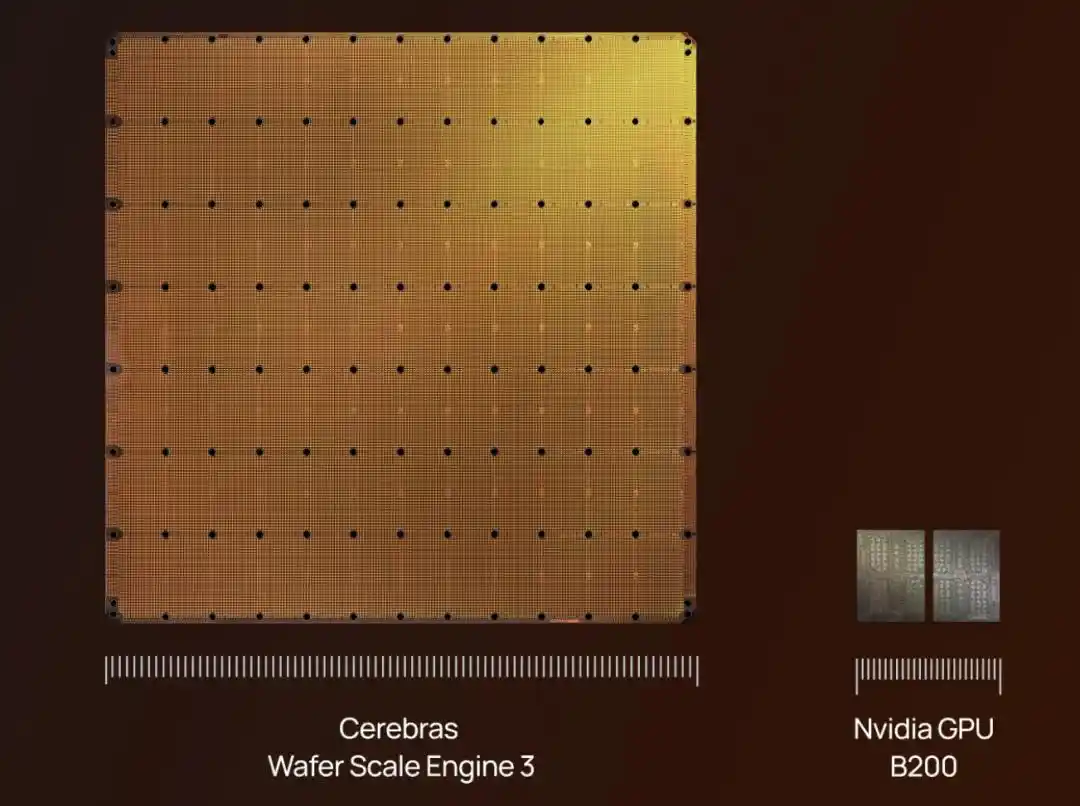
Among AI chip manufacturers, Cerebras's solution is unique: its successive chip generations are manufactured from entire silicon wafers, integrating vast numbers of computing cores and ultra-high-speed interconnection networks on a single die.
Traditional GPUs, when running autoregressive token generation for large models, are limited by memory bandwidth, requiring constant transfer of massive model weights between off-chip HBM and computing cores. Additionally, multi-card partitioning introduces communication delays across chips (via PCIe/NVLink).
In contrast, each of Cerebras's latest wafer-scale chips (WSE-3) integrates 4 trillion transistors, delivers 125 petaflops of AI compute power, and features up to 44 GB of on-chip high-speed SRAM. Model parameters reside directly in the high-bandwidth on-chip SRAM, eliminating the wait time associated with repeatedly loading weights from off-chip memory.
Of course, as a cutting-edge flagship model, the full parameter count of GPT-5.6 Sol obviously far exceeds the chip's capacity. Cerebras also has a "Pipelined across wafers" mechanism. This distributes the various network layers of the model across multiple wafers, with each layer's parameters residing in the SRAM of its respective chip, allowing tokens to seamlessly flow between wafers in a pipeline.
For many large model users, a 14x speedup for the flagship model means that many tasks that previously required switching to secondary models (like Luna and Terra) can now be confidently run at full power. For Agent tasks requiring multi-round tool use, code generation/debugging, and complex chain-of-thought reasoning, processes that used to take hours can be compressed into minutes.
Faster speeds might also mean a shift in how we use AI:

Within the AI community, people are already looking forward to Ultrafast mode versions for Luna and Terra. The only question is whether Cerebras's chips will be sufficient.
References:
https://openai.com/index/previewing-ultrafast/
https://www.cerebras.ai/blog/accelerating-gpt-5-6-sol-ultrafast-with-openai
This article is from the WeChat public account "Almost Human" (ID: almosthuman2014), by the machinehearts team focused on large models.