Grayscale: "If the Proposals Are Adopted, the Prices of These Two Altcoins Could Rise"

cryptonews.ruPublished on 2026-08-14Last updated on 2026-08-14

Abstract

Grayscale's Head of Research, Zach Pandl, stated that proposed changes to the tokenomics of Ethereum ($ETH) and Solana ($SOL) could significantly slow their supply growth rates, potentially boosting prices. The discussed code modifications aim to reduce the annual inflation of ETH and SOL tokens. Slower supply growth could decrease the number of new tokens entering the market, increasing scarcity. Grayscale estimates that if implemented, Ethereum's annual supply inflation could fall to about 0.4% by late 2031—close to Bitcoin's rate—while Solana's could drop to roughly 1.1%. For context, this compares to gold's ~1.8% annual supply growth and the US CPI inflation of ~3.3%. While the proposals are still under community discussion and not finalized, Pandl noted that Solana's changes appear to have broader support and a higher likelihood of adoption. However, lower token inflation might also reduce staking rewards, as a significant portion comes from new token issuance. Pandl concluded that the reduced supply could increase scarcity and upward price pressure, particularly benefiting investors holding non-staked tokens.

Zach Pandl, Head of Research at Grayscale, stated that if the proposed tokenomics changes being discussed within the Ethereum ($ETH) and Solana ($SOL) communities are implemented, the supply growth rates of both crypto assets could slow significantly, which could potentially have a favorable impact on prices.

According to Pandl, the code changes under consideration for the Ethereum and Solana ecosystems are aimed at reducing the annual token inflation rates of $ETH and $SOL. All else being equal, slowing supply growth could reduce the number of new tokens entering the market, leading to increased scarcity of existing assets.

According to Grayscale's estimates, if these rules are enacted, the annual supply inflation of Ethereum could fall to approximately 0.4% by the end of 2031. This figure is close to Bitcoin's supply growth rate. Solana's annual supply inflation is projected to decline to around 1.1%.

For comparison, Grayscale noted that the annual supply increase of gold is approximately 1.8 percent, while U.S. Consumer Price Index inflation is approximately 3.3 percent.

The proposed changes for Ethereum and Solana are still under discussion within their communities and have not yet been finalized. Pandl stated that the proposals for Solana appear to have received broader approval and therefore have a relatively higher probability of being implemented.

However, reducing token inflation could also lead to a decrease in rewards for investors engaged in staking. This is because a significant portion of staking revenue for $ETH and $SOL comes from the issuance of new tokens.

Pandl noted that the slowdown in supply growth could lead to increased scarcity, exerting upward pressure on the prices of $ETH and $SOL, and that investors holding non-staked tokens, in particular, could benefit.

*This is not investment advice.

end-content

Related Questions

QAccording to Grayscale's research head, what could be the potential impact on the prices of Ethereum ($ETH) and Solana ($SOL) if certain tokenomic changes are implemented?

AIf the discussed tokenomic changes in the Ethereum and Solana ecosystems are implemented, the supply growth rates of both crypto assets could slow significantly. This would potentially lead to a supply shortage of the existing tokens, exerting upward pressure on the prices of $ETH and $SOL.

QWhat specific annual supply inflation rates does Grayscale estimate for Ethereum and Solana by the end of 2031 if the proposed rules are enacted?

AGrayscale estimates that if the rules are enacted, Ethereum's annual supply inflation could decrease to approximately 0.4% by the end of 2031. For Solana, the annual supply inflation is projected to fall to around 1.1%.

QWhat comparison did Grayscale make regarding the projected supply inflation of Ethereum and Solana versus traditional assets?

AGrayscale compared the projected supply inflation rates to traditional assets. They noted that Ethereum's projected 0.4% rate is close to Bitcoin's supply growth rate. For context, the annual supply increase of gold is approximately 1.8%, and the U.S. Consumer Price Index (CPI) inflation is around 3.3%.

QWhat potential downside does the article mention regarding the reduction of token inflation for $ETH and $SOL?

AThe article mentions that reducing token inflation could lead to lower rewards for investors who participate in staking. This is because a significant portion of the staking yield for $ETH and $SOL comes from the issuance of new tokens.

QWhich of the two proposed changes (Ethereum's or Solana's) is stated to have a relatively higher chance of being implemented, and why?

AThe proposed changes for Solana are stated to have a relatively higher chance of being implemented. According to Zach Pandl, the proposals for Solana appear to have received broader acceptance within its community.

Related Reads

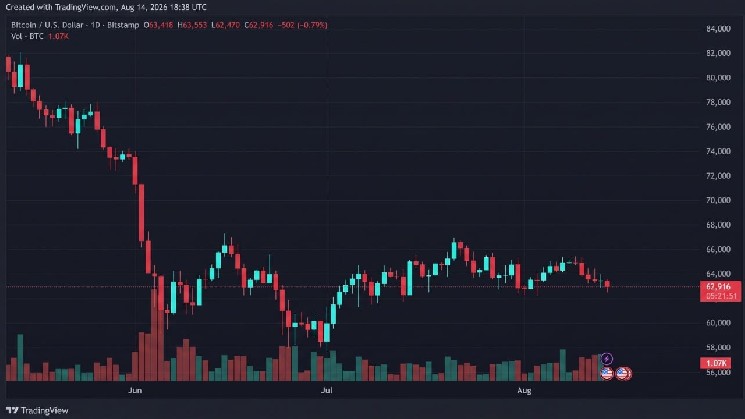
Bitcoin Price Drops to $62,470 as Sellers Retest $63,000 Support Level

Bitcoin's price fell below $63,000 for a second consecutive day on Friday, hitting an intraday low of $62,470. The cryptocurrency later recovered to trade just above $63,000, leaving it nearly flat for the past 24 hours and for August overall, with a weekly loss of 2.6%. The volatility triggered significant liquidations, with $26 million of leveraged long Bitcoin positions liquidated over 24 hours. Market sentiment was further dampened by data showing over $131 million in outflows from spot Bitcoin ETFs for a second straight day, signaling a potential pullback by institutional investors. Adding to the negative pressure, index provider MSCI has proposed new criteria for "non-operating companies" in its global indexes, which could lead to the exclusion of firms holding significant digital assets like Bitcoin on their balance sheets. Companies such as Strategy and Metaplanet could be affected, potentially forcing index-tracking funds to sell their shares. Strategy publicly criticized the proposal, arguing digital assets are legitimate assets and index providers should not dictate what companies can own. Public consultations on MSCI's proposal end September 30, with a final decision expected by October 16. If approved, exclusions could begin in November, potentially triggering sustained institutional selling and damaging a key bridge for Bitcoin adoption in the corporate sector.

cryptonews.ru1h ago

Bitcoin Price Drops to $62,470 as Sellers Retest $63,000 Support Level

cryptonews.ru1h ago

Trading

Spot
活动图片