Top 3 des prévisions de prix : Bitcoin (BTC), Ethereum (ETH), XRP (XRP)

cryptonews.ruPublished on 2026-08-07Last updated on 2026-08-07

Abstract

Les trois principales cryptomonnaies - Bitcoin (BTC), Ethereum (ETH) et XRP - évoluent dans des zones techniques clés. Le Bitcoin maintient une position stable au-dessus d'un niveau de support consolidé autour de 64 000 $, malgré un échec à franchir la résistance de 64 942 $. Sa proximité avec plusieurs moyennes mobiles convergeant vers 64 000 $ suggère un potentiel point d'inflexion. L'Ethereum affiche une structure plus robuste, ayant repris au-dessus de ses moyennes mobiles clés autour de 1 900 $. Le franchissement du niveau de Fibonacci à 1 914 $ pourrait propulser le prix vers 1 946 $, voire 1 980 $. À l'inverse, le XRP reste sous pression baissière, évoluant sous toutes ses moyennes mobiles autour de 1,025 $. Bien que des conditions de survente puissent indiquer un rebond technique, les vendeurs dominent. Un soutien immédiat à 1,0145 $ est crucial pour éviter une chute vers le niveau psychologique de 1,00 $.

Bitcoin, Ethereum et $XRP sont entrés dans des zones de négociation clés alors que les investisseurs évaluent si les tendances récentes des prix persisteront ou évolueront. Le Bitcoin continue de se maintenir au-dessus d'un important amas de support, malgré une perte de dynamique près d'un niveau clé de Fibonacci.

Dans le même temps, Ethereum conserve une position technique plus forte après s'être rétabli au-dessus de plusieurs moyennes mobiles, ce qui donne confiance aux acheteurs dans la tendance actuelle. $XRP, cependant, reste sous pression, l'impulsion baissière dominant son graphique.

Prévision du prix du Bitcoin : Le BTC maintient sa stabilité au-dessus du support principal

Le Bitcoin s'échange autour de 64 257 $ après avoir échoué à poursuivre sa hausse au-dessus du niveau de retracement de Fibonacci à 0,786 situé à 64 942 $. Cependant, le recul n'a pas endommagé la structure globale. Au lieu de cela, le prix continue d'évoluer au-dessus d'un groupe étroitement soudé de moyennes mobiles exponentielles (20, 50, 100 et 200) dans la fourchette de 63 995 $ à 64 192 $.
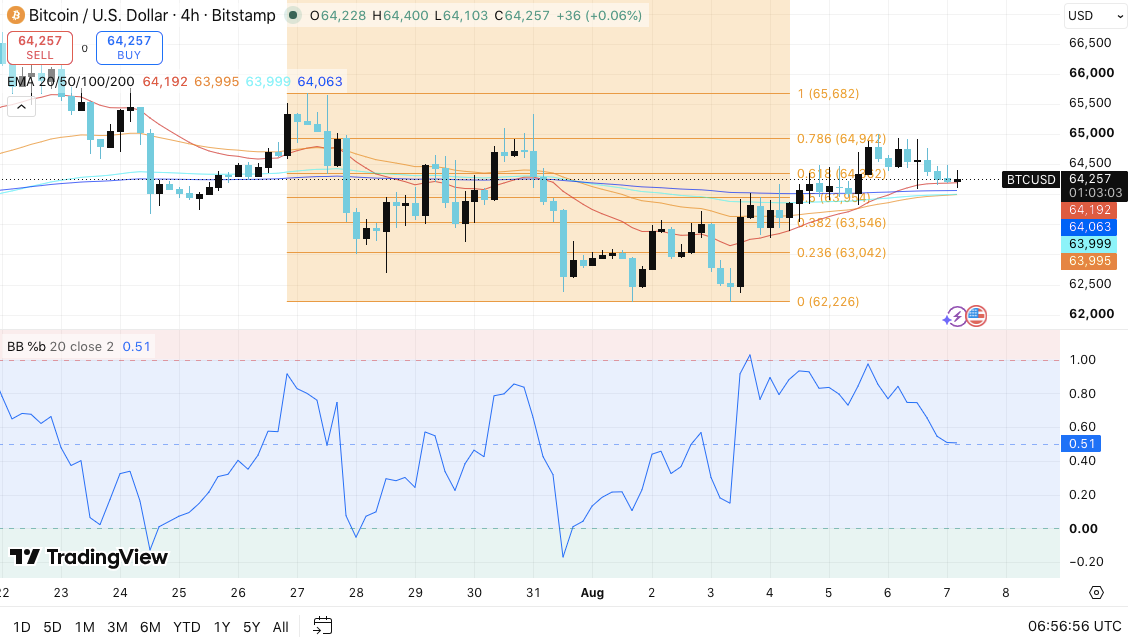
Dynamique du prix du Bitcoin (Source : TradingView)

Une telle convergence technique signale souvent un point d'inflexion important. De plus, la valeur neutre du Bollinger Band %B montre que l'impulsion s'est refroidie sans fort déplacement baissier. Les acheteurs continuent de défendre la zone des 64 000 $, malgré la prise de bénéfices sur le marché.

Articles associés : Prévision des prix des memecoins : Dogecoin (DOGE), Shiba Inu (SHIB), MemeCore (M)

Si le Bitcoin franchit les 64 942 $, les acheteurs pourraient défier le point haut d'oscillation autour de 65 682 $. Cependant, une perte du support à 63 954 $ pourrait accroître la pression vendeuse et exposer 63 546 $ avant que le marché ne teste 63 042 $.

Prévision du prix d'Ethereum : L'ETH maintient sa structure haussière

Ethereum continue de surperformer après s'être rétabli suite à un récent creux d'oscillation autour de 1 821 $. L'actif s'échange actuellement autour de 1 903 $, se maintenant au-dessus des moyennes mobiles exponentielles (MME) 20, 50, 100 et 200. De plus, un mouvement réussi au-dessus du retracement de Fibonacci à 0,382 a renforcé la confiance des acheteurs à court terme.
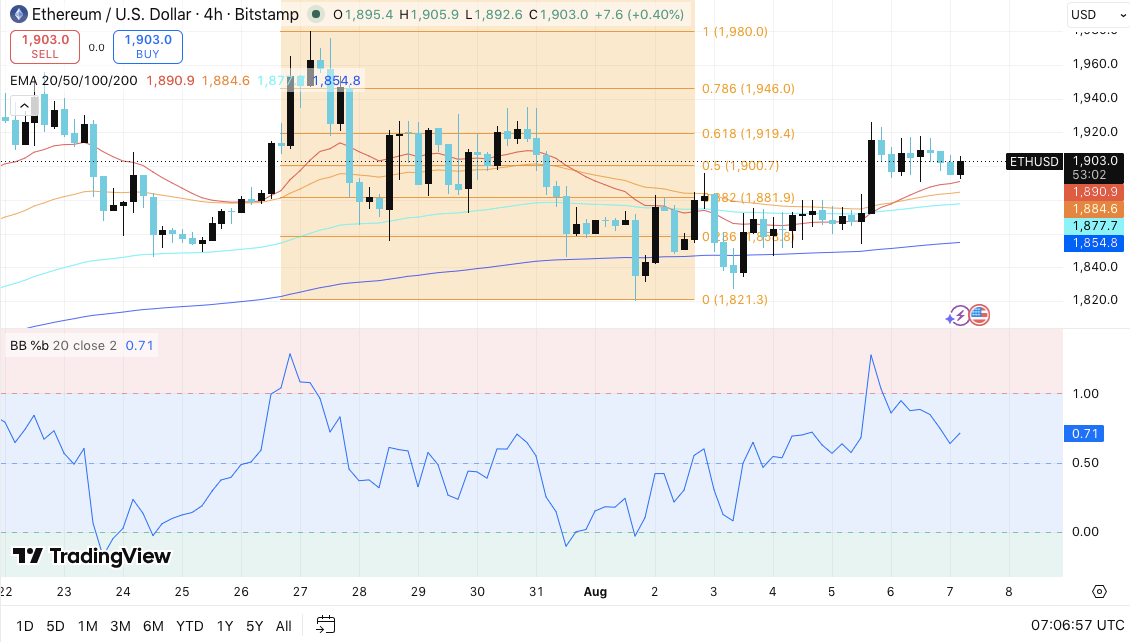
Dynamique du prix d'Ethereum (Source : TradingView)

Actuellement, la zone des 1 900 $ sert de support immédiat. En outre, l'indicateur des bandes de Bollinger suggère que l'impulsion haussière pourrait encore s'étendre avant d'atteindre des conditions de surachat.

Une hausse résolue au-dessus de 1 914 $ pourrait stimuler une nouvelle progression vers 1 946 $. De plus, un dégagement des 1 980 $ confirmerait un élan de hausse plus solide. D'un autre côté, la perte de la zone de support à 1 890 $ pourrait entraîner un repli vers 1 877 $ et vers la MME 200 autour de 1 855 $.

Prévision du prix du $XRP : $XRP cherche la stabilité après une faiblesse récente

$XRP reste le moins performant des trois actifs. Le jeton s'échange autour de 1,025 $, se maintenant en dessous de toutes les principales moyennes mobiles à court terme. En conséquence, la tendance baissière prédominante reste inchangée, les vendeurs continuant de créer des plus hauts et des plus bas de plus en plus bas.
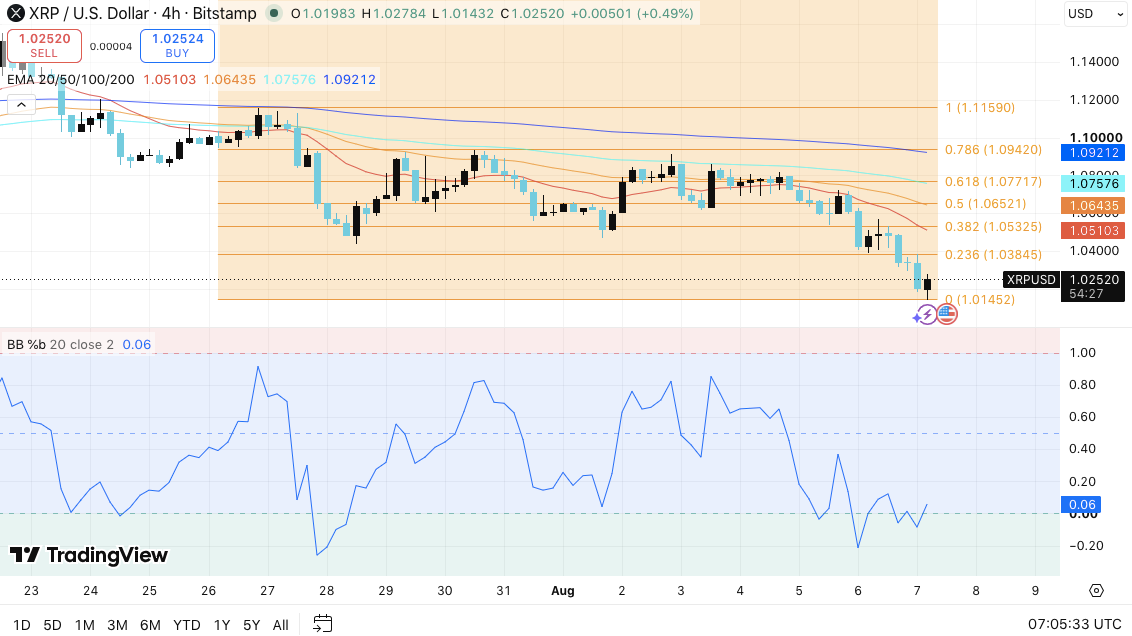
Dynamique du prix du $XRP (Source : TradingView)

L'indicateur Bollinger Band %B indique des conditions de survente, augmentant la probabilité d'un rebond à court terme. Cependant, les acheteurs devront reprendre la résistance située entre 1,053 $ et 1,065 $ avant que le sentiment ne s'améliore significativement.

L'incapacité à défendre le support immédiat à 1,0145 $ pourrait conduire au niveau psychologique du $XRP à 1,00 $. De plus, une rupture en dessous de ce seuil pourrait ouvrir la zone de support de 0,985 $ à 0,970 $.


Trending Cryptos

Related Questions

QQuel est le principal niveau de soutien pour le Bitcoin mentionné dans l'article ?

ALe principal niveau de soutien pour le Bitcoin se situe autour de 64 000 dollars, avec un cluster spécifique de moyennes mobiles entre 63 995 et 64 192 dollars.

QPourquoi la position technique d'Ethereum est-elle considérée comme plus forte que celle du Bitcoin selon l'article ?

ALa position technique d'Ethereum est considérée comme plus forte car il s'est rétabli au-dessus de plusieurs moyennes mobiles (20, 50, 100 et 200 EMA) et a dépassé le niveau de retracement de Fibonacci à 0.382, ce qui renforce la confiance des acheteurs.

QQuelle est la situation actuelle du XRP par rapport à ses moyennes mobiles ?

ALe XRP se négocie actuellement en dessous de toutes ses principales moyennes mobiles à court terme, ce qui indique que la tendance baissière dominante reste intacte.

QSelon l'article, que pourrait indiquer la convergence technique observée sur le graphique du Bitcoin ?

ALa convergence technique étroite des moyennes mobiles exponentielles (20, 50, 100 et 200 EMA) sur le graphique du Bitcoin signale souvent un point d'inflexion important sur le marché.

QQuel indicateur technique suggère une possibilité de rebond à court terme pour le XRP, malgré sa faiblesse ?

AL'indicateur %B des Bandes de Bollinger pointe vers des conditions de survente pour le XRP, ce qui augmente la probabilité d'un rebond technique à court terme.

Related Reads

How 5G Will Be Launched in Russia: The Digital Ministry's Proposal and the Roadmap to 2035

Russia's Ministry of Digital Development has proposed a plan for launching 5G networks. It allows the "Big Four" mobile operators (Beeline, Megafon, MTS, T2) to deploy 5G on existing 4G/LTE base stations and frequencies, and will allocate them the new 4.63–4.99 GHz band. A key element is "technological neutrality," permitting the use of foreign equipment until September 2026. The new 4.63–4.99 GHz band is intended for more advanced services and industrial applications. However, a phased transition to Russian-made base stations will begin in 2027, with a target of at least 50% domestic equipment by 2030. The rollout timeline aims for 5G in cities with over 1 million people by the end of 2027, expanding to 84 cities by 2035. Initial "5G Ready" service, operating over existing infrastructure, will offer minimal speed improvements. Significant speed gains (4-10x over LTE) will require the new band and corresponding equipment. The plan addresses long-standing regulatory delays, including the military's hold on the global standard 3.4–3.8 GHz band. This forced Russia to adopt the 4.63–4.99 GHz range, overlapping with a Chinese band, making Chinese equipment a potential transitional solution. The success of the rollout will depend on equipment supply and the pace of production localization, while a challenge lies in smartphone compatibility with this non-standard frequency band.

cryptonews.ru26m ago

How 5G Will Be Launched in Russia: The Digital Ministry's Proposal and the Roadmap to 2035

cryptonews.ru26m ago

The Federal Reserve Bank of Dallas Announces a Colossal $700 Billion Allocation! How Will This Affect Bitcoin?

The Federal Reserve Bank of Dallas warns that the growing adoption of tokenized deposits in the banking sector could pose unforeseen risks to the financial system. Tokenized deposits, which transfer traditional bank deposits to blockchain infrastructure, offer features like instant settlement and programmable payments. While issued by regulated banks and maintaining deposit characteristics, they could enable customers to move funds between banks much faster in search of higher yields. This would significantly weaken banks' liquidity management and lending capacity. The Fed's analysis estimates that an increase in deposit interest rate sensitivity by 10% could reduce the interest rate risk banks can bear by approximately $700 billion over ten years. Similarly, a 10% shortening of the average deposit maturity could reduce the banking system's capacity to convert deposits into loans by about $580 billion. This acceleration of deposit movement could force banks to rely on more expensive wholesale funding, increasing borrowing costs for consumers and businesses and potentially making traditional banks resemble non-bank financial institutions. While the report does not directly address Bitcoin, the described shifts could have long-term implications. Firstly, the tokenization of deposits by banks could promote institutional adoption of blockchain-based financial infrastructure, indirectly legitimizing digital asset classes like Bitcoin. Secondly, faster-moving deposits and resulting higher funding costs could increase the price of liquidity in the financial system. This could create near-term headwinds for risk assets, including Bitcoin, due to tighter financial conditions and potential selling pressure. The report concludes that widespread adoption of this technology could impact many areas, from payment systems to monetary policy transmission mechanisms.

cryptonews.ru51m ago

The Federal Reserve Bank of Dallas Announces a Colossal $700 Billion Allocation! How Will This Affect Bitcoin?

cryptonews.ru51m ago

Trading

Spot

Hot Articles

What is $BITCOIN

DIGITAL GOLD ($BITCOIN): A Comprehensive Analysis Introduction to DIGITAL GOLD ($BITCOIN) DIGITAL GOLD ($BITCOIN) is a blockchain-based project operating on the Solana network, which aims to combine the characteristics of traditional precious metals with the innovation of decentralized technologies. While it shares a name with Bitcoin, often referred to as “digital gold” due to its perception as a store of value, DIGITAL GOLD is a separate token designed to create a unique ecosystem within the Web3 landscape. Its goal is to position itself as a viable alternative digital asset, although specifics regarding its applications and functionalities are still developing. What is DIGITAL GOLD ($BITCOIN)? DIGITAL GOLD ($BITCOIN) is a cryptocurrency token explicitly designed for use on the Solana blockchain. In contrast to Bitcoin, which provides a widely recognized value storage role, this token appears to focus on broader applications and characteristics. Notable aspects include: Blockchain Infrastructure: The token is built on the Solana blockchain, known for its capacity to handle high-speed and low-cost transactions. Supply Dynamics: DIGITAL GOLD has a maximum supply capped at 100 quadrillion tokens (100P $BITCOIN), although details regarding its circulating supply are currently undisclosed. Utility: While precise functionalities are not explicitly outlined, there are indications that the token could be utilized for various applications, potentially involving decentralized applications (dApps) or asset tokenization strategies. Who is the Creator of DIGITAL GOLD ($BITCOIN)? At present, the identity of the creators and development team behind DIGITAL GOLD ($BITCOIN) remains unknown. This situation is typical among many innovative projects within the blockchain space, particularly those aligning with decentralized finance and meme coin phenomena. While such anonymity may foster a community-driven culture, it intensifies concerns about governance and accountability. Who are the Investors of DIGITAL GOLD ($BITCOIN)? The available information indicates that DIGITAL GOLD ($BITCOIN) does not have any known institutional backers or prominent venture capital investments. The project seems to operate on a peer-to-peer model focused on community support and adoption rather than traditional funding routes. Its activity and liquidity are primarily situated on decentralized exchanges (DEXs), such as PumpSwap, rather than established centralized trading platforms, further highlighting its grassroots approach. How DIGITAL GOLD ($BITCOIN) Works The operational mechanics of DIGITAL GOLD ($BITCOIN) can be elaborated on based on its blockchain design and network attributes: Consensus Mechanism: By leveraging Solana’s unique proof-of-history (PoH) combined with a proof-of-stake (PoS) model, the project ensures efficient transaction validation contributing to the network's high performance. Tokenomics: While specific deflationary mechanisms have not been extensively detailed, the vast maximum token supply implies that it may cater to microtransactions or niche use cases that are still to be defined. Interoperability: There exists the potential for integration with Solana’s broader ecosystem, including various decentralized finance (DeFi) platforms. However, the details regarding specific integrations remain unspecified. Timeline of Key Events Here is a timeline that highlights significant milestones concerning DIGITAL GOLD ($BITCOIN): 2023: The initial deployment of the token occurs on the Solana blockchain, marked by its contract address. 2024: DIGITAL GOLD gains visibility as it becomes available for trading on decentralized exchanges like PumpSwap, allowing users to trade it against SOL. 2025: The project witnesses sporadic trading activity and potential interest in community-led engagements, although no noteworthy partnerships or technical advancements have been documented as of yet. Critical Analysis Strengths Scalability: The underlying Solana infrastructure supports high transaction volumes, which could enhance the utility of $BITCOIN in various transaction scenarios. Accessibility: The potential low trading price per token could attract retail investors, facilitating wider participation due to fractional ownership opportunities. Risks Lack of Transparency: The absence of publicly known backers, developers, or an audit process may yield skepticism regarding the project's sustainability and trustworthiness. Market Volatility: The trading activity is heavily reliant on speculative behavior, which can result in significant price volatility and uncertainty for investors. Conclusion DIGITAL GOLD ($BITCOIN) emerges as an intriguing yet ambiguous project within the rapidly evolving Solana ecosystem. While it attempts to leverage the “digital gold” narrative, its departure from Bitcoin's established role as a store of value underscores the need for a clearer differentiation of its intended utility and governance structure. Future acceptance and adoption will likely depend on addressing the current opacity and defining its operational and economic strategies more explicitly. Note: This report encompasses synthesised information available as of October 2023, and developments may have transpired beyond the research period.

2.3k Total ViewsPublished 2025.05.13Updated 2025.05.13

What is $BITCOIN

Discussions

Welcome to the HTX Community. Here, you can stay informed about the latest platform developments and gain access to professional market insights. Users' opinions on the price of BTC (BTC) are presented below.

活动图片