Los ETF de Ethereum mantienen una semana de ganancias gracias a entradas de 27 millones de dólares, mientras Bitcoin pierde 61.5 millones

cryptonews.ruPublished on 2026-08-03Last updated on 2026-08-03

Abstract

La semana comenzó con flujos mixtos en los ETF de criptomonedas. Los fondos de ether mantuvieron una racha positiva por cuarta semana consecutiva, acumulando una entrada neta de 27,42 millones de dólares. En contraste, los ETF de bitcoin sufrieron una salida neta de 61,53 millones, interrumpiendo tres semanas de ganancias, aunque julio cerró con una entrada neta de 172,8 millones. Los flujos fueron volátiles: tras dos días de salidas, el miércoles y jueves vieron entradas significativas, pero una gran salida el viernes revirtió la tendencia. BlackRock's IBIT lideró las entradas semanales (86,9M), mientras que Fidelity's FBTC tuvo la mayor salida (85,2M). Entre los altcoins, los ETF de XRP atrajeron 14,86 millones y los de Solana 2,82 millones. Sin embargo, los fondos de HYPE registraron una tercera semana consecutiva de salidas, por 14,75 millones. La reunión de la Fed, que mantuvo las tasas sin cambios pero mostró divisiones internas, aumentó la sensibilidad de activos como bitcoin. Los inversores mostraron una mayor selectividad, favoreciendo la estabilidad relativa de ether y casos específicos como XRP y Solana, mientras recortaban exposiciones más sensibles a factores macroeconómicos o percibidas como saturadas.

La semana comenzó con una pequeña entrada de capital, se convirtió en un verdadero flujo y terminó con una salida masiva. Al cierre del viernes, los inversores en fondos cotizados (ETF) de criptomonedas mostraron resultados marcadamente dispares: Ethereum mantuvo su dinámica alcista, la recuperación de Bitcoin se estancó y los flujos de capital hacia los altcoins se distribuyeron en todo el espectro de riesgos.

Los ETF de Bitcoin abrieron con dos sesiones en negativo. Los inversores retiraron 11.64 millones de dólares el lunes y 49.75 millones el martes, prolongando la ola de salidas iniciada la semana anterior.

La demanda regresó a mediados de semana. El miércoles, los fondos atrajeron 32.11 millones de dólares, y el jueves otros 233.13 millones, con siete productos registrando entradas y ninguno salidas.

El viernes acabó con esta recuperación. Una salida de 265 millones de dólares resultó en que, al cierre de la semana, los ETF de Bitcoin registraran una salida neta de 61.53 millones de dólares, poniendo fin a tres semanas consecutivas de ganancias. No obstante, julio aún cerró con una entrada neta de 172.8 millones de dólares, manteniendo una modesta recuperación mensual.
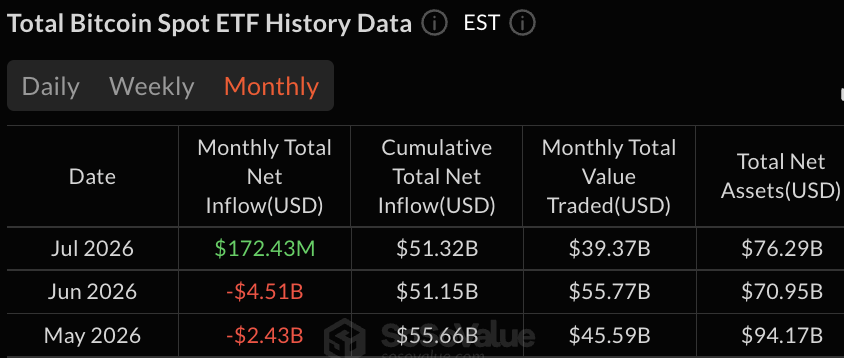
Los ETF de Bitcoin terminaron julio con una entrada neta de 172 millones de dólares, a pesar de la dinámica mixta de los flujos semanales. Fuente: Sosovalue

El ETF IBIT de Blackrock encabezó la lista de líderes semanales con una entrada de 86.9 millones de dólares. El ETF MSBT de Morgan Stanley atrajo 7.4 millones, mientras que los ETF BITB de Bitwise y HODL de Vaneck atrajeron 2.9 millones y 2.3 millones respectivamente. En otros fondos, las salidas fueron más significativas. El FBTC de Fidelity perdió 85.2 millones, el GBTC de Grayscale 52.6 millones, y el ARKB de ARK 21Shares registró una salida de 30.6 millones de dólares.

La reunión de la Reserva Federal dividió la semana en dos partes. Tras una votación de 9 contra 3, los responsables del banco central mantuvieron la tasa de fondos federales en el rango del 3.50%–3.75%, mientras que tres funcionarios votaron a favor de un aumento de un cuarto de punto porcentual. El presidente de la Fed, Kevin Warsh, declaró que las tasas de interés del mercado habían aumentado entre reuniones, ya que el banco central abandonó su fuerte dependencia de las proyecciones de política futura. Este entorno elevó la sensibilidad de las posiciones líquidas dependientes de factores macroeconómicos, como los ETF de Bitcoin.

Ethereum mantiene posiciones, mientras los altcoins muestran dinámicas dispares

Los ETF de Ethereum mostraron resultados más estables. El lunes atrajeron 9.23 millones de dólares, el martes 14.53 millones, y el miércoles se observó una salida de 18.65 millones. Las entradas de 13.29 millones el jueves y unos 9 millones el viernes elevaron el total semanal a 27.42 millones de dólares.

Esto extendió la racha positiva de Ethereum a cuatro semanas, aunque la escala de la demanda se mantuvo modesta.

Los ETF de $XRP cerraron la semana con una entrada neta de 14.86 millones de dólares. El fondo XRPZ de Franklin Templeton atrajo capital durante varias sesiones, acelerándose la demanda el jueves y viernes.

Los ETF de Solana atrajeron 2.82 millones de dólares. El martes, esta categoría sufrió una salida de 18.07 millones, pero luego se recuperó con una entrada de 19.06 millones el miércoles y pequeñas ganancias durante el resto de la semana.

Los fondos de $HYPE siguieron claramente a la zaga. Las recompras alcanzaron los 14.75 millones de dólares, marcando la tercera semana consecutiva con resultados negativos. Se observaron salidas durante cuatro sesiones, incluyendo una retirada de 8.78 millones el miércoles.

Los datos finales mostraron que los inversores aún están dispuestos a mantener posiciones en criptomonedas a través de fondos regulados. A medida que avanzaba la semana, su elección se volvió más selectiva: prefirieron la estabilidad de Ethereum y oportunidades específicas vinculadas a $XRP y Solana, mientras reducían posiciones sensibles a factores macroeconómicas en Bitcoin y posiciones sobresaturadas en fondos de $HYPE.

end-content

Trending Cryptos

Related Questions

Q¿Cómo se comportaron los ETF de bitcoin en términos de flujos de capital durante la semana reportada?

ALos ETF de bitcoin experimentaron una semana volátil con dos sesiones iniciales de salida de fondos (11,64 millones de dólares el lunes y 49,75 millones el martes), seguidas por entradas los días miércoles (32,11 millones) y jueves (233,13 millones). Sin embargo, una fuerte salida de 265 millones el viernes resultó en un flujo neto semanal negativo de 61,53 millones de dólares, poniendo fin a tres semanas consecutivas de crecimiento.

Q¿Cuál fue el resultado neto de los ETF de éter (Ethereum) para la semana y qué tendencia representa?

ALos ETF de éter registraron un flujo neto positivo de 27,42 millones de dólares durante la semana. Esto extendió su racha de entradas de capital a cuatro semanas consecutivas, mostrando un rendimiento más estable en comparación con el bitcoin, aunque la magnitud de la demanda se describe como modesta.

Q¿Qué fondos ETF específicos lideraron las entradas y salidas de capital en la categoría de bitcoin?

AEntre los ETF de bitcoin, el IBIT de Blackrock lideró las entradas con 86,9 millones de dólares. Otros con entradas fueron el MSBT de Morgan Stanley (7,4 millones), el BITB de Bitwise (2,9 millones) y el HODL de Vaneck (2,3 millones). Por el lado de las salidas, los mayores fueron el FBTC de Fidelity (-85,2 millones), el GBTC de Grayscale (-52,6 millones) y el ARKB de ARK 21Shares (-30,6 millones).

QAdemás del bitcoin y el éter, ¿qué otros criptoactivos menciona el artículo en relación con los flujos de sus ETF?

AEl artículo menciona los ETF de XRP, que obtuvieron un flujo neto positivo de 14,86 millones de dólares, y los de Solana, que atrajeron 2,82 millones. Por el contrario, los fondos asociados al token $HYPE (Hyperliquid) registraron una salida neta significativa de 14,75 millones de dólares, marcando su tercera semana negativa consecutiva.

QSegún el artículo, ¿cómo influyó la reunión de la Reserva Federal (Fed) en el mercado y en productos como los ETF de bitcoin?

ALa reunión de la Fed, donde se mantuvo la tasa de fondos federales sin cambios, dividió la semana. El artículo señala que el tono de la Fed aumentó la sensibilidad de las posiciones líquidas dependientes de factores macroeconómicos, como los ETF de bitcoin. El anuncio hizo que los inversores fueran más selectivos, reduciendo exposiciones sensibles a la macroeconomía, como la del bitcoin.

Related Reads

Wall Street Morning Report: AI + Cloud Computing Takes Over the Market Again, Amazon Knocks on the Door of $3 Trillion

Wall Street's August began with a strong rally, driven by easing Middle East tensions as President Trump signaled progress on U.S.-Iran talks, prompting a sharp drop in oil prices. Major indices hit record or near-record highs, with the Dow Jones Industrial Average up 1.32%, the Nasdaq Composite surging 2.13%, and the S&P 500 rising 1.48%. The energy sector was the sole decliner. The AI and cloud computing narrative dominated the tech rally. The "Magnificent Seven" index jumped 3.6%. Amazon's market cap surpassed $3 trillion for the first time following robust AWS results, while Nvidia regained a $5 trillion valuation. Meta, Google, and Microsoft also posted significant gains. Other AI-related stocks like Palantir, CoreWeave, and various semiconductor and infrastructure companies saw strong advances. In other markets, gold held above $4,000, supported by central bank buying. Treasury yields fell as oil prices dropped. The U.S. dollar remained stable despite strong manufacturing data. Japan's substantial currency intervention raised concerns, but U.S. officials reassured markets about the mechanism used. Key events ahead include major industry conferences (Ai4 2026, FMS Summit) and earnings reports from companies like SpaceX, AMD, and Pfizer. The White House is also set to host a meeting with leading AI firms to discuss regulatory frameworks.

marsbit4m ago

Wall Street Morning Report: AI + Cloud Computing Takes Over the Market Again, Amazon Knocks on the Door of $3 Trillion

marsbit4m ago

The July Tech Stock Pullback: Which Funds Are Paying the Price for Buying High?

In July, China's technology stocks experienced a sharp correction, causing significant pain for actively managed mutual funds that aggressively increased their holdings in the sector during the second quarter. The sell-off saw major indices like the ChiNext and STAR 50 fall over 25% and 28% for the month, respectively. Funds that piled into tech at its June peak faced steep losses. Notably, several veteran "value investor" fund managers, known for long-term holdings in consumer staples, made dramatic shifts. Star managers like Zhang Kun (E Fund Blue Chip Selected) and Liu Yanchun (Invesco Great Wall Dingyi) drastically reduced positions in liquor stocks like Kweichow Moutai, switching instead to semiconductor and AI hardware companies like SMIC and Ingenic International. Data shows active equity funds' allocation to the electronics sector reached a historical high of 42.64% by end-Q2. Around 67 funds saw their TMT (Technology, Media, Telecom) weighting surge from an average of 6.75% to 54.99%. The consequences were severe in July: these high-TMT funds fell an average of over 20%, with 12 plunging more than 40%. Examples include Jinhua High-Quality Growth and Guoshou Anbao Wenhui, which fell 26.34% and nearly 40% respectively after raising TMT weights above 70%. The article also highlights issues of "style drift," where funds with names like "high-dividend" held high-P/E tech stocks instead, confusing investors. Newly launched funds suffered even more. For instance, Guotai Haitong New Energy RuiXuan Hybrid, launched in mid-June, saw its net asset value plummet to 0.5509 yuan by July 30, a loss of nearly 45%. Analysts note the extreme sector concentration mirrored past bubbles (e.g., 2021 new energy). The intense, crowded trade itself became a major risk. While tech stocks rebounded sharply on July 31, the funds that chased the high face a longer-term market test.

marsbit20m ago

The July Tech Stock Pullback: Which Funds Are Paying the Price for Buying High?

marsbit20m ago

Dalio's Warning: AI Bubble Is Here, Gold Is the Hard Asset

Ray Dalio, founder of Bridgewater Associates, warns that the AI sector is currently in a bubble, drawing parallels to historical examples like the 1929 crash and the dot-com bubble. He explains that revolutionary new technologies lead to excessive excitement and investment, often with investors ignoring price fundamentals and taking on debt, which ultimately creates unsustainable asset valuations. Dalio outlines three key signs that a bubble is about to burst: 1) Rising interest rates, which force asset sales for liquidity. 2) A significant increase in stock supply as companies issue more shares. 3) A shift in ownership from steadfast institutional investors to less knowledgeable, often leveraged, retail investors. To navigate the potential downturn, he strongly advocates for a diversified investment portfolio, criticizing cash as a poor long-term store of value due to inflation. He specifically recommends allocating 5-15% of a portfolio to gold, which he views as a unique "hard asset" and an effective hedge because it is no one else's liability. In contrast, he is skeptical of Bitcoin as "digital gold," citing potential vulnerabilities to future technologies like quantum computing and government intervention. Regarding the AI revolution, Dalio believes the primary beneficiaries will be capitalists who own the automating technology, potentially exacerbating wealth inequality as machines replace both physical and increasingly complex cognitive labor. However, he concludes that humans with exceptional intelligence and strong collaborative skills will continue to thrive by leveraging uniquely human traits like emotion and intuition that AI cannot replicate. Finally, touching on his theory of long-term cycles, Dalio suggests the world is currently approaching a significant inflection point in an approximate 80-year cycle of changing world orders.

marsbit48m ago

Dalio's Warning: AI Bubble Is Here, Gold Is the Hard Asset

marsbit48m ago

On the Eve of Circle's Earnings Report, Wall Street Shows Major Divergence in CRCL Valuation

On the eve of Circle (CRCL) releasing its quarterly earnings report, Wall Street analysts are deeply divided over the company's valuation. Morgan Stanley downgraded Circle from "Equal Weight" to "Underweight," slashing its price target from $106 to $38. Analyst James Faucette argues the market overestimates the growth potential of Circle's core USDC stablecoin, noting its circulation hasn't increased since Q3 2025 and new use cases beyond remittances and card spending are limited. He warns that slowing USDC growth could pressure the crucial "reserve income" and shift revenue toward lower-margin transaction fees. In stark contrast, TD Cowen initiated coverage with a "Buy" rating and an $82 price target. Analyst Bryan Bergin believes the market underestimates Circle's potential to evolve from a stablecoin issuer into a broader digital financial infrastructure platform. He forecasts a ~31% annual growth rate for USDC through 2030 and expects faster growth in fee-based revenue from services like payments, RWA tokenization, and its Arc network. A key external factor adding uncertainty is the stalled progress of the CLARITY Act in the US Senate, whose delay could dampen institutional adoption expectations for stablecoins. The core disagreement lies in whether Circle's future hinges on USDC circulation growth or a successful platform-based transformation. The upcoming earnings report is keenly awaited for insights into reserve income trends and the progress of newer business verticals.

marsbit2h ago

On the Eve of Circle's Earnings Report, Wall Street Shows Major Divergence in CRCL Valuation

marsbit2h ago

Trading

Spot

Hot Articles

What is $BITCOIN

DIGITAL GOLD ($BITCOIN): A Comprehensive Analysis Introduction to DIGITAL GOLD ($BITCOIN) DIGITAL GOLD ($BITCOIN) is a blockchain-based project operating on the Solana network, which aims to combine the characteristics of traditional precious metals with the innovation of decentralized technologies. While it shares a name with Bitcoin, often referred to as “digital gold” due to its perception as a store of value, DIGITAL GOLD is a separate token designed to create a unique ecosystem within the Web3 landscape. Its goal is to position itself as a viable alternative digital asset, although specifics regarding its applications and functionalities are still developing. What is DIGITAL GOLD ($BITCOIN)? DIGITAL GOLD ($BITCOIN) is a cryptocurrency token explicitly designed for use on the Solana blockchain. In contrast to Bitcoin, which provides a widely recognized value storage role, this token appears to focus on broader applications and characteristics. Notable aspects include: Blockchain Infrastructure: The token is built on the Solana blockchain, known for its capacity to handle high-speed and low-cost transactions. Supply Dynamics: DIGITAL GOLD has a maximum supply capped at 100 quadrillion tokens (100P $BITCOIN), although details regarding its circulating supply are currently undisclosed. Utility: While precise functionalities are not explicitly outlined, there are indications that the token could be utilized for various applications, potentially involving decentralized applications (dApps) or asset tokenization strategies. Who is the Creator of DIGITAL GOLD ($BITCOIN)? At present, the identity of the creators and development team behind DIGITAL GOLD ($BITCOIN) remains unknown. This situation is typical among many innovative projects within the blockchain space, particularly those aligning with decentralized finance and meme coin phenomena. While such anonymity may foster a community-driven culture, it intensifies concerns about governance and accountability. Who are the Investors of DIGITAL GOLD ($BITCOIN)? The available information indicates that DIGITAL GOLD ($BITCOIN) does not have any known institutional backers or prominent venture capital investments. The project seems to operate on a peer-to-peer model focused on community support and adoption rather than traditional funding routes. Its activity and liquidity are primarily situated on decentralized exchanges (DEXs), such as PumpSwap, rather than established centralized trading platforms, further highlighting its grassroots approach. How DIGITAL GOLD ($BITCOIN) Works The operational mechanics of DIGITAL GOLD ($BITCOIN) can be elaborated on based on its blockchain design and network attributes: Consensus Mechanism: By leveraging Solana’s unique proof-of-history (PoH) combined with a proof-of-stake (PoS) model, the project ensures efficient transaction validation contributing to the network's high performance. Tokenomics: While specific deflationary mechanisms have not been extensively detailed, the vast maximum token supply implies that it may cater to microtransactions or niche use cases that are still to be defined. Interoperability: There exists the potential for integration with Solana’s broader ecosystem, including various decentralized finance (DeFi) platforms. However, the details regarding specific integrations remain unspecified. Timeline of Key Events Here is a timeline that highlights significant milestones concerning DIGITAL GOLD ($BITCOIN): 2023: The initial deployment of the token occurs on the Solana blockchain, marked by its contract address. 2024: DIGITAL GOLD gains visibility as it becomes available for trading on decentralized exchanges like PumpSwap, allowing users to trade it against SOL. 2025: The project witnesses sporadic trading activity and potential interest in community-led engagements, although no noteworthy partnerships or technical advancements have been documented as of yet. Critical Analysis Strengths Scalability: The underlying Solana infrastructure supports high transaction volumes, which could enhance the utility of $BITCOIN in various transaction scenarios. Accessibility: The potential low trading price per token could attract retail investors, facilitating wider participation due to fractional ownership opportunities. Risks Lack of Transparency: The absence of publicly known backers, developers, or an audit process may yield skepticism regarding the project's sustainability and trustworthiness. Market Volatility: The trading activity is heavily reliant on speculative behavior, which can result in significant price volatility and uncertainty for investors. Conclusion DIGITAL GOLD ($BITCOIN) emerges as an intriguing yet ambiguous project within the rapidly evolving Solana ecosystem. While it attempts to leverage the “digital gold” narrative, its departure from Bitcoin's established role as a store of value underscores the need for a clearer differentiation of its intended utility and governance structure. Future acceptance and adoption will likely depend on addressing the current opacity and defining its operational and economic strategies more explicitly. Note: This report encompasses synthesised information available as of October 2023, and developments may have transpired beyond the research period.

1.4k Total ViewsPublished 2025.05.13Updated 2025.05.13

What is $BITCOIN

Discussions

Welcome to the HTX Community. Here, you can stay informed about the latest platform developments and gain access to professional market insights. Users' opinions on the price of BTC (BTC) are presented below.

活动图片