Blackrock invested $11.75 million in ETHA as ether funds again outperform bitcoin funds

cryptonews.ruPublished on 2026-07-28Last updated on 2026-07-28

Abstract

Institutional demand for crypto started the week unevenly. Bitcoin ETFs faced net outflows of $11.64 million, marking a third consecutive day of withdrawals, with BlackRock's IBIT and Fidelity's FBTC seeing modest outflows. In contrast, Ethereum ETFs attracted $9.23 million in inflows, led by BlackRock's ETHA fund which pulled in $11.75 million. Meanwhile, Solana and XRP ETFs saw smaller inflows of $1.03 million and $592,470 respectively, while Hyperliquid ($HYPE) ETFs continued to struggle with significant outflows of $2.89 million. The data highlights a shift in institutional capital, showing selective preference for Ethereum and certain altcoins over Bitcoin and newer tokens like HYPE.

Institutional demand for cryptocurrency started the week unevenly. Ethereum-based funds attracted new buyers, products based on smaller altcoins showed modest growth, and bitcoin-based exchange-traded funds (ETFs) remained under pressure, extending a reversal that began late last week.

On Monday, July 27, bitcoin ETFs recorded a net outflow of $11.64 million. This outflow was modest compared to previous sessions but marked the third consecutive day ending in the red.

Ether rises as bitcoin inflows remain restrained

Only two bitcoin funds reported net activity. BlackRock's IBIT fund saw an outflow of $8.82 million, and Fidelity's FBTC fund lost $2.82 million. No bitcoin ETF attracted fresh capital during the session. Total trading volume reached $1.34 billion, and aggregate net asset value at the close was $78.71 billion.

Ether ETFs showed the opposite trend. This category received $9.23 million, with BlackRock's ETHA fund leading the way by attracting $11.75 million. A $2.52 million withdrawal from Invesco's QETH fund reduced the final figure. Ether ETF trading volume was $775.34 million, and net assets at the end of the day amounted to $10.65 billion.
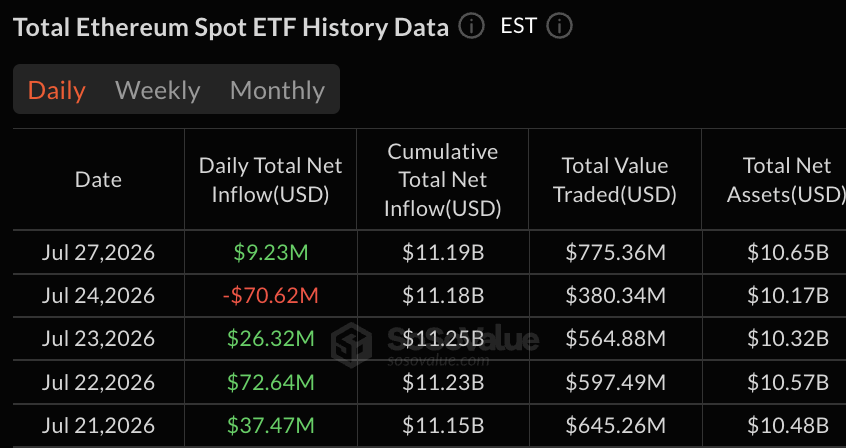
Ether ETFs showed steady inflows throughout last week. Source: Sosovalue

This contrast reflects the selective nature of institutional demand. Bitcoin remains the benchmark for crypto market presence, but lately, investors have shown greater willingness to allocate funds to ether when conditions allow.

Giselle Ly, Director and Digital Asset Strategist at Fidelity International, told Bitcoin.com News that bitcoin is often the first stop for institutional investors entering the cryptocurrency market. She said ETFs lower the barrier to entry and help major investors make more informed asset allocation decisions, rather than simply prompting them to buy or sell bitcoin.

Solana and $XRP rise, while $HYPE continues to fall

Solana ETFs attracted $1.03 million, with most of the capital going to Bitwise's BSOL fund. Total trading volume was $39.55 million, and net assets at the close were $889.31 million.

ETFs on $XRP attracted a more modest sum of $592,470. All the inflow went to Franklin Templeton's XRPZ fund. Trading volume for $XRP products reached $12.66 million, and aggregate assets remained at around $1 billion.

$HYPE ETFs remained the weakest market segment. This category saw a net outflow of $2.89 million, extending a difficult period following a successful start. Bitwise's BHYP fund lost $2.24 million, and 21Shares' THYP fund saw an outflow of approximately $658,940. Trading volume for $HYPE ETF funds reached $12.82 million, and net assets fell to $279.22 million.

Monday's data showed that institutional capital hasn't gone away. It has become more selective, favoring ether and measured altcoin investments, while funds investing in bitcoin and $HYPE face renewed selling pressure.

end-content

Trending Cryptos

Related Questions

QAccording to the article, which cryptocurrency ETF category attracted capital inflows on July 27th, while Bitcoin ETFs saw outflows?

AEthereum ETFs attracted capital inflows on July 27th, with a total of $9.23 million coming into the category. In contrast, Bitcoin ETFs experienced net outflows of $11.64 million.

QWhat was the specific dollar amount BlackRock's ETHA fund attracted, and which competing fund's outflows partially offset the total Ethereum ETF inflow?

ABlackRock's ETHA fund attracted $11.75 million. The total Ethereum ETF inflow was partially offset by an outflow of $2.52 million from Invesco's QETH fund.

QHow did the Solana and $XRP ETF categories perform in terms of capital flows on the day discussed?

ASolana ETFs attracted $1.03 million in inflows, primarily into the BSOL fund by Bitwise. $XRP ETFs attracted a more modest inflow of $592,470, entirely into Franklin Templeton's XRPZ fund.

QWhich ETF category continued a period of difficulty with significant outflows, and which specific funds contributed most to this outflow?

A$HYPE ETFs continued a difficult period with a net outflow of $2.89 million. Bitwise's BHYP fund lost $2.24 million, and 21Shares' THYP fund saw an outflow of approximately $658,940.

QWhat does the article suggest about the current nature of institutional capital in the cryptocurrency market, based on the day's ETF flow data?

AThe article suggests institutional capital has become more selective. It is favoring Ethereum and measured investments in altcoins like Solana and $XRP, while Bitcoin and $HYPE-focused funds are facing renewed selling pressure.

Related Reads

Virtuals Launches Hyperboost: Extends 14 Days of Rewards for Each Graduated Token to Combat 'Peak on Day One' Curse

Virtuals Protocol launched "Hyperboost" on July 27, 2026, to combat the "first-day peak" trend where over 75% of its AI Agent tokens see trading volume peak within 24 hours of graduation (launch to Uniswap). The mechanism automatically allocates a fraction of each token's previously idle graduation supply into a 14-day reward pool. Rewards are distributed daily, split between users based on trading volume share and creators for content posted about the token on platforms like X. Claims are immediate with no vesting. Early data from the first ~48 hours shows newly graduated tokens like AMARA and MAGE still experiencing significant post-graduation price declines (-78% and -55% in 24h respectively), indicating it's too early to judge effectiveness. Community concerns focus on potential wash trading due to volume-based rewards and a lack of transparency around content reward criteria. Hyperboost is part of Virtuals' broader ecosystem, which has over 18,000 AI Agent tokens and $750M+ in protocol revenue. While the feature could theoretically boost activity for its native VIRTUAL token by increasing trading volume in its paired pools, VIRTUAL's price remains influenced by broader market trends, down 7.4% over the past week. Observers note that several weeks of data will be needed to properly assess the mechanism's impact on sustaining post-graduation trading activity.

marsbit26m ago

Virtuals Launches Hyperboost: Extends 14 Days of Rewards for Each Graduated Token to Combat 'Peak on Day One' Curse

marsbit26m ago

Trading

Spot

Hot Articles

What is $BITCOIN

DIGITAL GOLD ($BITCOIN): A Comprehensive Analysis Introduction to DIGITAL GOLD ($BITCOIN) DIGITAL GOLD ($BITCOIN) is a blockchain-based project operating on the Solana network, which aims to combine the characteristics of traditional precious metals with the innovation of decentralized technologies. While it shares a name with Bitcoin, often referred to as “digital gold” due to its perception as a store of value, DIGITAL GOLD is a separate token designed to create a unique ecosystem within the Web3 landscape. Its goal is to position itself as a viable alternative digital asset, although specifics regarding its applications and functionalities are still developing. What is DIGITAL GOLD ($BITCOIN)? DIGITAL GOLD ($BITCOIN) is a cryptocurrency token explicitly designed for use on the Solana blockchain. In contrast to Bitcoin, which provides a widely recognized value storage role, this token appears to focus on broader applications and characteristics. Notable aspects include: Blockchain Infrastructure: The token is built on the Solana blockchain, known for its capacity to handle high-speed and low-cost transactions. Supply Dynamics: DIGITAL GOLD has a maximum supply capped at 100 quadrillion tokens (100P $BITCOIN), although details regarding its circulating supply are currently undisclosed. Utility: While precise functionalities are not explicitly outlined, there are indications that the token could be utilized for various applications, potentially involving decentralized applications (dApps) or asset tokenization strategies. Who is the Creator of DIGITAL GOLD ($BITCOIN)? At present, the identity of the creators and development team behind DIGITAL GOLD ($BITCOIN) remains unknown. This situation is typical among many innovative projects within the blockchain space, particularly those aligning with decentralized finance and meme coin phenomena. While such anonymity may foster a community-driven culture, it intensifies concerns about governance and accountability. Who are the Investors of DIGITAL GOLD ($BITCOIN)? The available information indicates that DIGITAL GOLD ($BITCOIN) does not have any known institutional backers or prominent venture capital investments. The project seems to operate on a peer-to-peer model focused on community support and adoption rather than traditional funding routes. Its activity and liquidity are primarily situated on decentralized exchanges (DEXs), such as PumpSwap, rather than established centralized trading platforms, further highlighting its grassroots approach. How DIGITAL GOLD ($BITCOIN) Works The operational mechanics of DIGITAL GOLD ($BITCOIN) can be elaborated on based on its blockchain design and network attributes: Consensus Mechanism: By leveraging Solana’s unique proof-of-history (PoH) combined with a proof-of-stake (PoS) model, the project ensures efficient transaction validation contributing to the network's high performance. Tokenomics: While specific deflationary mechanisms have not been extensively detailed, the vast maximum token supply implies that it may cater to microtransactions or niche use cases that are still to be defined. Interoperability: There exists the potential for integration with Solana’s broader ecosystem, including various decentralized finance (DeFi) platforms. However, the details regarding specific integrations remain unspecified. Timeline of Key Events Here is a timeline that highlights significant milestones concerning DIGITAL GOLD ($BITCOIN): 2023: The initial deployment of the token occurs on the Solana blockchain, marked by its contract address. 2024: DIGITAL GOLD gains visibility as it becomes available for trading on decentralized exchanges like PumpSwap, allowing users to trade it against SOL. 2025: The project witnesses sporadic trading activity and potential interest in community-led engagements, although no noteworthy partnerships or technical advancements have been documented as of yet. Critical Analysis Strengths Scalability: The underlying Solana infrastructure supports high transaction volumes, which could enhance the utility of $BITCOIN in various transaction scenarios. Accessibility: The potential low trading price per token could attract retail investors, facilitating wider participation due to fractional ownership opportunities. Risks Lack of Transparency: The absence of publicly known backers, developers, or an audit process may yield skepticism regarding the project's sustainability and trustworthiness. Market Volatility: The trading activity is heavily reliant on speculative behavior, which can result in significant price volatility and uncertainty for investors. Conclusion DIGITAL GOLD ($BITCOIN) emerges as an intriguing yet ambiguous project within the rapidly evolving Solana ecosystem. While it attempts to leverage the “digital gold” narrative, its departure from Bitcoin's established role as a store of value underscores the need for a clearer differentiation of its intended utility and governance structure. Future acceptance and adoption will likely depend on addressing the current opacity and defining its operational and economic strategies more explicitly. Note: This report encompasses synthesised information available as of October 2023, and developments may have transpired beyond the research period.

1.1k Total ViewsPublished 2025.05.13Updated 2025.05.13

What is $BITCOIN

Discussions

Welcome to the HTX Community. Here, you can stay informed about the latest platform developments and gain access to professional market insights. Users' opinions on the price of BTC (BTC) are presented below.

活动图片