Author: Ed Elson
Translated by: Deep Tide TechFlow
Deep Tide Introduction: The number of new business registrations in the US hit a record high last year, but behind the data lies an awkward truth – 70% of new companies have no intention of hiring anyone. They are merely part-time hobbies dressed up in the shell of an LLC. When "founder" becomes the trendiest social label and starting a company is cheaper than a date, genuine entrepreneurial spirit is being diluted into an Instagram persona.
The US economy doesn't have much good news right now. Oil prices are soaring, mortgage rates are rising, labor force participation is plummeting, and the cost-of-living crisis is intensifying.
However, there is indeed one bright spot that many economists find encouraging: the rise of American entrepreneurial spirit. Nearly 6 million new business applications were filed last year (a record high), and we are on track to break that record in 2026. Setting aside everything else, America may be more entrepreneurial than ever.
That's why I was shocked when my colleague Dan Chiolan shared the following data last week: of the 5.7 million new businesses started last year, only 30% are expected to ever create any jobs... ever.
Wait... what?
Yes, you read that correctly. According to the US Census Bureau, roughly 70% of new US businesses are classified as "likely non-employer businesses," meaning they are expected to create no jobs at all. How do we know? Through various factors, such as whether the business owner provided a date for first paying wages or indicated they were hiring. The data tells us America isn't creating more businesses, it's just filing more paperwork.
Is this an outlier? No. Over the past two decades, the share of new businesses unlikely to hire has doubled. Meanwhile, the share of "high-propensity" businesses (i.e., those likely to hire) has halved, with the actual number stagnating, meaning (genuine) American entrepreneurship has actually been at a standstill.
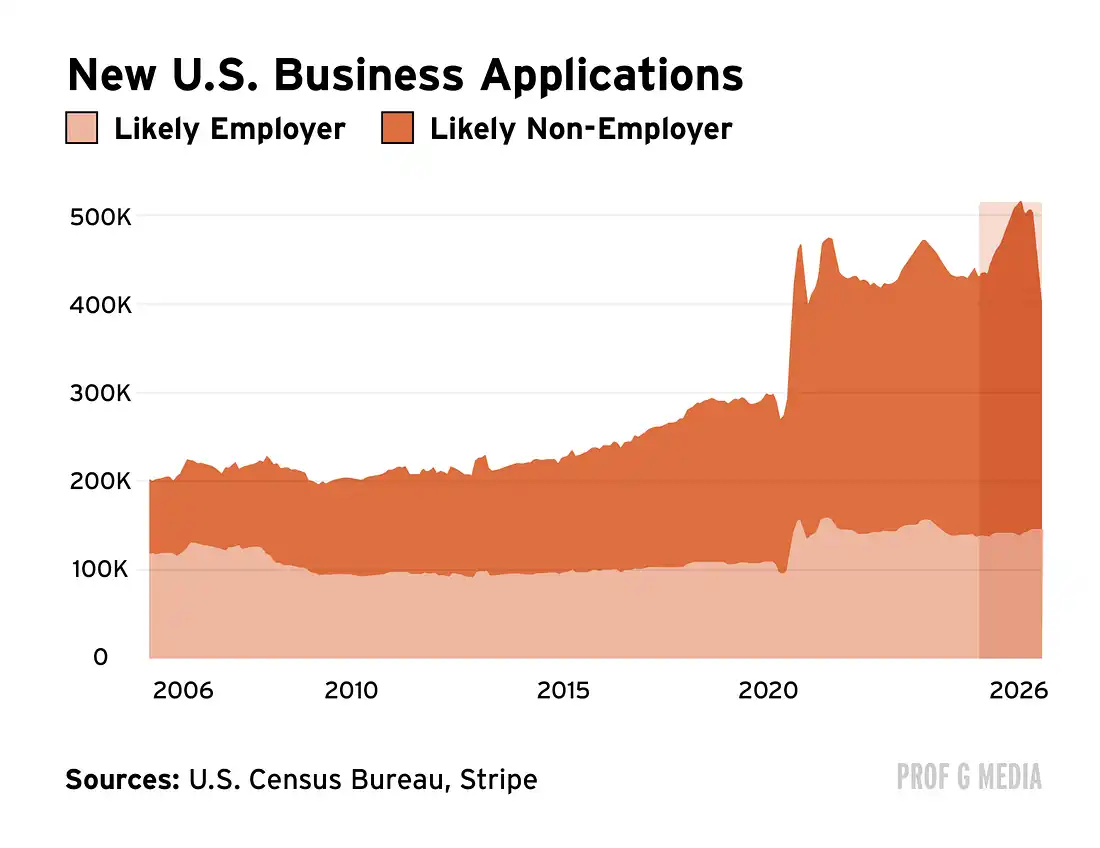
Chart: US new business registration application trends from 2006–2026. Light pink represents "likely employer," dark orange represents "likely non-employer." Source: U.S. Census Bureau, Stripe.
How is this possible? Is it AI related? Probably not, as this trend started long before ChatGPT. Look at the spike in 2020; it's more likely related to COVID, which probably means it's related to people being bored at home with nothing to do. Allow me to introduce my latest economic theory:
The False Startup Boom
What we are witnessing is not a rise in entrepreneurship, but the rise of what I call false businesses. What is a false business? Exactly what it sounds like. It's the "creative side project" your high school friend launched out of boredom during pandemic lockdowns. It's your distant cousin's "lifestyle brand" that hasn't sold a single product but already has a Substack. It's the "collective" whose mission isn't to collect revenue but to collect Instagram followers. It's the kind of business you can barely make time for without quitting your day job because... it's not a real business at all. It's a hobby you happen to have registered.
How do people have time to register hobbies as companies? Because now creating an LLC takes about 15 minutes. It costs roughly $130—about 30% less than the average price of a date. In other words, America's most accessible hobby isn't pottery or pickleball... it's entrepreneurship.
Can I prove my theory? No. But like gravity, I don't know what other theory fits. The number of non-employer businesses is surging, while the revenue generated by these businesses is plummeting, meaning there are millions of new businesses with almost no sales. Given how many of my friends have launched Instagram accounts disguised as "companies," one can only look at the evidence and conclude: they are the problem.
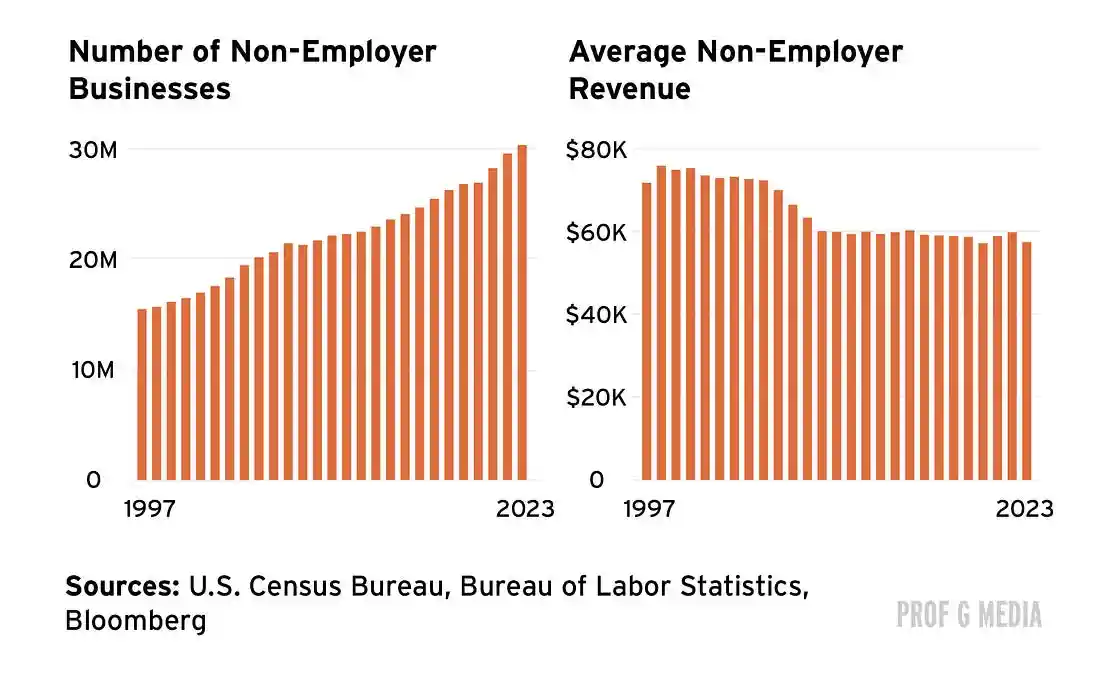
Chart: US non-employer business count (left) vs. average revenue (right) from 1997–2023. Source: U.S. Census Bureau, Bureau of Labor Statistics, Bloomberg.
The Cult of Entrepreneurship
So the question is, why would anyone start a false business? Why not just have a hobby on the side? Why make it an LLC? The answer, like all trends, is simple: because it's cool now.
The world's hottest job today is "founder." From Jensen Huang to Elon Musk, founders are the rock stars of our digital age. The data reflects this: roughly 70% of Gen Z say owning a business is "part of the American Dream" (significantly higher than other demographics), and nearly half say they don't want a regular 9-to-5 job at all.
Yet, more important than being a founder is being *able* to call yourself one. The word "founder" evokes independence, fearlessness, and courage—precisely the traits people like to showcase on dating apps or social media. As a result, the number of Americans adding "founder" to their LinkedIn profiles surged 69% last year.
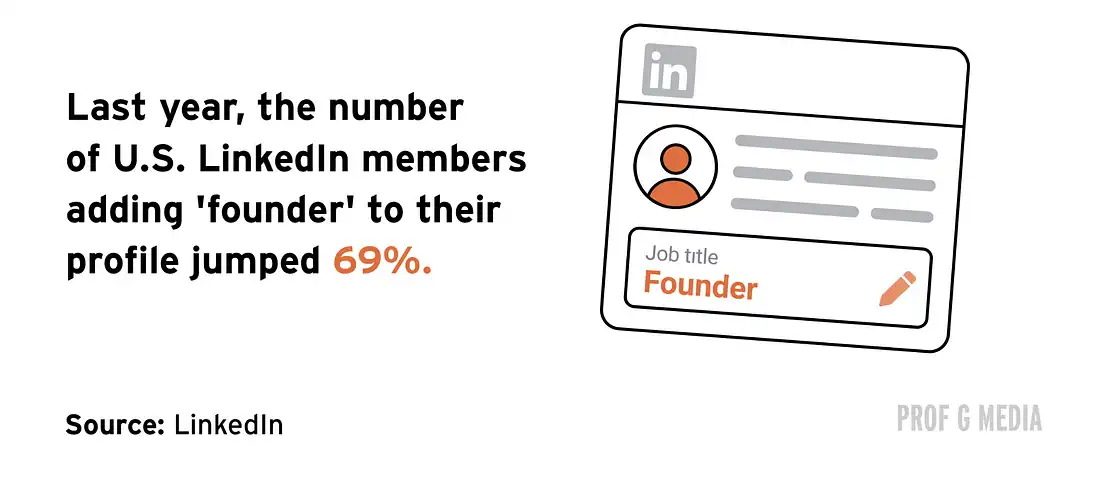
Chart: Surge in US LinkedIn users adding "Founder" title to their profiles last year, up 69%. Source: LinkedIn.
I suspect most of these new "founders" are running false businesses. Honestly, I get it. Unlike starting a real business (which requires significant sacrifice), a false business lets you keep your real job while also being a "business owner." It's all the great taste of being a founder, with none of the calories. Does it matter what your business does or if it makes money? Of course not! All that matters is that you have one.
The Cult of the Founder...
Why is this happening? Over the past two decades, our society has been psychologically conditioned into a state of founder worship. Founders are no longer just businesspeople—they are trendsetters, celebrities, cowboys, and tastemakers. They grace magazine covers and billboards. They host podcasts, write manifestos, dominate our algorithms. Founders are a unique blend of wealth and relevance, something many dream of but few achieve.
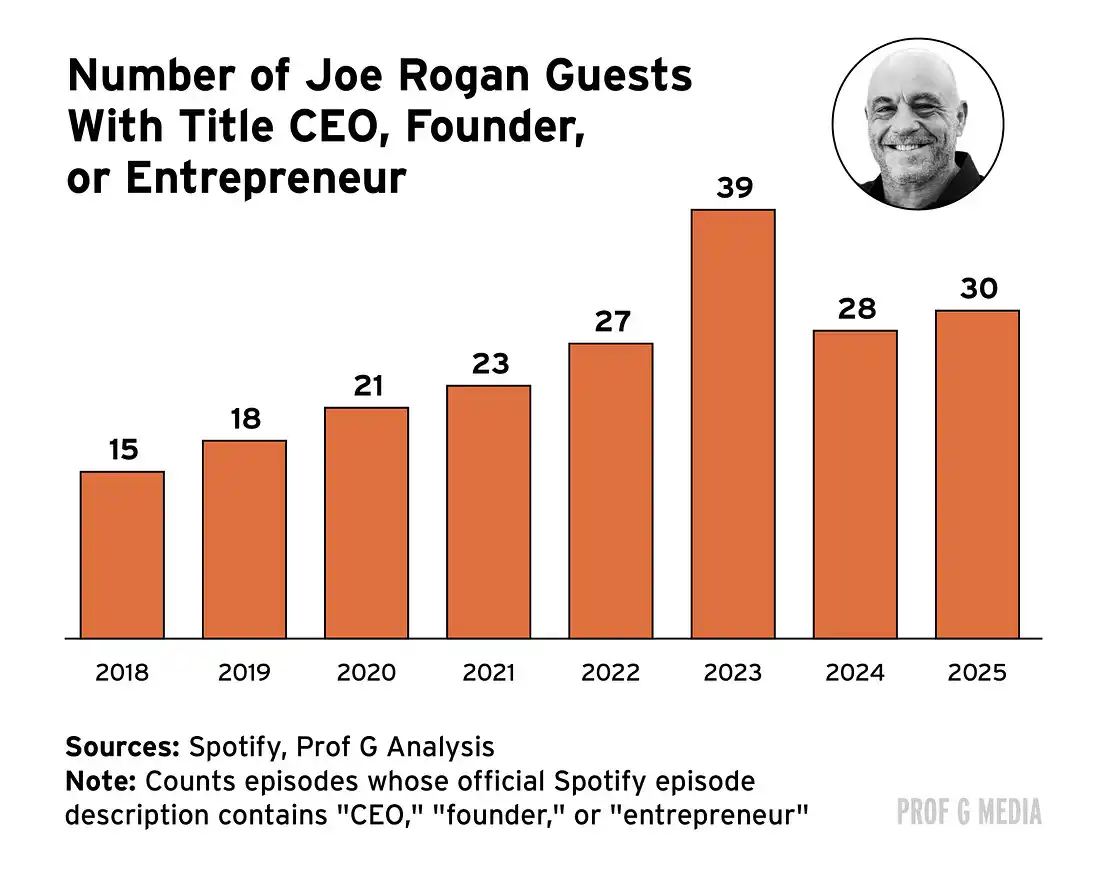
Chart: Count of Joe Rogan podcast episodes featuring guests with titles containing CEO, Founder, or Entrepreneur from 2018–2025. Source: Spotify, Prof G Analysis.
Thus, there is immense social capital in being a founder. Starting a company today doesn't just make you rich; it makes you interesting. For a generation that says its lives lack meaning, this is a powerful proposition. Where people once filled internal voids with alcohol, affairs, and eventually yoga, today they fill them with startups.
...Gone Astray
The unhealthy obsession with founderhood can lead to dark places. I know countless examples of people who have ruined themselves due to a deep-seated desire to be Steve Jobs (Elizabeth Holmes, SBF, Charlie Javice, etc.). However, what fascinates me most recently is a scandal involving Phoebe Gates, daughter of Bill Gates.
The 23-year-old Stanford graduate is currently under investigation after her shopping startup, backed by Hailey Bieber and valued at $185 million, was exposed for faking sales data. This fraud, known as "cookie stuffing," is common in the affiliate marketing industry, but it also raises a deeper, more interesting question: Why did the daughter of the world's nineteenth-richest person feel the need to fake her way into being a founder? We now have our answer: because it's cool.
I should have known, from the moment she publicly announced her Series A, which looked less like a funding round and more like a Coachella lineup. I also should have known when she and her co-founder launched the quintessential false business of the moment: a podcast. Or when she achieved the holy grail of false businesses: appearing on Call Her Daddy. The point is, there were signs.
Harder Than You Think
You may have gathered by now that I dislike the false startup boom. Fakeness aside, I despise the lie it promotes, which could mislead millions in their careers: that entrepreneurship is easy.
Let's be clear: it's not. One-fifth of US businesses fail in their first year, half disappear within five years. While the dream of raising venture capital is alluring, for most it's just a dream: only 0.05% of startups ever raise venture funding, and among those that do, roughly three-quarters fail to return a single dollar to investors.
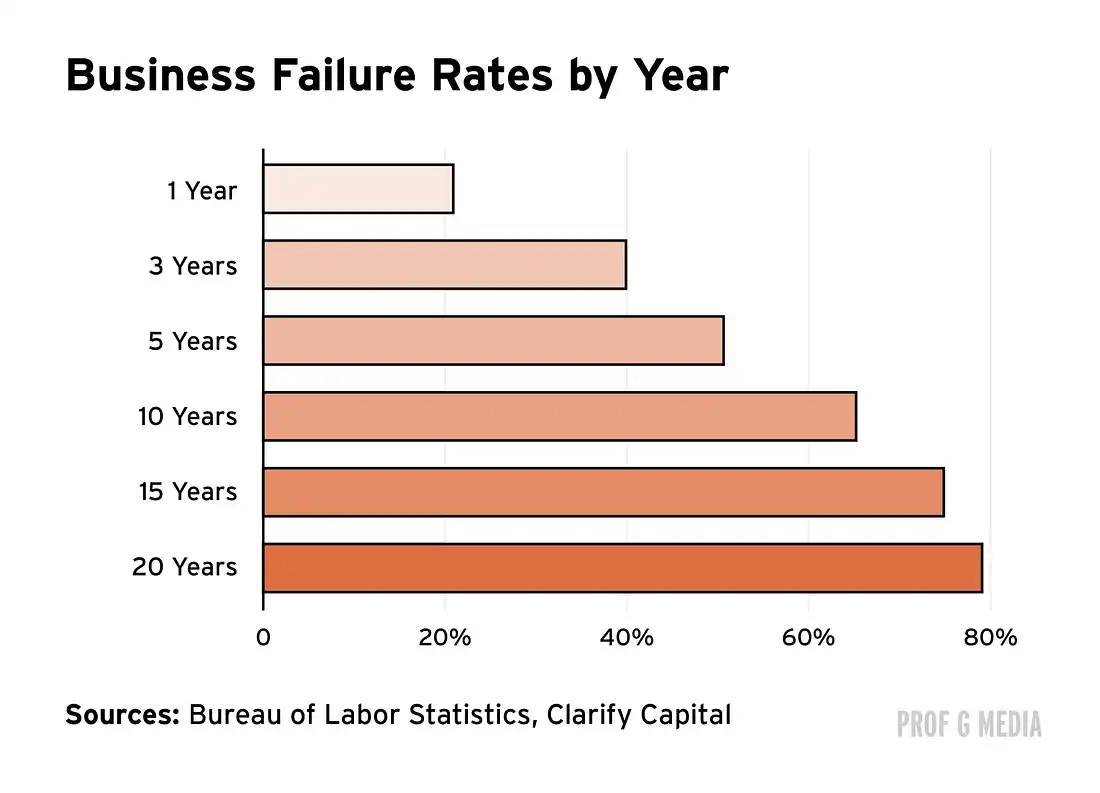
Chart: US business failure rates by years in business, showing nearly 80% gone after 20 years. Source: Bureau of Labor Statistics, Clarify Capital.
I'm not trying to discourage anyone from starting a business. Done right, it can be transformative. But we should also acknowledge the truth about being a founder: it's extremely difficult, often unrewarding, requires immense personal sacrifice, and likely won't end well. This isn't an opinion—it's a statistical fact.
Many seem to believe they can avoid the negatives of entrepreneurship by starting a false business. "Do it on the side," they think, "so you don't have to go all in." What they fail to realize is that nothing meaningful is ever achieved on the side. There's an important reason for that: meaning doesn't come from the outcome; it comes from the process. That's why it's called meaning. It's proportional to how much you're willing to sacrifice.
The better option is to make a choice. Either choose to start a business, or choose not to, but don't fool yourself into thinking you can choose both. This applies to every other area of life, too. From side hustles to "situationships," young people have developed an allergy to making decisions. We can barely decide what to eat or watch, let alone what to do with our careers. It may stem from our addiction to algorithms, as the more we outsource responsibility to our phones, the less we take for ourselves. But for too many young people, the result is that we're not living our lives; we're letting life happen to us.
This state of limbo is something we have the power to reject. Whether as a founder or not, immense meaning is within anyone's grasp. It exists both inside and outside your work, in your current job and your next one. It's there for the taking. All you have to do is choose.
See you next week.