Claude Doesn't Submit Code Directly After Writing It: Runs 4 Skills for Self-Check, Fixes Issues, Then Comes Back to You

marsbitXuất bản vào 2026-07-27Cập nhật gần nhất vào 2026-07-27

Tóm tắt

Claude No Longer Submits Code Directly: 4 Self-Check Skills to Run Before Coming Back to You AI already writes code, but the burden of reviewing it still falls on you. To address this, Anthropic has built a "verification loop" into Claude Code. After writing code, Claude now runs four self-check skills before delivering the work: * `/code-review`: Finds potential bugs and provides review feedback. * `/simplify`: Cleans up the diff, removing redundant or over-complex implementations to reduce future maintenance costs. * `/verify`: Performs end-to-end validation, actually running the application to confirm the feature works, not just appears to. * `/design`: Used only for UI changes; cross-references the implementation against the project's DESIGN.md file. This loop extends the AI agent's workflow from "gather context → execute" to "gather context → execute → auto-verify → fix → re-verify." It tackles the new bottleneck in AI-assisted development: the speed of verifying code now outpaces human review. These skills are built on Claude Code's existing verification foundation (like running apps and using linters). Teams can create their own custom verification skills by documenting their repetitive manual checks in plain language as Markdown files. Verification can be triggered at four levels: manually (Standalone), embedded in a task, chained with other skills, or automatically on every PR (On every PR). The shift signifies that competition in AI programming is movin...

AI has taken over the task of writing code. But the job of acceptance still falls on you.

Whether a piece of code is written correctly or not is not AI's responsibility; ultimately, you still have to go through it line by line. This hurdle has stumped many people.

Recently, Anthropic has also integrated AI acceptance into the loop.

They made Claude, after writing code, not immediately hand it over. Instead, it runs four checks itself first:

/code-review to root out bugs, /simplify to clean up redundant implementations, /verify to perform end-to-end verification, and if the UI was touched this time, use /design to cross-check against the visual specifications in DESIGN.md.

Only after running through all four does it count as delivered.

On July 22nd, the Claude Code team publicly shared this internal "verification loop."

In other words, after Claude writes code, it first finds and fixes errors on its own before coming back to you.

This signifies AI evolving from "being able to write code" to "being able to check the code it wrote."

Agent Work Loop Gains an Extra Verification Step

Anthropic gave this system a name: the verification loop.

The official definition is simple: it's an iterative process where Claude checks and attempts to fix its own work.

What it changes is the agent's work cycle.

Previously, it was "gather context → execute action → manual check." The final step rested on humans: the AI hands over the work, and you have to review it line by line.

Now this line is extended to "gather context → execute action → automatic verification → fix → verify again." Checking and fixing are placed back inside the loop.
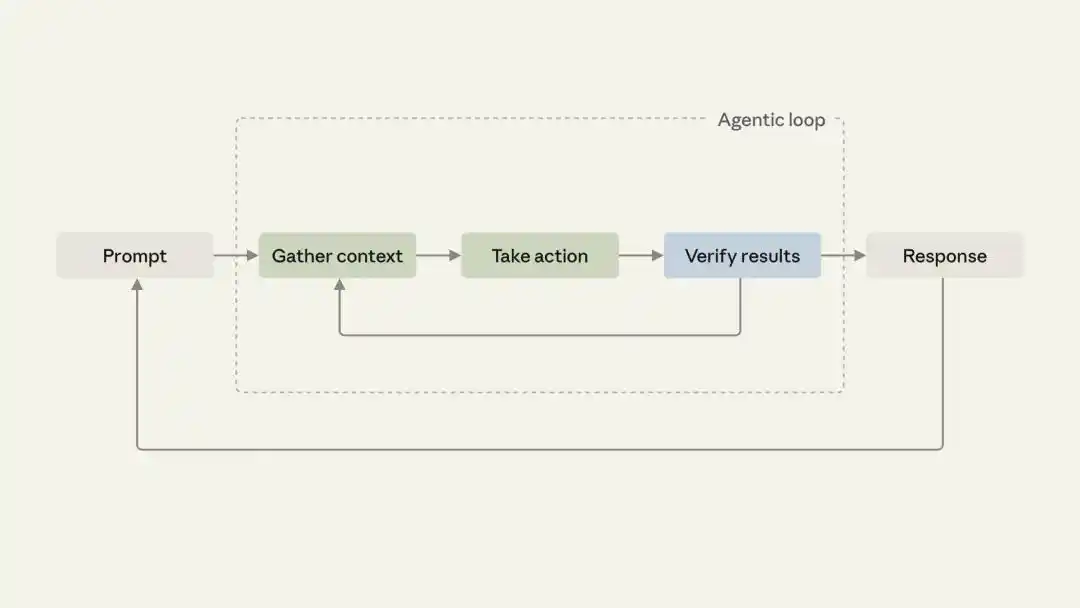
Anthropic's official agent cycle diagram: after a prompt comes in, Claude gathers context, executes actions, verifies results. If verification fails, it loops back; only when it passes does it return.

Some checks Claude already knows how to do. Deterministic signals in the codebase, like type checker, linter, running tests, runtime errors—it can read these and will fix them as it goes.

The real trouble lies with another category: whether the UI changes are correct, whether the user flow is smooth, whether this change has buried unseen pitfalls...

In the past, these could only be caught by humans watching, performing the same checks dozens or hundreds of times.

Anthropic's solution is to write down each of those manual checks you perform every time, package them into Skills, and have Claude execute them automatically for each task.

For decades, all software engineering processes—writing requirements, planning, layer upon layer of reviews, endless meetings—were essentially because: writing code was too slow, and engineers' time was too valuable.

But when AI makes the act of writing code faster and cheaper, this premise disappears.

The Claude Code team's own assessment is: the bottleneck hasn't vanished; it has merely shifted: from "writing code" to verification, code review, security, and other such stages.

Code is generated too quickly. The new problem becomes: are these codes correct, who will maintain them, can people keep up with the pace of reviewing code.

Faced with this new bottleneck, the Claude Code team first experimented on themselves.

The 4 Self-Check Skills the Claude Code Team Uses Daily

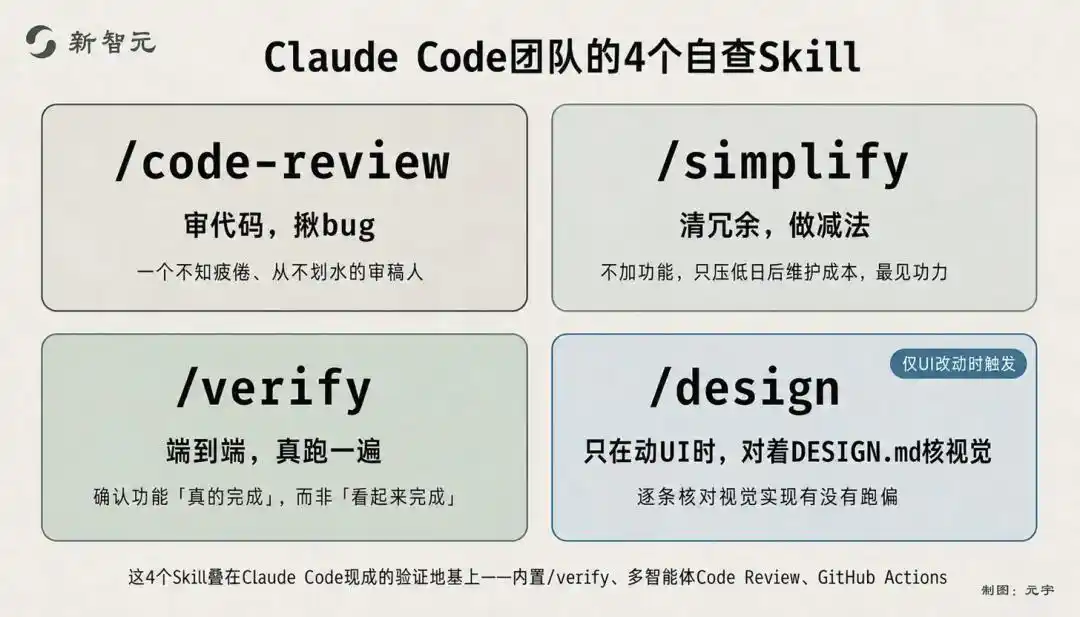
Internally, the Claude Code team uses these four self-check Skills every day.

/code-review, specialized in reviewing code changes, rooting out potential bugs, and providing review comments along the way.

This is like having a tireless reviewer on standby.

/simplify, cleans up the diff for this change, removing convoluted, complex implementations to make the structure simpler.

It doesn't add features for you; instead, it removes redundancy, simplifies implementation, pushing down future maintenance costs.

This point is crucial and requires real skill. Most people write code by adding more; tools that proactively simplify are particularly valuable.

/verify, performs end-to-end verification, actually running things to confirm the feature is truly complete, not just "looks complete."

/design, only comes into play when the UI is touched. It cross-checks against the DESIGN.md in the repository, verifying point by point if your visual implementation has deviated.

These 4 Skills didn't appear out of thin air.

Underlying them, Claude Code has already laid a foundation of existing verification support:

The built-in /verify can run the application to observe changes; you specify the build and test commands in CLAUDE.md, and it follows them. There's also Code Review specifically for multi-agent reviews on PRs, and GitHub Actions that automatically trigger on every commit.

The team's 4 Skills are like adding their own layer of process on top of this general foundation.
How to Write Your Own Verification Skill?

Anthropic's method is also simple:

Write down that manual step you always perform in plain language, as if you were explaining precautions to a new colleague on their first day.

If you're even stuck on how to describe this check step, you can first ask Claude to provide a version of general best practices and then modify it.

Your version will likely differ from the generic approach at a few key points, and those differences are precisely the things most worth documenting.

Checks don't necessarily have to be vague judgments like "feels right or not."

For example: any change that deletes a database field without an accompanying data migration step should be rejected. This is a "local rule" that a generic linter will never catch but is specific to your project.

Any rule you've only been able to enforce by manually watching like a hawk is worth writing into a loop.

What to do after writing it?

Throw it to skill-creator to have it interview you back, or simply drop a Markdown file into .claude/skills/.

The simplest verification Skill is a few lines of instructions plus a body paragraph. Then test it once on a new task to confirm this check step actually runs. If not, fix it.

For Skills you can't modify, like built-in ones or those hosted by plugins, there's a workaround: write a wrapper Skill that first calls the original, then calls your verification. A detour, but it still embeds the check.

Verification Isn't One-Size-Fits-All; It Has 4 Levels

After packaging checks into Skills, the next question is: when should this thing trigger?

Anthropic provides 4 levels of automation, from loose to tight.

Standalone: You remember to manually invoke it.

Embedded: Embedded into a specific task flow, running alongside it.

Chained: Several verification Skills strung into a chain, automatically running one after another.

On every PR: The strictest level, automatically running on every code commit.

The official term for the middle layer transition is "from habit to contract."

What was "I always remember to run /verify after /simplify" as a personal habit becomes "automatically call /verify after /simplify runs" as a fixed contract once chained.

The entire chain completes the development loop on its own, only coming back to you when your approval is needed.

The longer the chain, the higher the reliability, but the official team specifically cautioned: chained verification will genuinely burn through tokens.

So don't immediately set all checks as PR gates that block every commit. The right approach is to first see if it's stable, then gradually add more.

Behind the 4 Skills: AI Programming is Changing Tracks

Behind the 4 Skills, the competition in AI programming is shifting from generation to verification.

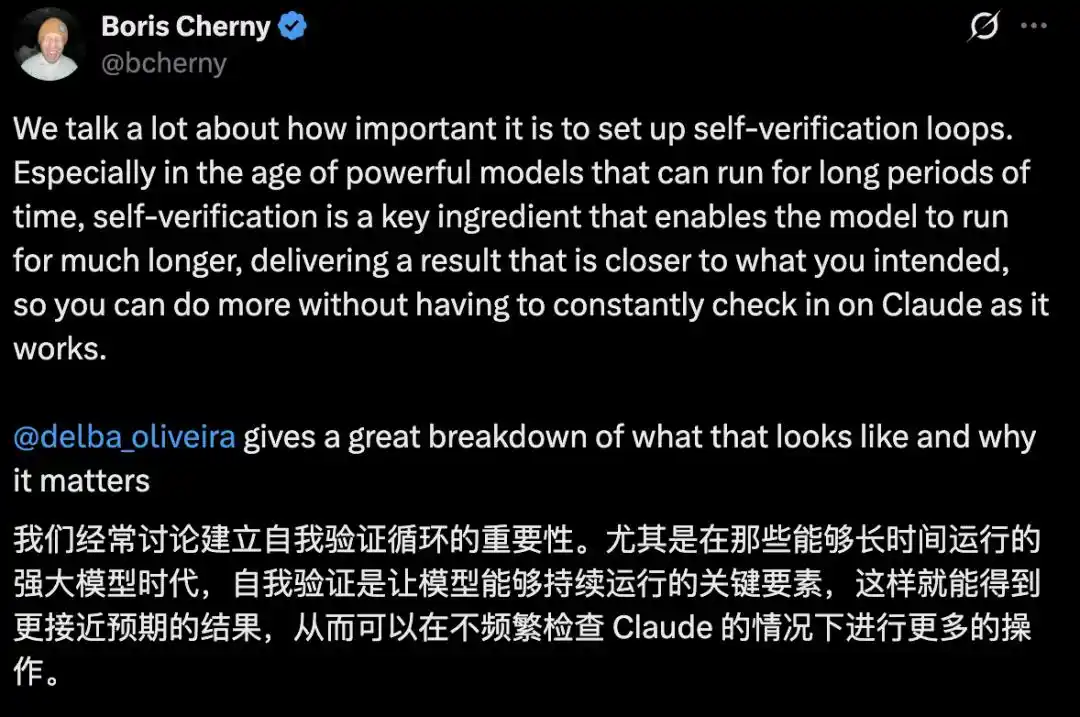
The creator of Claude Code has given the same assessment.

On June 9th of this year, he tweeted: In an era where powerful models can run autonomously for long periods, self-verification is key to letting models run longer and produce results closer to your expectations. You don't have to watch Claude frequently to hand over more work.

Simply put, the more solid the verification, the more confidently an agent can run; the longer it runs, the less hassle for humans.
In the past, we relied on prompts, but they have a ceiling too: they only solve the task at hand; next time you start from scratch.

Let's first correct a common misunderstanding: A Skill is not a piece of Markdown prompt.

It's a capability module containing instructions, file structure, scripts, tool calls, configuration, and an entire workflow. It's about solidifying a team's check steps, design norms, and lessons learned into a package readily available for Claude to reference when needed.

More crucially, Skills are evolving from a feature of Claude Code into an open standard across vendors.

According to industry analysis, GitHub Copilot, Cursor, OpenAI Codex, and Gemini CLI have already adopted the same format.

This means the Skills you solidify for your team won't be locked into one specific tool. They will encapsulate your team's experience, norms, and check processes, turning into reusable capabilities.

This also highlights a stark reality: the same Claude might yield efficiency differences of several times between different teams. This gap isn't due to the model but rather the workflow:

Have you written checks into Skills? Have you set up verification loops? Have you enabled the agent to run its own feedback loop to completion?

Ultimately, an agent's capability is an addition problem: model, plus tools, plus verification mechanisms, plus workflow.

The model aspect is becoming more similar across vendors. What truly creates distance are the latter three items, all of which are in the user's hands.

Of course, what this blog post demonstrates is the process optimization of AI-assisted development, not "AI can already write software independently." It still requires engineers and cannot handle production-grade delivery without humans.

Therefore, it's not about agents coming to take human engineers' jobs, but the direction is already clear.

In the past, we've been teaching AI how to write code. Now we need to start teaching it to verify if what it wrote is correct.

For someone who uses AI to write code every day, the day when "having to manually review everything before leaving work" can finally be entrusted to AI with peace of mind is the day it truly starts carrying the load for you.

References:

https://claude.com/blog/building-verification-loops-in-claude-code-with-skills

https://claude.com/blog/getting-started-with-loops?utm_source=chatgpt.com

This article is from the WeChat public account "New Zhiyuan", author: ASI Revelation

Tiền kỹ thuật số thịnh hành

Câu hỏi Liên quan

QWhat is the core innovation described in the article regarding Claude's code generation?

AThe core innovation is the introduction of a 'verification loop' where Claude, after writing code, automatically runs it through four specialized Skill checks (code-review, simplify, verify, design) to find and fix errors before delivering the final code to the user.

QWhat are the four primary verification Skills used by the Claude Code team internally?

AThe four primary Skills are: /code-review (to catch potential bugs and provide review comments), /simplify (to clean up and streamline the implementation), /verify (to perform end-to-end functional verification), and /design (to ensure UI changes align with a project's DESIGN.md file).

QWhat is the key difference between a traditional AI coding workflow and the new 'verification loop' workflow?

AThe traditional workflow is: 'collect context -> execute action -> human review'. The new 'verification loop' workflow extends this to: 'collect context -> execute action -> automatic verification -> repair -> re-verify', embedding the review and repair steps back into an automated loop before returning to the user.

QAccording to the article, what is the main 'bottleneck' that has shifted as AI code generation becomes faster?

AThe main bottleneck has shifted from 'writing code' to the verification, code review, and security aspects. The article states that the new problem is ensuring the rapidly generated code is correct, maintainable, and can be reviewed at the required pace.

QHow does the article describe the nature and importance of 'Skills' compared to simple prompts?

AA Skill is described not as a simple prompt, but as a modular capability package. It contains instructions, file structures, scripts, tool calls, configurations, and workflows. It is a way to encapsulate a team's review steps, design standards, and learned lessons into a reusable asset that Claude can access autonomously.

Nội dung Liên quan

Phỏng vấn lãnh đạo Robinhood: Chiến lược "đòn bẩy" thu hút khách hàng với Meme + token hóa cổ phiếu Mỹ, tất cả các dòng sản phẩm đều đạt doanh thu hàng trăm triệu USD

**Tóm tắt:** Johann Kerbrat, Phó Chủ tịch cấp cao phụ trách mảng Crypto và Kinh doanh Quốc tế của Robinhood, đã chia sẻ chiến lược "đòn bẩy" đằng sau Robinhood Chain sau 3 tuần ra mắt mainnet: song song phát triển meme token và Tài sản Thế giới Thực (RWA). Chuỗi đạt khối lượng giao dịch DEX hàng tuần hơn 30 tỷ USD với hơn 105 triệu giao dịch. Chiến lược này nhằm thu hút hai nhóm người dùng khác nhau: cộng đồng DeFi qua meme và người dùng toàn cầu muốn tiếp cận cổ phiếu Mỹ được mã hóa (hiện có 90+ mã, tại 120+ quốc gia). Robinhood muốn chuyển 27 triệu tài khoản có tiền gửi của mình lên chain bằng cách kết hợp sản phẩm DeFi (như Robinhood Earn) với trải nghiệm người dùng đơn giản, thân thiện của CeFi, không yêu cầu ví tự quản. Về công nghệ, họ chọn stack L2 của Arbitrum thay vì xây L1 riêng để tận dụng bảo mật của Ethereum, hệ sinh thái EVM và tập trung vào sản phẩm tài chính. Kerbrat nhấn mạnh mục tiêu là "mở rộng chiếc bánh" - đưa nhiều người dùng hơn vào thế giới crypto hơn là cạnh tranh thị phần với các chain khác như Base. Các đối tác DeFi được lựa chọn dựa trên khả năng đáp ứng yêu cầu tuân thủ, tạo trải nghiệm độc đáo và khác biệt hóa. Về doanh thu, tất cả các mảng kinh doanh chính của Robinhood (chứng khoán, crypto, v.v.) đều đạt doanh thu hàng trăm triệu USD. Hiện tại, Robinhood Chain ưu tiên tối đa hóa tỷ lệ áp dụng hơn là tối ưu doanh thu từ phí gas, với tầm nhìn dài hạn là trở thành một "siêu ứng dụng" tài chính toàn diện.

marsbit1 giờ trước

Phỏng vấn lãnh đạo Robinhood: Chiến lược "đòn bẩy" thu hút khách hàng với Meme + token hóa cổ phiếu Mỹ, tất cả các dòng sản phẩm đều đạt doanh thu hàng trăm triệu USD

marsbit1 giờ trước

Báo cáo Quý 3 của Fidelity: BTC, ETH và SOL tiếp tục tích lũy đáy, đợt gấu tiền mã hóa này còn kéo dài bao lâu?

Báo cáo Q3 của Fidelity cho thấy thị trường tiền mã hóa đang tiếp tục tìm đáy trong xu hướng giảm hiện tại. Chỉ số NUPL trọng số giảm xuống -0.01, với BTC duy trì lợi nhuận chưa thực hiện trong khi ETH và SOL chìm sâu trong khoản lỗ. Tỷ lệ thống trị của BTC tăng lên 68%, phản ánh xu hướng tập trung vốn vào tài sản có tính thanh khoản cao nhất. Giá cả giảm mạnh, nhiều chỉ số tiệm cận vùng "đầu hàng" lịch sử. Dựa trên chu kỳ đáy khoảng 300 ngày vào các năm 2018 và 2022, đợt điều chỉnh kéo dài 203 ngày hiện tại có thể đã trải qua 2/3 chặng đường. Tháng 10/2026 được đề xuất là khung thời gian đáng quan sát, nhưng không phải là dự báo chắc chắn về điểm đáy. * **Bitcoin (BTC):** NUPL ở mức 0.09 (tích cực), nhưng động lực giá vẫn âm. Chỉ số Yardstick cho thấy BTC có thể bị định giá thấp so với sức mạnh băm của mạng lưới. * **Ethereum (ETH):** NUPL ở mức -0.43 (tích cực cho lợi nhuận dài hạn), động lực âm. Khối lượng chuyển stablecoin vẫn tăng trưởng mạnh, thể hiện nhu cầu sử dụng thực tế. * **Solana (SOL):** NUPL ở mức -0.72 (tích cực), động lực âm. Các chỉ số sử dụng cơ bản và khối lượng chuyển stablecoin vẫn thể hiện sự phục hồi tích cực bất chấp thị trường suy yếu. Báo cáo kết luận rằng thị trường vẫn đang trong giai đoạn tích lũy và điều chỉnh, với sự thận trọng cao.

marsbit1 giờ trước

Báo cáo Quý 3 của Fidelity: BTC, ETH và SOL tiếp tục tích lũy đáy, đợt gấu tiền mã hóa này còn kéo dài bao lâu?

marsbit1 giờ trước

Bitcoin và Ethereum đã thể hiện như thế nào trong tháng 8? Đây là những thông tin chính bạn cần biết

Bitcoin và Ethereum đã bước vào tháng Tám với thành tích lịch sử yếu sau khi kết thúc tháng Bảy tăng trưởng. Dữ liệu lịch sử cho thấy khả năng cả hai đóng cửa tháng với mức lỗ là không thể loại trừ. Trong tháng Bảy, Ethereum vượt trội hơn Bitcoin với mức tăng 18,5%, so với mức tăng 7% của Bitcoin. Tuy nhiên, hiệu suất trong tháng Tám của Ethereum từ năm 2016 trở lại đây khá hỗn hợp: tăng trong 4 lần và giảm trong 6 lần. Đợt tăng mạnh nhất là vào năm 2017 (92,86%), trong khi đợt giảm mạnh nhất là vào năm 2018 (-34,79%). Mặc dù lợi nhuận trung bình của Ethereum trong tháng Tám là 6,74%, nhưng lợi nhuận trung vị âm (-1,74%) cho thấy mức trung bình tích cực chủ yếu được thúc đẩy bởi một vài đợt tăng trưởng mạnh. Bitcoin cũng không có tín hiệu rõ ràng trong tháng Tám. Lợi nhuận trung bình hàng tháng là 1,06%, nhưng lợi nhuận trung vị là -6,99%, điều này cho thấy các phiên đóng cửa thua lỗ phổ biến hơn. Gần đây, Bitcoin thể hiện sự biến động: tăng 8,13% vào tháng 8/2025, tăng 2,95% vào 2024 và giảm 4,02% vào 2023. Tóm lại, mặc dù lợi nhuận trung bình lịch sử của cả Bitcoin và Ethereum trong tháng Tám là dương, nhưng lợi nhuận trung vị âm cho thấy khả năng thua lỗ là phổ biến hơn, với mức trung bình được nâng lên bởi một số đợt tăng mạnh hiếm hoi.

cryptonews.ru1 giờ trước

Bitcoin và Ethereum đã thể hiện như thế nào trong tháng 8? Đây là những thông tin chính bạn cần biết

cryptonews.ru1 giờ trước

Lãnh đạo HIVE: GPU phục vụ AI mang lại doanh thu cao gấp 10 lần mỗi giờ so với các trang trại khai thác tiền điện tử

Lãnh đạo HIVE: GPU cho AI mang lại doanh thu gấp 10 lần mỗi giờ so với trang trại khai thác tiền điện tử Trong một cuộc thảo luận gần đây, Chủ tịch HIVE Frank Holmes đã tiết lộ sự chênh lệch lớn về khả năng sinh lời giữa việc cung cấp sức mạnh tính toán cho trí tuệ nhân tạo (AI) và khai thác Bitcoin. Một cụm 504 GPU Nvidia B200 của HIVE trong cơ sở hạ tầng AI của Bell Canada ở Manitoba tạo ra khoảng 2,90 đô la mỗi giờ trên mỗi GPU. Trong khi đó, các giàn khai thác Bitcoin của công ty chỉ tạo ra khoảng 0,12 đô la mỗi giờ – chênh lệch hơn 20 lần. Đây là cốt lõi trong chiến lược của HIVE: đầu tư phần lớn vào kinh doanh AI có lợi nhuận cao hơn, đồng thời vẫn duy trì hoạt động khai thác Bitcoin đáng kể. Năm tài chính 2026, HIVE đạt tốc độ băm trung bình 22,2 EH/s, chiếm khoảng 3% tổng tốc độ băm mạng Bitcoin và khai thác được 2.885 BTC. Doanh thu tổng thể của HIVE năm 2026 đạt 297,8 triệu đô la, tăng 158%. Bộ phận AI và điện toán hiệu suất cao (HPC) mới, BUZZ HPC, đóng góp 19,5 triệu đô la. HIVE đã chuyển hướng sang AI từ sớm, với khoản đầu tư 70 triệu đô la vào chip Nvidia cách đây ba năm, giúp họ có lợi thế khi cơn sốt AI bùng nổ. Công ty đã nhận được đánh giá "Mua" đầu tiên từ một nhà phân tích, ký thỏa thuận cung cấp điện toán đám mây GPU trị giá khoảng 220 triệu đô la với Bell và startup AI Cohere, cũng như huy động 75 triệu đô la thông qua phát hành trái phiếu. Dự án đầy tham vọng nhất của HIVE là một trung tâm dữ liệu AI công suất 320 MW đang được xây dựng ở Vùng Toronto, dự kiến chứa hơn 100.000 GPU. Khi hoạt động đầy đủ vào nửa cuối năm 2027, cơ sở này dự kiến tạo ra khoảng 360 triệu đô la doanh thu định kỳ hàng năm. HIVE không đơn độc trong xu hướng này. Các công ty khai thác đối thủ như MARA, Hut 8 và Terawulf cũng đang chuyển hướng nguồn lực năng lượng hạn chế sang các hợp đồng AI/HPC sinh lời hơn, trước bối cảnh biên lợi nhuận khai thác Bitcoin giảm và giá mỗi hash giảm. Mục tiêu trước mắt của HIVE là tăng gấp mười lần doanh thu hàng năm từ AI/HPC vào cuối năm tài chính, phụ thuộc vào việc đưa vào vận hành đúng hạn trung tâm dữ liệu Toronto và các hợp đồng dịch vụ đám mây GPU tiếp theo.

cryptonews.ru3 giờ trước

Lãnh đạo HIVE: GPU phục vụ AI mang lại doanh thu cao gấp 10 lần mỗi giờ so với các trang trại khai thác tiền điện tử

cryptonews.ru3 giờ trước

Giao dịch

Giao ngay

Bài viết Nổi bật

Làm thế nào để Mua 4

Chào mừng bạn đến với HTX.com! Chúng tôi đã làm cho mua 4 (4) trở nên đơn giản và thuận tiện. Làm theo hướng dẫn từng bước của chúng tôi để bắt đầu hành trình tiền kỹ thuật số của bạn.Bước 1: Tạo Tài khoản HTX của BạnSử dụng email hoặc số điện thoại của bạn để đăng ký tài khoản miễn phí trên HTX. Trải nghiệm hành trình đăng ký không rắc rối và mở khóa tất cả tính năng. Nhận Tài khoản của tôiBước 2: Truy cập Mua Crypto và Chọn Phương thức Thanh toán của BạnThẻ Tín dụng/Ghi nợ: Sử dụng Visa hoặc Mastercard của bạn để mua 4 (4) ngay lập tức.Số dư: Sử dụng tiền từ số dư tài khoản HTX của bạn để giao dịch liền mạch.Bên thứ ba: Chúng tôi đã thêm những phương thức thanh toán phổ biến như Google Pay và Apple Pay để nâng cao sự tiện lợi.P2P: Giao dịch trực tiếp với người dùng khác trên HTX.Thị trường mua bán phi tập trung (OTC): Chúng tôi cung cấp những dịch vụ được thiết kế riêng và tỷ giá hối đoái cạnh tranh cho nhà giao dịch.Bước 3: Lưu trữ 4 (4) của BạnSau khi mua 4 (4), lưu trữ trong tài khoản HTX của bạn. Ngoài ra, bạn có thể gửi đi nơi khác qua chuyển khoản blockchain hoặc sử dụng để giao dịch những tiền kỹ thuật số khác.Bước 4: Giao dịch 4 (4)Giao dịch 4 (4) dễ dàng trên thị trường giao ngay của HTX. Chỉ cần truy cập vào tài khoản của bạn, chọn cặp giao dịch, thực hiện giao dịch và theo dõi trong thời gian thực. Chúng tôi cung cấp trải nghiệm thân thiện với người dùng cho cả người mới bắt đầu và người giao dịch dày dạn kinh nghiệm.

Tổng lượt xem 655Xuất bản vào 2025.10.20Cập nhật vào 2026.06.02

Làm thế nào để Mua 4

Thảo luận

Chào mừng đến với Cộng đồng HTX. Tại đây, bạn có thể được thông báo về những phát triển nền tảng mới nhất và có quyền truy cập vào thông tin chuyên sâu về thị trường. Ý kiến ​​của người dùng về giá của 4 (4) được trình bày dưới đây.

活动图片