Completely Free, Open-Source Alternative to Claude Science, Use DeepSeek/GLM as You Like

marsbitОпубликовано 2026-07-07Обновлено 2026-07-07

Введение

Free, Open-Source Alternative to Claude Science: OpenScience Lets Researchers Use Any AI Model Like DeepSeek or GLM Shortly after Anthropic launched Claude Science, a specialized AI workbench for scientific research, the open-source community responded with its own solution: OpenScience. Developed by YC-backed Synthetic Sciences, this platform offers a full AI research workflow covering literature review, hypothesis generation, code experimentation, and paper writing. Unlike Claude Science, which is restricted to macOS/Linux, paid users, and only Claude models, OpenScience is model-agnostic and free. Researchers can use any AI model—DeepSeek, GLM, Claude, GPT, or local models via Ollama—simply by providing their own API keys, keeping data private. OpenScience features over 250 editable research skill packs, more than four times Claude Science's initial offering, and supports one-command installation. It emphasizes openness, arguing that scientific AI tools should not be controlled by a single company. The project includes a clear disclaimer of no affiliation with Anthropic, reflecting caution in the open-source community.

Researchers are ecstatic!!

Less than a week after Anthropic's Claude Science launched, the open-source community has presented its own answer.

An AI research team incubated by YC, has delivered 'the open-source alternative to Claude Science' — OpenScience.

It's also a full-process AI research workbench covering literature search, hypothesis generation, code experiments to paper writing, but it is not tied to any single model provider.

DeepSeek, GLM, Claude, GPT... regardless of domestic or international, use whichever one you want.

Moreover, the project adopts the developer-friendly Apache 2.0 license and can be installed with just one command.

Once the news broke, the project directly trended on X. People bluntly stated:

This is what scientific AI should look like. (Anthropic: Just say my name.)

Claude Science is powerful, but it's unusable...

About 5 days ago, Anthropic officially launched Claude Science at a closed-door event by MIT Technology Review.

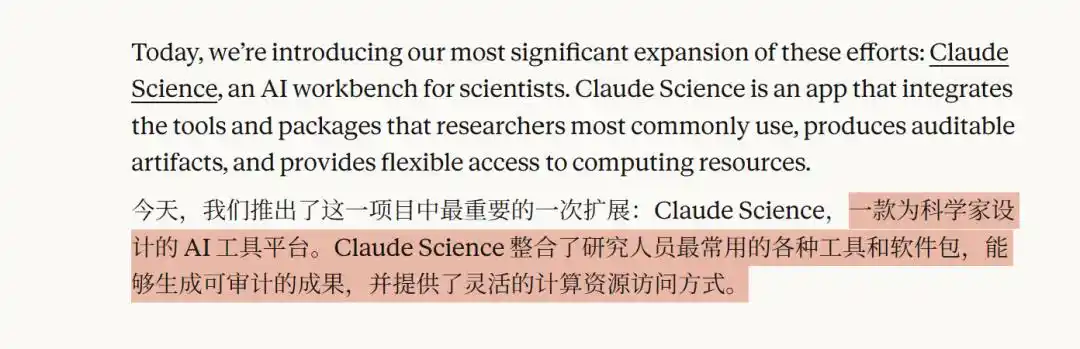
This is an AI workbench specifically for scientists, providing various tools and software packages most commonly used by researchers.
For example, previously, a researcher completing a study had to search literature on PubMed, write code in Jupyter, run statistics in R, connect to a cluster via SSH to submit tasks, and then use various tools to create charts and write papers.

Switching between a dozen windows, the mere 'transitions' between tools consumed a huge amount of energy.

What Claude Science aims to do is bundle all of this into the same workbench.

Specifically, it achieves several key integrations:

At the database and toolchain level, it comes with built-in connectors to over 60 scientific databases and pre-configured skill packages, covering common research fields like genomics, single-cell analysis, proteomics, structural biology, chemoinformatics, etc.

You ask in natural language, and specialized Agents automatically perform cross-database queries — no need to manually search databases like UniProt, PDB, Ensembl, ChEMBL, GEO one by one.

It also integrates with NVIDIA's BioNeMo Agent Toolkit, allowing direct connection to life science models like Evo 2, Boltz-2, OpenFold3.
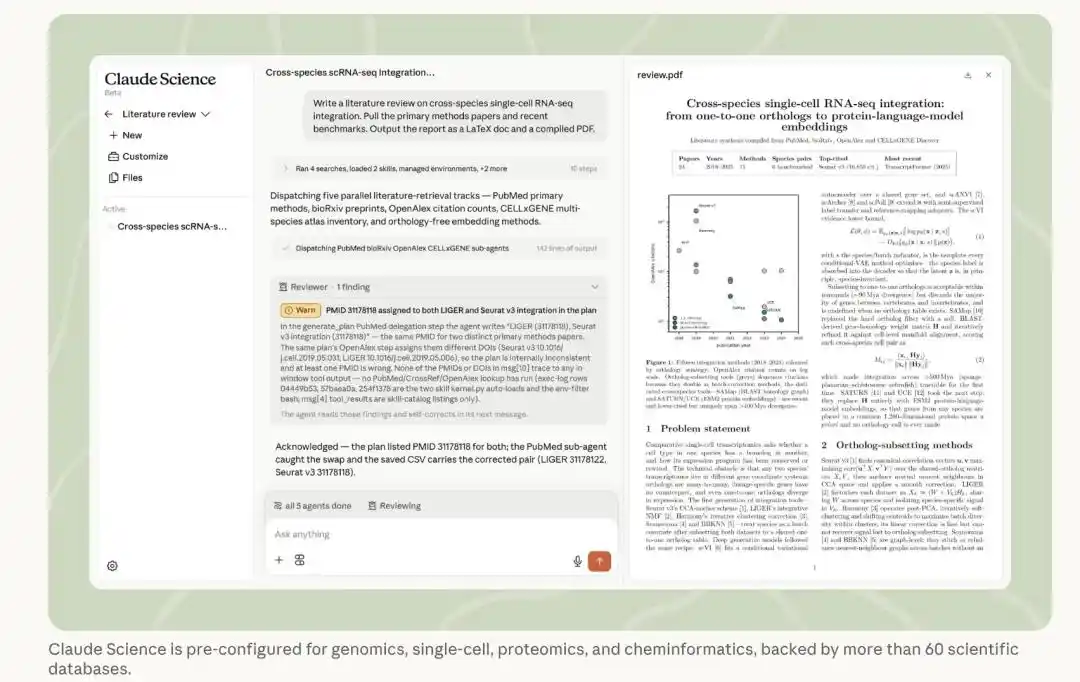
At the execution level, it introduces a multi-agent architecture.

The main Agent handles overall planning, sub-agents process different tasks in parallel, and there is a Reviewer Agent specifically responsible for fact-checking, such as verifying citations, validating calculation results, and flagging potential errors.

The generated output is not just text. It can natively render content like 3D protein structures, genome browser tracks, chemical structure formulas.

Moreover, each chart retains the generation code, runtime environment, natural language description, and complete conversation history.

In some scenarios, scientists can even modify charts with a single sentence, and the system automatically rewrites the underlying code.

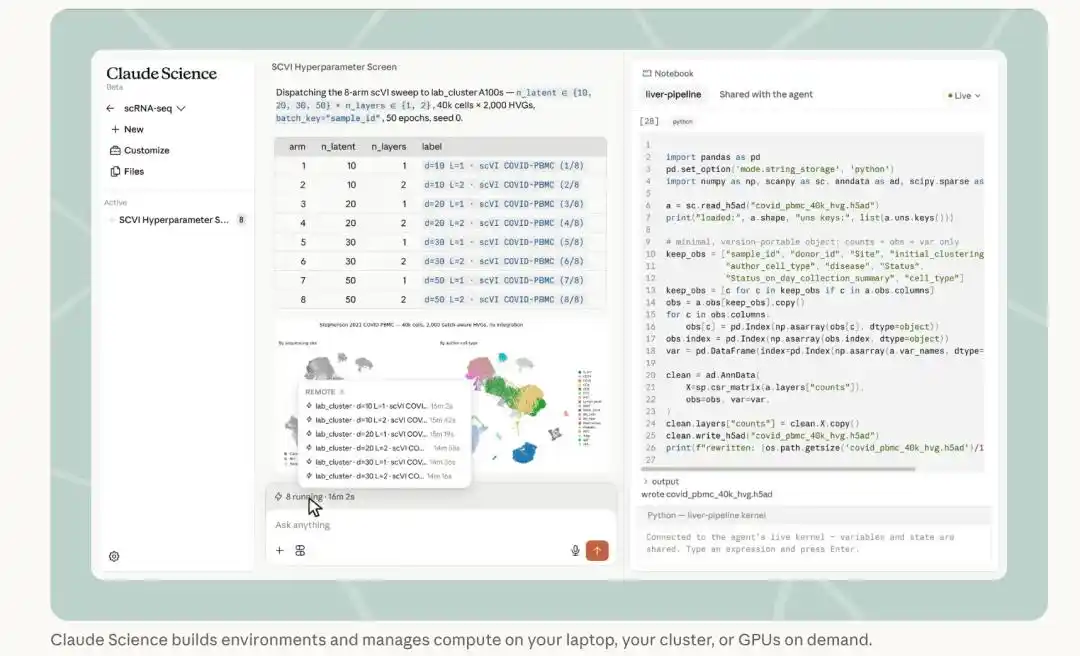
At the computing power level, Claude Science can directly interface with your lab's existing infrastructure.

Be it notebooks, Linux servers, or HPC cluster login nodes, it can connect via SSH or use a Modal account to call cloud GPUs on demand, scaling from a single GPU to hundreds.

Large-scale datasets only need to be loaded once; sensitive data never leaves your own system. Only the context needed for each step of analysis is sent to Claude.
Early beta users have already produced some practical cases.

Jerome Lecoq, a neuroscientist at the Allen Institute, used it to build a multi-agent 'computational review template' containing about 20 custom skills, letting sub-agents read thousands of papers, extract core viewpoints and quantitative data, and then generate review chapters one by one.

To put it simply, writing a review used to take two years; now he has about 10 drafts in hand —

Many exceed 100 pages, and all citations have been verified by the Reviewer Agent.

Stephen Francis from the UCSF Brain Tumor Center used it for molecular epidemiological studies of glioma, running germline variant analysis.

He said Claude Science compressed the previously required time to one-tenth, and his team independently validated the results, confirming the analysis was both fast and reliable.

Combined with the evaluation of AI research capabilities by Harvard physicist Matthew Schwartz this past March, Claude's current level is roughly equivalent to a second-year graduate student.

He published a guest post titled "Vibe Physics: The AI Grad Student" on the Anthropic official blog, documenting his entire process of using Claude Opus 4.5 to complete a theoretical physics paper.

His conclusion at the time was:

Current AI research capability is roughly equivalent to a second-year grad student — can work, doesn't complain about being tired, but needs a supervisor to monitor every step.

This assessment was later incorporated by Anthropic into the Claude Science technical documentation as a calibration point for the product's positioning.

However, Claude Science currently has several hard limitations:

Only supports macOS and Linux

Only available to Pro/Max/Team/Enterprise paying users

Only Claude's own models can be used on the platform

These thresholds stacked together, especially for domestic research teams in China, make Claude Science something "visible but out of reach."

Good News: An Open-Source Alternative is Here

Targeting the above limitations, the open-source project OpenScience emerged.

The team behind it is called Synthetic Sciences, founded in San Francisco in 2025, and just graduated from the YC Winter 2026 batch this year.

The founding team's ambition is not small: to build a platform that lets scientists directly delegate complex research tasks to "AI co-scientists," enabling AI to autonomously run the entire chain from literature review to hypothesis generation to experiment execution to paper writing.

They have an internal core belief:

Scientific foundation models need to possess genuine 'research taste,' and this taste cannot be achieved by simply scaling parameters. It must be a two-pronged approach: product and model. Use the product to collect high-quality scientific process data, then use this data to train models with taste.

OpenScience is the first product landing on this path.
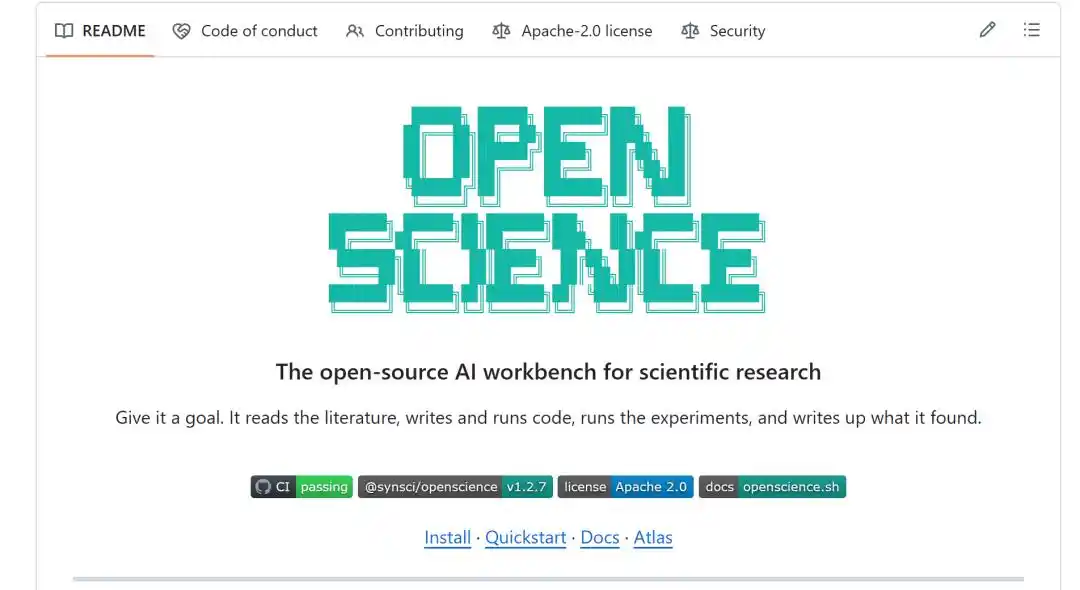
Although OpenScience's mission is the same as Claude Science's, they have a fundamental difference:

Model-agnostic.

In Synthetic Sciences' own words:

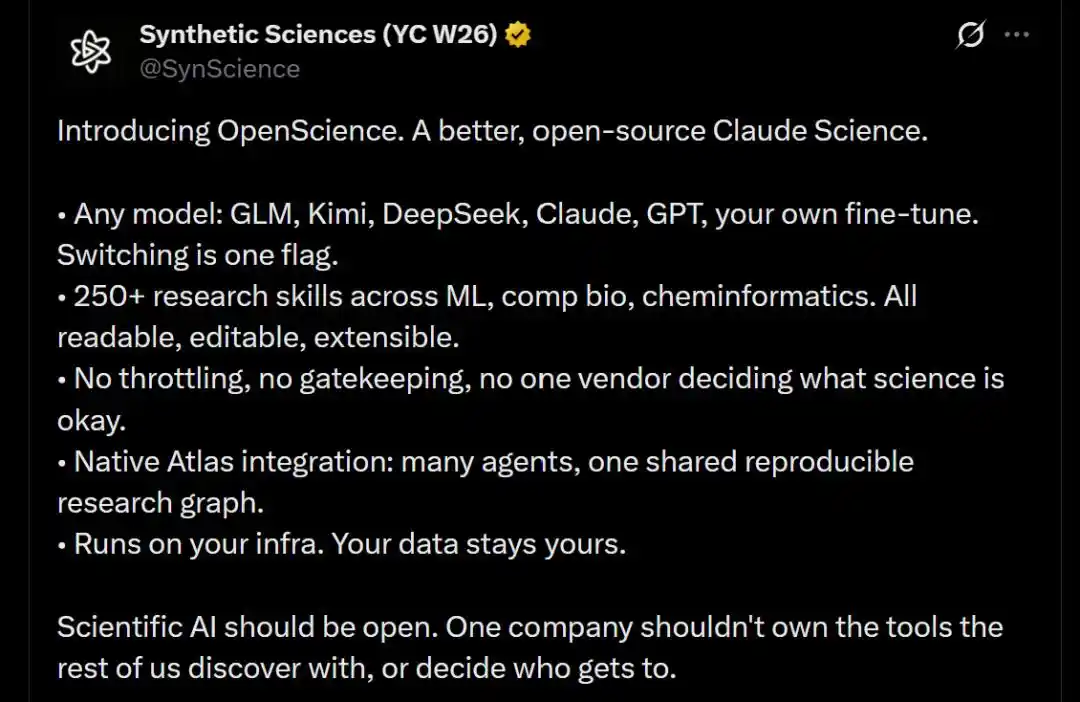
Scientific AI should be open. The tools humans use for exploration and discovery should not be monopolized by one company, nor should that company decide who is qualified to use them.

Therefore, on this platform, Anthropic, OpenAI, Google, DeepSeek, GLM... as long as you have an API Key, you can connect directly.

You can even run local models, deploy via Ollama, without a single byte of your data leaving your machine.

Your Key stays locally, requests go directly to the model provider, not passing through any intermediate server.

Moreover, OpenScience supports switching models per request.

Within the same workbench, you can use Claude for this step, then switch to DeepSeek for the next, without changing any configuration.
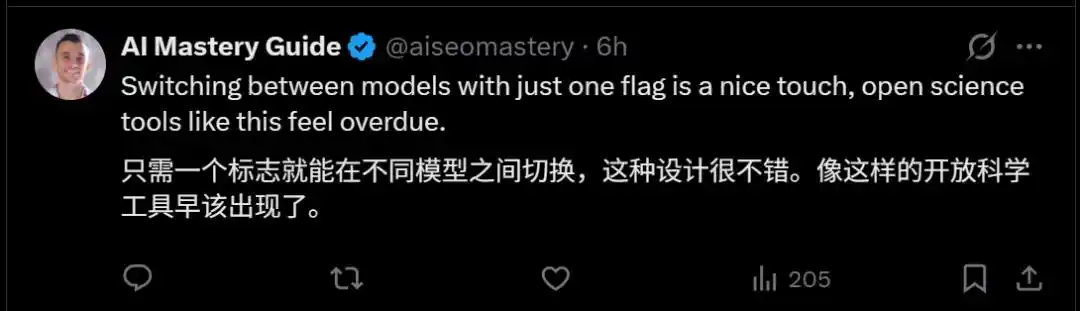
Feature-wise, OpenScience is even more aggressive than Claude Science —

Built-in with over 250 research skill packages, more than 4 times that of Claude Science, covering ML, computational biology, chemoinformatics, etc., and all are readable, editable, and extensible.
Installation is also simple, just one command in the terminal:

Open and use immediately, the workbench automatically pops up in the browser. On first run, select a model source, fill in the API Key, and you can start working.

You can also install it globally:

If configuring Keys is troublesome, the team also provides a hosted platform called Atlas —

Top up a wallet to directly call various cutting-edge models without configuring Keys one by one, plus persistent research graphs and cloud computing power.

But Atlas is not mandatory. You can use OpenScience fully for free with your own Keys, no barrier.

One More Thing

Interestingly, if you scroll to the very bottom of OpenScience's GitHub page, you'll see a statement added specifically:

OpenScience is an independent project. It is not affiliated with, endorsed by, or sponsored by Anthropic. “Claude” is a trademark of Anthropic, PBC, used here only to describe compatibility.
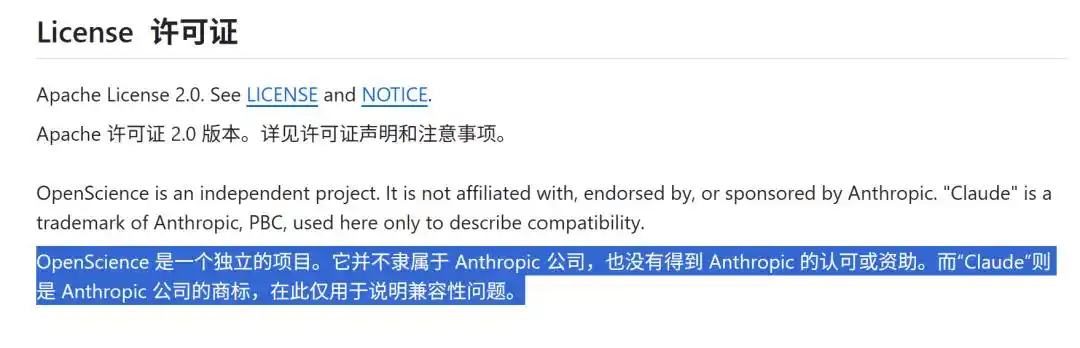
Translation: We are an independent project, with no relation to Anthropic whatsoever. Mentioning "Claude" is purely about describing compatibility, don't read too much into it.

It seems the impression left by the "lobster" incident on the entire open-source community is still too profound.

With OpenClaw changing names several times before, OpenScience this time directly welded the disclaimer onto the first version of the README.

Nothing else — survive first, then talk about being an alternative (doge).

Open-source address:

https://x.com/i/trending/2073904804829741364?s=20

Reference links:

[1]https://x.com/SynScience/status/2073829478393086311?s=20

[2]https://x.com/i/trending/2073904804829741364?s=20

[3]https://www.openscience.sh/

[4]https://www.anthropic.com/news/claude-science-ai-workbench

This article is from WeChat official account "QbitAI", author: Yi Shui

Трендовые криптовалюты

Связанные с этим вопросы

QWhat is OpenScience and how does it compare to Claude Science?

AOpenScience is an open-source AI scientific research workbench that serves as a free alternative to Anthropic's Claude Science. Unlike Claude Science, which is proprietary and limited to Claude models for paid users, OpenScience is model-agnostic, allowing users to freely choose and switch between various AI models like DeepSeek, GLM, Claude, or GPT via API keys or local deployments. It is released under the Apache 2.0 license and offers more than 250 research skill packages, significantly more than Claude Science's 60+.

QWhat are the key limitations of Claude Science mentioned in the article?

AClaude Science has several key limitations: 1) It only supports macOS and Linux operating systems. 2) It is exclusively available to Pro, Max, Team, and Enterprise paying users. 3) Users are restricted to using only Anthropic's proprietary Claude models on the platform. These restrictions, especially the payment requirement and model lock-in, make it inaccessible to many researchers, particularly in certain regions.

QHow does OpenScience address data privacy and local deployment?

AOpenScience prioritizes data privacy and flexibility by supporting local model deployment. Users can run models locally using tools like Ollama, ensuring that sensitive research data never leaves their own machines. API keys are also stored locally, and requests are sent directly to the model provider without passing through any intermediate servers, giving researchers full control over their data and computational environment.

QWhat was the early user feedback on Claude Science's capabilities?

AEarly internal testers reported positive results. A neuroscientist at the Allen Institute used Claude Science to create a multi-agent computational review template, enabling the generation of lengthy, citation-verified review papers in a fraction of the traditional time (e.g., producing ~10 papers over 100 pages each that previously would have taken years). A researcher at UCSF's Brain Tumor Center used it for molecular epidemiology studies, reducing the required time for germline variant analysis to one-tenth while maintaining result accuracy verified by his team.

QWhat is the stated long-term vision of the Synthetic Sciences team behind OpenScience?

AThe Synthetic Sciences team aims to build a platform where scientists can delegate complex research tasks to 'AI co-scientists' that autonomously handle the entire research pipeline from literature review to hypothesis generation, experiment execution, and paper writing. They believe that truly capable scientific foundation models require 'research taste,' which cannot be achieved by merely scaling model parameters. Instead, it requires a product-model co-development approach, where the product collects high-quality research process data to train models with genuine scientific intuition.

Похожее

Полный последний макроанализ Рэя Далио: купить больше золота и немного биткойна

В своей последней макроэкономической статье Рэй Далио анализирует долговую динамику государств, используя модель «большого цикла». Он описывает признаки надвигающегося долгового кризиса: рост расходов на обслуживание долга, дисбаланс между спросом и предложением гособлигаций, вынужденное смягчение денежно-кредитной политики и монетизацию долга. Далио отмечает, что США столкнутся с серьёзными проблемами из-за крупного дефицита бюджета и высокого уровня госдолга, а также предупреждает о рисках для Японии, Великобритании, ЕС и Китая. В качестве стратегии выхода он предлагает сократить дефицит бюджета до 3% ВВП за счёт баланса между сокращением расходов, увеличением налогов и снижением процентных ставок. Для инвесторов он рекомендует диверсифицировать портфель, сократить долю облигаций, а также добавить в него золото и небольшое количество биткоина в качестве защиты от обесценивания фиатных валют.

marsbit4 мин. назад

Полный последний макроанализ Рэя Далио: купить больше золота и немного биткойна

marsbit4 мин. назад

Попытки главы Минфина США обуздать доходность казначейских облигаций разожгли «валютные девальвационные сделки»! Золото достигло трёхмесячного максимума, биткоин за неделю взлетел более чем на 25%

Министр финансов США Джанет Йеллен предприняла попытку сдержать рост доходности долгосрочных казначейских облигаций, однако этот эффект оказался кратковременным. Вместо этого её действия спровоцировали ослабление доллара и резкий рост цен на золото и биткоин, что усилило логику торговли на обесценивание валюты. Основными драйверами этой динамики стали растущий дефицит бюджета США и структурное давление на долгосрочные процентные ставки, вызванное масштабными государственными заимствованиями и огромным спросом на капитал со стороны компаний, особенно в сфере ИИ. Биткоин за неделю вырос более чем на 25%, достигнув $78 000, а золото обновило трёхмесячный максимум. Корреляция между биткоином и золотом находится на самом высоком уровне со времён пандемии, укрепляя восприятие криптовалюты как инструмента хеджирования. Эксперты отмечают, что действия Казначейства могут повлиять на ликвидность, но не способны подавить фундаментальные факторы, такие как инфляция и спрос на капитал. Рэй Далио из Bridgewater рекомендовал инвесторам сокращать вложения в облигации и увеличивать долю золота и биткоина на фоне рисков долгового кризиса. Хотя повествование о торговле на обесценивание привлекательно, некоторые аналитики сомневаются в устойчивости текущего роста, указывая на отсутствие новых катализаторов. Внимание рынка теперь приковано к отчёту Nvidia и предстоящему симпозиуму в Джексон-Хоуле, где станет ясно, смогут ли прибыли компаний ИИ продолжать поддерживать рынки и будут ли действия ФРС согласованы с желанием Вашингтона сохранять низкие процентные ставки.

华尔街日报2 ч. назад

Попытки главы Минфина США обуздать доходность казначейских облигаций разожгли «валютные девальвационные сделки»! Золото достигло трёхмесячного максимума, биткоин за неделю взлетел более чем на 25%

华尔街日报2 ч. назад

Александр Шохин: бизнесу нужна ставка ниже 10% и доллар на уровне 90–95 рублей

Глава Российского союза промышленников и предпринимателей Александр Шохин вновь высказался за возможное использование "нерыночных" инструментов для удержания курса рубля в заданном коридоре, чтобы избежать чрезмерной волатильности. Ранее он уже отмечал, что текущий курс сложно назвать полностью рыночным. Шохин обозначил целевые ориентиры для бизнеса к концу 2026 года: ключевая ставка Банка России на уровне 12%, инфляция 4-5% и курс доллара в районе 90-95 рублей. При этом комфортным для инвестиций бизнес видит снижение ставки ниже 10%. Он подчеркивает прямую связь между стабильностью валюты, уровнем ставки, инфляцией и готовностью компаний инвестировать в новые проекты. Исторически валютный коридор в России уже применялся в 1995-1998 годах, но его удержание требовало значительных резервов и завершилось резким расширением границ во время кризиса. Вопрос о конкретных механизмах и источниках интервенций для поддержания такого коридора в текущих условиях остается открытым.

cryptonews.ru4 ч. назад

Александр Шохин: бизнесу нужна ставка ниже 10% и доллар на уровне 90–95 рублей

cryptonews.ru4 ч. назад

Поезд к Биткоину уже ушёл со станции? Пользовательский индикатор перестал подавать сигналы!

Рост цены биткоина вывел индикатор AHR999 из зоны «покупки на спаде» (значение ниже 0,45), где он находился примерно 82 дня — с 29 мая по 19 августа. После недавнего повышения стоимости BTC индикатор достиг отметки 0,5073 и вернулся в зону средней долларовой стоимости (DCA), которая находится в диапазоне от 0,45 до 1,20 и считается областью для устойчивых покупок. Индикатор AHR999 помогает долгосрочным инвесторам, использующим стратегию постепенного накопления, оценивать относительную дешевизну или дороговизну рынка, анализируя краткосрочную доходность и отклонение цены от расчетной стоимости. Исторически значения ниже 0,45 интерпретируются как «покупка на спаде», от 0,45 до 1,20 — как зона для планомерных покупок, а выше 1,20 — как область относительно высокой цены. При этом индикатор не является прямым сигналом к действиям на рынке.

cryptonews.ru4 ч. назад

Поезд к Биткоину уже ушёл со станции? Пользовательский индикатор перестал подавать сигналы!

cryptonews.ru4 ч. назад

Торговля

Спот

Популярные статьи

Как купить GLM

Добро пожаловать на HTX.com! Мы сделали приобретение Golem (GLM) простым и удобным. Следуйте нашему пошаговому руководству и отправляйтесь в свое крипто-путешествие.Шаг 1: Создайте аккаунт на HTXИспользуйте свой адрес электронной почты или номер телефона, чтобы зарегистрироваться и бесплатно создать аккаунт на HTX. Пройдите удобную регистрацию и откройте для себя весь функционал.Создать аккаунтШаг 2: Перейдите в Купить криптовалюту и выберите свой способ оплатыКредитная/Дебетовая Карта: Используйте свою карту Visa или Mastercard для мгновенной покупки Golem (GLM).Баланс: Используйте средства с баланса вашего аккаунта HTX для простой торговли.Третьи Лица: Мы добавили популярные способы оплаты, такие как Google Pay и Apple Pay, для повышения удобства.P2P: Торгуйте напрямую с другими пользователями на HTX.Внебиржевая Торговля (OTC): Мы предлагаем индивидуальные услуги и конкурентоспособные обменные курсы для трейдеров.Шаг 3: Хранение Golem (GLM)После приобретения вами Golem (GLM) храните их в своем аккаунте на HTX. В качестве альтернативы вы можете отправить их куда-либо с помощью перевода в блокчейне или использовать для торговли с другими криптовалютами.Шаг 4: Торговля Golem (GLM)С легкостью торгуйте Golem (GLM) на спотовом рынке HTX. Просто зайдите в свой аккаунт, выберите торговую пару, совершайте сделки и следите за ними в режиме реального времени. Мы предлагаем удобный интерфейс как для начинающих, так и для опытных трейдеров.

401 просмотров всегоОпубликовано 2024.05.07Обновлено 2026.06.02

Как купить GLM

Обсуждения

Добро пожаловать в Сообщество HTX. Здесь вы сможете быть в курсе последних новостей о развитии платформы и получить доступ к профессиональной аналитической информации о рынке. Мнения пользователей о цене на GLM (GLM) представлены ниже.

活动图片