Tron traders on alert! THIS make-or-break level will decide TRX’s next move

ambcryptoPublished on 2026-06-26Last updated on 2026-06-26

Abstract

Tron (TRX) traders are watching a key support level as the cryptocurrency, which has gained 13.44% year-to-date, approaches a potential turning point. The asset is testing a crucial support zone between $0.318 and $0.320, a level that has previously initiated two rallies. A bounce from this support, followed by a close above $0.334, could propel TRX toward $0.353 and $0.377. Conversely, a break below $0.310 would signal a bearish shift, indicating a steeper decline. While the chart shows fading momentum into support, technical indicators offer a more bullish perspective. Bollinger Band analysis suggests the middle band has held as support on recent touches, and the Money Flow Index reading of 65 indicates continued capital inflow. The immediate price action at this make-or-break support level will determine TRX's next significant move.

While most major cryptocurrencies have suffered significant outflows this year, Tron [TRX] has held a largely bullish posture—the asset has booked a 13.44% gain year-to-date, and that resilience is now about to be tested.

TRX is approaching a decisive level on its price chart, and how it reacts there will determine whether it holds its place among the year’s bullish performers or breaks down into a far steeper decline.

TRX nears the support level that defines its trend

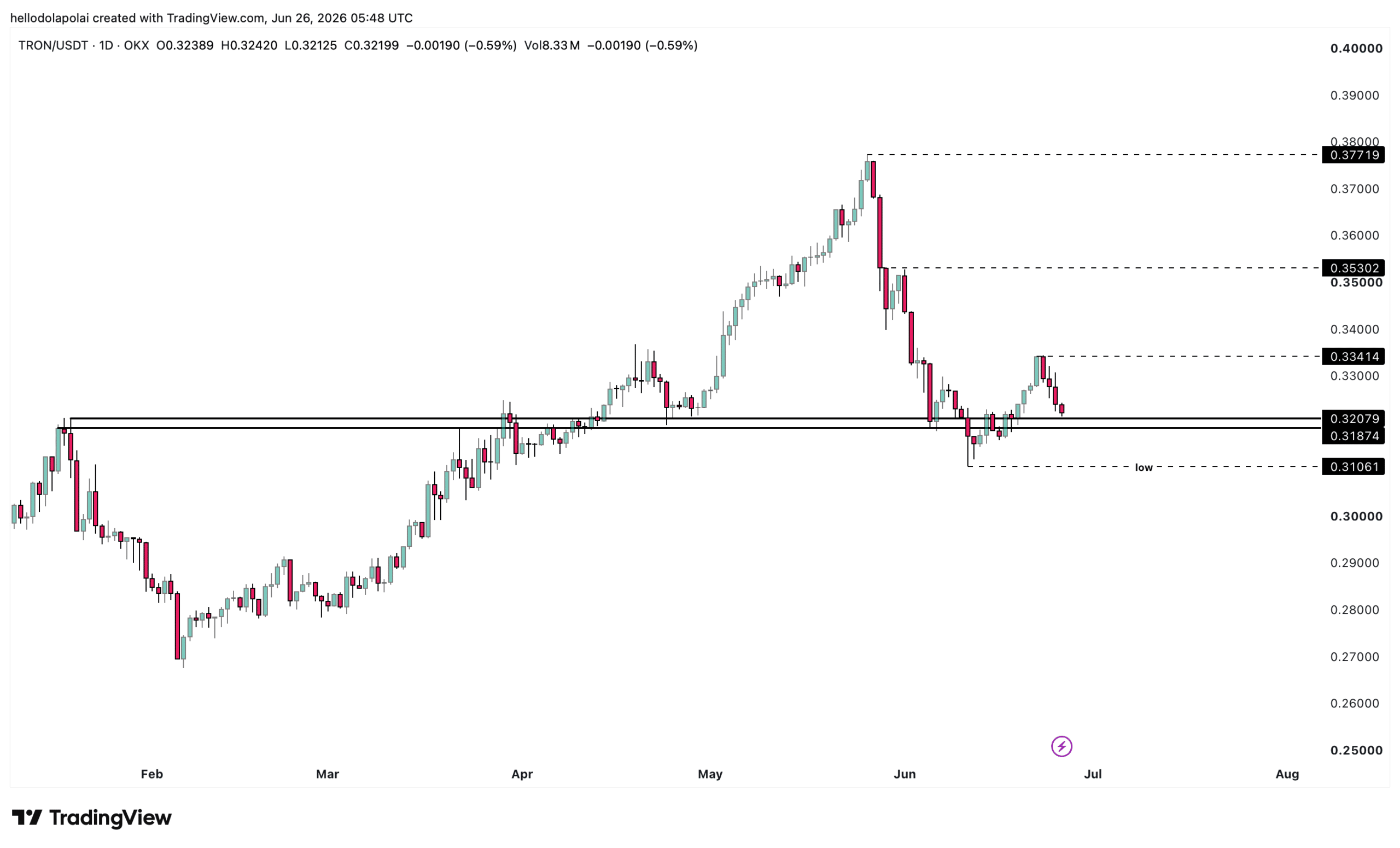
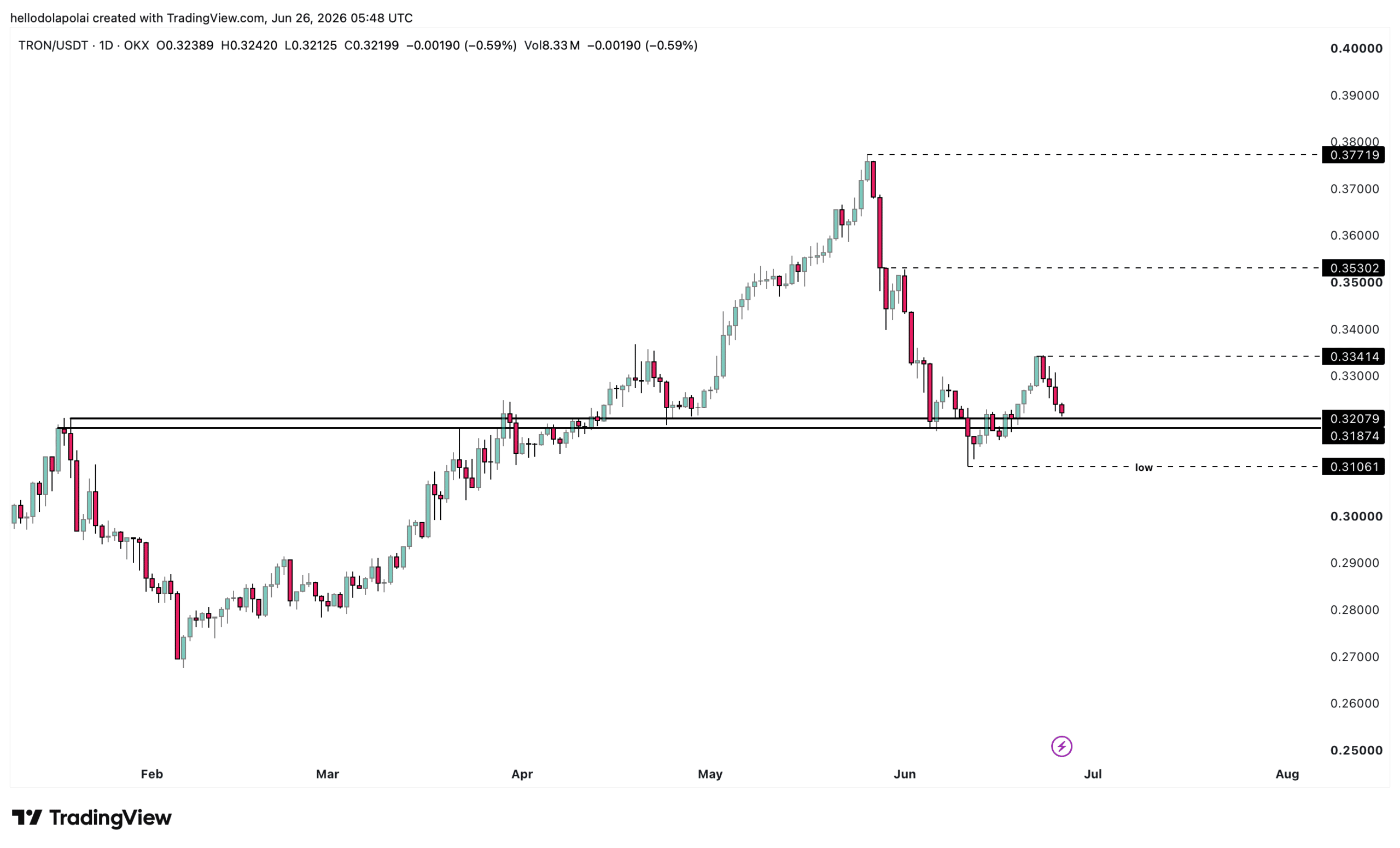
Chart analysis shows TRX bearing down on a key support level that will decide whether the asset can sustain its run. The token has shed 2% over the past day as it edges closer to that line.

This level has anchored two separate rallies, though the gains thinned noticeably as price ground back into support on the second attempt. Fading momentum into a level of this kind often signals that buying pressure there is weakening.
Source: TradingView

At the time of writing, the support sits between $0.318 and $0.320. Two scenarios flow from this chart pattern and frame the near-term bull and bear cases.

A bounce off support, a candle close above $0.334, and follow-through trade above it would confirm that bulls hold the upper hand, opening the path toward $0.353 and $0.377. A drop beneath $0.310—the marked low—would carve out a lower low and point to TRX extending its losses further.

TRX indicators lean bullish against the chart’s caution

The indicators paint a slightly different picture from the one the chart suggests.

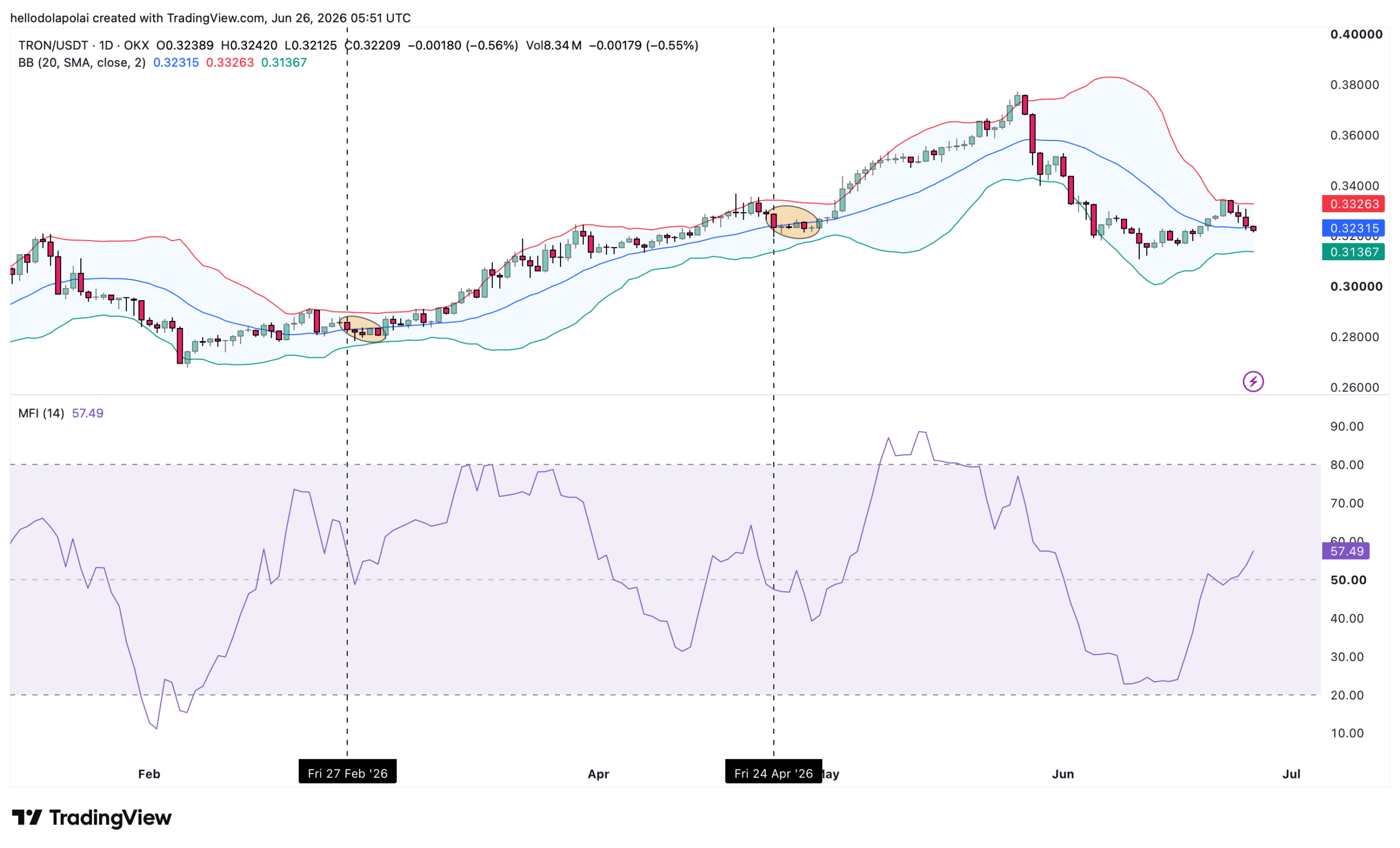
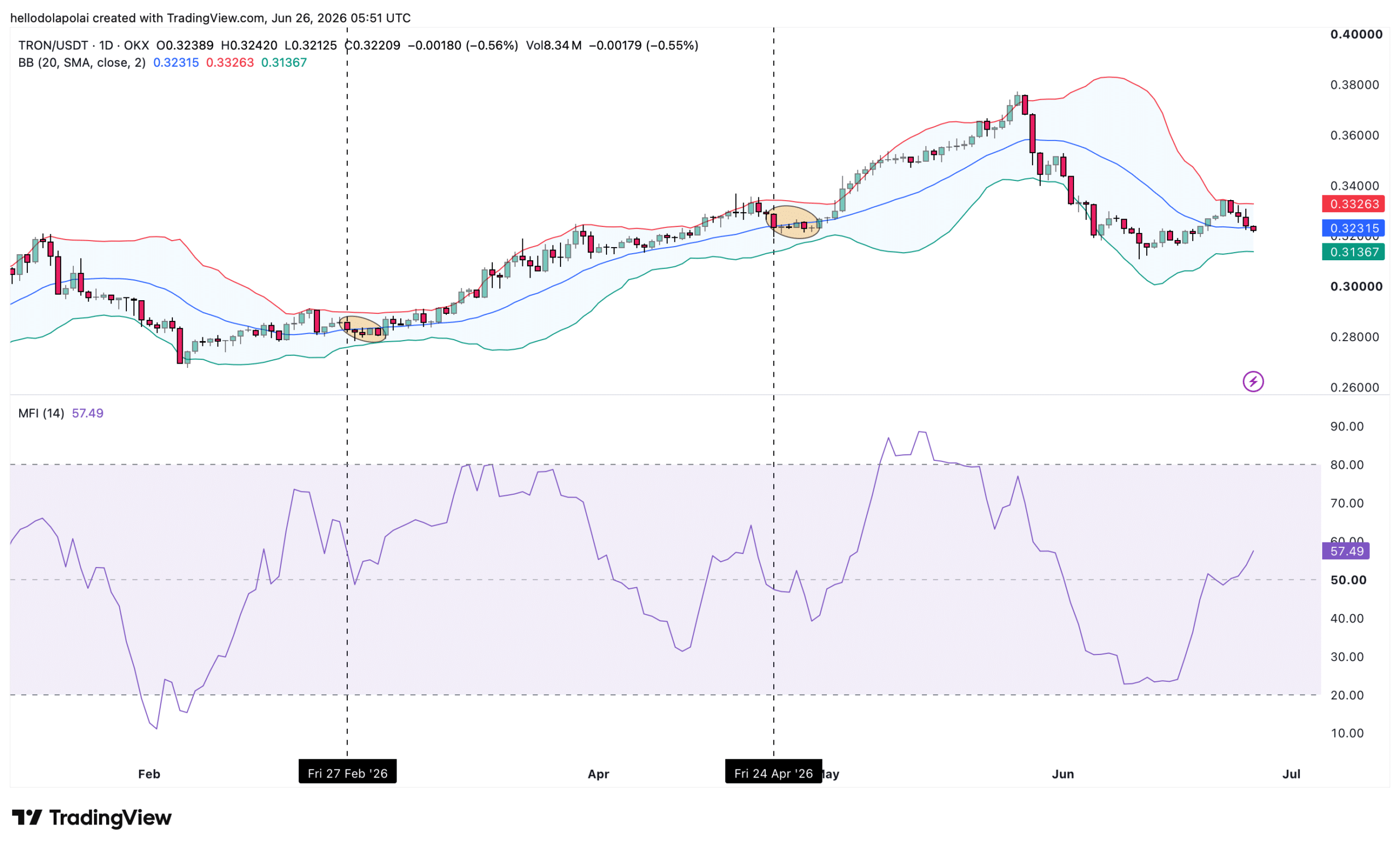
Bollinger Band analysis points to price settling at its present level and attempting a move higher, provided the middle band (marked in blue) holds as support.
Source: TradingView

The middle band has done exactly that on the last two occasions the price dropped to it—and, notably, both touches landed on Fridays roughly two months apart, on the 27th of February and the 24th of April.

Now, at the time of writing, it is the 26th of June, another Friday.

There is no guarantee the fractal holds, but the Bollinger Band frames the worst case as a slide to $0.313. The Money Flow Index, which tracks capital moving into and out of an asset, reinforces the bullish read.

The MFI has kept climbing, with a current reading of 65 that sits firmly in the bullish zone (50–80), a sign that capital is flowing in and supporting the bullish case already in motion, and that the asset is likely to stay on that path.


Final Summary

  • TRX is holding just above a $0.318–$0.320 support zone that has sparked two rallies this year, and the reaction there decides whether its gains survive.
  • Momentum still leans bullish as capital flows in, but a break below $0.310 would flip the outlook bearish.


Trending Cryptos

Related Questions

QWhat is the critical support level that TRX is approaching, according to the article?

ATRX is approaching the critical support level between $0.318 and $0.320.

QWhat are the two possible price scenarios outlined for TRX based on its reaction to the support level?

AThe two scenarios are: 1) A bounce off support, a close above $0.334, and a move higher targeting $0.353 and $0.377. 2) A drop below $0.310, which would signal a lower low and extend losses.

QWhat bullish signal does the Money Flow Index (MFI) provide for TRX in the article?

AThe Money Flow Index has a reading of 65, which is in the bullish zone (50–80), indicating that capital is flowing into TRX and supporting the bullish case.

QAccording to the Bollinger Band analysis, what is the worst-case price target mentioned if TRX breaks down?

AAccording to the Bollinger Band analysis, the worst-case scenario is a slide down to $0.313.

QHow has Tron (TRX) performed year-to-date compared to other major cryptocurrencies, as stated in the article?

ATron (TRX) has gained 13.44% year-to-date, showing resilience while most other major cryptocurrencies have suffered significant outflows.

Related Reads

In the AI Era, What's Left for Bitcoin?

As Bitcoin falls below $60,000, the author reflects on the relationship between AI and Bitcoin, seeing them as two sides of the same coin. In the AI era, the cost of generating content has plummeted, making fake text, images, and videos increasingly easy and cheap to produce. This has led to a fundamental shift: while AI dramatically lowers the cost of information production, it also undermines trust and authenticity online. What becomes truly valuable is not more content, but the ability to verify what is real—"verifiability." This perspective offers a new lens for Bitcoin. Its massive energy consumption, often criticized as wasteful, is reinterpreted. While AI burns energy to enhance "capability" and efficiency, Bitcoin burns energy to produce "verifiability." Its purpose is not to be trusted but to enable a system where no trust in intermediaries—banks, platforms, or developers—is needed. Every transaction and the entire ledger's history is secured by cryptography and a decentralized network of nodes, making it independently verifiable. AI cannot forge a transaction on the Bitcoin network because the system is designed for proof, not generation. The author draws a historical parallel to the Renaissance: the printing press drastically reduced the cost of copying knowledge, while double-entry bookkeeping reduced the cost of trust in commerce. Today, AI is the new printing press, reducing content creation costs to near zero. Blockchain, and Bitcoin as its pioneer, may be the modern equivalent of double-entry bookkeeping—a foundational technology for verifying digital asset ownership and historical records without centralized authorities. Thus, AI and blockchain are not competitors. AI lowers the cost of creation; blockchain lowers the cost of verification. In an age where AI can generate anything, true scarcity may lie not in more content, but in independently verifiable facts. Whether the market will reprice Bitcoin accordingly remains uncertain, but its core value proposition as a "machine for producing verifiability" becomes strikingly relevant.

marsbit37m ago

In the AI Era, What's Left for Bitcoin?

marsbit37m ago

In the Age of AI, What's Left for Bitcoin?

Author: Sevclub, Seven Research Amid Bitcoin's recent drop below $60k, the author reflects on a growing sense that AI and Bitcoin are two sides of the same coin. Today, encountering any content triggers a new default question: "Was this made by AI?" The cost of generating convincing text, images, and video is now negligible. While the internet lowered information *distribution* costs, AI is crashing information *production* costs to near zero. The consequence is a flood of content where truth and falsehood are increasingly indistinguishable. In this environment, what becomes truly valuable is not more information, but the ability to verify what is real—"verifiability." This reframes the common criticism that Bitcoin "wastes electricity." AI consumes power to produce "capability" (e.g., more powerful models). Bitcoin consumes power to produce something else: "verifiability." Bitcoin's core purpose isn't about belief or trust in any institution, developer, or even its creator. It's about enabling independent verification. Every bitcoin's origin, every transaction, and the integrity of the entire ledger are secured by mathematics, cryptography, and a global network of nodes. AI can fabricate convincing media, but it cannot falsify a transaction on the Bitcoin network. The expended energy makes篡改历史 (tampering with history) prohibitively expensive, purchasing a globally verifiable ledger. The author draws a historical parallel to the Renaissance. The printing press drastically reduced the cost of copying knowledge, while double-entry bookkeeping reduced the cost of trust in commerce—one enabled creation, the other verification. Today, AI is the new printing press, driving content production costs toward zero. The question becomes: what is this era's "double-entry bookkeeping"? Blockchain appears to be the leading candidate. It doesn't verify which news is true or which image is real, but it provides a foundational layer for independently verifying asset ownership and historical records in the digital realm without centralized authorities. Therefore, AI and blockchain are not in competition. AI lowers the cost of *generation*. Blockchain (and Bitcoin as a prime example) lowers the cost of *verification*. One creates, the other proves. Whether Bitcoin ultimately succeeds remains uncertain, facing potential challenges from quantum computing, regulation, and technical evolution. However, the author now sees it less as a "machine for making bitcoin" and more as a "machine for making verifiability." In an age where AI can generate anything, true scarcity may no longer be "more content," but "more independently verifiable facts." Whether the market will price this accordingly is a separate question.

链捕手46m ago

In the Age of AI, What's Left for Bitcoin?

链捕手46m ago

Trading

Spot

Hot Articles

Discussions

Welcome to the HTX Community. Here, you can stay informed about the latest platform developments and gain access to professional market insights. Users' opinions on the price of S (S) are presented below.

活动图片