Cardano’s ‘ghost chain’ label debunked? Why ADA’s 34 dApps don’t tell the full story

ambcryptoPublished on 2026-06-30Last updated on 2026-06-30

Abstract

The article examines and refutes the "ghost chain" label sometimes applied to Cardano (ADA). While Cardano has significantly fewer dApps and lower transaction/user counts compared to leading Layer 1 chains like Ethereum and Solana, this is partly due to its unique Extended Unspent Transaction Output (EUTXO) model. This model batches transactions, improving security and determinism but potentially underrepresenting true on-chain activity. The piece acknowledges recent ecosystem challenges but highlights Cardano's strong development activity and its distinct focus on peer-reviewed research, security, and sustainability for institutional use. It concludes that while various chains occupy different niches, low activity metrics alone are insufficient to deem Cardano a "ghost chain."

A ghost chain is a blockchain that is technically running but has very little on-chain activity and development activity.

Over the past decade, there have been many shiny new blockchains that have burst onto the scene. They managed to capture the public’s attention, attracting capital inflows, but have fizzled away eventually.

This fizzle can be due to a lack of funding, community conviction, or the failure to address real issues.

A decline in upgrades and communication regarding the future vision, a failure to keep hold of the influx of initial users due to questionable utility, or a security mishap that leads to a significant loss due to hacks and exploits can devastate investor sentiment.

Compounded over time, a steady decline in usage and trading volume can see a functional chain that is hardly being used at scale.

The chains that have stood the test of time are the ones high up in the crypto assets list. None of the dozens of so-called Ethereum killers that seized the public imagination have managed to knock Ethereum off its pedestal in the crypto ecosystem.

A closer look at the current top Layer 1 tokens

Owing to its reliability and security, and combined with Layer-2 solutions that address speed, Ethereum is the dominant base layer blockchain. It dominates the DeFi sectors due to liquidity and security and also processes over half of all stablecoin activity.

XRP is optimized to be a cross-border settlement layer by using its On-Demand Liquidity network to convert fiat into XRP, send it globally, and convert it back to fiat within seconds.

Solana has exceptional throughput and is a hub for trading. Low-cost, high-speed settlements mean that Solana is a leader in real-world asset tokenization.

TRON is the primary Tether [USDT] settlement layer, with over 75% of USDT transfers occurring on this network. TRON’s high throughput also makes it a highly active DeFi chain by transaction volume.

And of course, the Bitcoin network has the strongest security among them all. The asset itself is primarily used as a store of value and a hedge against inflation and also acts as institutional-grade collateral.

Cardano has a more unique role in the crypto ecosystem. Its focus is on sustainability, security, and rigorous, peer-reviewed development methodology. As a result, it is well-suited for institutional compliance and enterprise requirements.

Factors critics point at to throw “ghost chain” shade at Cardano

Earlier in June, TapTools, the Cardano ecosystem’s primary blockchain explorer, began shutting down. The exit of senior executives took valuable technical know-how away.

This knowledge could not be replaced quickly enough to allow the platform to continue to be operated responsibly. It was worrisome.

Founder Charles Hoskinson warned that more dApps and DeFi on Cardano would die in the second half of the year. Treasury and community governance systems were unable to react fast enough to help save struggling projects.

Amid worsening market sentiment, the pressure on smaller projects with limited revenue could add to the concerns swirling around the Cardano ecosystem.
Source: Santiment

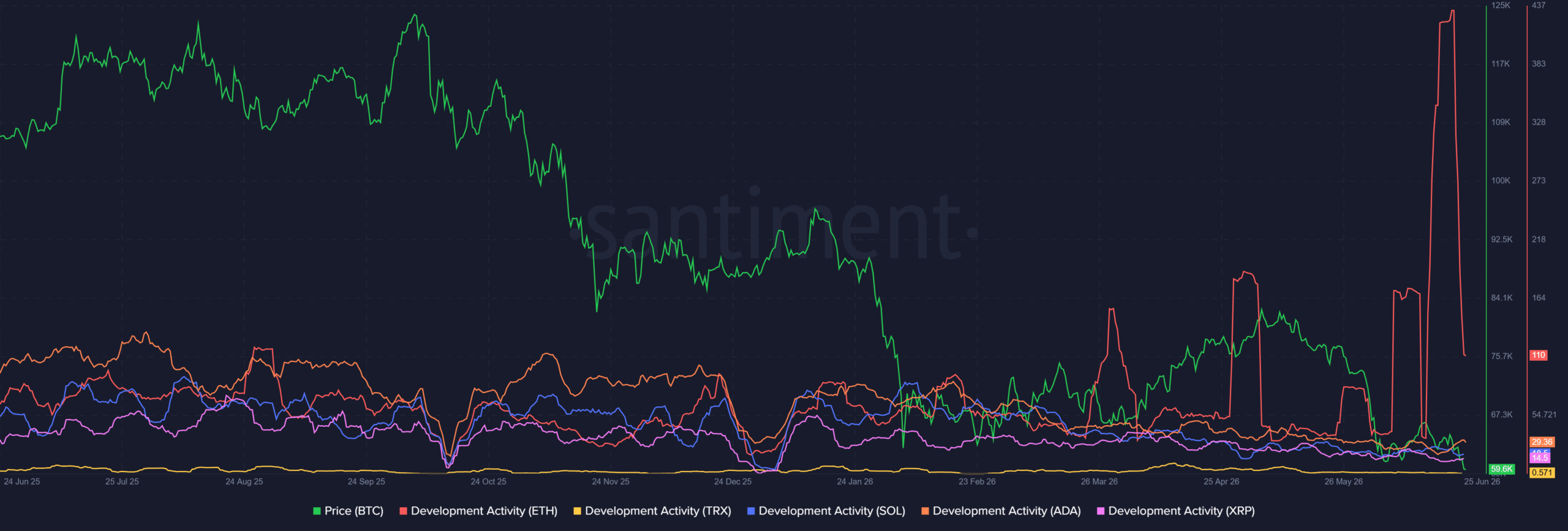
On the bright side, the developmental activity statistics for Cardano were strong. Santiment data showed that it was only second on the list of the prominent Layer 1 networks discussed earlier, in terms of developmental activity.

Yet, Cardano has far fewer dApps, numbering only 34, compared to Solana’s 442 and Ethereum’s 1564, according to blockchain data platform Moralis.
Source: Token Terminal

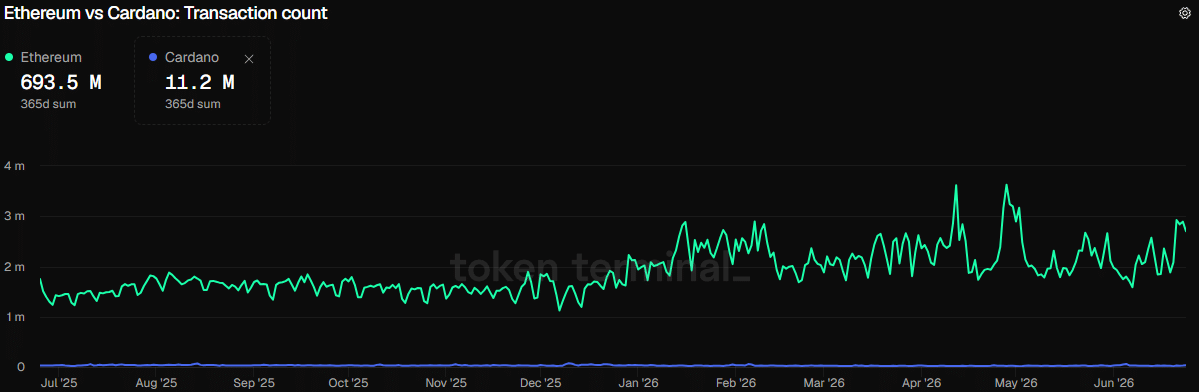
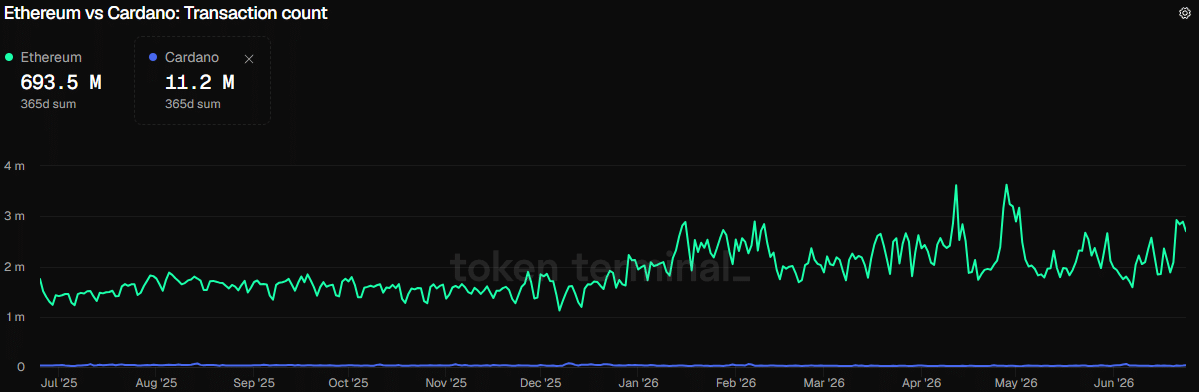
Yet, the transaction count comparison between Ethereum and Cardano showed a massive gulf. Solana was one of the leaders on this front, with 103.2 billion transactions over the past year, according to Token Terminal data.
Source: Token Terminal

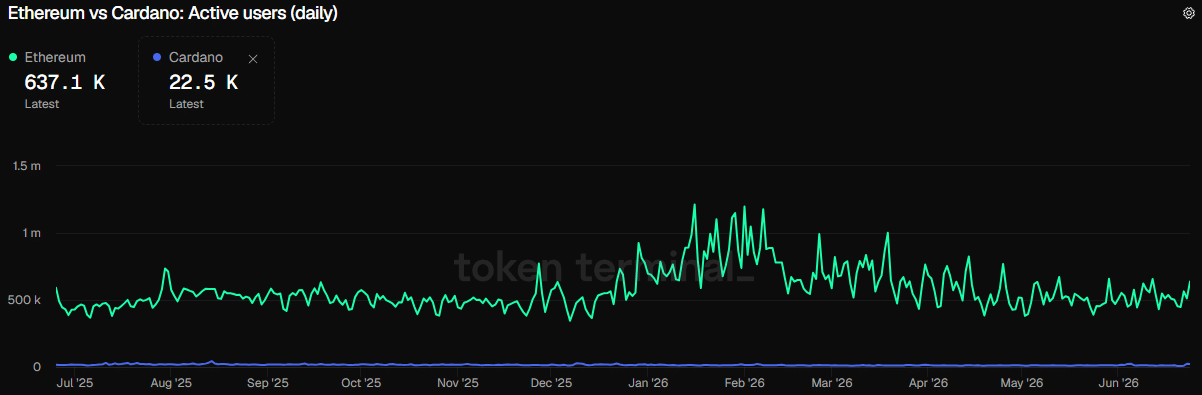
Similarly, the daily active users also showcased a giant gap in the numbers on the two chains. On this front, TRON was the winner, with 3.9 million active users, much higher even than Ethereum.

Explaining the vast gulf between Cardano and the other leading blockchains

While the extreme difference in on-chain activity can be alarming at first, it is not reason enough to conclude Cardano is a ghost chain. The network uses an Extended Unspent Transaction Output (EUTXO) model.

Batcher protocols scoop up the open orders on the blockchain, aggregating them into an optimized transaction that can be submitted to the Cardano ledger.

Effectively, the difference of a factor of 50 that we saw in a couple of metrics examined can be explained by the EUTXO model. Batching capabilities of the network offer advantages in determinism and security, but also underestimate on-chain activity.

In the past, blockchains that failed to fill a niche and dominate a segment of the market have withered away. The established survivors were doing relatively well, but it remains to be seen if they can keep their status in the years to come.


Final Summary

  • The blockchain trilemma means that various Layer 1s have to make their own tradeoffs. The dominant chains have managed to seize a niche for themselves.
  • The Cardano network activity was much lower than its peers, but this alone was not reason enough for critics to brand it a “ghost chain.”


Trending Cryptos

Related Questions

QWhat is a 'ghost chain' as defined in the article, and which blockchain is accused of potentially being one?

AA 'ghost chain' is defined as a blockchain that is technically running but has very little on-chain activity and development activity. The article discusses whether the label of a 'ghost chain' is justified for Cardano (ADA).

QAccording to the article, what are some of the key factors that have led critics to label Cardano a 'ghost chain'?

ACritics point to factors such as the shutdown of TapTools (Cardano's primary blockchain explorer), the warning from founder Charles Hoskinson about more dApps and DeFi projects potentially dying, and key metrics like Cardano having only 34 dApps compared to hundreds or thousands on other chains, as well as significantly lower transaction counts and daily active users.

QHow does the article explain the vast difference in on-chain activity metrics between Cardano and other leading blockchains like Ethereum and Solana?

AThe article explains the difference by citing Cardano's use of the Extended Unspent Transaction Output (EUTXO) model. Batcher protocols on Cardano aggregate multiple orders into single, optimized transactions for the ledger. This batching capability offers advantages in determinism and security but leads to an underestimation of on-chain activity when compared to simpler transaction counting on other networks.

QWhat is Cardano's stated unique role or focus in the crypto ecosystem, according to the article?

ACardano's focus is on sustainability, security, and a rigorous, peer-reviewed development methodology. As a result, it is described as being well-suited for institutional compliance and enterprise requirements.

QDespite the criticism, what positive metric for Cardano is highlighted in the article?

AThe article highlights that Cardano's developmental activity statistics are strong. Data from Santiment showed that Cardano ranked second only to Ethereum among the prominent Layer 1 networks discussed, in terms of developmental activity.

Related Reads

In the AI Era, What's Left for Bitcoin?

As Bitcoin falls below $60,000, the author reflects on the relationship between AI and Bitcoin, seeing them as two sides of the same coin. In the AI era, the cost of generating content has plummeted, making fake text, images, and videos increasingly easy and cheap to produce. This has led to a fundamental shift: while AI dramatically lowers the cost of information production, it also undermines trust and authenticity online. What becomes truly valuable is not more content, but the ability to verify what is real—"verifiability." This perspective offers a new lens for Bitcoin. Its massive energy consumption, often criticized as wasteful, is reinterpreted. While AI burns energy to enhance "capability" and efficiency, Bitcoin burns energy to produce "verifiability." Its purpose is not to be trusted but to enable a system where no trust in intermediaries—banks, platforms, or developers—is needed. Every transaction and the entire ledger's history is secured by cryptography and a decentralized network of nodes, making it independently verifiable. AI cannot forge a transaction on the Bitcoin network because the system is designed for proof, not generation. The author draws a historical parallel to the Renaissance: the printing press drastically reduced the cost of copying knowledge, while double-entry bookkeeping reduced the cost of trust in commerce. Today, AI is the new printing press, reducing content creation costs to near zero. Blockchain, and Bitcoin as its pioneer, may be the modern equivalent of double-entry bookkeeping—a foundational technology for verifying digital asset ownership and historical records without centralized authorities. Thus, AI and blockchain are not competitors. AI lowers the cost of creation; blockchain lowers the cost of verification. In an age where AI can generate anything, true scarcity may lie not in more content, but in independently verifiable facts. Whether the market will reprice Bitcoin accordingly remains uncertain, but its core value proposition as a "machine for producing verifiability" becomes strikingly relevant.

marsbit15m ago

In the AI Era, What's Left for Bitcoin?

marsbit15m ago

In the Age of AI, What's Left for Bitcoin?

Author: Sevclub, Seven Research Amid Bitcoin's recent drop below $60k, the author reflects on a growing sense that AI and Bitcoin are two sides of the same coin. Today, encountering any content triggers a new default question: "Was this made by AI?" The cost of generating convincing text, images, and video is now negligible. While the internet lowered information *distribution* costs, AI is crashing information *production* costs to near zero. The consequence is a flood of content where truth and falsehood are increasingly indistinguishable. In this environment, what becomes truly valuable is not more information, but the ability to verify what is real—"verifiability." This reframes the common criticism that Bitcoin "wastes electricity." AI consumes power to produce "capability" (e.g., more powerful models). Bitcoin consumes power to produce something else: "verifiability." Bitcoin's core purpose isn't about belief or trust in any institution, developer, or even its creator. It's about enabling independent verification. Every bitcoin's origin, every transaction, and the integrity of the entire ledger are secured by mathematics, cryptography, and a global network of nodes. AI can fabricate convincing media, but it cannot falsify a transaction on the Bitcoin network. The expended energy makes篡改历史 (tampering with history) prohibitively expensive, purchasing a globally verifiable ledger. The author draws a historical parallel to the Renaissance. The printing press drastically reduced the cost of copying knowledge, while double-entry bookkeeping reduced the cost of trust in commerce—one enabled creation, the other verification. Today, AI is the new printing press, driving content production costs toward zero. The question becomes: what is this era's "double-entry bookkeeping"? Blockchain appears to be the leading candidate. It doesn't verify which news is true or which image is real, but it provides a foundational layer for independently verifying asset ownership and historical records in the digital realm without centralized authorities. Therefore, AI and blockchain are not in competition. AI lowers the cost of *generation*. Blockchain (and Bitcoin as a prime example) lowers the cost of *verification*. One creates, the other proves. Whether Bitcoin ultimately succeeds remains uncertain, facing potential challenges from quantum computing, regulation, and technical evolution. However, the author now sees it less as a "machine for making bitcoin" and more as a "machine for making verifiability." In an age where AI can generate anything, true scarcity may no longer be "more content," but "more independently verifiable facts." Whether the market will price this accordingly is a separate question.

链捕手23m ago

In the Age of AI, What's Left for Bitcoin?

链捕手23m ago

Trading

Spot

Hot Articles

Discussions

Welcome to the HTX Community. Here, you can stay informed about the latest platform developments and gain access to professional market insights. Users' opinions on the price of S (S) are presented below.

活动图片