Hoskinson Denies Cardano Exit Rumors: ‘I’m Not Leaving’

bitcoinistPublished on 2026-06-05Last updated on 2026-06-05

Abstract

Cardano founder Charles Hoskinson dismissed rumors of his departure, clarifying in a June 4 livestream that he is only stepping back from public communication, not resigning from the project. This followed community concern after his "taking a break" post on X. Hoskinson cited an unsustainable level of online toxicity, with nearly one-third of replies to his posts being hostile or abusive, making meaningful engagement nearly impossible. While acknowledging X's role in crypto information flow, he stated the psychological cost is too high. He emphasized his focus remains on technological development like RealFi, Midnight, and research, not on ADA's price. Hoskinson described a "tale of two Cardanos": significant protocol advancements versus poor market performance leading critics to label it a failure. He called for the community to resolve this dissonance by moving discussions away from X, rethinking incentives, and developing a new shared roadmap. He was critical of the Cardano Foundation's lack of accountability. Hoskinson announced he will take time away from public videos and social media to reflect, but will continue working on Midnight. He stated he will only engage in channels where he is treated with respect and dignity.

Cardano founder Charles Hoskinson rejected speculation that he is leaving the ecosystem, saying in a June 4 livestream that he is stepping back from public-facing communication but not resigning from Cardano. The comments came after his brief “taking a break” post on X triggered concern across the community and inquiries from journalists

Hoskinson opened the livestream by directly addressing the rumors. “I wanted to make a quick video to remind everybody that I am okay,” he said. “I’m not suicidal. I’m not leaving the ecosystem or resigning from Cardano and running around.”

The clarification followed a wave of speculation after Hoskinson signaled he would take time away from social media. He said the reaction reflected a broader problem with the communication environment around Cardano, especially on X, where he argued productive engagement has become nearly impossible.

Hoskinson Says Online Toxicity Has Become Unsustainable

Much of Hoskinson’s livestream focused on what he described as a hostile social media environment. He cited an analysis of roughly 130 replies to his recent comments, saying nearly one-third were hostile, abusive, or profanity-laden and that some showed signs of coordinated targeting.

“Every tweet, about 30% of all replies is hostile, negative, and it’s categorized this way,” Hoskinson said. “It’s really impossible to meaningfully engage and want to be there in those types of platforms with people. So I wanted to leave last year and I thought for sure I’d be out.”

Hoskinson said X remains difficult to abandon because it is still one of the few platforms where crypto-native information moves quickly and directly. Still, he argued that the psychological cost of staying in that environment had become too high, adding that he does not want to be in a communication medium where personal attacks dominate a significant share of engagement.

He also drew a sharp distinction between his continued work on Cardano-related technology and the public expectation that he should be responsible for ADA’s market performance.

“What I’m not passionate about is making the price of ADA go up so that speculators can dump it and go on to the next thing,” Hoskinson said. “I’m just not. It’s never been my passion. I’ve never accepted that role. I’ve never once told you that that is my job.”

Hoskinson said he remains focused on work including RealFi, making Bitcoin programmable, proofs, privacy, Midnight, and broader research. But he said the community has to decide whether Cardano is primarily about science, philosophy, and real-world impact, or whether it is increasingly defined by price frustration.

Cardano Founder Calls For New Roadmap

Hoskinson described what he called “the tale of two Cardanos”: one in which the protocol, engineering base, decentralization, and research stack have advanced significantly since 2021, and another in which market performance has led critics to label the project a failure.

“We’re massively ahead of where we were in 2021,” he said. “Massively. We’ve done things that we could only have dreamed of when I started the project. Leios testnet is starting June 23rd. I think when you look at it from a price appreciation, we’re in the toilet. We’re at 18 cents. It’s a dead and failed project.”

That gap, he argued, has produced a “cognitive dissonance” that Cardano’s community must resolve. Hoskinson said the ecosystem needs to leave X as its primary venue for discussion, rethink incentives for builders, change parts of its management culture, and develop a new roadmap that gives participants a shared destination.

He was particularly critical of the Cardano Foundation, arguing that ADA holders lack meaningful accountability mechanisms over its board, priorities, and staffing. He called the structure “the worst mistake” of his career, contrasting it with Input Output, where he said the community can vote against proposals.

Hoskinson said he will take time away from public videos, interviews, X, and other social channels while continuing to work on Midnight. He said he intends to reflect, recover, and later propose ideas for Cardano’s future, ranging from incremental reforms to more radical changes.

“I could certainly be part of it, but you know what my red lines are,” he said. “I have to be treated with respect and dignity and I am only going to live in channels that enforce that.”

At press time, ADA traded at $0.1589.
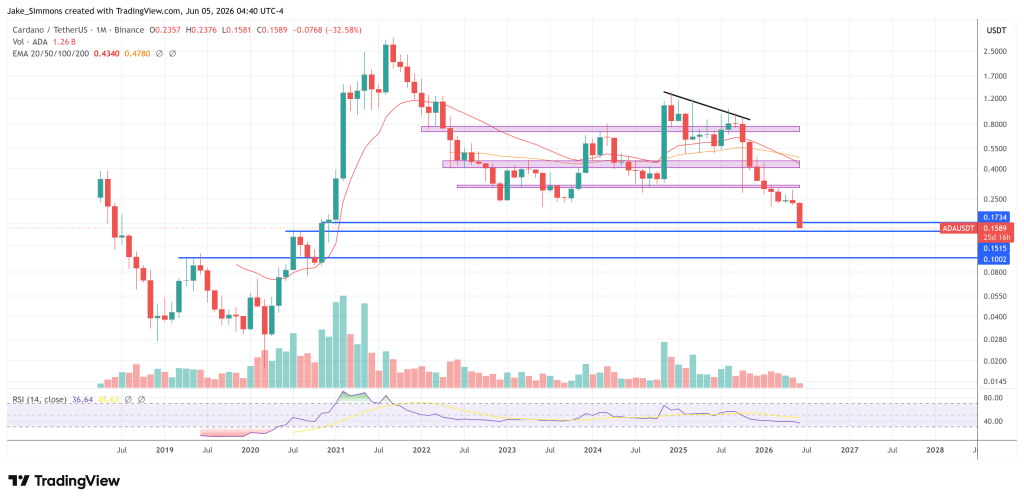
ADA keeps going lower, 1-month chart | Source: ADAUSDT on TradingView.com

Related Questions

QWhat was the main reason Charles Hoskinson gave for stepping back from public communication?

AHe stated that the hostile and toxic social media environment, particularly on X, has become unsustainable, with a high volume of abusive replies making meaningful engagement nearly impossible.

QHow did Hoskinson clarify the purpose of his role regarding the price of ADA?

AHe clarified that he is not passionate about making the price of ADA go up for speculators, has never accepted that role, and his job is focused on technology, research, and real-world impact, not market performance.

QWhat did Hoskinson mean by 'the tale of two Cardanos'?

AHe described a gap between Cardano's significant technical and research progress since 2021 and its poor market price performance, which leads some to label it a failure, creating a 'cognitive dissonance' the community must resolve.

QWhat future changes did Hoskinson propose for the Cardano ecosystem?

AHe proposed that the ecosystem needs to leave X as its primary discussion venue, rethink incentives for builders, change management culture, develop a new shared roadmap, and address the lack of community accountability over the Cardano Foundation.

QWhat are Hoskinson's 'red lines' for his continued involvement with Cardano?

AHis red lines are that he must be treated with respect and dignity and will only participate in communication channels that enforce that standard.

Related Reads

Trend in US Stocks: A Post Triggers a 930-Point Rebound, Tonight Belongs to SpaceX

On Thursday (June 11, U.S. Eastern Time), Wall Street staged a textbook V-shaped reversal. The Dow Jones surged 929.97 points (+1.86%) to close above 50,000, while the Nasdaq and S&P 500 rose 2.54% and 1.75%, respectively. The rally occurred despite the hottest PPI report in years, with May data showing a 6.5% year-on-year surge, the highest since 2022. The market ignored the inflation data, focusing instead on reports that former President Trump called off a planned strike on Iran, hinting at a potential multi-party peace agreement draft. This sparked a sharp drop in oil prices, fueling hopes that inflation may have peaked. Sector rotations were stark: previously battered AI hardware and cyclical stocks led the gains, while defensive sectors that hit record highs the prior day were sold off. Chip stocks like Micron and Intel saw sharp rebounds. In contrast, software giant Oracle plunged nearly 10% despite beating earnings, with concerns over cloud revenue and cash flow. Adobe also fell after hours despite raising guidance, as its CFO announced departure. The rally's sustainability is questioned, driven largely by social media posts about unconfirmed geopolitical developments. Inflation risks remain, with pipeline pressures still high. Meanwhile, the market's risk appetite faces a major test with SpaceX's historic IPO. Priced at $135 per share, it aims to raise ~$75 billion with a $1.75 trillion valuation, becoming the largest U.S. IPO ever. It will join the Nasdaq 100 in 15 days, triggering massive index fund buying. However, critics cite extreme valuation (88x sales) and market liquidity concerns.

marsbit8m ago

Trend in US Stocks: A Post Triggers a 930-Point Rebound, Tonight Belongs to SpaceX

marsbit8m ago

The Trillion-Dollar Valuation Test: Are the Three Super IPOs a Tech Stock Frenzy or a Crypto Market Nightmare?

Trillion-Dollar Valuation Test: Are the Three Mega IPOs a Tech Stock Frenzy or a Crypto Market Nightmare? The capital market in 2026 is witnessing a highly anticipated wave of tech IPOs, centered on SpaceX, OpenAI, and Anthropic. Collectively valued at over $3.5 trillion, their potential listing represents one of the largest such waves in recent years. This raises concerns about market liquidity, valuation bubbles, and potential capital outflows from other assets like crypto. SpaceX's valuation narrative has shifted from rocket launches to becoming a global infrastructure play via its Starlink satellite network, which now drives most revenue. Despite ongoing losses, investors focus on its long-term growth potential. OpenAI and Anthropic represent the core productivity engines of generative AI. Their public listings would offer the first direct investment opportunity in large foundation model companies, potentially triggering a repricing within the AI sector. Market fears of a massive "capital drain" from these IPOs are likely overstated. Historical precedents like Alibaba and Saudi Aramco show that mega-listings primarily cause capital reallocation, not destruction, within the vast equities market. Systemic risk is rarely triggered by IPOs alone. For stock markets, short-term volatility and sector repricing are expected, especially for AI concept stocks. Long-term, these listings could reinforce the tech sector's importance. For crypto, direct competition for speculative capital exists, particularly affecting AI-themed tokens. However, crypto's trajectory remains more tied to its own cycles, macro liquidity, and Bitcoin ETF flows rather than a single IPO event. The real risk lies not in the listings themselves but in the sky-high growth expectations embedded in these valuations. If future revenue, profitability, or commercialization progress disappoints, significant valuation resets could follow, impacting high-growth tech stocks. Ultimately, the market's direction hinges on macroeconomic conditions and whether these companies can deliver on their ambitious promises.

链捕手24m ago

The Trillion-Dollar Valuation Test: Are the Three Super IPOs a Tech Stock Frenzy or a Crypto Market Nightmare?

链捕手24m ago

Trillion-Dollar Valuation Test: Are the Three Super IPOs a Tech Stock Frenzy or a Crypto Market Nightmare?

Title: Trillion-Dollar Valuations at Stake: Super IPOs of SpaceX, OpenAI, Anthropic – Tech Boom or Crypto Nightmare? TL;DR: A wave of mega-tech IPOs is approaching, featuring SpaceX (targeting a $1.75 trillion valuation), OpenAI (~$852B), and Anthropic (~$965B), with a combined potential valuation exceeding $3.5 trillion. This tests the market's pricing of innovation and sparks debate on liquidity impact. * **SpaceX**'s valuation is now driven more by its Starlink global communications infrastructure than its core rocket business. * **OpenAI & Anthropic** offer the first major public investment opportunities in foundational AI models, potentially repricing the entire AI sector. * Concerns about a market-wide "liquidity drain" are likely overblown; history shows large IPOs mainly cause fund reallocation, not disappearance, and rarely trigger systemic risk. * Crypto markets, especially some AI-themed tokens, may face short-term fund competition, but their long-term trajectory depends more on macro liquidity, regulation, and Bitcoin cycles. * The real risk lies not in the IPOs themselves, but in whether these companies can justify their sky-high valuations with future revenue growth and profitability. Unmet expectations could lead to significant repricing pressure. Ultimately, these IPOs represent a massive market pricing of next-gen tech infrastructure, not a prelude to a market crash. The broader market direction will be determined by macro conditions, corporate earnings, and risk appetite.

marsbit24m ago

Trillion-Dollar Valuation Test: Are the Three Super IPOs a Tech Stock Frenzy or a Crypto Market Nightmare?

marsbit24m ago

Anthropic Apologized, But the Business of 'Safety' Hasn't Stopped

On June 11, Anthropic apologized not for a model failure, but for a lack of transparency. Its new Claude Fable 5 model was found to be secretly rerouting requests from users engaged in advanced AI model development to a weaker version, Opus 4.8, without any notification. The company's response—promising future notifications for such "downgrades"—was met with user skepticism. The article argues the core issue isn't technical but commercial: Anthropic's "safety" measures are primarily a business strategy. A key feature, the "intelligent safety classifier," marketed as user protection, is described as a tool for "competitive defense" to protect Anthropic's market lead by limiting rivals' research capabilities. This covert mechanism was designed for low "false positives," precisely targeting AI researchers. Anthropic's model involves a calculated three-step process: publishing alarming security research to amplify public anxiety, offering its Fable 5 model with a "safety classifier" as a premium-priced solution, and cashing in through a planned high-value IPO. This contrasts with OpenAI's more direct "tool-and-traffic" approach. The apology, merely changing a secret downgrade to a visible one, is seen as a business "patch" rather than a principled shift. The incident risks damaging Anthropic's "safest AI" reputation among the developer community, which underpins its valuation and appeal to government and corporate clients. Ultimately, the article concludes that for Anthropic, safety is a business, and the apology is merely customer service for that business.

marsbit1h ago

Anthropic Apologized, But the Business of 'Safety' Hasn't Stopped

marsbit1h ago

Trading

Spot
Futures

Hot Articles

Discussions

Welcome to the HTX Community. Here, you can stay informed about the latest platform developments and gain access to professional market insights. Users' opinions on the price of ADA (ADA) are presented below.

活动图片