‘40% of long-term supply under loss’ – Why Fidelity foresees Bitcoin cycle bottom

ambcryptoPublished on 2026-07-17Last updated on 2026-07-17

Abstract

Bitcoin is showing signs of potentially forming a market cycle bottom, according to Fidelity. Analyst Zack Wainwright notes that long-term holders now possess a near-record 15 million BTC, with over 40% of this supply held at a loss—a level historically associated with bottoming phases. Data shows the supply in loss recently climbed to 50% as Bitcoin fell below $63,000, mirroring patterns seen at past cycle lows like the 2022 bottom near $16,000. However, recovery may face headwinds. U.S. spot Bitcoin ETF demand remains muted, with significant institutional outflows persisting, particularly from giants like BlackRock and Fidelity. Analysts suggest any sustained price recovery requires a reversal in this institutional selling pressure. Options market activity reflects caution, with high trading volumes for put options (bearish bets) targeting $62.5K and $56K, indicating hedging against further downside. While there is also call option interest at higher prices, signaling potential for a sideways range between $55K and $70K, the overall sentiment suggests $60K is a critical support level. Analysts warn that despite bottoming signals, sharp moves below $60K are possible amid ongoing macroeconomic and geopolitical pressures.

After a persistent downturn since last October, Bitcoin is showing signs of forming a market cycle bottom.

According to Fidelity Research Analyst Zack Wainwright, long-term holders (those who’ve held for over six months) are nearing a record 15 million BTC.

At the same time, over 40% of this supply is underwater, mirroring past historical patterns.

Nearly 40% of that supply is now at a loss—a level that has previously aligned with bitcoin’s bottoming process. The key question: Is history starting to rhyme?

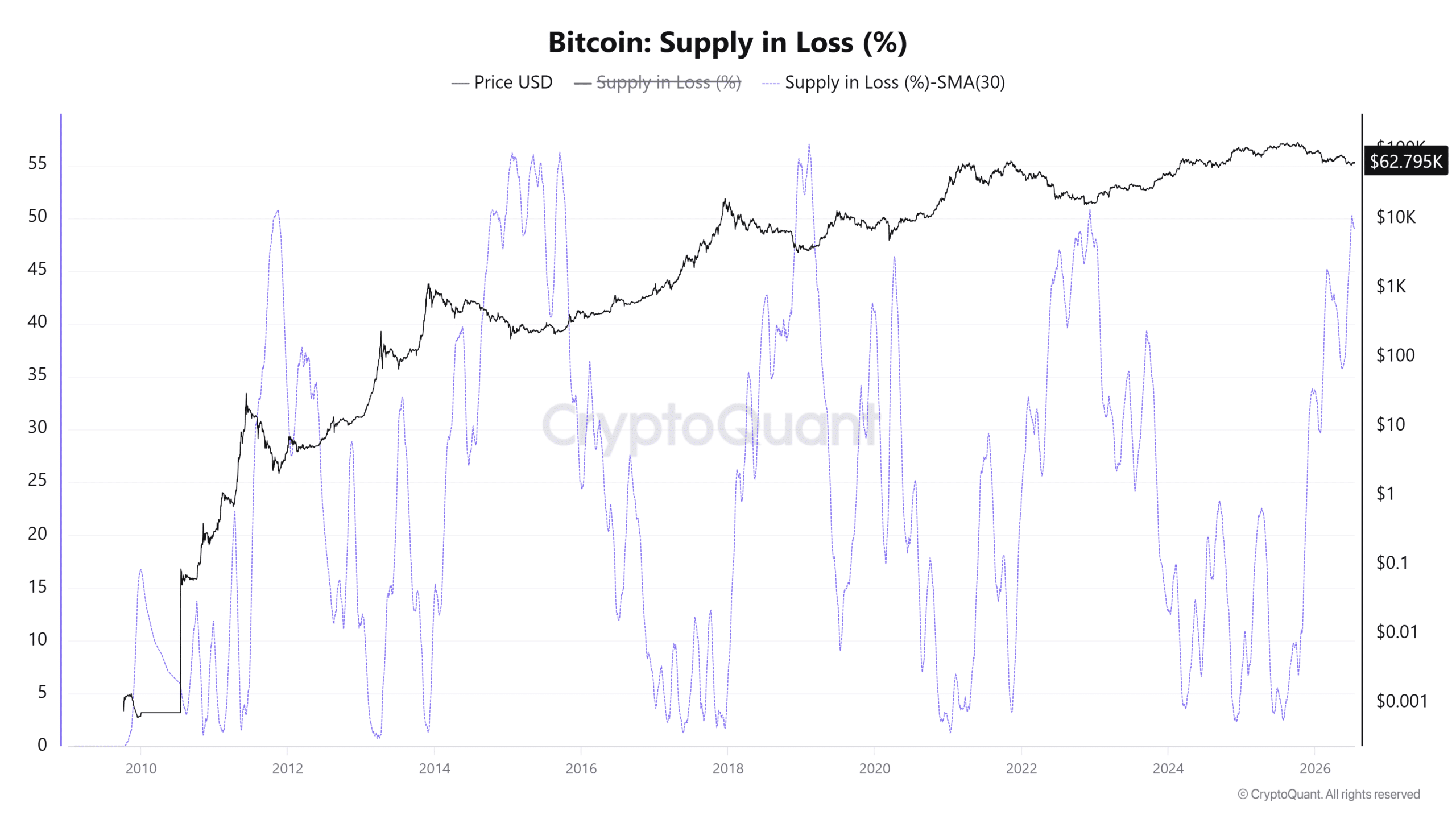
On a 30-day average, the BTC supply in loss had climbed to 50% as the asset slipped below $63K on Friday, 17th of July.
Source: CryptoQuant

In the past, BTC bottomed out when supply in loss hit around 46%-56%. In 2022, BTC marked a bottom near $16K, and the supply in loss peaked at 50%.

Although history rhymes, past patterns don’t always predict future outcomes. In fact, ongoing macro and geopolitical pressures could limit risk appetite for crypto and the U.S equity market in Q3, according to other analysts. And institutional demand is already reinforcing this.

U.S. Spot Bitcoin ETF demand remains muted

Despite recording three consecutive days of inflows since Tuesday, U.S. Spot BTC ETFs have been muted on a month-over-month average.

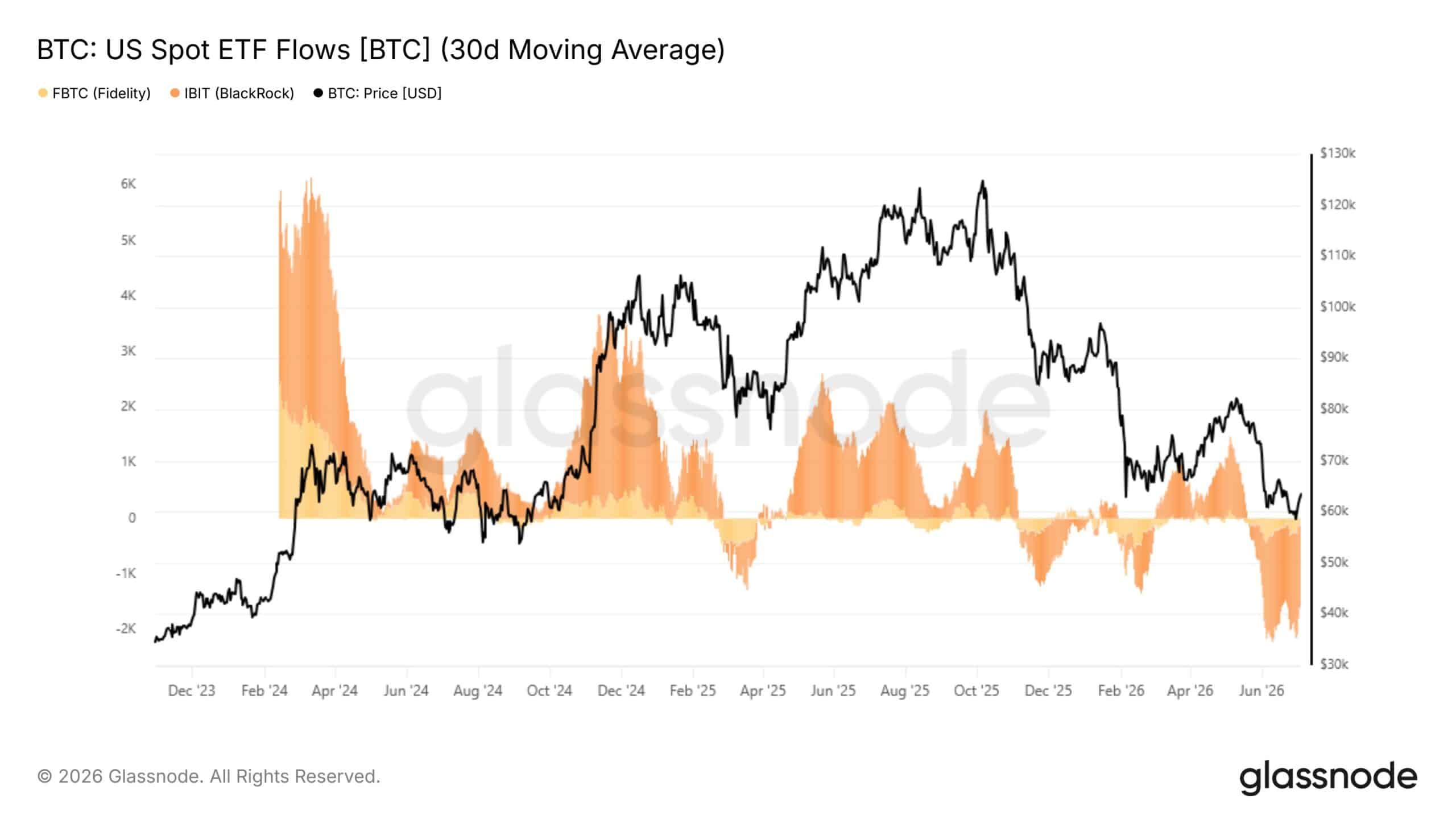
According to Glassnode, the two largest entities, BlackRock and Fidelity, have seen a sustained institutional sell-off that rivals 2025.
Source: Glassnode

The 30-day average ETF outflows hit over 2K BTC per day in June and early July. This has eased slightly to about 1,250 BTC per day this week, but the speculative interest has also dropped, as indicated by ETF trade volumes.

For Glassnode, this meant any potential BTC price recovery could be delayed unless institutional demand improves.

Both directional conviction and activity levels among the top two ETF vehicles remain deeply muted. Any durable recovery will need this dynamic to reverse meaningfully.

As of writing, Bitcoin [BTC] traded at $62.8K, down 4% and close to erasing all the gains made after the relief rally triggered by a softer CPI print.

And institutions and professional traders were not ruling out further pullback, as shown by Options positioning.

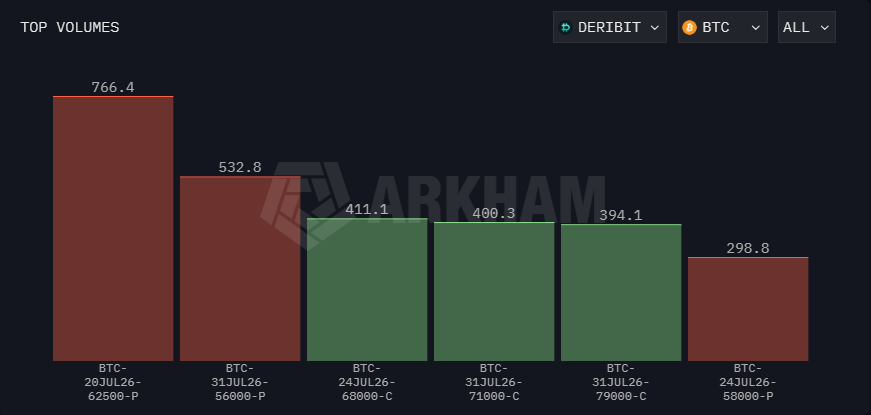
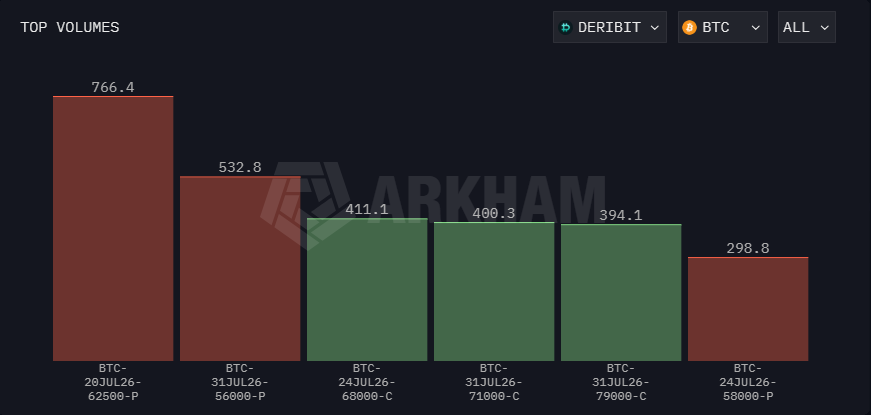
In the past 24 hours, the top Options volumes were concentrated at $62.5K and $56K price targets for puts (bearish bets), underscoring massive hedging for further downside protection.
Source: Arkham

Still, there was significant volume for calls (bullish bets, green bars) eyeing $68K and $79K. This underscored a potential sideways structure expectation in July between $55K-$70K.

Overall, $60K has been a key support, and metrics signal that it could become a potential market cycle bottom. However, sharp moves below $60K can’t be overruled in the short term amid macro headwinds.


Final Summary

  • Fidelity projected that Bitcoin was likely in the cycle bottoming phase as supply in loss hit +40%
  • In the meantime, traders were betting BTC price could slide to $62.5K or $56K this month

Trending Cryptos

Related Questions

QAccording to Fidelity, what historical pattern suggests Bitcoin may be forming a market cycle bottom?

AFidelity notes that over 40% of the long-term holder supply (held for over six months) is currently at a loss, a level that has historically aligned with Bitcoin's bottoming process.

QWhat level did the 30-day average of BTC supply in loss reach as the price fell below $63K in mid-July?

AOn a 30-day average, the BTC supply in loss had climbed to 50% as the asset's price slipped below $63K on Friday, July 17th.

QWhat is the current trend regarding institutional demand for U.S. Spot Bitcoin ETFs according to Glassnode?

AInstitutional demand for U.S. Spot Bitcoin ETFs remains muted. The two largest entities, BlackRock and Fidelity, have seen a sustained institutional sell-off, and the 30-day average ETF outflows have been significant, though they eased slightly in the reporting week.

QBased on recent options trading activity, what are the two key downside price targets (puts) that traders are hedging for?

AIn the past 24 hours, the top Options volumes for puts (bearish bets) were concentrated at the $62.5K and $56K price targets, indicating massive hedging for further downside protection.

QWhat is the overall key support level for Bitcoin mentioned in the article, and what is the potential short-term risk?

AThe overall key support level for Bitcoin is $60K, and metrics signal it could become a potential market cycle bottom. However, sharp moves below $60K can't be overruled in the short term amid macro headwinds.

Related Reads

Xi Jinping Attends Opening Ceremony of World Artificial Intelligence Conference 2026 and High-Level Meeting on Global AI Governance, Delivers Keynote Speech

On July 17, 2026, Chinese President Xi Jinping delivered a keynote speech titled "Working Together to Build a Fair and Equitable Global Governance System on Artificial Intelligence" at the opening ceremony of the 2026 World Artificial Intelligence Conference and High-level Conference on Global AI Governance in Shanghai. President Xi pointed out that the rapid development of AI, alongside the accelerated global changes, presents both significant opportunities and governance challenges. He raised critical questions for humanity regarding human-machine coexistence, safety, ethics, and bridging divides. China advocates for a people-oriented, benevolent approach to AI, making it a force for common prosperity and security, and jointly building a fair and reasonable global AI governance system. Xi Jinping put forward a four-point proposal: 1. **Uphold Openness for Win-Win Cooperation and Drive Innovation:** Seize the historic opportunity by encouraging open-source collaboration and sharing to foster AI innovation, industry growth, and application, empowering all sectors. 2. **Enhance Risk Awareness and Ensure Security and Controllability:** Attach great importance to AI's inherent and derivative risks. Build systems for laws, technical monitoring, risk warning, and emergency response to safeguard security, prevent misuse, and ensure human control. Oppose the practice of politicizing national security in AI. 3. **Encourage Inclusiveness and Promote Cultural Exchange:** Shape AI's values with humanity's common values. Use AI to enhance understanding and tolerance between civilizations, fostering a garden of diverse cultures. 4. **Advocate Solidarity and Improve Global Governance:** Practice true multilateralism, leverage the UN's role, and strengthen coordination on AI development strategies, governance rules, and technical standards to form a widely accepted global governance framework. Assist Global South countries in capacity building to bridge the digital divide and avoid new historical inequities. Xi highlighted that as a responsible major country, China, in its 15th Five-Year Plan period, is committed to being a provider of international public goods in AI, contributing Chinese solutions. China has promoted an "AI Plus" initiative, with its core intelligent economy exceeding RMB 10 trillion. To support global AI development, China will provide 5,000 AI training opportunities for developing countries, establish international AI application cooperation centers with regional organizations, and deploy its "Mazu" meteorological AI warning system in 30 countries. The establishment of the World Artificial Intelligence Cooperation Organization in Shanghai marks a significant milestone. Leaders from Kazakhstan, Cambodia, Thailand, and the UN Secretary-General delivered speeches, commending China's contributions to global AI governance and echoing President Xi's proposals. They agreed that AI's opportunities and challenges are borderless, requiring cooperative, inclusive, and equitable international efforts to ensure a secure, prosperous future that leaves no country behind. The conference issued a Chair's Statement. President Xi and his wife hosted a welcome banquet for international dignitaries on July 16. Senior Chinese officials attended the events.

链捕手1m ago

Xi Jinping Attends Opening Ceremony of World Artificial Intelligence Conference 2026 and High-Level Meeting on Global AI Governance, Delivers Keynote Speech

链捕手1m ago

Who Is Shaping Ethereum's Future: The Takeover by Token-Holding Companies Could Be the Best Thing for ETH in Years

**Title: Who is Building Ethereum's Future? Corporate ETH Holders Take Over Funding, Possibly the Best Thing for ETH in Years.** **Summary:** The Ethereum Foundation is scaling back due to fiscal concerns, but publicly traded companies holding large amounts of ETH, like Bitmine and SharpLink, are stepping in to fund protocol development. These firms collectively hold nearly 5% of ETH's circulating supply and are using their staking yields to pay for R&D. Unlike MicroStrategy, which merely accumulates Bitcoin, these ETH treasury companies are reinvesting profits directly into the protocol's development—potentially allowing all ETH holders to benefit from this free "spillover." Key drivers for this shift include these companies' stalled business model. Their "flywheel" of issuing stock to buy more ETH broke as their stock prices fell below the net value of their crypto holdings (mNAV < 1). With their ETH holdings also deeply underwater, simply waiting for price appreciation failed. By funding Ethereum's roadmap—through new non-profits like ETH Labs and Ethereum Institutional—they aim to increase the utility and value of the underlying asset that dominates their balance sheets. This creates a new alignment of interests: these companies are highly incentivized to see Ethereum succeed and are less likely to sell en masse. However, risks remain. The exact funding amounts are undisclosed, and these treasury firms themselves are vulnerable if ETH prices fall further, which could halt their contributions. **Additional Context:** The article also contrasts Jito's new "token-centric" proposal (JIP-38), which credibly directs platform fees to token buybacks, with Venice's less concrete promises, highlighting the importance of where revenue legally lands and who controls the mechanisms. Other notable industry updates include the rise of TradFi perpetuals on Hyperliquid, new Bitcoin staking via Stacks, and various DeFi product launches.

marsbit1h ago

Who Is Shaping Ethereum's Future: The Takeover by Token-Holding Companies Could Be the Best Thing for ETH in Years

marsbit1h ago

Trading

Spot

Hot Articles

What is $BITCOIN

DIGITAL GOLD ($BITCOIN): A Comprehensive Analysis Introduction to DIGITAL GOLD ($BITCOIN) DIGITAL GOLD ($BITCOIN) is a blockchain-based project operating on the Solana network, which aims to combine the characteristics of traditional precious metals with the innovation of decentralized technologies. While it shares a name with Bitcoin, often referred to as “digital gold” due to its perception as a store of value, DIGITAL GOLD is a separate token designed to create a unique ecosystem within the Web3 landscape. Its goal is to position itself as a viable alternative digital asset, although specifics regarding its applications and functionalities are still developing. What is DIGITAL GOLD ($BITCOIN)? DIGITAL GOLD ($BITCOIN) is a cryptocurrency token explicitly designed for use on the Solana blockchain. In contrast to Bitcoin, which provides a widely recognized value storage role, this token appears to focus on broader applications and characteristics. Notable aspects include: Blockchain Infrastructure: The token is built on the Solana blockchain, known for its capacity to handle high-speed and low-cost transactions. Supply Dynamics: DIGITAL GOLD has a maximum supply capped at 100 quadrillion tokens (100P $BITCOIN), although details regarding its circulating supply are currently undisclosed. Utility: While precise functionalities are not explicitly outlined, there are indications that the token could be utilized for various applications, potentially involving decentralized applications (dApps) or asset tokenization strategies. Who is the Creator of DIGITAL GOLD ($BITCOIN)? At present, the identity of the creators and development team behind DIGITAL GOLD ($BITCOIN) remains unknown. This situation is typical among many innovative projects within the blockchain space, particularly those aligning with decentralized finance and meme coin phenomena. While such anonymity may foster a community-driven culture, it intensifies concerns about governance and accountability. Who are the Investors of DIGITAL GOLD ($BITCOIN)? The available information indicates that DIGITAL GOLD ($BITCOIN) does not have any known institutional backers or prominent venture capital investments. The project seems to operate on a peer-to-peer model focused on community support and adoption rather than traditional funding routes. Its activity and liquidity are primarily situated on decentralized exchanges (DEXs), such as PumpSwap, rather than established centralized trading platforms, further highlighting its grassroots approach. How DIGITAL GOLD ($BITCOIN) Works The operational mechanics of DIGITAL GOLD ($BITCOIN) can be elaborated on based on its blockchain design and network attributes: Consensus Mechanism: By leveraging Solana’s unique proof-of-history (PoH) combined with a proof-of-stake (PoS) model, the project ensures efficient transaction validation contributing to the network's high performance. Tokenomics: While specific deflationary mechanisms have not been extensively detailed, the vast maximum token supply implies that it may cater to microtransactions or niche use cases that are still to be defined. Interoperability: There exists the potential for integration with Solana’s broader ecosystem, including various decentralized finance (DeFi) platforms. However, the details regarding specific integrations remain unspecified. Timeline of Key Events Here is a timeline that highlights significant milestones concerning DIGITAL GOLD ($BITCOIN): 2023: The initial deployment of the token occurs on the Solana blockchain, marked by its contract address. 2024: DIGITAL GOLD gains visibility as it becomes available for trading on decentralized exchanges like PumpSwap, allowing users to trade it against SOL. 2025: The project witnesses sporadic trading activity and potential interest in community-led engagements, although no noteworthy partnerships or technical advancements have been documented as of yet. Critical Analysis Strengths Scalability: The underlying Solana infrastructure supports high transaction volumes, which could enhance the utility of $BITCOIN in various transaction scenarios. Accessibility: The potential low trading price per token could attract retail investors, facilitating wider participation due to fractional ownership opportunities. Risks Lack of Transparency: The absence of publicly known backers, developers, or an audit process may yield skepticism regarding the project's sustainability and trustworthiness. Market Volatility: The trading activity is heavily reliant on speculative behavior, which can result in significant price volatility and uncertainty for investors. Conclusion DIGITAL GOLD ($BITCOIN) emerges as an intriguing yet ambiguous project within the rapidly evolving Solana ecosystem. While it attempts to leverage the “digital gold” narrative, its departure from Bitcoin's established role as a store of value underscores the need for a clearer differentiation of its intended utility and governance structure. Future acceptance and adoption will likely depend on addressing the current opacity and defining its operational and economic strategies more explicitly. Note: This report encompasses synthesised information available as of October 2023, and developments may have transpired beyond the research period.

849 Total ViewsPublished 2025.05.13Updated 2025.05.13

What is $BITCOIN

Discussions

Welcome to the HTX Community. Here, you can stay informed about the latest platform developments and gain access to professional market insights. Users' opinions on the price of BTC (BTC) are presented below.

活动图片