Are Bitcoin Whales Really Back In The Market? CryptoQuant Researcher Says No

bitcoinist2026-01-04 tarihinde yayınlandı2026-01-04 tarihinde güncellendi

Özet

Despite Bitcoin's recent price surge above $90,000, on-chain analysis from CryptoQuant researcher Julio Moreno suggests that large investors, or "whales," are not driving the rally. Data indicates that the total holdings of addresses with over 1,000 BTC have actually declined when exchange wallet addresses are excluded. This is because recent whale activity has been skewed by exchanges consolidating funds into fewer, larger addresses. The shrinking whale balances signal waning demand, a potential precursor to a bear market. This is further supported by significant net outflows from US spot Bitcoin ETFs, including BlackRock's IBIT, which has seen withdrawals in 8 of the last 10 weeks.

The price of Bitcoin has made a solid start to the new year, jumping above the $90,000 mark on Friday, January 2nd. While this newly-found momentum could have been triggered by a plethora of factors, an on-chain expert has pointed out that whale activity is not one of them.

Look Closer: BTC Whale Holdings Actually In Decline

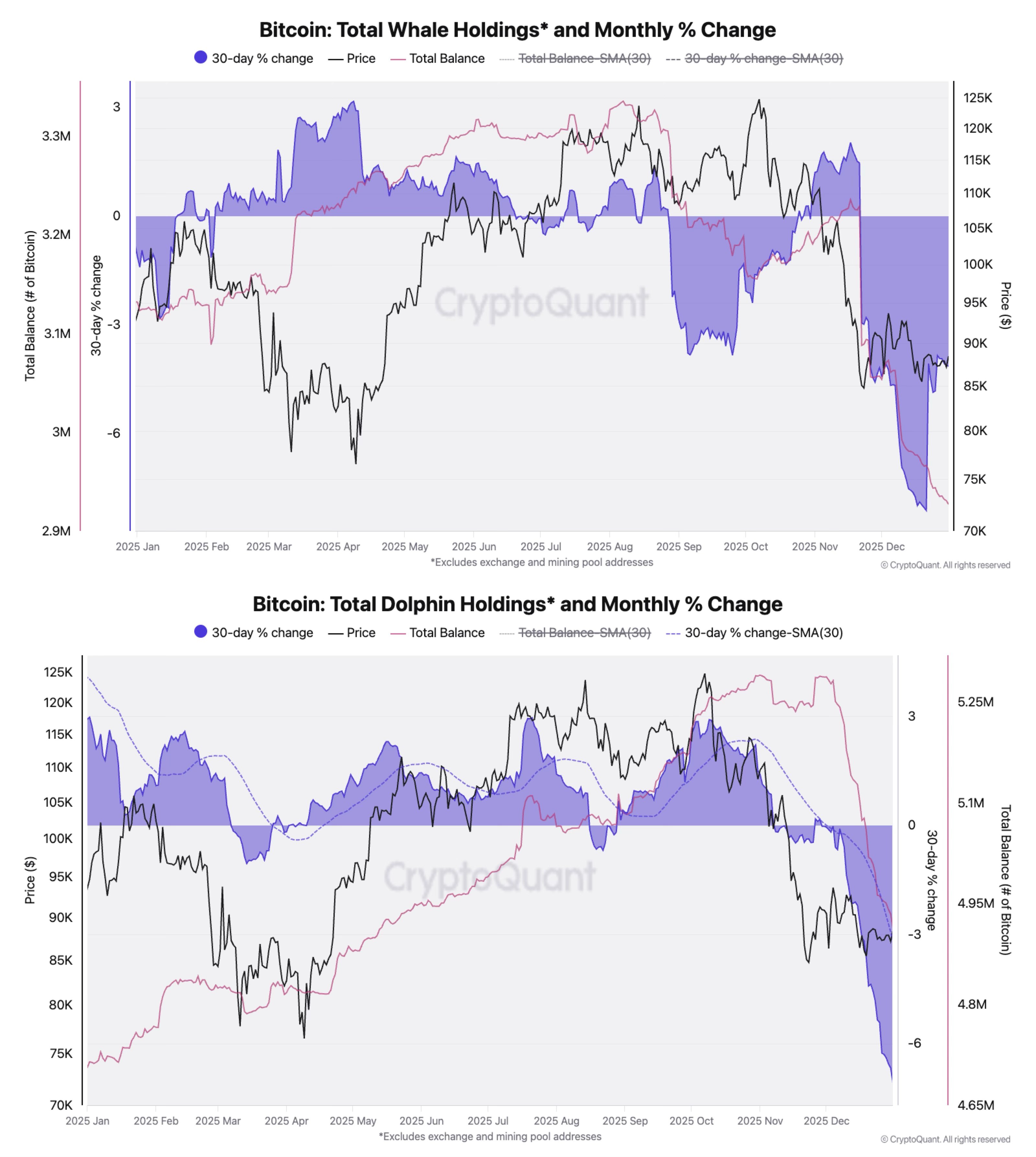
In a recent post on the social media platform X, CryptoQuant’s head of research Julio Moreno argued that the largest Bitcoin investors are not back buying enormous amounts of BTC. This conclusion is based on the Total Whale Holdings and Monthly % Change and Total Dolphin Holdings and Monthly % Change chart.

As the name suggests, the Total Whale Holdings and Monthly % Change chart shows the total balance of addresses with more than 1,000 coins and how it has changed in the past month. Meanwhile, the Total Dolphin Holdings and Monthly % Change chart depicts the change in the balance of investors with between 100 and 1,000 BTC (capturing exchange-traded fund holdings).

What’s more peculiar is that the Total Whale (and Dolphin) Holdings and Monthly % Change excludes exchange wallet addresses. According to Moreno, the majority of Bitcoin whale data has been skewed by exchanges consolidating a lot of their holdings into fewer addresses with larger balances, explaining why whales seem to be in a reaccumulation phase recently.

Interestingly, the data is indeed skewed, as upon removing all exchange addresses’ data, the total Bitcoin whale balances shows a decline rather than an ascent. The same trend can be seen in the lower Total Dolphin Holdings and Monthly % Change chart in the image below.
Source: @jjc_moreno on X

This shrinking balances of Bitcoin whales tells a story of waning demand in the market, sending signals of the start of a bear market. As seen in past cycles, the lack of apparent demand growth is the most telltale sign of impending correction phase for the Bitcoin price.

As of this writing, the price of BTC stands at around $90,320, reflecting an over 2% leap in the past 24 hours.

Spot Bitcoin ETFs Suffering Historic Losses

Since its trading debut, the US Bitcoin ETF market has been an excellent way to judge investor demand in the cryptocurrency market. However, market data hasn’t been telling a pretty story for the flagship cryptocurrency in recent weeks.

For context, the largest Bitcoin ETF, BlackRock’s IBIT, posted roughly $244 million in net outflows last week, marking its 2nd-consecutive weekly withdrawal. The fund has now witnessed net withdrawals in 8 of the last 10 weeks, with a total of just 20 weekly outflows since its launch two years ago.

According to recent data, crypto funds registered approximately $446 million in net outflows last week, marking the sixth week of withdrawal over the last nine weeks.

The price of BTC on the daily timeframe | Source: BTCUSDT chart on TradingView


İlgili Sorular

QAccording to the CryptoQuant researcher, are Bitcoin whales actually buying large amounts of BTC despite the recent price increase?

ANo, the CryptoQuant researcher argues that the largest Bitcoin investors are not back buying enormous amounts of BTC. Data shows their total holdings are actually in decline when exchange wallet addresses are excluded.

QWhat specific data does the article cite to show that whale demand is waning?

AThe article cites the Total Whale Holdings and Monthly % Change chart, which tracks the balance of addresses holding over 1,000 BTC. When exchange addresses are removed from the data, it shows a decline in total whale balances, indicating waning demand.

QHow does the researcher explain the recent data that seemed to show whales were reaccumulating Bitcoin?

AThe researcher, Julio Moreno, explains that the data was skewed because exchanges have been consolidating a lot of their holdings into fewer addresses with larger balances, creating the false appearance that whales were in a reaccumulation phase.

QWhat is the performance of spot Bitcoin ETFs, according to the article?

ASpot Bitcoin ETFs are suffering historic losses. The largest one, BlackRock's IBIT, posted significant net outflows last week, marking its second-consecutive weekly withdrawal. Crypto funds overall saw approximately $446 million in net outflows.

QWhat does a decline in whale balances typically signal for the Bitcoin market, based on past cycles?

ABased on past cycles, a decline in whale balances and the resulting lack of apparent demand growth is a telltale sign of an impending correction phase and the start of a bear market for the Bitcoin price.

İlgili Okumalar

Why is Ethereum Urgently Needing ZK-ification?

The article discusses the urgent need for Ethereum to adopt zero-knowledge (ZK) technology as a core narrative for its future development. While Ethereum previously focused on ICOs, DeFi, and being a global financial settlement layer, it now lacks a compelling new narrative. ZK technology is highlighted as a critical solution, with Ethereum being the blockchain most invested in its development. ZK-EVM has reached the Alpha stage, a milestone celebrated by Vitalik Buterin. The primary motivation for ZK integration is to maintain Ethereum’s decentralization while improving scalability. Currently, increasing the Gas limit boosts TPS but raises node operation costs, potentially centralizing the network. ZK proofs allow nodes to verify transactions efficiently without expensive hardware upgrades, similar to automated exam grading versus manual checking. ZK itself doesn’t directly increase TPS but enables future Gas limit hikes with minimal node cost increases. The recent Fusaka upgrade, including PeerDAS, advances this goal. A ZK-powered Ethereum could achieve over 1000 TPS, strengthening its narrative. The article also addresses the role of third-party ZK teams (e.g., Polygon, Scroll, ZKsync, Taiko), which remain crucial for innovation and testing different ZK-EVM types (Type 1 to 4). ZK-VMs, like Brevis, are noted for higher performance and diversity, as they aren’t constrained by EVM compatibility. While ZK L1 may attract some L2 users, it also benefits L2s by reducing costs and improving foundational infrastructure. In summary, Ethereum’s ZK transformation, after years of development, is entering a critical phase, driven by collaborative efforts between Ethereum and external ZK projects.

marsbit17 dk önce

Why is Ethereum Urgently Needing ZK-ification?

marsbit17 dk önce

BSC Pop-up Store Style Memes: How Can They Compete with Solana?

The crypto market's high-beta phase has reignited the meme coin frenzy, with Solana and Binance Smart Chain (BSC) emerging as two dominant but divergent ecosystems. Solana leverages its high-speed, low-cost infrastructure (0.4s transaction time, ~$0.005 fees) and culture-first approach, epitomized by platforms like pump.fun, where memes evolve from community-driven narratives and often face rapid failure—over 98% of projects eventually collapse. Its top meme tokens, like BONK and WIF, thrive on viral momentum and decentralized innovation, but the ecosystem is highly competitive and transient. BSC, in contrast, relies heavily on central figures like CZ and He Yi, and its EVM compatibility attracts event-driven, sentiment-heavy trading—particularly within Chinese-speaking communities. While BSC memes can achieve rapid, concentrated pumps, they often lack longevity without ongoing influencer support. Data from Dexscreener (as of Jan 12, 2026) highlights key differences: Solana recorded 26.92M transactions ($8.65B volume) vs. BSC’s 5.9M ($7.80B), reflecting Solana’s retail-heavy, high-frequency trading versus BSC’s大户-dominated, narrative-centric rallies. Ultimately, Solana’s strength lies in its resilient, tool-rich culture, while BSC excels in short-term, liquidity-injected opportunities. The choice between chains depends on risk appetite: probability and algorithms on Solana, versus community sentiment and timing on BSC.

比推19 dk önce

BSC Pop-up Store Style Memes: How Can They Compete with Solana?

比推19 dk önce

İşlemler

Spot
Futures

Popüler Makaleler

Tartışmalar

HTX Topluluğuna hoş geldiniz. Burada, en son platform gelişmeleri hakkında bilgi sahibi olabilir ve profesyonel piyasa görüşlerine erişebilirsiniz. Kullanıcıların BTC (BTC) fiyatı hakkındaki görüşleri aşağıda sunulmaktadır.

活动图片