Fed Cuts are Irrelevant to Bitcoin, Says Kevin O’Leary, as Bitcoin Hyper Raises $28.8M

bitcoinistPublished on 2025-12-03Last updated on 2025-12-03

Abstract

Quick Facts: ➡️ Celebrity investor, Kevin O’Leary’s view that Bitcoin can hold up without imminent Fed cuts shifts attention from...

Trusted Editorial content, reviewed by leading industry experts and seasoned editors. Ad Disclosure

Quick Facts:

  • ➡️ Celebrity investor, Kevin O’Leary’s view that Bitcoin can hold up without imminent Fed cuts shifts attention from macro speculation to actual network adoption.
  • ➡️ Bitcoin’s base layer still struggles with throughput, fees, and programmability, pushing real-world DeFi and gaming activity toward faster, smart-contract-ready ecosystems.
  • ➡️ Competing Bitcoin Layer 2s are racing to bring scalable execution to $BTC, utilizing designs ranging from payment channels to roll-ups and modular sidechains.
  • ➡️ Bitcoin Hyper introduces an SVM-powered Bitcoin Layer 2 that targets Solana-level performance while anchoring settlement to $BTC, aiming to unlock programmable, low-fee Bitcoin DeFi.

Kevin O’Leary’s latest stance on Bitcoin is ($BTC) blunt: if the asset’s investment case depends on a single Federal Reserve meeting, it probably wasn’t robust to begin with.

The Canadian businessman and TV personality’s argument that $BTC can hold its own even without near-term rate cuts shifts the spotlight back to adoption, utility, and real transaction demand.

For you as a $BTC holder, that’s a very different conversation from the usual ‘pivot or no pivot’ guessing game. If Bitcoin is going to matter regardless of Fed timing, then the infrastructure that actually lets people pay, trade, and build on top of it becomes the real battleground for upside.

That’s where Bitcoin’s structural limits come roaring back into view.

💡 The base layer still handles roughly seven transactions per second (TPS), with long confirmation times and fee spikes during congestion. That’s fine as a store-of-value ledger, but it’s a non-starter for high-frequency DeFi or gaming.

Bitcoin Hyper ($HYPER) steps into that gap as a high-octane way to express long-term $BTC conviction.

Instead of trying to time macro, it offers a Bitcoin-aligned Layer 2 that uses a Solana Virtual Machine (SVM) execution layer to push performance to and beyond Solana-style speeds, while anchoring settlement and trust back to Bitcoin itself.

Why Macro Fatigue Is Pushing Attention Back to Bitcoin Infrastructure

After two years of ‘will they, won’t they’ on Fed cuts, investor fatigue is real. Bitcoin’s resilience through multiple rate-hike cycles has already tested the original thesis that it’s a levered bet on liquidity. Increasingly, the more durable narrative is that $BTC will survive macro noise if it keeps gaining real-world usage.

At the same time, Bitcoin’s base chain was never designed for modern, smart-contract-heavy workloads. Competing Layer 1s like Solana and Ethereum offer sub-second or low-single-second finality and thousands of transactions per second, with fees often below $0.01.
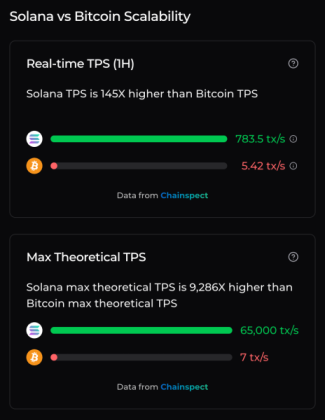
Bitcoin vs Solana transactions per second.

That’s why you see NFTs, perpetual DEXs, and gaming clusters gravitate there instead of to Bitcoin.

To pull that activity back toward $BTC, a new wave of infrastructure is emerging.

Among the frontrunners, Bitcoin Hyper fits into that broader race as one of several contenders trying to marry Bitcoin’s settlement guarantees with throughput and programmability that can actually host complex DeFi, NFT, and gaming ecosystems at scale.

⚡ Learn more about the project in ‘What is Bitcoin Hyper?’

How Bitcoin Hyper Turns BTC Conviction Into High-Throughput Utility

Where Bitcoin Hyper differentiates itself is in its preferred execution layer. Rather than inventing yet another VM, it integrates the Solana Virtual Machine directly into a Bitcoin Layer 2.

That means developers can tap SVM’s parallelized execution and high TPS design, while still routing economic value through Bitcoin.

Under the hood, Bitcoin Hyper uses a modular design: Bitcoin Layer 1 acts as the settlement and security anchor, while a real-time SVM Layer 2 handles execution.

A single sequencer batches and orders transactions, periodically anchoring state back to Bitcoin. The result is extremely low-latency processing for swaps, payments, and dApp calls, while $BTC itself remains the ultimate source of truth.

Bitcoin Hyper Layer 2.

For users, that architecture shows up as practical advantages: high-speed payments in wrapped $BTC with low fees, DeFi primitives like swaps, lending, and staking, plus NFT and gaming dApps built in Rust using familiar SVM tooling.

SPL-compatible tokens are adapted for the Layer 2, giving Solana-native builders a clear porting path into the Bitcoin universe without rewriting everything from scratch.

On the market side, the presale has already raised over $28.8M, with tokens currently offered at $0.013365, signaling strong demand for a BTC-centric scalability play.

Whales are also betting big on the project, with one recently snapping up over $500K worth of $HYPER tokens.

💸 If you want to grab your share of tokens, you can check out our Bitcoin Hyper buying guide for more information.

Meanwhile, if you’re more of a long-term investor, you’ll be pleased to know that $HYPER has a huge potential upside given its premise. By the end of 2026, $HYPER could go a high of $0.20, or a 1396% increase from its current price.

But with yet another price increase coming up in a few hours, now’s your chance to buy tokens at a currently discounted price.

Join the $HYPER presale today.

This article is for informational purposes only and does not constitute financial, investment, or trading advice; always do your own research.

Authored by Bogdan Patru, Bitcoinist — https://bitcoinist.com/kevin-oleary-says-fed-cuts-wont-impact-bitcoin-as-bitcoin-hyper-pumps

Editorial Process for bitcoinist is centered on delivering thoroughly researched, accurate, and unbiased content. We uphold strict sourcing standards, and each page undergoes diligent review by our team of top technology experts and seasoned editors. This process ensures the integrity, relevance, and value of our content for our readers.

As a crypto writer, Bogdan’s responsibilities are split between researching and writing articles and entertaining the team with his humor bordering on the politically incorrect, an aspiring Bill Burr, if you will. Thanks to his 12+ years of writing experience in just as many fields, including tech, cybersecurity, modelling, fitness, crypto, and other topics-that-shall-not-be-named, he's become a genuine asset to the team. While his position as a senior writer at PrivacyAffairs thought him valuable lessons about the power of self-management, his entire writing career was and is an exercise in self-improvement. Now, he's ready to sink his teeth into crypto and teach people how to take control of their own money on the blockchain. With fiat as an eternally devaluing currency, Bitcoin and altcoins seem like the best-fitting alternative for Bogdan. Bogdan’s biggest professional accomplishment, aside from securing a position as a main writer for Bitcoinist, was his 5-year run as a writing manager at Blackwood Productions, where he coordinated a team of four writers. During that time, he learned the value of teamwork and that of creating a working environment that breeds efficiency, positivity, and friendship.

Trending Cryptos

Related Reads

Apple Sues OpenAI Sparking Feud, Musk Slams Altman for Fraud, Altman Retorts with 'Space Data Center' Boast

Apple Sues OpenAI as Musk-Altman Feud Escalates The public feud between Elon Musk and OpenAI CEO Sam Altman intensified, coinciding with their respective AI companies launching flagship models in the same week, highlighting fierce competition. On July 11, Musk posted on X, accusing Altman of taking "fraud to the next level" regarding OpenAI's commercial practices. Altman fired back, sarcastically suggesting Musk was the one selling "short-term space datacenter" concepts to public market investors. Musk countered with allegations that Altman "stole an open-source AI charity" and, amid Apple's recent lawsuit, "stole all of Apple's phone tech." He mockingly referenced Altman needing a "parole officer's" approval to travel. This exchange occurred against the backdrop of a significant legal development: Apple filed a lawsuit against OpenAI in a California federal court, alleging the AI company deliberately solicited Apple employees to leak confidential information on unreleased products to aid its own hardware plans. Apple demands OpenAI cease this activity, destroy proprietary materials, and redesign upcoming products. OpenAI responded, stating it has no interest in other companies' trade secrets and remains focused on innovation. This lawsuit could profoundly impact their two-year partnership where OpenAI provides key tech for Apple Intelligence and Siri. The rivalry extended to product releases. OpenAI launched GPT-5.6, while Musk's SpaceXAI unveiled Grok 4.5. Both are positioned as AI agents capable of multi-step tasks. GPT-5.6 is noted for strengths in broad reasoning, business workflows, and cybersecurity. Grok 4.5 is highlighted for higher efficiency in autonomous programming and developer workflows, with lower usage costs than GPT-5.6, though OpenAI's model reportedly still leads in areas like abstract reasoning. The differing strengths offer distinct choices for enterprises and developers based on their specific needs.

marsbit6h ago

Apple Sues OpenAI Sparking Feud, Musk Slams Altman for Fraud, Altman Retorts with 'Space Data Center' Boast

marsbit6h ago

Trading

Spot

Hot Articles

What is DOGE M

Doge Matrix ($doge m): The New Breed of Community-Driven Cryptocurrency Introduction In the ever-evolving landscape of cryptocurrency, new projects constantly emerge, each aiming to capture the interest of investors and enthusiasts alike. One of the latest entrants to this domain is Doge Matrix, represented by the ticker symbol $doge m. This project has attracted attention thanks to its roots in the popular meme culture surrounding Dogecoin, establishing its place within the web3 space. This article aims to provide a comprehensive analysis of Doge Matrix, covering its overview, creator, investors, functionality, timeline, and notable aspects. What is Doge Matrix ($doge m)? Doge Matrix is a community-driven cryptocurrency project that seemingly builds upon the widespread appeal of Dogecoin, a digital currency known for its Shiba Inu mascot and its meme origins. While the overarching objectives of Doge Matrix are not extensively defined, it is characterized by a commitment to harnessing community involvement and support. Unlike traditional cryptocurrencies that often emphasize utility or intrinsic value through underlying technologies, Doge Matrix positions itself within a space that embraces the cultural phenomenon of cryptocurrencies, particularly appealing to those who resonate with the ethos of meme-based assets. Drawing on the strengths of the Dogecoin community, Doge Matrix operates as part of a broader ecosystem, inviting participation and engagement from users who share an interest in cryptocurrency and the digital landscape. Who is the Creator of Doge Matrix ($doge m)? The identity of the creator of Doge Matrix remains unknown. This lack of transparency is not an uncommon occurrence in the cryptocurrency space, where some projects are launched without revealing the identities of their founders. The absence of information regarding the founding team can raise questions among potential investors about the project’s accountability and direction. Who are the Investors of Doge Matrix ($doge m)? As it stands, there is no publicly available information detailing the investors or investment foundations that back Doge Matrix. The project appears to rely primarily on community support rather than institutional investment. This model aligns with the community-driven nature of the initiative, fostering an environment where the direction of the project is shaped by its participants rather than being dictated by a select few financial backers. How Does Doge Matrix ($doge m) Work? The specifics regarding the operational mechanisms of Doge Matrix are somewhat vague, reflecting a broader trend of projects in the meme coin space where innovative functionalities are not always clearly articulated. Nonetheless, Doge Matrix seems designed to tap into the existing cryptocurrency ecosystem by encouraging user participation while tapping into the familiar cultural references associated with Dogecoin. Its potentially unique characteristics derive from community interactions rather than technological advancements, emphasizing shared experiences and collaboration among token holders. While the exact innovations have not been explicitly outlined, the project appears to create a space where community members can engage, share ideas, and propel the project's potential forward. Timeline of Doge Matrix ($doge m) Reflecting on the project’s timeline reveals notable events that have defined its journey thus far: November 25, 2024: Doge Matrix reached its all-time high value, marking a significant milestone in its early history. January 1, 2025: Conversely, Doge Matrix hit its all-time low value, illustrating the volatility often associated with cryptocurrencies, especially in the early stages of a project's lifecycle. Ongoing: The project continues to be actively traded and supported by its community, although specific future milestones or objectives have yet to be disclosed. Key Points About Doge Matrix ($doge m) Community Focus At the heart of Doge Matrix is a commitment to community engagement. The project thrives on the premise of collaboration and shared objectives among its members, emphasizing the importance of collective effort. Unlike centralized projects that often have a defined leadership structure, Doge Matrix at present showcases a more fluid approach to governance, where every community member's voice matters. Volatility The cryptocurrency market is notorious for its volatility, and Doge Matrix is no exception. Its price history reflects significant fluctuations between high and low values, which is typical of many new cryptocurrencies but underscores the risks associated with investment in emerging tokens. Lack of Detailed Information One of the most striking features about Doge Matrix is the scarcity of detailed information regarding its technological underpinnings and operational mechanisms. This ambiguity necessitates that potential investors conduct thorough due diligence before engaging with the project. Conclusion In summary, Doge Matrix ($doge m) illustrates a new wave of cryptocurrency projects that lean heavily on community engagement and cultural relevance. While lacking in certain specifics—such as clear leadership, defined objectives, and detailed functionality—the project has managed to generate interest within the crypto community, leveraging the established appeal of meme culture. As with any investment in the cryptocurrency space, understanding the inherent risks and conducting comprehensive research is essential for potential participants. Doge Matrix stands as a reminder of the dynamic, sometimes unpredictable nature of the crypto industry, marked by constant evolution and enthusiasm for community-driven initiatives.

4.0k Total ViewsPublished 2025.02.03Updated 2025.02.03

What is DOGE M

What is $M

Understanding Mantis ($M): A New Era in Cross-Chain Interoperability In the continually evolving landscape of Web3 and cryptocurrency, new projects strive to offer innovative solutions aimed at enhancing the user experience and expanding functional possibilities within the decentralized financial ecosystem. One such project garnering attention is Mantis ($M), a pioneering protocol founded on the principles of cross-chain interoperability and intent-based settlements. This article delves into the essential aspects of Mantis, including its core functionality, creators, investment backing, innovative features, and critical milestones. What is Mantis ($M)? Mantis is described as a multi-domain intent settlement protocol that simplifies cross-chain interactions, enabling users to execute complex financial transactions across various blockchain platforms seamlessly. The protocol operates through three primary layers: Intent Expression: Users can articulate their transaction goals using natural language facilitated by the DISE LLM, an advanced AI language model. For instance, a user might express a desire to swap Ethereum (ETH) for Solana (SOL) with a specific slippage tolerance of 1%. Execution: This layer employs a network of solvers that compete to fulfill user intents. Transactions are executed using mechanisms such as Coincidence of Wants (CoWs) and Order Flow Auctions (OFAs), which ensure that user demands are met optimally. Settlement: Leveraging the Inter-Blockchain Communication (IBC) protocol, Mantis enables atomic cross-chain transactions, allowing users to operate across various supported chains, including Ethereum, Solana, and Cosmos. Mantis is engineered to introduce native yield generation for idle assets, employing cryptographic proofs to maintain the integrity of transactions throughout the entire process. Creators & Development Team Mantis was conceived by the Composable Foundation, a research-driven organization notable for its emphasis on blockchain interoperability solutions. This foundation collaborates with esteemed academic institutions, including Harvard University and the University of Lisbon, contributing to extensive research and development efforts that inform Mantis's architecture and functionality. The Composable Foundation’s commitment to fostering innovation in the blockchain space positions Mantis as a robust solution for the growing demand for interoperability among multiple blockchain networks. Investors & Backing While specific details about individual investors have not been publicly disclosed, Mantis enjoys substantial backing from various entities, including: Ecosystem grants from IBC-enabled chains, which support the protocol's growth and integration within decentralized finance ecosystems. Strategic partnerships with infrastructure providers that enhance Mantis's network capabilities and deployment strategies. Funding through the Composable Foundation's treasury, ensuring sustained financial support for ongoing development and operational costs. These collaborative efforts reflect a consensus among stakeholders about the importance of enhancing cross-chain functionality and the potential utility of Mantis's infrastructural innovations. Key Innovations Mantis sets itself apart through several pioneering innovations that enhance its functionality and utility: Chain-Agnostic Intents: Users can initiate transactions from any supported chain while settling on another. This flexibility empowers users, driving increased interaction among different platforms. AI-Powered Interface: The integration of DISE LLM allows users to conduct complex DeFi operations using natural language, thereby simplifying interactions and making blockchain technology accessible to a broader audience. Cross-Domain MEV Capture: Mantis creates an internal market for maximal extractable value (MEV) through competitions among solvers. This innovative approach allows for greater efficiency and value extraction in complex transactions. Modular Settlement Layer: The protocol supports various verification methods, including zero-knowledge proofs and optimistic rollups, providing a versatile framework that can adapt to emerging blockchain technologies. Historical Timeline Mantis's development is marked by several critical milestones that chart its trajectory and growth: | Year | Milestone | |————|————————————————————————-| | 2022 | Initial concept development within the Composable Foundation's research division. | | Q3 2024 | Launch of the testnet with bridging capabilities between Solana and Ethereum. | | Q1 2025 | Anticipated Token Generation Event (TGE) alongside the mainnet launch. | | Q2 2025 | Expected integration of DISE LLM and expansion of cross-chain capabilities. | | 2025 H2 | Planned support for over 15 chains through further IBC upgrades. | This timeline outlines Mantis's evolution, from conceptual discussions to active implementation and future growth phases. Ecosystem Growth Strategy Mantis's strategy for ecosystem growth includes several initiatives designed to encourage user participation and developer engagement: Credits System: Users can earn protocol credits by providing liquidity and engaging in referral programs. These credits are redeemable for incentives in the future, fostering a robust user community. Modular Software Development Kit (SDK): This toolkit empowers developers to create applications based on intent-driven models utilizing Mantis's infrastructure, thus promoting innovation within its ecosystem. Governance Model: As the protocol matures, $M token holders will have a voice in protocol governance, allowing them to vote on proposed upgrades and changes, thereby enhancing community engagement and decentralization. Mantis represents a significant advancement in the realm of cross-chain architecture. By seamlessly integrating advanced AI algorithms with a robust settlement framework, Mantis seeks to tackle the problems of fragmentation within multi-chain ecosystems. Its innovative approach prioritizes improved user experiences while adhering to the foundational principles of decentralization and security, setting a new standard for the future interoperability of blockchain technologies. As Mantis continues its journey of growth and implementation, it promises to be a project to watch closely in the competitive landscape of Web3 and decentralized finance. With its focus on crossing boundaries and elevating user engagement, Mantis is poised to be an integral part of the future developments in the cryptocurrency space.

441 Total ViewsPublished 2025.03.18Updated 2025.03.18

What is $M

How to Buy M

Welcome to HTX.com! We've made purchasing MemeCore (M) simple and convenient. Follow our step-by-step guide to embark on your crypto journey.Step 1: Create Your HTX AccountUse your email or phone number to sign up for a free account on HTX. Experience a hassle-free registration journey and unlock all features.Get My AccountStep 2: Go to Buy Crypto and Choose Your Payment MethodCredit/Debit Card: Use your Visa or Mastercard to buy MemeCore (M) instantly.Balance: Use funds from your HTX account balance to trade seamlessly.Third Parties: We've added popular payment methods such as Google Pay and Apple Pay to enhance convenience.P2P: Trade directly with other users on HTX.Over-the-Counter (OTC): We offer tailor-made services and competitive exchange rates for traders.Step 3: Store Your MemeCore (M)After purchasing your MemeCore (M), store it in your HTX account. Alternatively, you can send it elsewhere via blockchain transfer or use it to trade other cryptocurrencies.Step 4: Trade MemeCore (M)Easily trade MemeCore (M) on HTX's spot market. Simply access your account, select your trading pair, execute your trades, and monitor in real-time. We offer a user-friendly experience for both beginners and seasoned traders.

7.9k Total ViewsPublished 2025.07.02Updated 2026.06.02

How to Buy M

Discussions

Welcome to the HTX Community. Here, you can stay informed about the latest platform developments and gain access to professional market insights. Users' opinions on the price of M (M) are presented below.

活动图片