‘We’re trying to defend Bitcoin’: Why BIP-110 is losing community support

ambcryptoPublished on 2026-07-12Last updated on 2026-07-12

Abstract

Blockstream CEO Adam Back argues that Bitcoin Improvement Proposal 110 (BIP-110), a contentious soft fork, is misguided. He contends discussions are fueled by misconceptions about Bitcoin's architecture, not malicious intent, and that the proposal's proponents are often well-intentioned newcomers. BIP-110, implemented in December 2025, aims to restrict arbitrary data like Ordinals inscriptions to prevent network spam and preserve Bitcoin's primary function as peer-to-peer cash. Back acknowledges spam is an issue but believes Bitcoin's existing market-driven mechanisms—transaction fees, miner incentives, and decentralized consensus—already address it. He argues BIP-110 clashes with Bitcoin's permissionless ethos and that a fork based on it would likely fail due to a lack of community support and because it contradicts Bitcoin's foundational principles. Market dynamics show limited support for the proposal, with only 10 out of 2,016 blocks backing a temporary upgrade on July 4th. Concurrently, Ordinals activity has dropped to all-time lows, with fewer than 10,000 inscriptions daily. Bitcoin's price has also fallen 45% over the past year. Michael Saylor echoes Back's critical stance on BIP-110.

Bitcoin Improvement Proposal (BIP-110), the contentious Bitcoin [BTC] soft fork, is back in the news, and many industry experts are talking about it.

This time, Blockstream CEO Adam Back contended that misconceptions about Bitcoin’s architecture are fueling discussions over BIP 110 and the OP_RETURN policy. Acknowledging many BIP 110 proponents as well-intentioned newcomers, he added,

If these are the people with #110 in their handles, I’m sad to see them about to fork off and get disillusioned without understanding why bitcoin rejected 110 robustly.

AD

For background, BIP-110 was implemented in December 2025. This was done to prevent arbitrary data, such as Ordinals inscriptions, which resemble non-fungible tokens, from spamming the network and to maintain Bitcoin’s primary function as a peer-to-peer cash system.

Back acknowledges that spam is a genuine issue. However, he argues that Bitcoin already addresses it through market‐driven mechanisms. This includes things like transaction fees, miner incentives, and decentralized consensus, rather than restrictive rules.

Does BIP‐110 clash with Bitcoin ethos?

The CEO further argued that BIP 110 also goes against the permissionless nature of Bitcoin. He concluded that anyone who disagrees with its direction can fork the network and impose their own regulations.

Moreover, he contends that a fork based on BIP 110 is unlikely to be successful. This, he believes, would happen due to the lack of widespread community support and the fact that it goes against the fundamental ideas of Bitcoin.

He added,

It would be sad if bitcoin lost people disillusioned due to simple lack of understanding of what’s going on there, we’re all trying to defend bitcoin and keep it on mission.

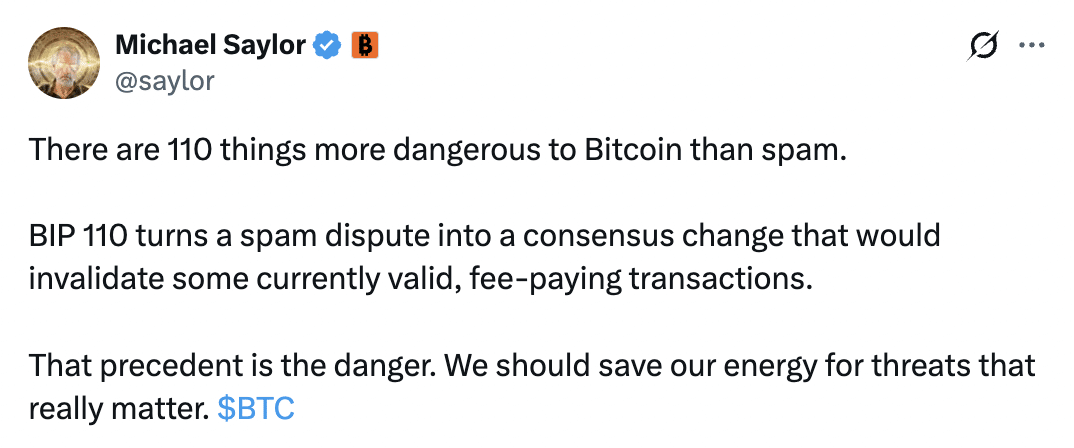
Echoing similar sentiments, Strategy’s Michael Saylor said,
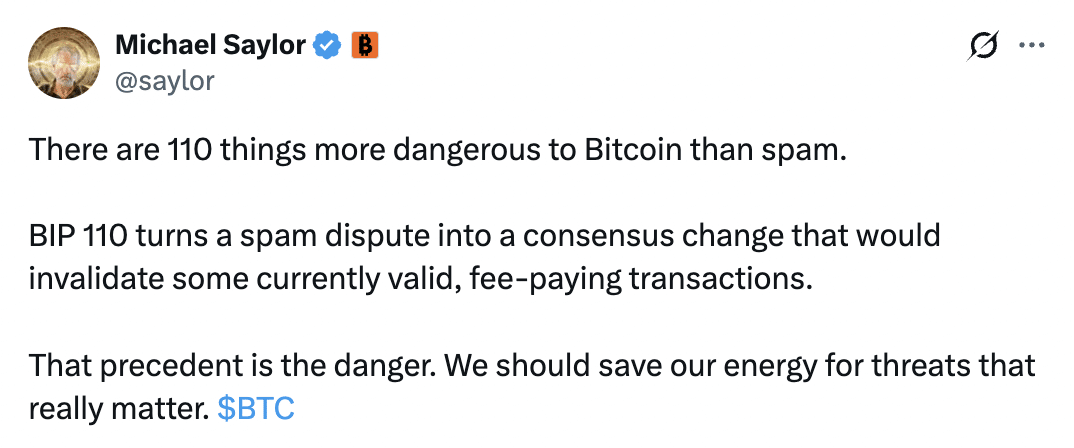
Source: Michael Saylor/X

Market dynamics raise further concerns

This criticism came after only 10 blocks out of 2,016 supported the temporary upgrade on the 4th of July.

Adding further pressure, Ordinals activity has dropped to all‐time lows. For the past month, fewer than 10,000 Ordinals have been added to the Bitcoin blockchain each day.
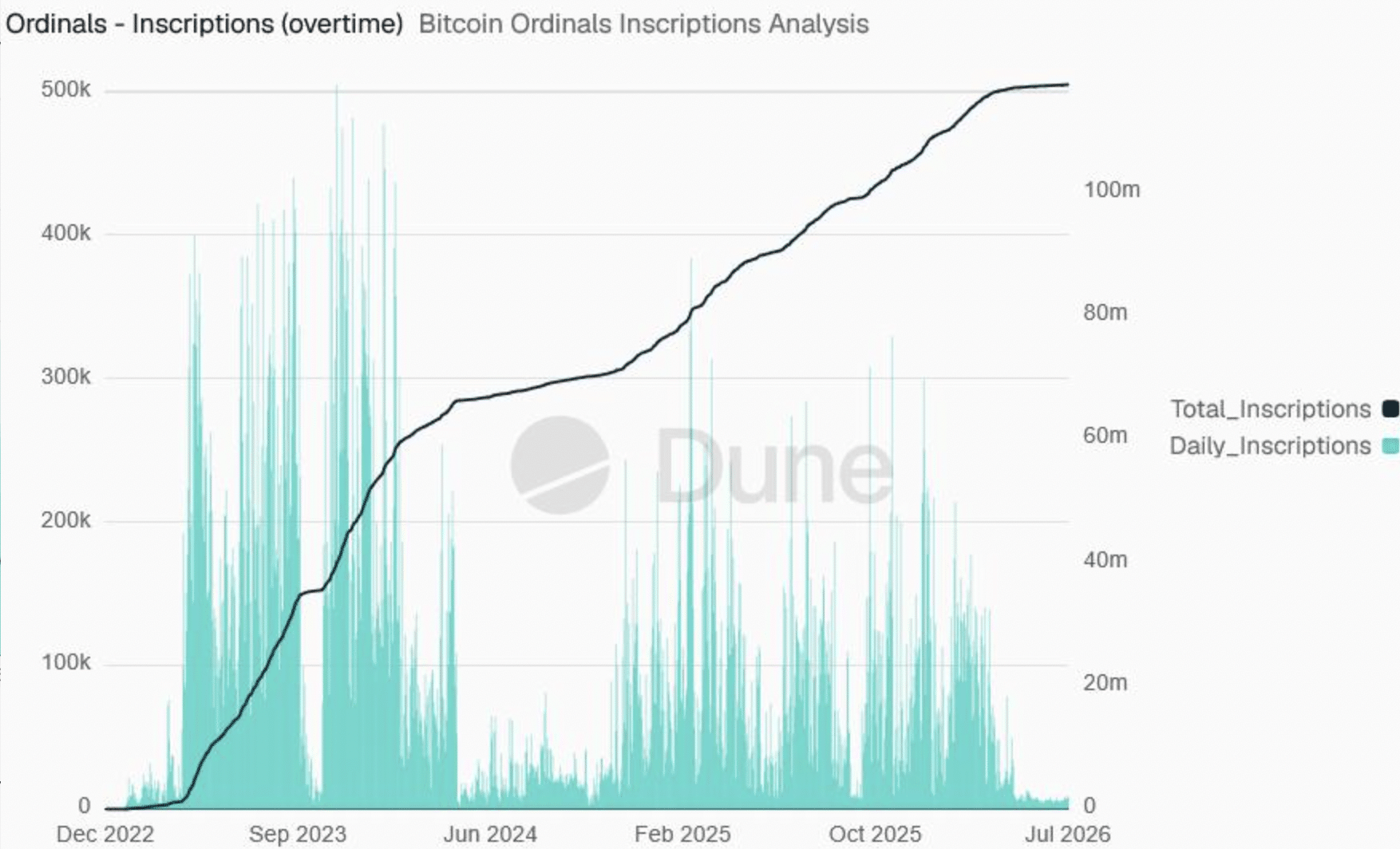
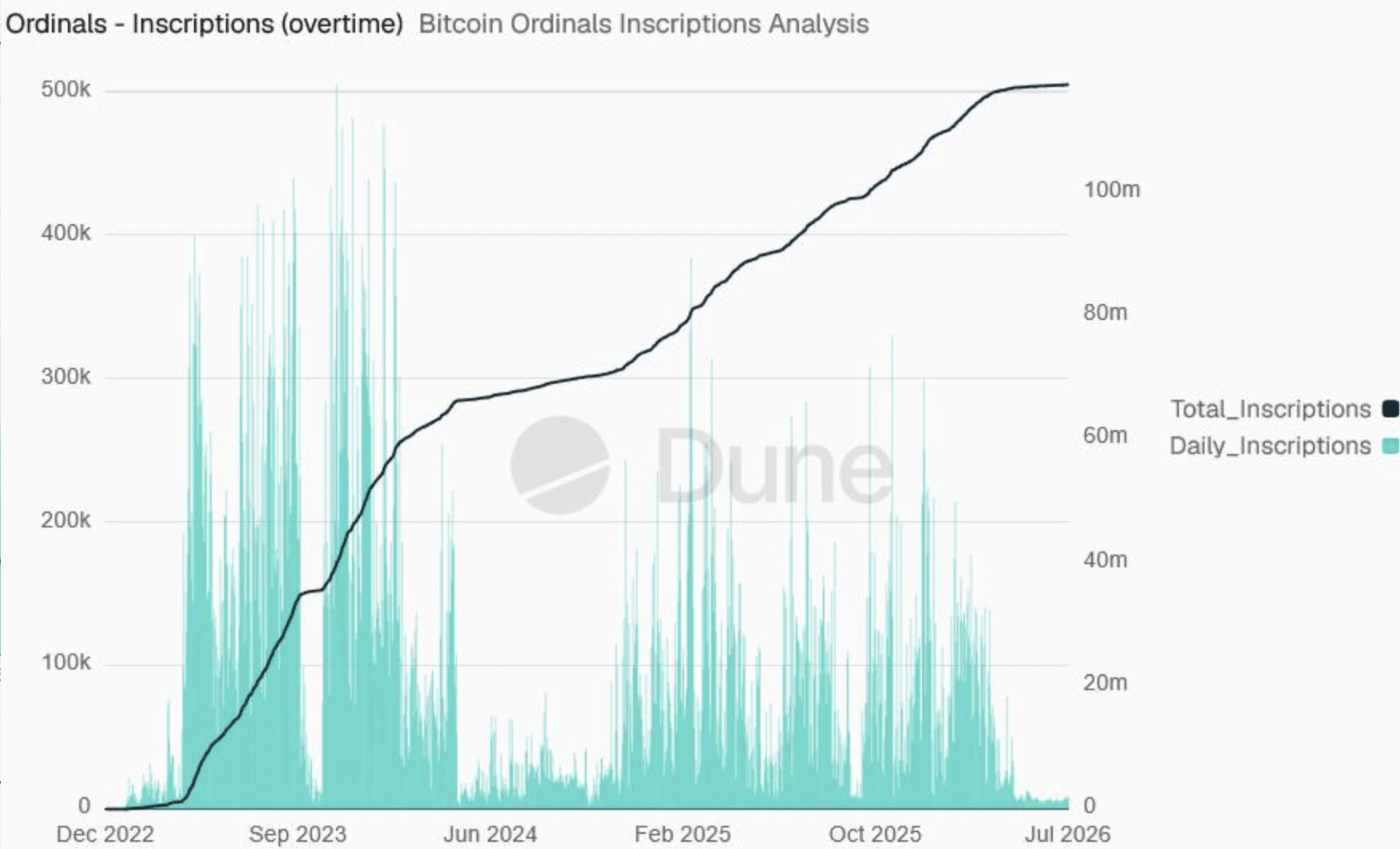
Source: Dune Analytics

Finally, Bitcoin’s price has fallen 45% over the past year, from its peak of $124,500 to $63,901.24 at press time.


Final Summary

  • Adam Back criticizes BIP-110 in light of false beliefs about the architecture of Bitcoin rather than malicious intent.
  • Saylor stands supporting Back’s argument as even Ordinals activity falls to its all-time lows.

Trending Cryptos

Related Questions

QWhat is the main purpose of the BIP-110 soft fork, and when was it implemented?

AThe main purpose of the BIP-110 soft fork was to prevent arbitrary data, such as Ordinals inscriptions, from spamming the Bitcoin network and to maintain Bitcoin's primary function as a peer-to-peer cash system. It was implemented in December 2025.

QWhat are Adam Back's main criticisms of the BIP-110 proposal?

AAdam Back's main criticisms are that BIP-110 is based on misconceptions about Bitcoin's architecture and that it clashes with Bitcoin's permissionless nature. He argues that spam is already addressed through market-driven mechanisms like transaction fees and miner incentives, and that imposing restrictive rules goes against Bitcoin's fundamental ethos.

QAccording to the article, what evidence suggests that community support for BIP-110 is low?

AThe article cites that only 10 blocks out of a required 2,016 supported the temporary upgrade on July 4th. Additionally, it notes that a fork based on BIP-110 is unlikely to succeed due to a lack of widespread community support.

QHow does Michael Saylor's position relate to Adam Back's argument?

AMichael Saylor echoes similar sentiments to Adam Back, supporting the argument against BIP-110. His supportive stance is highlighted in the article alongside the context of declining Ordinals activity.

QWhat are the key market dynamics mentioned that add pressure to the debate around BIP-110?

AThe key market dynamics mentioned are the drop in Ordinals activity to all-time lows (fewer than 10,000 per day for the past month) and Bitcoin's price falling 45% over the past year from its peak of $124,500.

Related Reads

Apple Sues OpenAI Sparking Feud, Musk Slams Altman for Fraud, Altman Retorts with 'Space Data Center' Boast

Apple Sues OpenAI as Musk-Altman Feud Escalates The public feud between Elon Musk and OpenAI CEO Sam Altman intensified, coinciding with their respective AI companies launching flagship models in the same week, highlighting fierce competition. On July 11, Musk posted on X, accusing Altman of taking "fraud to the next level" regarding OpenAI's commercial practices. Altman fired back, sarcastically suggesting Musk was the one selling "short-term space datacenter" concepts to public market investors. Musk countered with allegations that Altman "stole an open-source AI charity" and, amid Apple's recent lawsuit, "stole all of Apple's phone tech." He mockingly referenced Altman needing a "parole officer's" approval to travel. This exchange occurred against the backdrop of a significant legal development: Apple filed a lawsuit against OpenAI in a California federal court, alleging the AI company deliberately solicited Apple employees to leak confidential information on unreleased products to aid its own hardware plans. Apple demands OpenAI cease this activity, destroy proprietary materials, and redesign upcoming products. OpenAI responded, stating it has no interest in other companies' trade secrets and remains focused on innovation. This lawsuit could profoundly impact their two-year partnership where OpenAI provides key tech for Apple Intelligence and Siri. The rivalry extended to product releases. OpenAI launched GPT-5.6, while Musk's SpaceXAI unveiled Grok 4.5. Both are positioned as AI agents capable of multi-step tasks. GPT-5.6 is noted for strengths in broad reasoning, business workflows, and cybersecurity. Grok 4.5 is highlighted for higher efficiency in autonomous programming and developer workflows, with lower usage costs than GPT-5.6, though OpenAI's model reportedly still leads in areas like abstract reasoning. The differing strengths offer distinct choices for enterprises and developers based on their specific needs.

marsbit5h ago

Apple Sues OpenAI Sparking Feud, Musk Slams Altman for Fraud, Altman Retorts with 'Space Data Center' Boast

marsbit5h ago

Robinhood Chain's Success Proves Ethereum is Not Dead

Robinhood Chain's success demonstrates that Ethereum's L1+L2 model is thriving, not dying. Traditional crypto projects often focused on token sales and chose infrastructure to maximize token value. However, real-world businesses building cash-based products make different, pragmatic choices. When launching its chain, Robinhood chose Ethereum as its base layer and built a custom L2 using Arbitrum technology. It uses Ethereum blobs for data availability, ETH for gas, and relies on Ethereum for security. This mirrors Coinbase's earlier decision to build Base as an Ethereum L2. These are not ideological choices but sound business decisions driven by needs for security, liquidity, control, and predictable economics. The shift in the industry is from "token-centric" models to "cash business" models. Real companies serving broad user bases prioritize risk reduction, product improvement, and profit. For them, blockchain is infrastructure. The Ethereum L1+L2 "barbell" structure is ideal: the highly decentralized, neutral, and liquid L1 for settlement and security, combined with customizable, high-performance L2s for execution. This trend is positive for Ethereum and ETH. As more real businesses build on it, ETH becomes more integrated, distributed, and useful, strengthening its network effects and monetary premium. Robinhood's path—starting on an existing L2 and graduating to a dedicated one—is likely to become a standard playbook, proving the enduring utility of Ethereum's layered architecture for serious commercial adoption.

Odaily星球日报5h ago

Robinhood Chain's Success Proves Ethereum is Not Dead

Odaily星球日报5h ago

Trading

Spot

Hot Articles

What is $BITCOIN

DIGITAL GOLD ($BITCOIN): A Comprehensive Analysis Introduction to DIGITAL GOLD ($BITCOIN) DIGITAL GOLD ($BITCOIN) is a blockchain-based project operating on the Solana network, which aims to combine the characteristics of traditional precious metals with the innovation of decentralized technologies. While it shares a name with Bitcoin, often referred to as “digital gold” due to its perception as a store of value, DIGITAL GOLD is a separate token designed to create a unique ecosystem within the Web3 landscape. Its goal is to position itself as a viable alternative digital asset, although specifics regarding its applications and functionalities are still developing. What is DIGITAL GOLD ($BITCOIN)? DIGITAL GOLD ($BITCOIN) is a cryptocurrency token explicitly designed for use on the Solana blockchain. In contrast to Bitcoin, which provides a widely recognized value storage role, this token appears to focus on broader applications and characteristics. Notable aspects include: Blockchain Infrastructure: The token is built on the Solana blockchain, known for its capacity to handle high-speed and low-cost transactions. Supply Dynamics: DIGITAL GOLD has a maximum supply capped at 100 quadrillion tokens (100P $BITCOIN), although details regarding its circulating supply are currently undisclosed. Utility: While precise functionalities are not explicitly outlined, there are indications that the token could be utilized for various applications, potentially involving decentralized applications (dApps) or asset tokenization strategies. Who is the Creator of DIGITAL GOLD ($BITCOIN)? At present, the identity of the creators and development team behind DIGITAL GOLD ($BITCOIN) remains unknown. This situation is typical among many innovative projects within the blockchain space, particularly those aligning with decentralized finance and meme coin phenomena. While such anonymity may foster a community-driven culture, it intensifies concerns about governance and accountability. Who are the Investors of DIGITAL GOLD ($BITCOIN)? The available information indicates that DIGITAL GOLD ($BITCOIN) does not have any known institutional backers or prominent venture capital investments. The project seems to operate on a peer-to-peer model focused on community support and adoption rather than traditional funding routes. Its activity and liquidity are primarily situated on decentralized exchanges (DEXs), such as PumpSwap, rather than established centralized trading platforms, further highlighting its grassroots approach. How DIGITAL GOLD ($BITCOIN) Works The operational mechanics of DIGITAL GOLD ($BITCOIN) can be elaborated on based on its blockchain design and network attributes: Consensus Mechanism: By leveraging Solana’s unique proof-of-history (PoH) combined with a proof-of-stake (PoS) model, the project ensures efficient transaction validation contributing to the network's high performance. Tokenomics: While specific deflationary mechanisms have not been extensively detailed, the vast maximum token supply implies that it may cater to microtransactions or niche use cases that are still to be defined. Interoperability: There exists the potential for integration with Solana’s broader ecosystem, including various decentralized finance (DeFi) platforms. However, the details regarding specific integrations remain unspecified. Timeline of Key Events Here is a timeline that highlights significant milestones concerning DIGITAL GOLD ($BITCOIN): 2023: The initial deployment of the token occurs on the Solana blockchain, marked by its contract address. 2024: DIGITAL GOLD gains visibility as it becomes available for trading on decentralized exchanges like PumpSwap, allowing users to trade it against SOL. 2025: The project witnesses sporadic trading activity and potential interest in community-led engagements, although no noteworthy partnerships or technical advancements have been documented as of yet. Critical Analysis Strengths Scalability: The underlying Solana infrastructure supports high transaction volumes, which could enhance the utility of $BITCOIN in various transaction scenarios. Accessibility: The potential low trading price per token could attract retail investors, facilitating wider participation due to fractional ownership opportunities. Risks Lack of Transparency: The absence of publicly known backers, developers, or an audit process may yield skepticism regarding the project's sustainability and trustworthiness. Market Volatility: The trading activity is heavily reliant on speculative behavior, which can result in significant price volatility and uncertainty for investors. Conclusion DIGITAL GOLD ($BITCOIN) emerges as an intriguing yet ambiguous project within the rapidly evolving Solana ecosystem. While it attempts to leverage the “digital gold” narrative, its departure from Bitcoin's established role as a store of value underscores the need for a clearer differentiation of its intended utility and governance structure. Future acceptance and adoption will likely depend on addressing the current opacity and defining its operational and economic strategies more explicitly. Note: This report encompasses synthesised information available as of October 2023, and developments may have transpired beyond the research period.

744 Total ViewsPublished 2025.05.13Updated 2025.05.13

What is $BITCOIN

Discussions

Welcome to the HTX Community. Here, you can stay informed about the latest platform developments and gain access to professional market insights. Users' opinions on the price of BTC (BTC) are presented below.

活动图片