The NSA Is Trying To Backdoor Bitcoin, Warns Peter Todd — Here’s How

bitcoinistPublished on 2025-10-07Last updated on 2025-10-07

Abstract

Prominent Bitcoin developer Peter Todd alleged on Monday, October 6, that the US National Security Agency (NSA) is “looking to...

Trusted Editorial content, reviewed by leading industry experts and seasoned editors. Ad Disclosure

Prominent Bitcoin developer Peter Todd alleged on Monday, October 6, that the US National Security Agency (NSA) is “looking to backdoor crypto again” via the rollout of so-called quantum-secure algorithms—this time by pushing deployments that exclude tried-and-tested classical cryptography.

“Tl;dr: the NSA is clearly looking to backdoor crypto again with the rollout of “quantum secure” algorithms. The obvious way to implement them is AND: traditional AND quantum secure. So you need to break both. The NSA is trying to remove that seatbelt: quantum-only,” Todd wrote.

Is The NSA Plotting A Quantum Backdoor Into Bitcoin?

Todd’s comments came as cryptographer Daniel J. Bernstein (DJB) published a pair of blog posts—on October 4 and 5—criticizing current Internet Engineering Task Force (IETF) processes and warning that “weakened cryptography” could be standardized through procedural changes that suppress dissent.

In “MODPOD: The collapse of IETF’s protections for dissent,” Bernstein argues that a new moderation framework enables content-based censorship of objections, including objections to eliminating “hybrid” deployments that combine classical and post-quantum schemes. He adds there is “useful action” stakeholders can take by Tuesday, October 7 to oppose these changes.

At the heart of the dispute is whether migrations to post-quantum cryptography (PQC) should favor hybrid combinations—e.g., classical ECDH and PQ key encapsulation—rather than quantum-only switches. Hybrids hedge the unknowns of newly standardized PQC by requiring an attacker to break both components to compromise a session or signature. The IETF formalized the term “hybrid” in June 2025 (RFC 9794), and NIST’s own guidance and FAQs likewise describe and allow hybrid key-establishment modes during transition. That context underpins Todd’s claim that pushing “quantum-only” is a dangerous deviation from best practice.

Bernstein’s companion post on October 4 details real-world hybrid deployments—Google’s CECPQ1/2 experiments (ECC+NewHope, ECC+NTRU, ECC+SIKE), multi-vendor SSH support for ECC+sntrup761, and today’s browser usage dominated by ECC+ML-KEM (Kyber)—as evidence that hybridization is already mainstream and operationally feasible at Internet scale. The post argues that eliminating hybrids would lower safety margins precisely when new PQC is still maturing.

NIST, for its part, has led the global PQC program since 2016 and in August 2024 finalized standards for ML-KEM (Kyber) and two signature schemes (ML-DSA/Dilithium and SLH-DSA/SPHINCS+), with additional algorithms such as HQC selected in 2025. Throughout its materials, NIST acknowledges hybrid modes as legitimate transition mechanisms and has hosted dedicated workshops on KEM guidance—positions that cut against a blanket “quantum-only” mandate.

Why this matters for Bitcoin and broader crypto is twofold. First, Bitcoin’s ecosystem relies heavily on standardized primitives and network protocols—hashes, signatures, handshakes—whose evolution is shaped by NIST and IETF outputs even when implementation occurs in open-source codebases. Second, Todd grounds his warning in history: the NSA’s alleged role in the Dual_EC_DRBG fiasco two decades ago, where a NIST-endorsed random number generator was later withdrawn amid credible backdoor concerns, including reports that RSA made it the default in its toolkit following a secret payment. “Endorsement of backdoored crypto has happened before at the behest of the NSA,” Todd wrote, adding “It’s not a theoretical risk. They’re clearly gearing up to do it again.”

There is, however, no public proof that the NSA is currently inserting a specific backdoor into NIST’s PQC standards or IETF drafts. NIST continues to publish open guidance, workshops, and public comment processes around PQC, including explicit documentation of hybrid approaches. Developer Fudmottin (@Fudmottin) objected to Todd: “If NIST endorsed cryptographic algorithms such as SHA-256 turn out to have back doors or a weakness, then NIST is done. No one will even ask them about the time of day (yes, NIST keeps that standard for the USA).”

The immediate call to action comes from Bernstein’s posts urging stakeholders to engage IETF mechanisms by Tuesday, October 7 (any time zone) to object to MODPOD-style moderation and to defend hybrid cryptography as the default transition path. Todd’s amplification into the Bitcoin community underscores a longstanding mistrust of intelligence-led cryptographic policy—shaped by Dual_EC and other episodes—and a desire to keep consensus-critical systems insulated from standards that may weaken defense-in-depth.

At press time, Bitcoin traded at $134,545.
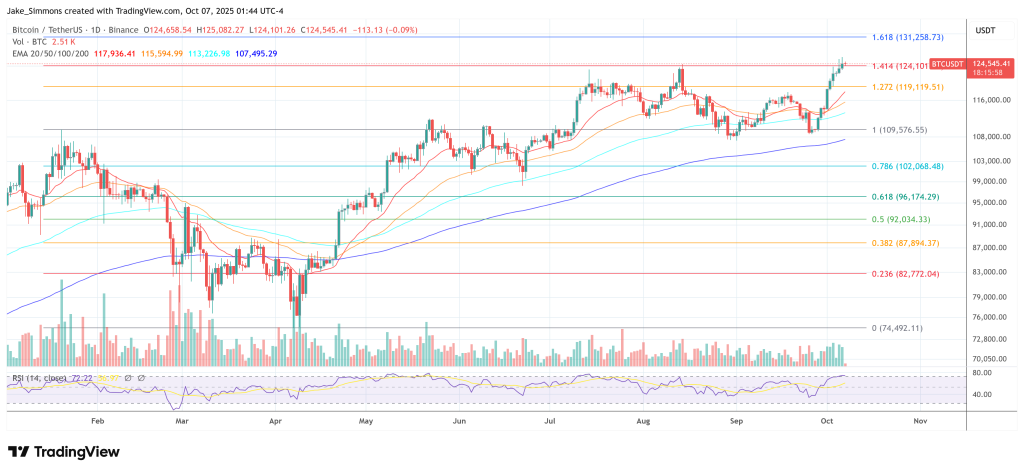
Bitcoin price
BTC remains above $124,000, 1-day chart | Source: BTCUSDT on TradingView.com
Featured image created with DALL.E, chart from TradingView.com
Editorial Process for bitcoinist is centered on delivering thoroughly researched, accurate, and unbiased content. We uphold strict sourcing standards, and each page undergoes diligent review by our team of top technology experts and seasoned editors. This process ensures the integrity, relevance, and value of our content for our readers.

Jake Simmons has been a Bitcoin enthusiast since 2016. Ever since he heard about Bitcoin, he has been studying the topic every day and trying to share his knowledge with others. His goal is to contribute to Bitcoin's financial revolution, which will replace the fiat money system. Besides BTC and crypto, Jake studied Business Informatics at a university. After graduation in 2017, he has been working in the blockchain and crypto sector. You can follow Jake on Twitter at @realJakeSimmons.

Related Reads

Trading

Spot
Futures

Hot Articles

What is $BITCOIN

DIGITAL GOLD ($BITCOIN): A Comprehensive Analysis Introduction to DIGITAL GOLD ($BITCOIN) DIGITAL GOLD ($BITCOIN) is a blockchain-based project operating on the Solana network, which aims to combine the characteristics of traditional precious metals with the innovation of decentralized technologies. While it shares a name with Bitcoin, often referred to as “digital gold” due to its perception as a store of value, DIGITAL GOLD is a separate token designed to create a unique ecosystem within the Web3 landscape. Its goal is to position itself as a viable alternative digital asset, although specifics regarding its applications and functionalities are still developing. What is DIGITAL GOLD ($BITCOIN)? DIGITAL GOLD ($BITCOIN) is a cryptocurrency token explicitly designed for use on the Solana blockchain. In contrast to Bitcoin, which provides a widely recognized value storage role, this token appears to focus on broader applications and characteristics. Notable aspects include: Blockchain Infrastructure: The token is built on the Solana blockchain, known for its capacity to handle high-speed and low-cost transactions. Supply Dynamics: DIGITAL GOLD has a maximum supply capped at 100 quadrillion tokens (100P $BITCOIN), although details regarding its circulating supply are currently undisclosed. Utility: While precise functionalities are not explicitly outlined, there are indications that the token could be utilized for various applications, potentially involving decentralized applications (dApps) or asset tokenization strategies. Who is the Creator of DIGITAL GOLD ($BITCOIN)? At present, the identity of the creators and development team behind DIGITAL GOLD ($BITCOIN) remains unknown. This situation is typical among many innovative projects within the blockchain space, particularly those aligning with decentralized finance and meme coin phenomena. While such anonymity may foster a community-driven culture, it intensifies concerns about governance and accountability. Who are the Investors of DIGITAL GOLD ($BITCOIN)? The available information indicates that DIGITAL GOLD ($BITCOIN) does not have any known institutional backers or prominent venture capital investments. The project seems to operate on a peer-to-peer model focused on community support and adoption rather than traditional funding routes. Its activity and liquidity are primarily situated on decentralized exchanges (DEXs), such as PumpSwap, rather than established centralized trading platforms, further highlighting its grassroots approach. How DIGITAL GOLD ($BITCOIN) Works The operational mechanics of DIGITAL GOLD ($BITCOIN) can be elaborated on based on its blockchain design and network attributes: Consensus Mechanism: By leveraging Solana’s unique proof-of-history (PoH) combined with a proof-of-stake (PoS) model, the project ensures efficient transaction validation contributing to the network's high performance. Tokenomics: While specific deflationary mechanisms have not been extensively detailed, the vast maximum token supply implies that it may cater to microtransactions or niche use cases that are still to be defined. Interoperability: There exists the potential for integration with Solana’s broader ecosystem, including various decentralized finance (DeFi) platforms. However, the details regarding specific integrations remain unspecified. Timeline of Key Events Here is a timeline that highlights significant milestones concerning DIGITAL GOLD ($BITCOIN): 2023: The initial deployment of the token occurs on the Solana blockchain, marked by its contract address. 2024: DIGITAL GOLD gains visibility as it becomes available for trading on decentralized exchanges like PumpSwap, allowing users to trade it against SOL. 2025: The project witnesses sporadic trading activity and potential interest in community-led engagements, although no noteworthy partnerships or technical advancements have been documented as of yet. Critical Analysis Strengths Scalability: The underlying Solana infrastructure supports high transaction volumes, which could enhance the utility of $BITCOIN in various transaction scenarios. Accessibility: The potential low trading price per token could attract retail investors, facilitating wider participation due to fractional ownership opportunities. Risks Lack of Transparency: The absence of publicly known backers, developers, or an audit process may yield skepticism regarding the project's sustainability and trustworthiness. Market Volatility: The trading activity is heavily reliant on speculative behavior, which can result in significant price volatility and uncertainty for investors. Conclusion DIGITAL GOLD ($BITCOIN) emerges as an intriguing yet ambiguous project within the rapidly evolving Solana ecosystem. While it attempts to leverage the “digital gold” narrative, its departure from Bitcoin's established role as a store of value underscores the need for a clearer differentiation of its intended utility and governance structure. Future acceptance and adoption will likely depend on addressing the current opacity and defining its operational and economic strategies more explicitly. Note: This report encompasses synthesised information available as of October 2023, and developments may have transpired beyond the research period.

363 Total ViewsPublished 2025.05.13Updated 2025.05.13

What is $BITCOIN

Discussions

Welcome to the HTX Community. Here, you can stay informed about the latest platform developments and gain access to professional market insights. Users' opinions on the price of BTC (BTC) are presented below.

活动图片