Bitcoin Hyper Accelerates Bitcoin’s Development: $HYPER to 100x?

bitcoinistPublished on 2025-08-27Last updated on 2025-08-27

Abstract

Why don’t more people use Bitcoin? It’s one of the world’s largest assets, with a market cap of over $2.2...

Trusted Editorial content, reviewed by leading industry experts and seasoned editors. Ad Disclosure

Why don’t more people use Bitcoin?

It’s one of the world’s largest assets, with a market cap of over $2.2 trillion. Bitcoin is divisible – you can spend tiny fractions of it at a time, in even smaller units than traditional dollars and cents. It takes 100 million satoshis to make one Bitcoin.

Since Bitcoin is highly divisible, liquid, and valuable, why isn’t it more commonly used in everyday transactions?

That’s just one of the questions Bitcoin developers face. The answers expose some of the problems with Bitcoin’s existing architecture and demonstrate how Bitcoin Hyper ($HYPER) could be the answer.

Bitcoin’s Speed and Scalability Gap

Despite being the largest cryptocurrency by market cap, Bitcoin’s Layer 1 has significant limitations. For example, it can only process around 7 transactions per second (TPS), much lower than Ethereum and Solana’s much higher throughput.

During peak usage, congestion increases, leading to higher fees and longer confirmation times, which makes everyday transactions inefficient.

There’s the additional issue that congestion spikes also lead to transaction fees that vary wildly, sometimes spiking dramatically.
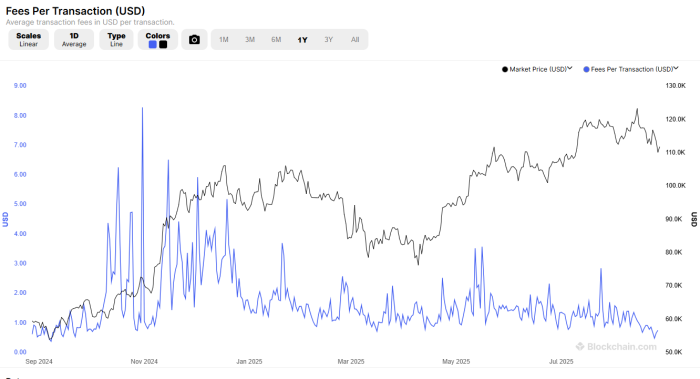
Fees per transaction

Both issues hinder Bitcoin’s adoption as a payment method; nobody wants to pay several dollars in fees for a small transaction.

The lack of programmability also hampers adoption – Bitcoin doesn’t support complex smart contracts, dApps, NFTs, and DeFi natively.

Its simple smart contract design emphasizes security and stability; ideal for a blockchain that focuses on being a ‘store-of-value,’ but less suitable for a more versatile blockchain built with Web3 in mind.
bitcoin hyper ecosystem update

The lack of DeFi, meme-coin ecosystems, and Web3 integrations limits Bitcoin’s role in mainstream crypto innovation. Without the ability to host complex smart contracts or support programmatic financial products, Bitcoin risks being sidelined.

Bitcoin Hyper’s Layer-2 Revolution

Bitcoin Hyper proposes a Layer-2 solution built atop Bitcoin’s mainnet, but leveraging the power of Solana through the SVM. The new Layer-2 targets transaction speeds of thousands of TPS – a monumental leap from the current 7 TPS average.

Bitcoin Hyper uses zk-rollups and a canonical bridge. It processes bundled transaction batches off-chain before settling them on Bitcoin’s mainnet.

Users transfer BTC into the Layer‑2 ecosystem using Bitcoin Hyper’s Canonical Bridge, wrapping BTC 1:1 to create fungible, fast-moving tokens within Hyper.
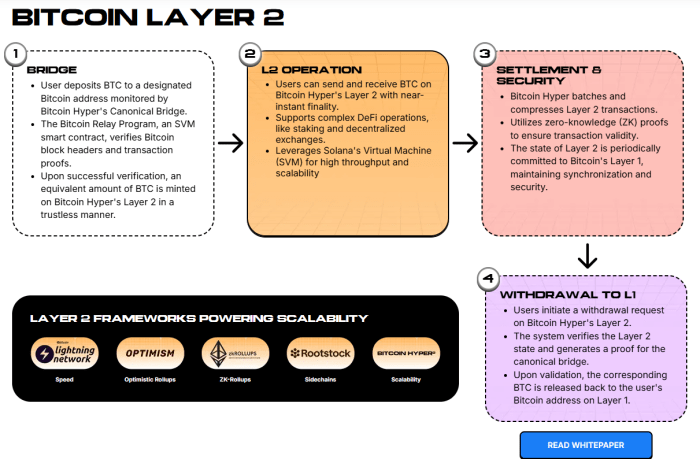
bitcoin hyper architecture

And because of the SVM, Bitcoin Hyper integrates true programmability in the form of smart contracts, dApps, NFTs, and DeFi. Learn more about the details of the architecture in the project’s whitepaper.

Ecosystem Token: HYPER

At its core, the $HYPER token drives the ecosystem: used for gas fees, staking, governance, and exclusive access to events and developer tools.

Early backers can earn very high yields as an incentive for presale participation. The current APY is around 90%.

Momentum is building fast. The Bitcoin Hyper presale surged past $12M, with massive whale purchases underlining investor confidence.

Whale buys include:

Learn how to buy $HYPER with our guide and see why we think the token price could jump from its current $0.012815 to a whopping $0.32, a 2397% increase.

Why Bitcoin Hyper Could Elevate Bitcoin’s Role in Crypto

If Bitcoin develops into a Hyper-enabled, programmable, DeFi-compatible chain, it could attract a new wave of developers and innovative products. By then, Bitcoin might shift from just a store of value to functioning more like Ethereum—a platform for digital financial innovation.

What is Bitcoin Hyper? It’s the key to a faster, cheaper, programmable Bitcoin. And in turn, the $HYPER token is the key to Layer 2, tied to ecosystem access, staking, and governance.

Bitcoin’s recent price momentum—fueled by favorable regulations and Fed sentiment—could support Hyper’s utility story, possibly driving $BTC to new highs.

Bitcoin price performance

In fact, Bitcoin Hyper could be launching at just the right time – the latest VanEck report maintained that Bitcoin could reach $180K by the end of the year.

A Vision for Bitcoin’s Next Chapter

Bitcoin Hyper isn’t just another memecoin. It positions itself as the real Layer-2 solution that Bitcoin has long needed – fast, smart, and programmable. By blending Solana-level performance with Bitcoin’s rock-solid foundation, Bitcoin Hyper ($HYPER) is laying the groundwork for an entirely new crypto narrative.

As always, do your own research. This isn’t financial advice.

Editorial Process for bitcoinist is centered on delivering thoroughly researched, accurate, and unbiased content. We uphold strict sourcing standards, and each page undergoes diligent review by our team of top technology experts and seasoned editors. This process ensures the integrity, relevance, and value of our content for our readers.

Aaron covers all things crypto, with an eye towards simple, easy-to-understand explanations for complicated topics. In his spare time, he writes fantasy stories for fun and enjoys working out and boxing.

Trending Cryptos

Related Reads

Trading Moments: Bitcoin's 200-week moving average has turned into a resistance level, can the July rise still be realized?

**Market Recap: Key Global Developments and Outlook** Global markets are navigating shifting dynamics. Geopolitical tensions eased as the US and Iran agreed to halt further military actions, planning talks for June 30. This pushed oil prices down, with WTI crude dropping below $70. Meanwhile, gold saw a "death cross" (50-day moving average crossing below the 200-day), pressured by a strong dollar and rising real yields. A methodological revision to the US PCE inflation index, set for September, is expected to artificially lower reported core inflation, drawing criticism for lack of transparency. In US equities, major indices extended losses, with the S&P 500 and Nasdaq recording their longest losing streaks since last year. Hedge funds aggressively sold tech stocks, particularly in semiconductors, leading to a sharp rotation into defensive sectors like healthcare and utilities. SpaceX is set for rapid inclusion in the Nasdaq 100, potentially triggering significant passive fund inflows, while its valuation faces scrutiny. Bitcoin is on track for its worst monthly performance since 2022, down over 18% in June. It has failed to reclaim its 200-week moving average (now acting as resistance near $62.6k), raising the risk of a drop toward $55k. Historically, July is a strong month for BTC, with an average gain of 7.6%. Analysts suggest the current sell-off could present a buying opportunity, with a key test being whether Bitcoin can stabilize above $61k to confirm a reversal. In Asia, South Korean stocks initially fell on semiconductor selling but recovered after the government announced a massive investment plan for chips and AI. Japanese retail sales showed strength, supporting consumer recovery. Chinese markets saw a rebalancing, with healthcare stocks surging on policy catalysts and consumption shares rebounding. Hong Kong tech stocks also rallied. **Key upcoming events:** * June 30: US-Iran technical talks; MiCA transition deadline in Spain; NetEase's dual-primary listing in Hong Kong. * July 1: ECB's Sintra Forum featuring key central bankers. * July 6-7: SpaceX's inclusion in Nasdaq 100 triggering passive fund flows. * September 30: New US PCE methodology takes effect.

marsbit2m ago

Trading Moments: Bitcoin's 200-week moving average has turned into a resistance level, can the July rise still be realized?

marsbit2m ago

Lao Huang: Prompt is Dead, the Entire AI Community is Frenziedly Chasing Loops

The article "Prompt is Dead: The AI Industry is Obsessively Chasing Loops" discusses a major shift in AI development, where "Loop Engineering" is replacing traditional prompt engineering. Industry leaders like NVIDIA's Jensen Huang, Andrew Ng, and engineers from Anthropic and OpenAI argue that manually crafting prompts is becoming obsolete. Instead, the new focus is on designing autonomous, self-improving AI systems (loops) that can operate 24/7. A loop system typically involves five key phases: Discovery (finding tasks), Handoff (assigning to agents), Validation (critical independent review), Persistence (saving progress), and Scheduling (automated operation). The core idea is to move humans from being the operational "engine" to being the system "architects" who design the loop, define goals, and set up verification mechanisms. A major challenge and necessity is implementing robust, independent validation to prevent AI from uncritically approving its own work. The trend is seen as part of a move towards "inference-time compute," where allocating computational budget effectively becomes a key engineering skill. While loops can produce higher-quality outputs, they are more expensive and time-consuming than simple prompting. The article warns of risks like "verification debt," "comprehension corrosion," and "cognitive surrender," where engineers might stop understanding the code their systems generate. Ultimately, the article concludes that in an era of automated loops, human judgment and oversight remain the most critical and scarce resources.

marsbit7m ago

Lao Huang: Prompt is Dead, the Entire AI Community is Frenziedly Chasing Loops

marsbit7m ago

Anthropic's Latest Report Reveals Global Workers' Patterns: Seeking Sleep at 5 AM, Asking for Recipes at 6 PM

A new report from Anthropic analyzes millions of hourly user interactions with Claude AI, revealing detailed patterns in daily life and work. The data shows distinct rhythms: people most frequently ask about sleep help around 5 AM, seek news at 7 AM, and search for dinner recipes at 6 PM—the day's single largest query spike. Usage sharply diverges between weekdays and weekends. Workdays are dominated by professional tasks like business emails and coding (backend, APIs). Weekends see a surge in personal use—nearly 50% of conversations—focused on emotional support, creative writing (especially fan fiction), medical advice, and side projects like AI agent design or game development. Weekend "entrepreneurial" queries peak globally, while job-hunting activity drops. The report introduces "artifact" analysis, finding 93% of conversations produce a tangible output (explanation, document, code, etc.). Blog posts are 81% work-related, while creative writing is over 80% personal. High-wage professionals (e.g., marketing managers, programmers) use Claude more intensively outside work hours, with longer conversations, more tokens consumed, and greater use of deep thinking features compared to lower-wage roles. Interestingly, Claude's responses typically register at a higher reading level than user prompts (by about one educational year on average), except for audience-focused writing like emails or blogs where the gap nearly disappears. The data also captures specific cultural moments, like an 8x spike in tax-related queries on the U.S. filing deadline. Precise hourly data transforms fragmented queries into a collective diary of modern life—mapping not just economic activity, but also cycles of anxiety, creativity, and daily rhythm, with AI acting as both a productivity tool and an intimate, always-available confidant.

marsbit23m ago

Anthropic's Latest Report Reveals Global Workers' Patterns: Seeking Sleep at 5 AM, Asking for Recipes at 6 PM

marsbit23m ago

Trading

Spot

Hot Articles

Discussions

Welcome to the HTX Community. Here, you can stay informed about the latest platform developments and gain access to professional market insights. Users' opinions on the price of S (S) are presented below.

活动图片