Anthropic's Latest Report Reveals Global Workers' Patterns: Seeking Sleep at 5 AM, Asking for Recipes at 6 PM

marsbitPublished on 2026-06-29Last updated on 2026-06-29

Abstract

A new report from Anthropic analyzes millions of hourly user interactions with Claude AI, revealing detailed patterns in daily life and work. The data shows distinct rhythms: people most frequently ask about sleep help around 5 AM, seek news at 7 AM, and search for dinner recipes at 6 PM—the day's single largest query spike. Usage sharply diverges between weekdays and weekends. Workdays are dominated by professional tasks like business emails and coding (backend, APIs). Weekends see a surge in personal use—nearly 50% of conversations—focused on emotional support, creative writing (especially fan fiction), medical advice, and side projects like AI agent design or game development. Weekend "entrepreneurial" queries peak globally, while job-hunting activity drops. The report introduces "artifact" analysis, finding 93% of conversations produce a tangible output (explanation, document, code, etc.). Blog posts are 81% work-related, while creative writing is over 80% personal. High-wage professionals (e.g., marketing managers, programmers) use Claude more intensively outside work hours, with longer conversations, more tokens consumed, and greater use of deep thinking features compared to lower-wage roles. Interestingly, Claude's responses typically register at a higher reading level than user prompts (by about one educational year on average), except for audience-focused writing like emails or blogs where the gap nearly disappears. The data also captures specific cultural moments...

Did you know?

At 5 a.m., the most common question people ask AI is how to fall asleep.

At 7 a.m., it's what major events happened in the world.

At 6 p.m., it's what to cook for dinner.

Just last night, Anthropic released the sixth report in its economic index series—for the first time, increasing the sampling precision of millions of Claude conversations from weekly to hourly!
What time you feel anxious, when you crave food, and when you can't sleep—it's all in the data.

AI knows your daily routine better than your partner.

AI Knows When You're Anxious or Craving Better Than Your Partner

First, there's the distinction between weekdays and weekends.

Monday to Friday: Business emails, PowerPoint presentations, marketing copy.

Saturday and Sunday: Emotional support, medical questions, investment advice.

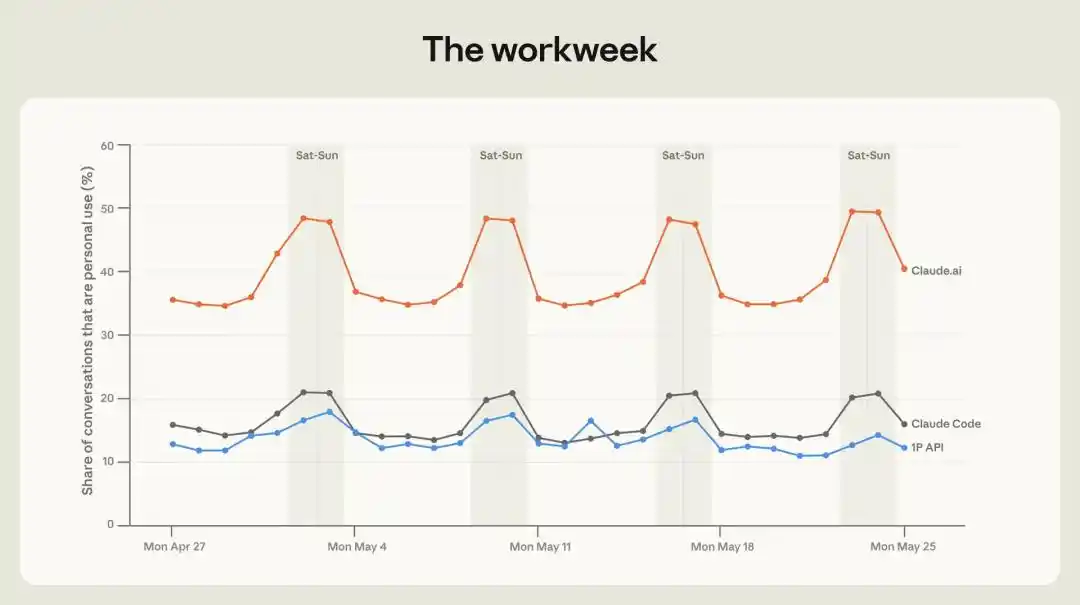
In Claude conversations, the proportion of personal use remains stable at around 35% on weekdays. But on weekends, it jumps to nearly 50%.

The usage of Claude Code also changes accordingly. Backend architecture, API debugging, and data storage all decline over the weekend, replaced by AI Agent design, quantitative trading, and game development.

The same group of people: working for five days, being themselves for two.
However, this "being themselves" isn't all about relaxing.

Entrepreneurship-related conversations peak across all countries on weekends, but job-seeking activities drop along with other work tasks.

Weekends are for dreaming of being a boss, not for submitting resumes.

Then, there's the 24-hour cycle of a day.

Anthropic plotted the frequency of different conversation categories by hour, creating what can be called an electrocardiogram of human life rhythm—

7 a.m.: News. 10-11 a.m.: A small peak for email writing. 6 p.m.: Recipe searches, the largest single-category spike of the day. Evening: Concentrated requests for TV show recommendations. Around 5 a.m.: The insomniacs arrive.
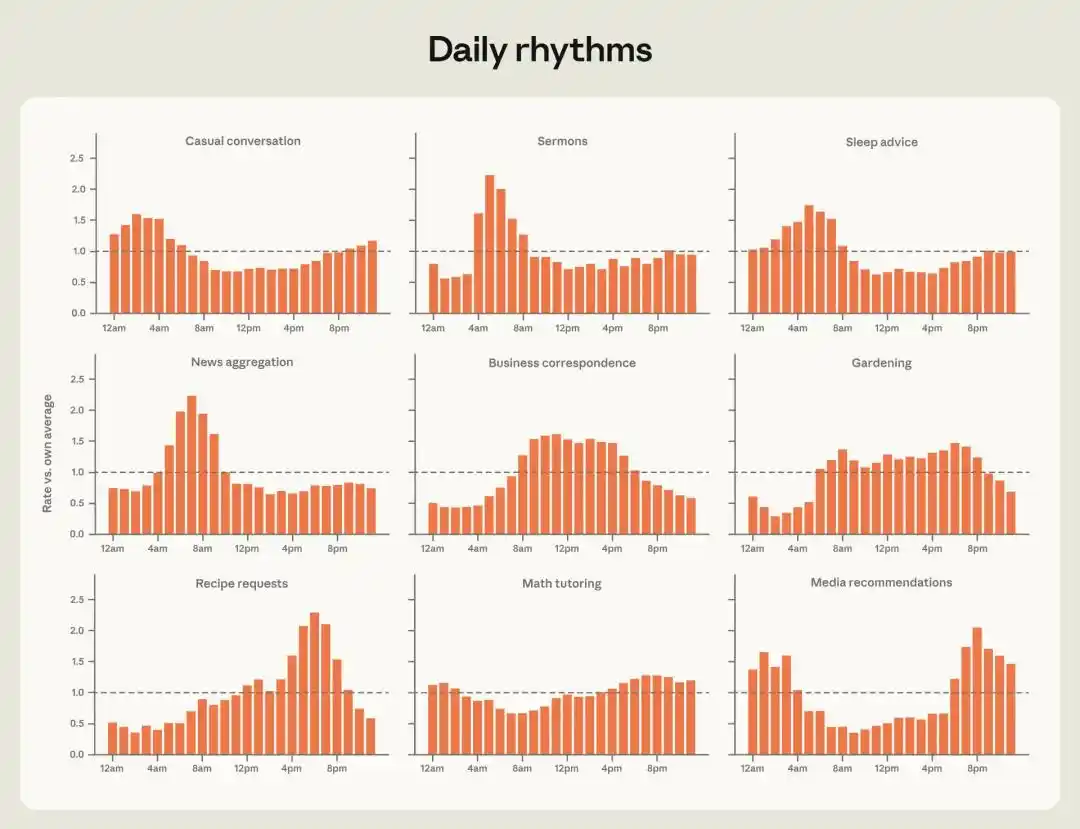
In contrast, gardening topics remain almost completely flat from sunrise to sunset.

Anthropic couldn't resist adding a pun in the report, calling gardening a "perennial topic of interest"—both "consistently popular" and referring to "perennial plants."

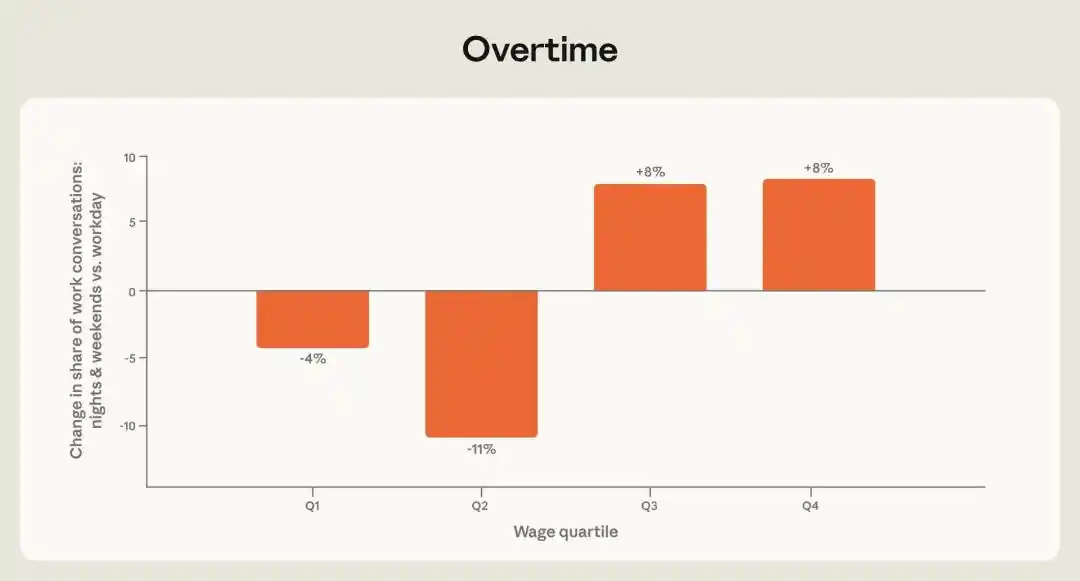
The post-work and weekend data also hides another layer of information: The work tasks Claude handles are clearly skewed towards higher-paying professions.

Conversations for low-wage positions like secretaries and telemarketers decline after hours, but the proportion for high-wage positions like marketing managers and programmers actually increases.

High-income workers have no off-hours. This isn't a new conclusion, but now it's backed by hourly data.
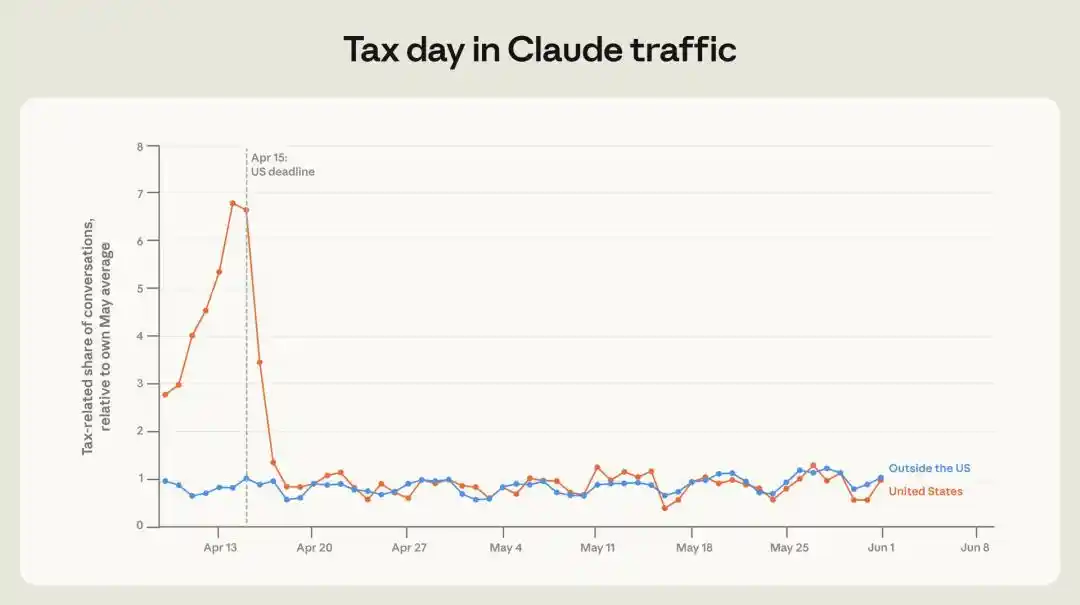
Of course, the most dramatic data point is Tax Day.

On April 14th, tax-related conversations were 8 times the daily average in May. They remained high on April 15th. On April 16th, they plummeted.

The American public collectively rushed to AI for tax help the day before the deadline, then scattered faster than anyone once it passed.
Creating PowerPoints by Day, Fan Fiction by Night

In this report, Anthropic also introduced a new analytical dimension: artifact.

The thing you take away after a conversation with Claude—a document, a piece of code, an explanation, an email—counts as an artifact.

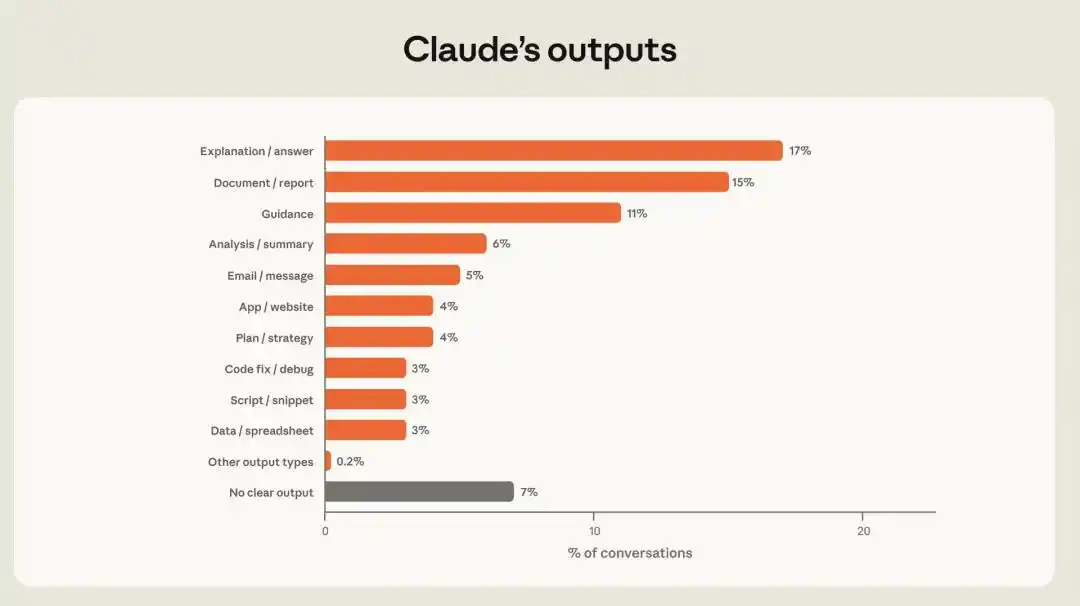
93% of conversations produced an artifact. Only 7% were pure chat, leaving nothing behind.

The top three categories were: Explanations (17%), Documents & Reports (15%), and Guidance & Advice (11%).

Overall, conversational outputs and written deliverables each account for about one-third, while code and technical work make up one-sixth.
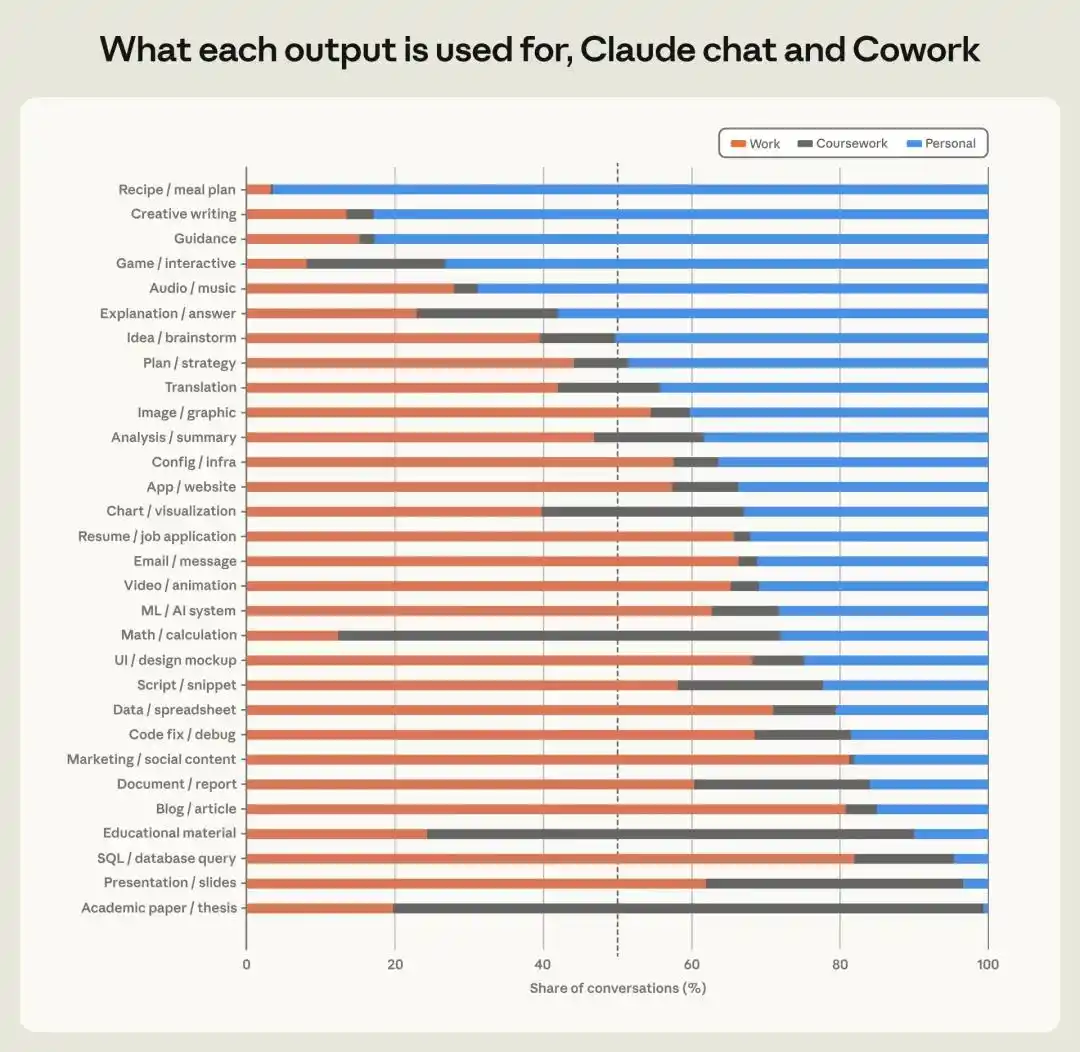
After categorization, Anthropic asked a follow-up question: Are these outputs for work or for life?

The answer varies by category.

Blogs and articles: 81% are for work.

Creative writing is the exact opposite: Over 80% are for personal use, mainly fan fiction, world-building, and poetry. Of the remaining work scenarios, 13% are for short video scripts and speeches.

Translation is the most "neutral," with 42% for work and 44% for personal use. Planning is similar: 44% for work (startup strategy, content strategy), 49% for personal use (travel itineraries, fitness plans).

By day, it's a productivity engine. By night, it's a life assistant.
The Higher the Pay, the Harder AI Works

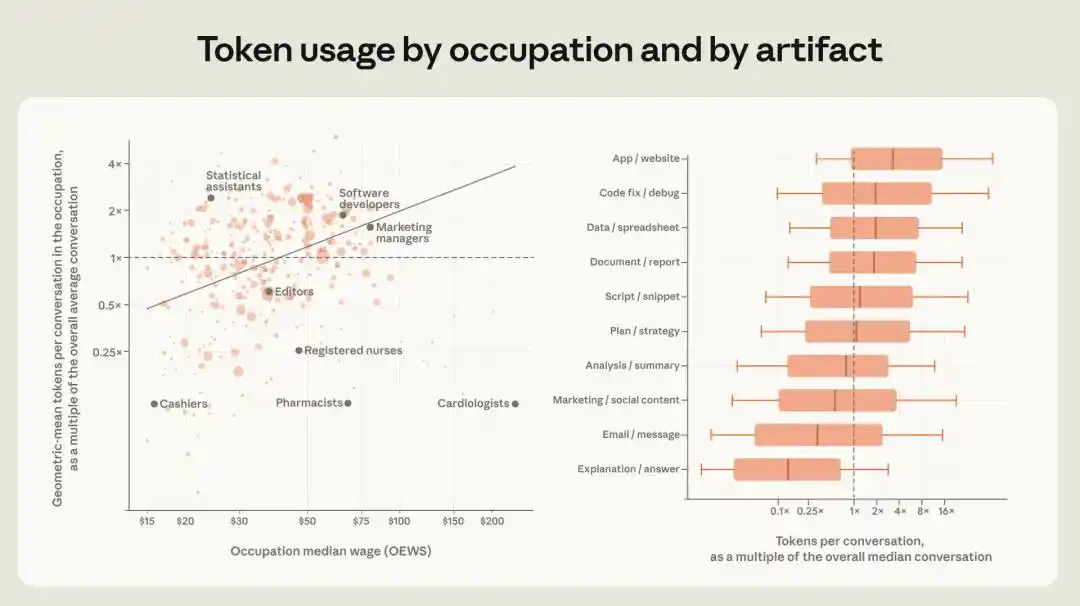
More interesting is the relationship between token consumption and salary.

Anthropic matched each conversation to the most relevant occupation and then compared it to the median wage for that profession.

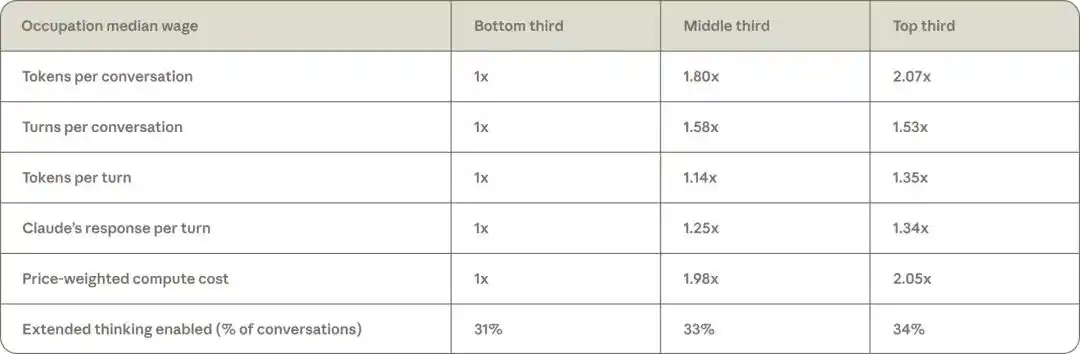
Thus, a pattern emerged: Conversations for high-salary professions consume more tokens.

Conversations associated with Marketing Managers ($80/hour) use about 2.5 times the tokens of those for Editors ($37/hour).

A conversation to build a website consumes over 3 times the median token count. An explanation uses only one-fifth of the median.

And high-income users don't simply "throw tasks at AI."

They output more per turn (1.34x), have more interaction turns (1.53x), and use the deep thinking feature more frequently (34% vs. 31%).

Claude isn't slacking, and neither are the people using it.
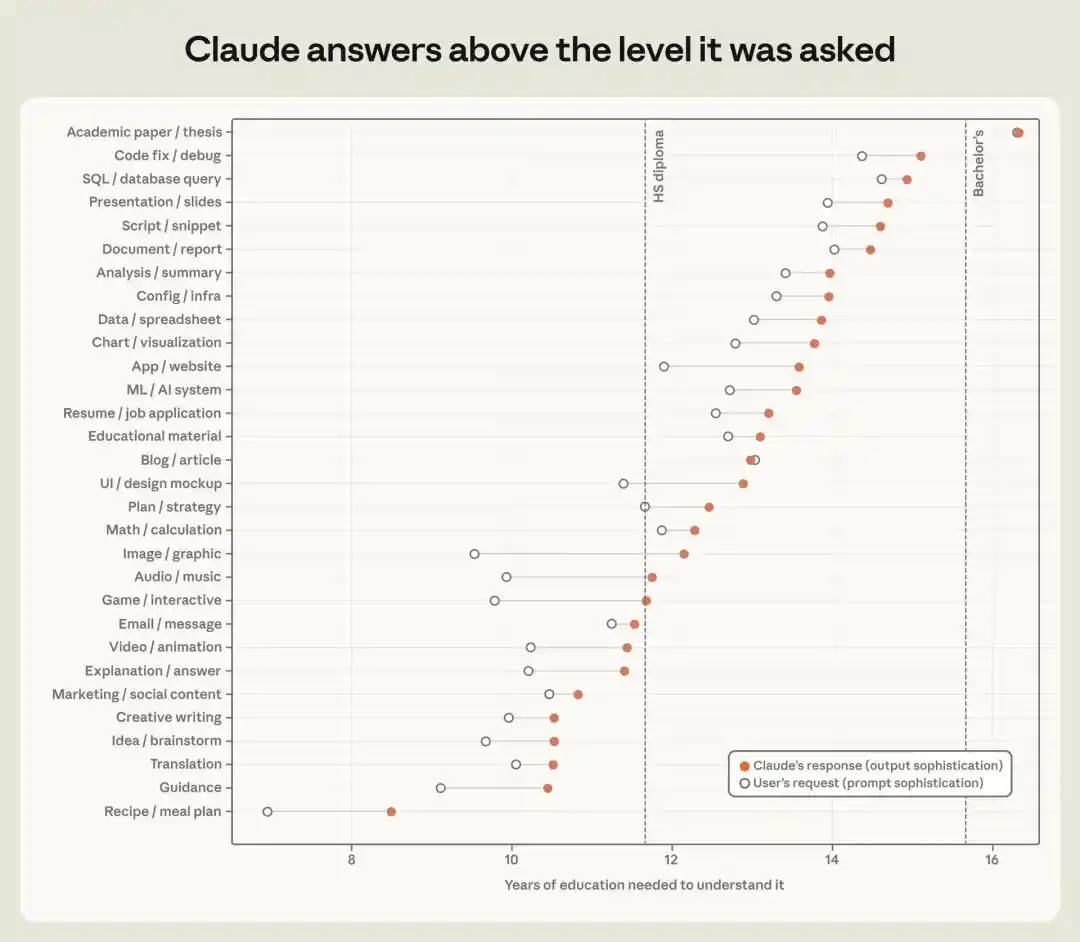
Of course, Claude not only works more but also works "higher."

Its responses generally have a higher reading level than user prompts, averaging about one year more of education.

The largest gaps are in Images & Graphics (+2.6 years), Games (+1.9 years), and Websites/Apps (+1.7 years).

But for audience-facing writing, the gap almost disappears: Blogs (-0.1 years), Academic Papers (+0.0 years), Emails (+0.3 years).

The reason is that prompts for such tasks often include text samples at the same level as the desired output. If you ask it to help write an email, you've likely already drafted a version yourself, so the reading levels are similar.
A Diary You Never Intended to Write

This so-called "rhythm" is simply you opening a dialog box every day, asking a few questions, and taking what you need.

But when these conversations are sliced hourly, outputs are divided into over 30 categories, and each interaction is matched to an occupation and salary bracket, the fragments form a picture.

Insomnia at 5 a.m., dinner anxiety at 6 p.m., sudden entrepreneurial thoughts on weekends, and emotional lows flooding in late at night.

Viewed individually, these are just hundreds of unrelated questions. But strung together, they become a person's schedule, emotional cycles, and days.

You might not have fully shared these things with people around you. But you've entrusted them all to a dialog box.

93% of conversations produced something. Conversely, 93% of conversations also left a trace of you.

Anthropic says this report aims to see how AI integrates into economic life. But once data becomes precise to the hour, what it reflects is more than just economics.

By day, Claude is your work buddy. At 5 a.m., only it knows you're still awake.

References:

https://x.com/AnthropicAI/status/2070528961235575278

https://www.anthropic.com/research/economic-index-june-2026-report

This article is from the WeChat public account "新智元" (New Zhiyuan), author: ASI启示录 (ASI Apocalypse)


Trending Cryptos

Related Questions

QAccording to the Anthropic report, what are the most common questions people ask AI at 5 AM, 7 AM, and 6 PM?

AAccording to the Anthropic report, at 5 AM, people most commonly ask AI for help with how to fall asleep. At 7 AM, they ask about major world news events. At 6 PM, the most common question is about what to cook for dinner.

QHow does Claude's usage differ between weekdays and weekends?

AOn weekdays, usage is dominated by work-related tasks such as business emails, PPTs, and marketing copy, with personal use accounting for about 35% of conversations. On weekends, personal use jumps to nearly 50%, focusing on emotional support, medical questions, and investment advice. Interestingly, weekend entrepreneurial conversations peak, while job-hunting activities decline.

QWhat does the report reveal about the relationship between profession/task complexity and AI interaction?

AThe report shows a correlation between higher-income professions and more complex AI interactions. Conversations related to high-paying jobs like marketing managers and programmers involve higher token consumption, more user input per round, and greater use of features like deep thinking. In contrast, lower-paying jobs have simpler interactions with lower resource usage.

QWhat are the three most common types of 'artifacts' or outputs produced from conversations with Claude?

AThe three most common types of 'artifacts' produced from conversations with Claude are: explanations (17%), documents and reports (15%), and guidance/advice (11%).

QWhat does the Anthropic report suggest about how AI usage reflects people's daily lives beyond just economic activity?

AThe report suggests that by analyzing hourly data, AI usage patterns reveal the daily rhythms, personal anxieties, and emotional cycles of users. It captures moments like 5 AM insomnia and 6 PM dinner anxiety, creating an unintentional diary of a person's life and well-being, not just their economic activities.

Related Reads

Tencent Buys Baidu Chips

China's internet giants, once defined by building closed, self-sufficient empires, are undergoing a fundamental shift. A key signal is Baidu's plan to spin off its AI chip unit, Kunlun Xin, for a Hong Kong IPO targeting a $50 billion valuation, potentially exceeding its parent company's worth. Concurrently, Alibaba's T-Head is also pursuing independence. Most significantly, reports indicate that rival Tencent has become a major customer for Kunlun Xin's chips. This move, where competitors begin procuring each other's core technologies, marks a decisive break from the past era of internal duplication and isolation. It signals the maturation of China's AI industry into a more open, specialized ecosystem. The underlying driver is the immense and clear cost of AI infrastructure, particularly the exploding demand for inference compute driven by AI agents and applications. Hardware is no longer just an internal cost center but a profitable, strategic business in itself. Globally, a parallel trend is evident as OpenAI, Google, Amazon, and others develop their own AI chips to control costs and optimize performance. The competition has moved beyond model benchmarks to a deeper, foundational war over token cost efficiency, inference cluster performance, and secure, scalable computing power. Baidu and Alibaba aren't dismantling their empires but are instead decoupling non-core, capital-intensive infrastructure to participate in and shape a larger, collaborative industrial base. The era of the all-encompassing super-app is giving way to an age of strategic specialization and open ecosystem building in the AI race.

marsbit10m ago

Tencent Buys Baidu Chips

marsbit10m ago

The Token Itself Is an Asset: Three Types of Tokenized Stocks, Which One Suits You?

"Tokenized Stocks: Three Types, Which One Fits You? For investors outside the US, buying stocks like SpaceX or Nvidia is difficult, requiring brokers, cross-border transfers, and often accredited investor status. Blockchain offers an alternative through tokenized stocks, a term encompassing three distinct products with vastly different ownership, voting, and profit rights. 1. **Full Real Ownership**: Companies like Superstate register native equity directly on-chain (e.g., Solana). Holders are on the official shareholder registry, with full voting rights, dividends, and legal ownership. This offers maximum rights but potentially less DeFi flexibility. 2. **SPV-Backed Tokens (Surrendered Ownership for DeFi Composability)**: Issuers like Backed (xStocks) and Ondo use offshore Special Purpose Vehicles (SPVs) to hold underlying shares 1:1 and issue tracking tokens. Investors get price exposure and dividends (reinvested as more tokens) but hold a claim on the SPV, not direct stock ownership. This enables use as collateral in DeFi protocols (Kamino, Morpho) and 24/7 minting/redemption, but carries SPV counterparty risk (highlighted by the PreStocks collapse). 3. **Perpetual Futures (Pure Price Speculation)**: Platforms like TradeXYZ (on Hyperliquid) and Ostium offer perpetual contracts. These are synthetic derivatives with no underlying stock ownership, using funding rates to track spot prices. They require only a price oracle, allowing extremely fast listing (e.g., SpaceX pre-IPO) and high leverage, attracting speculators. Their trading volume far exceeds tokenized spot products. The core value of tokens is that they don't need to replicate full stock ownership. Most retail investors never vote. Tokenization creates layered financial tools: full equity for institutions, composable tokens for DeFi users, and perpetuals for leveraged traders."

marsbit10m ago

The Token Itself Is an Asset: Three Types of Tokenized Stocks, Which One Suits You?

marsbit10m ago

AI as the Boss: Nearly Bankrupts 10 Companies...

A recent study from Princeton University tested 14 AI models, including large language models (LLMs) and a rule-based algorithm, in a simulation where they acted as CEOs of a virtual SaaS startup over 500 days. The goal was to grow an initial $1 million capital. The results were stark: only four "CEOs" ended with a profit. The top performer was Claude Fable 5, multiplying the capital 47-fold to $47.15 million. Claude Opus 4.8 and GPT-5.5 followed. Notably, the fourth profitable entity was a simple, pre-programmed rule-based algorithm, which outperformed many advanced LLMs with $15.76 million in profit. Five other models, including several major LLMs, went bankrupt before the simulation ended. Key takeaways from the research highlight that successful AI CEOs demonstrated a tendency for exploration and adaptation over caution. They excelled in discovering hidden information, predicting future cash flow, adapting quickly to changes (like competitor moves), and engaging in strategic "if-then" planning. The study also found that equipping LLMs with programming-agent frameworks, optimized for coding tasks, actually harmed their performance in this CEO role, suggesting a need for domain-specific adaptations. The article concludes by contrasting AI's current operational proficiency within defined frameworks with the type of visionary, intuitive decision-making—exemplified by figures like Steve Jobs—that truly drives transformative business strategy. This critical "matrix-drawing" capability, it argues, remains uniquely human.

marsbit20m ago

AI as the Boss: Nearly Bankrupts 10 Companies...

marsbit20m ago

Tokens as Assets: Which Type of Tokenized Stock Is Right for You?

**Tokenized Stocks: Three Models, Which Suits You?** For investors outside the US, accessing stocks like SpaceX or NVIDIA is often difficult, requiring compliant brokers and cross-border transfers. Blockchain offers an alternative through tokenized stocks, but this term encompasses three distinct models with vastly different ownership, voting rights, and economic benefits. The first model offers full, direct ownership. Platforms like Superstate register shares directly on-chain (e.g., Solana), with holders listed on the official shareholder registry, granting full voting rights, dividends, and legal status. The second model sacrifices direct ownership for DeFi composability. Issuers like Backed and Ondo use offshore Special Purpose Vehicles (SPVs) to issue tokens 1:1 backed by real shares. Holders gain price exposure and automated dividend accruals (via token balance increases), and tokens can be used as collateral in DeFi protocols. However, this introduces SPV counterparty risk, as seen in the PreStocks collapse. The third model abandons ownership entirely for pure price speculation. Perpetual futures platforms like TradeXYZ (on Hyperliquid) and Ostium create synthetic markets using price oracles and funding rates to track stock prices. They require no underlying shares, enabling rapid listing (e.g., SpaceX pre-IPO) and high leverage, which explains their trading volumes being 4-5x higher than tokenized spot markets. The core insight is that tokens derive value without needing to replicate full stock ownership. Most retail investors rarely exercise voting rights. These three models cater to different needs: direct ownership for institutions, DeFi-composable tokens for on-chain users, and perpetuals for leveraged, speculative traders. Tokenization is not a mere stock substitute but a new class of layered financial instruments.

Foresight News21m ago

Tokens as Assets: Which Type of Tokenized Stock Is Right for You?

Foresight News21m ago

Trading

Spot

Hot Articles

Discussions

Welcome to the HTX Community. Here, you can stay informed about the latest platform developments and gain access to professional market insights. Users' opinions on the price of S (S) are presented below.

活动图片