Bitcoin’s Volatility Drops as It Matures, Setting the Stage for Bitcoin Hyper ($HYPER) Presale to Explode

bitcoinistPublished on 2025-08-25Last updated on 2025-08-25

Abstract

Believe it or not, Bitcoin’s volatility has hit a five-year low, even as its price rockets to new highs and...

Trusted Editorial content, reviewed by leading industry experts and seasoned editors. Ad Disclosure

Believe it or not, Bitcoin’s volatility has hit a five-year low, even as its price rockets to new highs and then takes a breather.

The world’s first crypto is starting to act a lot more grown-up. The crazy price swings that it was famous for are now a thing of the past.

For years, Bitcoin’s wild price fluctuations scared potential investors. But it now seems less jumpy than a big tech stock. According to recent data, Bitcoin’s volatility has been lower than even Wall Street giants like Nvidia since 2022.
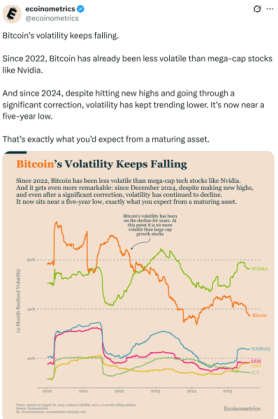
Ecoinometrics $BTC graph showing its declining volatility.
Source: @ecoinometrics on X

This shift shows a big change in how the market sees Bitcoin.

Popular crypto analyst Lyn Alden even thinks this current bull run will be ‘less extreme’ and last longer. We might see more steady climbs and periods of instability instead of the usual ‘to the moon and then crash’ pattern, she explains in a recent interview for CryptoSlate.

Bitcoin is finally settling down and acting like a legitimate financial asset.

This maturity will see projects upscaling the OG digital asset, like Bitcoin Hyper ($HYPER), get more attention from investors looking to diversify.

Why Bitcoin is Calming Down

So, why is Bitcoin suddenly so chill? A big reason is the launch of the spot Bitcoin ETFs in the U.S. back in early 2024.

These new, regulated products, offered by major players like BlackRock and Fidelity, made it super easy for everyday people and big institutions to get into Bitcoin.

With more people and more money flowing in, the market became a lot more stable, smoothing out those wild price swings.

Another factor is that you can now put Bitcoin in your 401(k) retirement account. As big-money players like pension funds and insurance companies start adding Bitcoin to their portfolios, the asset becomes less vulnerable to short-term speculators.

White House fact sheet about adding digital assets to your 401(k).

This means less drama and more stability. Bitcoin is also starting to move in sync with the broader stock market, which is another huge sign that it’s officially part of the mainstream.

For both casual investors and institutions, this lower volatility means less risk and a smoother ride. It proves Bitcoin is officially leaving its rebellious teenage phase behind and settling into its role as a key player in the financial world.

To keep up with the demand, though, it needs an upgrade. This is exactly what Bitcoin Hyper ($HYPER) brings to the table.

Its promising blockchain upscaling soltuion and an explosive presale nearing $12M are the main reasons why we think it’s one of the best crypto presales in 2025.

Why Bitcoin Needed an Upgrade like Bitcoin Hyper

The team behind Bitcoin Hyper ($HYPER) saw the many challenges faced by $BTC and decided to build a powerful new layer to upgrade the OG.

Bitcoin is a legend, but it’s got some major hang-ups. While it was a revolutionary idea, it was never built for the lightning-fast, high-tech world we live in now.

Its transactions are painfully slow, it’s not programmable for modern protocols like you see on Ethereum and Solana, and the fees can get pretty high when the network’s busy.

Enter Bitcoin Hyper’s Layer-2: fully programable for DeFi thanks to integrating the Solana Virtual Machine; maintaining trustless cross-chain transfers and secure settlement on Bitcoin’s network.

Bitcoin Hyper's ecosystem for short: payments, dApps, meme coins, and more.Their goal? To transform Bitcoin from a simple digital asset into a full-blown platform for innovation, all while keeping that rock-solid security that Bitcoin is famous for.

With such a daring promise and its devnet already live, it’s no surprise the $HYPER presale is booming. So far, the project has raised nearly $12M from thousands of investors.

Right now, the token sells for $0.012795. However, our $HYPER price prediction sees a potential $0.32 high by the end of 2025.

Check $HYPER to lock 2,400% potential ROI.

Bitcoin Hyper’s Secret for Unmatched Speed

Bitcoin Hyper ($HYPER) aims to solve Bitcoin’s bottlenecks, but it’s not the first L2 project to attempt this. So, what makes it unique? It’s the Solana Virtual Machine integration.

This add-on basically brings the insane speed and low latency of Solana to the Bitcoin world. It’s a simple but powerful change that brings Bitcoin up to modern standards.

This means developers can finally create super-fast, scalable dApps on a network that’s still backed by Bitcoin’s security.

That’s how Bitcoin Hyper acts as a high-performance Layer 2 chain, handling transactions at warp speed and then settling them on the main Bitcoin network later.
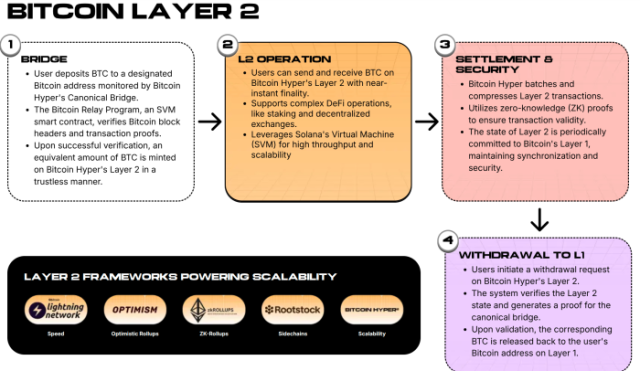
Bitcoin Layer 2 explained.

This setup keeps costs low and speed high without clogging up the original chain.

Another staple is the Canonical Bridge. It’s a decentralized bridge that lets you move your Bitcoin from the main chain to the Layer 2 easily and securely.

Once your $BTC is on the new layer, you can use it for virtually everything, from quick payments to DeFi protocols and NFT platforms.

Thanks to this new system, Bitcoin is becoming a dynamic platform ready for the future. Our full guide to What is Bitcoin Hyper covers its roadmap and features in even more detail.

Visit the Bitcoin Hyper presale for 93% APY.

Maturity Takes Time

Bitcoin’s story is about growing up. It’s moving on from being that wild, rebellious teenager to a more stable and serious adult in the financial world.

A major part of it is thanks to big-time players getting involved with things like ETFs and retirement accounts.

The fact that $BTC is less volatile now, combined with new tech upgrades like Bitcoin Hyper ($HYPER) coming its way, shows just how much the OG crypto is changing.

With Hyper’s help, Bitcoin isn’t just ‘digital gold’ you stick in a vault anymore. It’s becoming a versatile platform ready to power a whole new wave of apps.

Remember to do your own research and invest wisely. This article isn’t financial advice.

Editorial Process for bitcoinist is centered on delivering thoroughly researched, accurate, and unbiased content. We uphold strict sourcing standards, and each page undergoes diligent review by our team of top technology experts and seasoned editors. This process ensures the integrity, relevance, and value of our content for our readers.

Ben is a freelance writer specializing in crypto developments (mainly altcoins) and the intricate ways global economics shape the digital asset space. His B.Ed. in Education provides a unique foundation for his writing, enabling him to distill complex crypto concepts and market shifts into clear, digestible insights. This skill is key to helping readers adapt and apply their understanding to the ever-evolving world of crypto investment. Passionate about making crypto accessible, Ben crafts content designed to educate a broad audience, from current market events to the essential foundational knowledge that underpins them. His goal is to empower readers through understanding. When he’s not immersed in crypto analysis and breaking down complex topics, Ben is an avid Pokémon fan and enjoys all things Disney.

Trending Cryptos

Related Reads

In Such a Crowded Cross-border Payment Track, Where Does the Next Stop Lie in the Future?

The crowded cross-border payments industry faces a paradox: intense competition above water with financing and narratives, while beneath, price wars and shrinking margins in basic PSP services are common. The path forward lies not in simple "cross-border" solutions but in deep **localization**. Success requires mastering the fragmented and tightening regulations of fiat currencies in each market—the "last mile" of compliance, banking, and settlement. Many Chinese PSPs have succeeded by following Chinese merchants overseas but have not deeply penetrated mainstream local merchant ecosystems abroad. Their strong product capabilities need to be applied to new, complex markets. The future belongs to companies that evolve from single-channel providers to **cross-border capital network operators**. This means moving beyond competing on transaction fees to creating internal networks that optimize capital efficiency through multi-directional matching, netting, and position reuse across countries and currencies. For Web3 and stablecoins, the key is integration, not replacement. Stablecoins offer efficiency gains but cannot bypass the foundational trust, compliance, and legal frameworks of traditional finance. The realistic path is the gradual adoption and "taming" of Web3 technologies by established financial institutions. The ultimate solution is a **dual clearing infrastructure** combining deep local fiat capabilities (local accounts, compliance, banking) with lightweight stablecoin-native capabilities (on-chain settlement, wallets). The biggest opportunity lies not in oversaturated mainstream corridors but in complex, underserved regional corridors (e.g., specific CIS, Middle East-Southeast Asia, or Latin American trade pairs). The winners will be those who build hard-to-replicate, deep capabilities in these areas—acting as the essential "clearing shovels" or infrastructure providers. The future keywords are **more local, more networked, and more stablecoin-native**. High-profit opportunities remain in the non-standardized, difficult-to-replicate deep waters of the industry, requiring genuine on-the-ground presence and long-term patience.

链捕手1h ago

In Such a Crowded Cross-border Payment Track, Where Does the Next Stop Lie in the Future?

链捕手1h ago

Lightning Fast Five-Whip Combo! Strategy's Self-Rescue Plan Officially Released

Strategy, amidst the STRC de-pegging crisis, has unveiled its "Digital Credit Capital Framework" self-rescue plan. The five-part framework includes: 1) **Cash Reserves**: Management of ~$2.55B in USD reserves, dedicated solely to covering ~17.4 months of preferred stock dividends and debt interest, with a 12-month minimum coverage floor. 2) **Dividend Policy**: STRC's dividend yield rises to 12% from July 1st, with monthly reviews. Strategy clarifies de-pegging does not automatically trigger further hikes. 3) **Preferred Stock Buyback**: A $1B authorization, prioritizing STRC repurchases to support its price, reduce future dividend obligations, and signal commitment, using funds separate from dividend reserves. 4) **Common Stock Buyback**: A separate $1B authorization for MSTR stock, aimed at creating shareholder value when the stock is deemed undervalued, establishing a two-way capital management mechanism. 5) **Bitcoin Monetization**: Formal authorization to sell BTC (up to $1.25B earmarked) to build USD reserves, cover dividends/interest, or fund buybacks, marking a strategic shift where BTC becomes a managed asset rather than a strictly "hold-only" reserve. Market reaction saw MSTR and STRC shares rise pre-market, while BTC remained stable. The plan aims to restore confidence in STRC, ensure dividend sustainability, and reopen Strategy's funding channels.

Odaily星球日报2h ago

Lightning Fast Five-Whip Combo! Strategy's Self-Rescue Plan Officially Released

Odaily星球日报2h ago

The Sword of Damocles Over the AI Bull Market: Not Just in South Korea, Leverage in U.S. Stocks Is Equally Staggering

Global equity markets are hitting new highs driven by the AI boom, but the fuel behind this rally is becoming increasingly dangerous. From the US to South Korea, margin debt and leveraged ETF assets have soared to historical extremes, with their pro-cyclical nature amplifying tail risks in market volatility. In the US, margin debt rose 54% year-over-year in May, reaching a record $1.4 trillion. Simultaneously, leveraged ETF assets nearly doubled in under 70 days to over $220 billion by early June, with intense focus on tech, semiconductor indices, and single stocks like NVIDIA and Tesla. A warning sign appeared in South Korea, where the KOSPI index experienced extreme volatility, plunging 10% to trigger a circuit breaker, then sharply rebounding before halting again, partly driven by concentrated, highly leveraged positions in chip stocks. Analysts are raising alarms. Barclays warns that leveraged funds have accumulated roughly $300 billion in equity-linked derivatives since late March, creating a major source of non-discretionary risk. Morgan Stanley notes an unprecedented reliance on leveraged financing by marginal buyers, with financing becoming more expensive and scarce. Charles Schwab has tightened margin requirements. The core risk lies in the mechanics: leveraged ETFs and derivatives can create a "tail wags the dog" effect, where fund flows force market makers to buy underlying stocks, amplifying gains. This process reverses in a downturn, triggering a self-reinforcing selling spiral as funds deleverage. Additionally, the cost of borrowing to buy stocks has spiked to multi-year highs. Morgan Stanley warns this sets up a nonlinear risk: high financing costs stall momentum, a price decline triggers forced deleveraging, and selling pressure is multiplied by leverage, potentially leading to outsized declines. The current market breadth is narrow, with gains heavily concentrated in tech, making the rally vulnerable to a pullback in leveraged positions. In summary, the AI-fueled bull market is increasingly propped up by record leverage. When this trend reverses, the deleveraging process could magnify losses, posing a significant threat to financial stability.

marsbit2h ago

The Sword of Damocles Over the AI Bull Market: Not Just in South Korea, Leverage in U.S. Stocks Is Equally Staggering

marsbit2h ago

Trading

Spot

Hot Articles

Discussions

Welcome to the HTX Community. Here, you can stay informed about the latest platform developments and gain access to professional market insights. Users' opinions on the price of S (S) are presented below.

活动图片