Solana targets $80 next – 3 factors helping SOL bulls sustain this rally

ambcryptoPublished on 2026-06-29Last updated on 2026-06-29

Abstract

Solana (SOL) has demonstrated strong bullish momentum, defending the $70 support level and climbing to a local high of $73, currently trading near $72 with a 2.6% daily gain and a 39% surge in trading volume. Technical analysis reveals SOL holding above its 9-day and 21-day Moving Averages, with its Stochastic Momentum Index (SMI) showing a bullish crossover and trending upward, indicating strengthening short-term momentum. A key driver appears to be a shift in whale sentiment, with data showing concentrated large buy orders around $70-$71 and consistent negative exchange netflows, signaling accumulation. This combination of technical strength and whale demand suggests SOL could target the $80 resistance if buying pressure continues. However, a weakening in whale demand could see a retest below $70, with $62 as the next major support level.

SOL has recently exhibited strong bullish pressure. After hitting a low of $69, the altcoin defended $70 and climbed to a local high of $73 before slightly retracing.

In fact, as of this writing, Solana [SOL] traded at $72 after gaining 2.6% over the past day. At the same time, the altcoin’s trading volume rose 39%, indicating strong market participation.

What do Solana’s charts reveal?

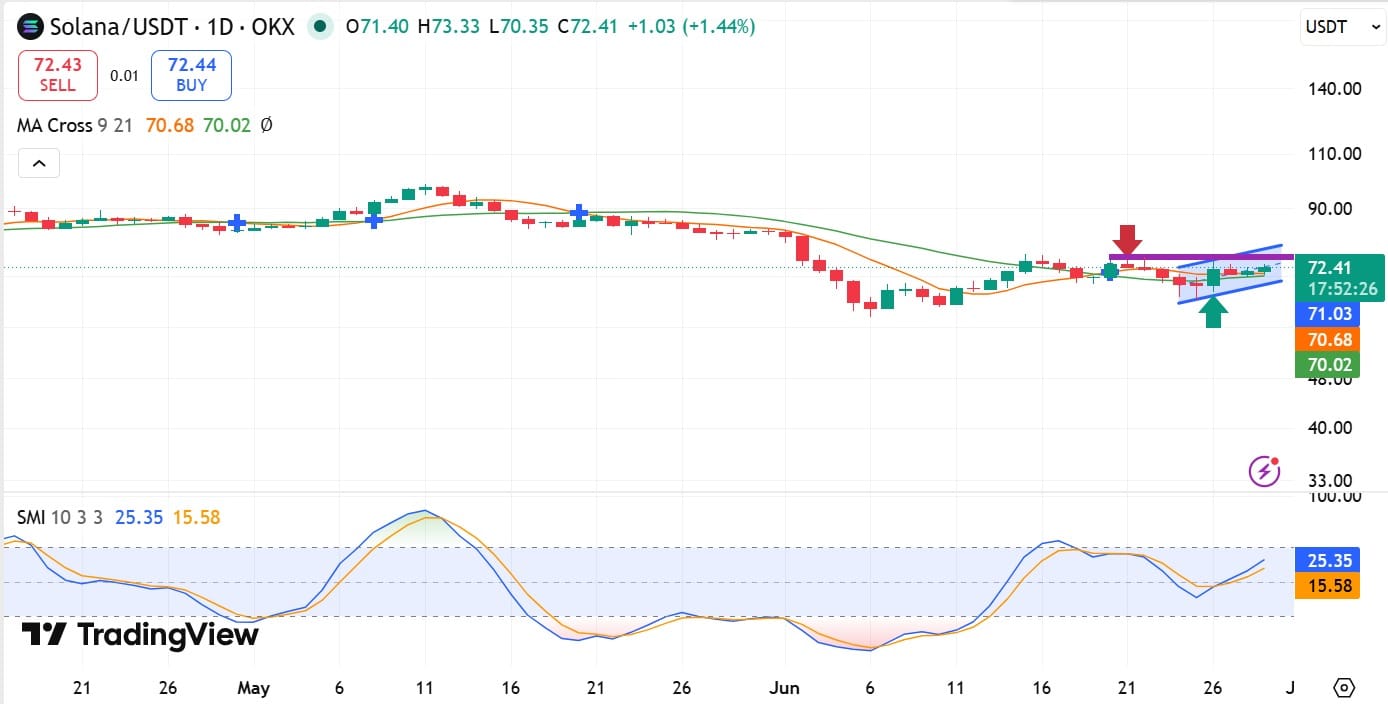
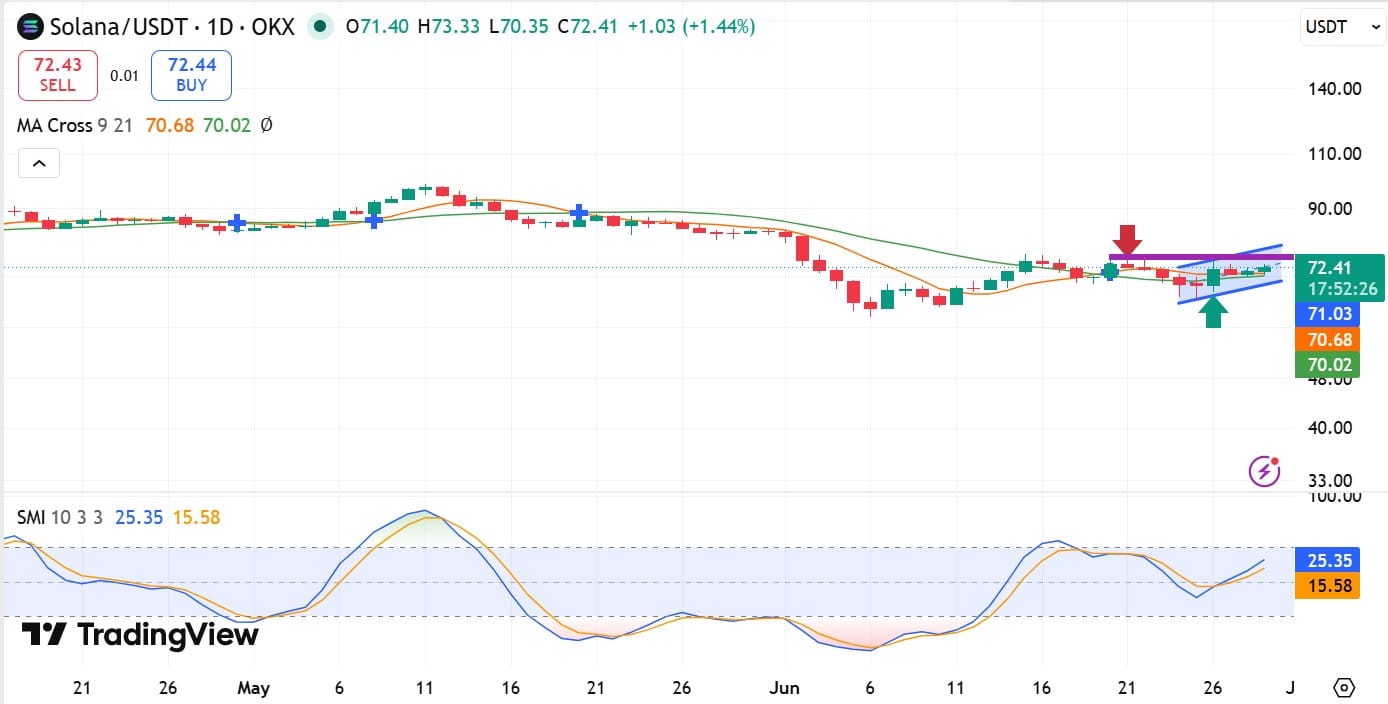
Solana held above its 9-day and 21-day Moving Averages, reinforcing its bullish market structure. That move signaled strengthening short-term momentum.

The altcoin’s momentum indicators also supported this trend. The Stochastic Momentum Index (SMI) formed a bullish crossover two days ago.
Source: TradingView

Since then, the SMI has climbed to 27, remaining just below the 30 threshold. This continued upward trajectory suggested improving market conditions.

Together, the Moving Averages and SMI pointed to sustained bullish momentum. A move above 30 on the SMI could confirm the trend’s strength, potentially opening the door to further gains.

Is whale sentiment shift the driving force?

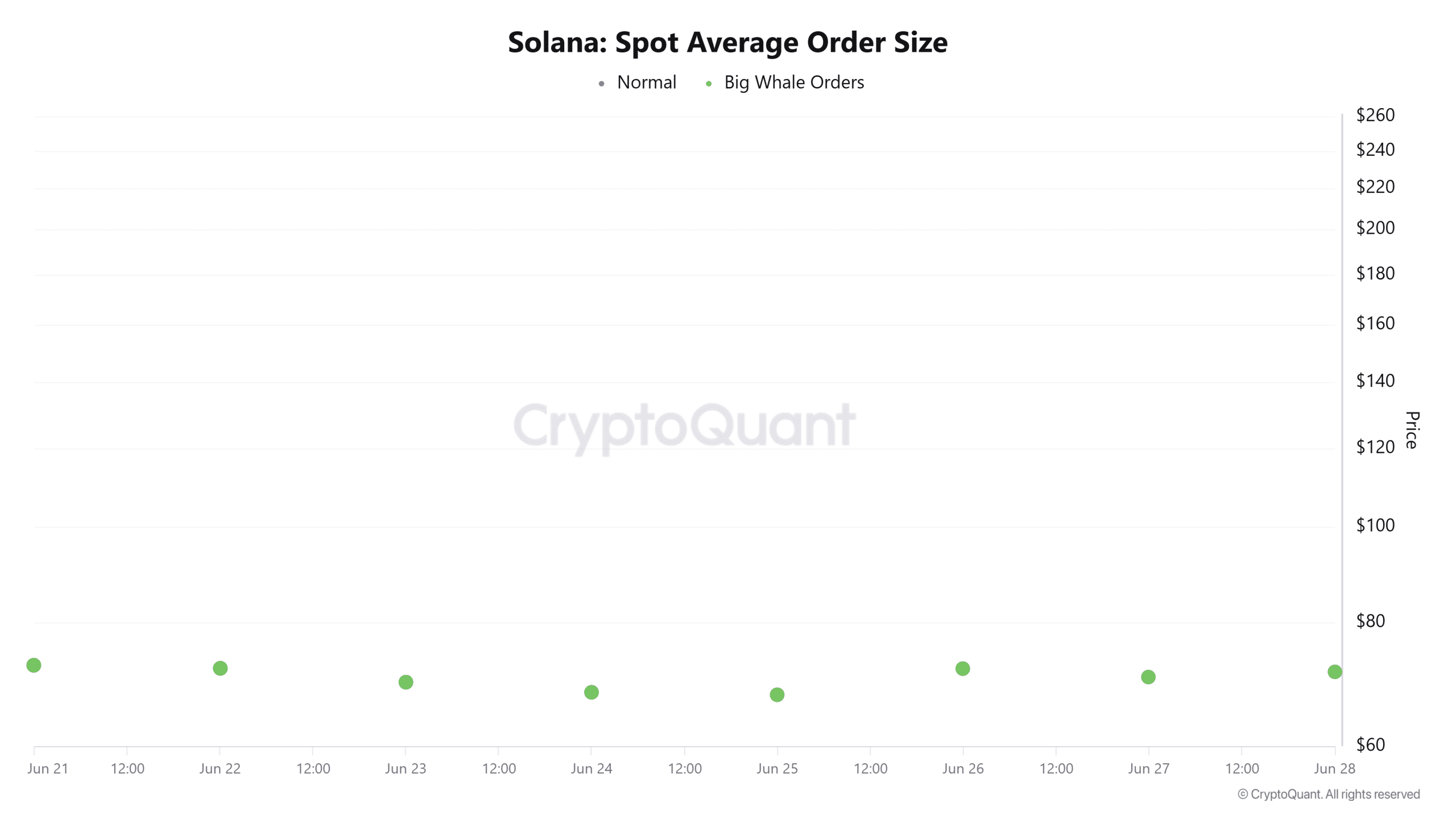
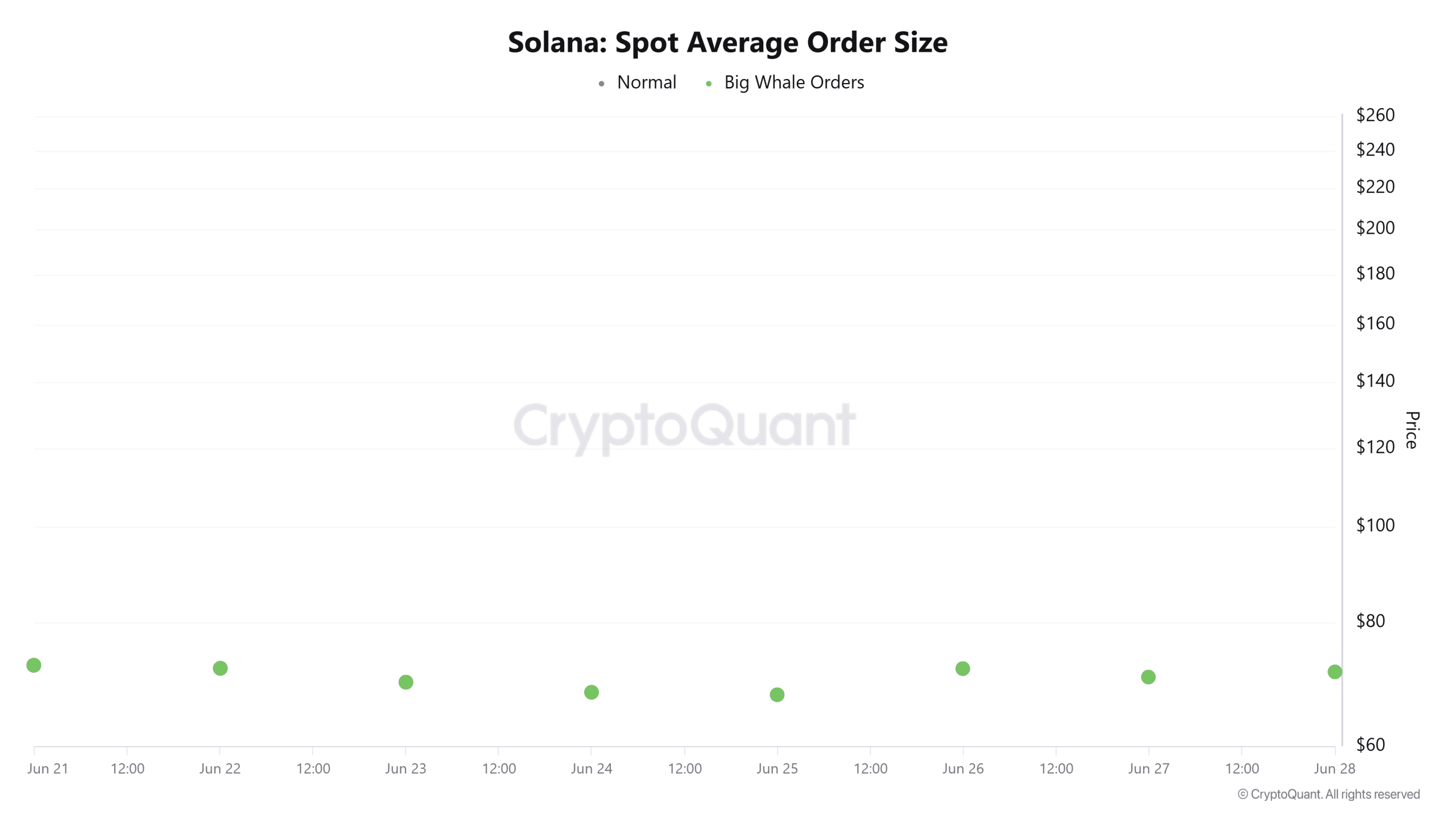
Solana’s renewed strength seems largely driven by a shift in sentiment among whales. Whale activity on the spot market has remained steady over the past week.

CryptoQuant’s Spot Average Order Size data showed large whale orders concentrated around the $70 and $71 price levels.
Source: CryptoQuant

These orders suggest that, at these levels, whales have increased participation in either buying or selling. Interestingly, the jump in whale orders has coincided with a significant jump in exchange outflows.

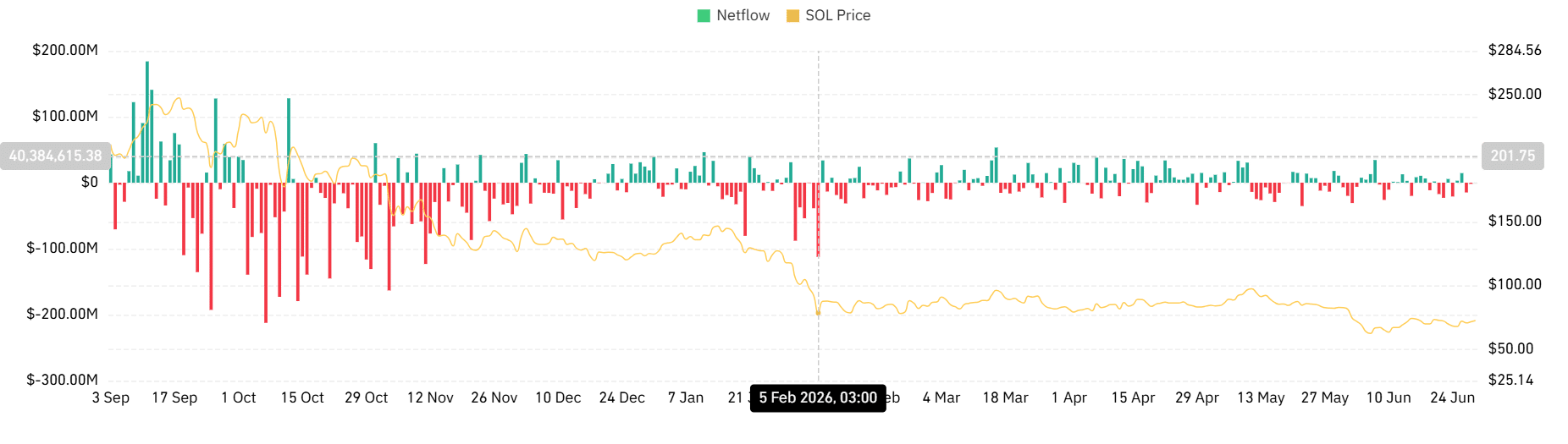
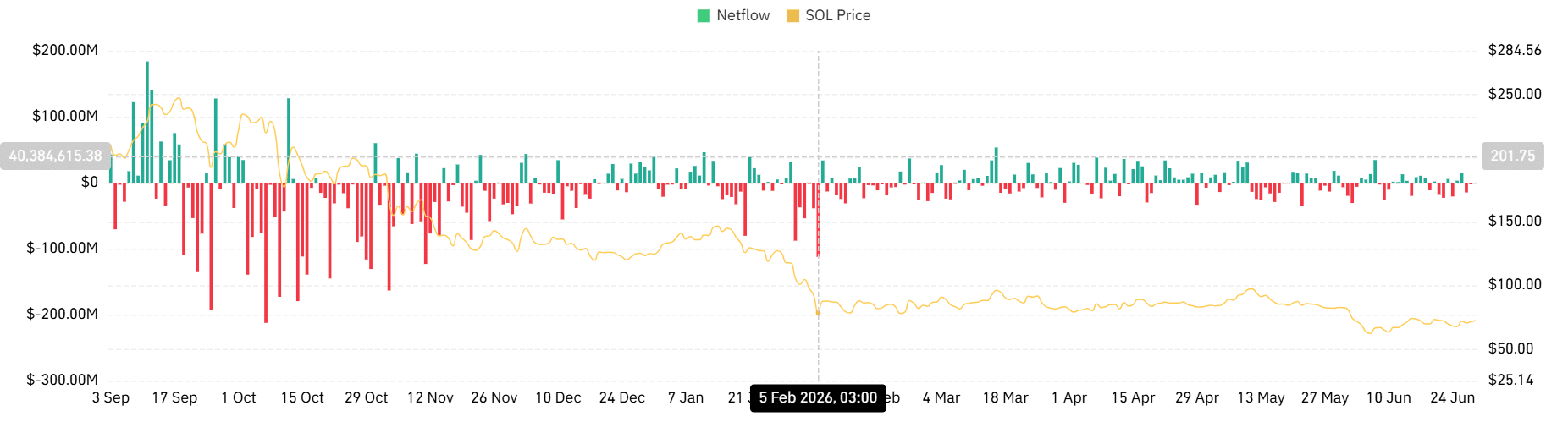
In fact, CoinGlass data showed that Solana Spot Netflow has remained negative over the past three days. Over the last week, Netflow recorded a positive value once.
Source: CoinGlass

At press time, Spot Netflows stood at -$112k, improving from -$1.7 million recorded the previous day. A negative Spot Netflow suggested whales were primarily accumulating SOL.

Can SOL extend its rally?

Solana maintained bullish momentum, supported by renewed whale demand. That could keep buyers in control if accumulation continues.

Therefore, if demand continues absorbing selling pressure, SOL could reclaim $75 and target the $80 resistance over the short to medium term.

However, if whale demand weakens, Solana could fall below $70 again, with $62 serving as the next key support.


Final Summary

  • Solana gained 2.6% after defending $70 and reaching a local high of $73 before easing slightly.
  • Renewed whale accumulation and improving momentum indicators could support a move toward $80 if demand persists.


Trending Cryptos

Related Questions

QAccording to the article, what are the two key technical indicators mentioned that reinforce Solana's bullish market structure?

AAccording to the article, Solana holding above its 9-day and 21-day Moving Averages, along with the Stochastic Momentum Index (SMI) forming a bullish crossover, reinforce its bullish market structure.

QWhat does the data on Spot Netflows suggest about whale activity regarding SOL?

AThe negative Spot Netflows data, with a current reading of -$112k, suggests that whales are primarily accumulating SOL, as more tokens are leaving exchanges than entering them.

QWhat price levels did whale orders concentrate around, as shown by CryptoQuant's data?

ACryptoQuant's Spot Average Order Size data showed that large whale orders were concentrated around the $70 and $71 price levels.

QWhat is the potential short-to-medium term price target for SOL if the current bullish conditions persist?

AIf demand continues to absorb selling pressure, the article states that SOL could reclaim $75 and target the $80 resistance level over the short to medium term.

QWhat is identified as a key support level for SOL if whale demand weakens and the price falls below $70?

AIf whale demand weakens and Solana falls below $70, the article identifies $62 as the next key support level.

Related Reads

AI Can 'Have Moods Too'! New Research from USTC: Confusion and Anxiety Make AI Work Better

The article discusses research from the University of Science and Technology of China and Oxford, revealing that allowing AI to recognize and act upon simulated "internal emotions" can significantly improve its performance. The study demonstrates a coherent pairing between specific emotional states in AI agents and their subsequent skill choices. For instance, an agent feeling curious and desirous will search for products, while one feeling confused and tense will rephrase queries. This mirrors human decision-making influenced by emotions. Statistical validation showed a 76.5% semantic consistency in these pairings. Crucially, the research challenges the traditional view of AI errors as flaws to be eliminated. It found that "bad" emotions like confusion, tension, or frustration serve as useful metacognitive signals, indicating a mismatch between the current strategy and the environment. By responding to these signals, AI can proactively adjust before a failure occurs. This is particularly effective in complex tasks prone to failure. For example, in tasks like "heating an item" and "picking up two items," success rates surged from 9.6% to 56.9% and 4.4% to 31.3%, respectively, when using the emotion-driven skill selection method (EMOTION2SKILL). The AI's "nervous" state about a closed microwave, for instance, prompted it to check and open it first, preventing failure. The article also mentions related work from Tianjin University, which embeds emotional prediction into world models (Large Emotional World Model, LEWM), significantly improving prediction accuracy in human-centric environments. Removing emotional data was found to degrade performance even in unrelated logical reasoning tasks. These studies build on earlier findings, like those from Anthropic, that identifiable emotional representations exist within large language models (LLMs). The focus is shifting from philosophical debate about AI emotion to practically harnessing these internal states as functional signals to enhance AI robustness and capability.

marsbitJust now

AI Can 'Have Moods Too'! New Research from USTC: Confusion and Anxiety Make AI Work Better

marsbitJust now

Trading

Spot

Hot Articles

Discussions

Welcome to the HTX Community. Here, you can stay informed about the latest platform developments and gain access to professional market insights. Users' opinions on the price of SOL (SOL) are presented below.

活动图片