Ethereum: Crollo Sotto i 4.100$, Ecco Quanto È Stato Venduto

bitcoinistPublished on 2025-08-21Last updated on 2025-08-21

Abstract

Il prezzo di Ethereum ha subito un rapido calo dopo aver raggiunto un massimo pluriennale di 4.776$ e aver toccato...

Trusted Editorial content, reviewed by leading industry experts and seasoned editors. Ad Disclosure

Il prezzo di Ethereum ha subito un rapido calo dopo aver raggiunto un massimo pluriennale di 4.776$ e aver toccato il livello della sua “Active Realized Price” il 14 agosto. La seconda criptovaluta per capitalizzazione ha registrato una forte vendita negli ultimi sei giorni, con il prezzo sceso fino a 4.074$ nelle ultime 24 ore. Il calo coincide con l’inizio del ritiro dei fondi da parte degli investitori istituzionali dai Spot Ethereum ETF a un ritmo record, un trend che mette in dubbio la sostenibilità del rialzo di Ethereum sopra i 4.800$ e il possibile raggiungimento di nuovi massimi storici.

422,3 Milioni Ritirati in Un Solo Giorno

Secondo i dati di SosoValue, martedì 19 agosto è stato uno dei peggiori giorni di sempre per gli Spot Ethereum ETF negli Stati Uniti. Circa 422,3 milioni di dollari sono stati ritirati in una sola sessione, rappresentando il secondo più grande deflusso giornaliero dalla creazione di questi fondi. L’unico ritiro maggiore risale al 4 agosto, quando gli outflow erano stati di 465 milioni di dollari.

Tra gli emittenti, Grayscale e Fidelity hanno guidato l’esodo con deflussi rispettivamente di 122 milioni e 156,32 milioni di dollari. L’ETF principale di BlackRock, l’iShares Ethereum Trust (ETHA), ha visto il suo patrimonio scendere da 3,6 milioni di ETH (circa 15,8 miliardi di dollari) a circa 14,7 miliardi martedì.

Il tempismo di questa ondata di ritiri nelle ultime 24 ore non potrebbe essere più dannoso, poiché Ethereum stava già scendendo dal recente picco. L’outflow ha subito amplificato la pressione al ribasso sul mercato, facendo crollare Ethereum sotto i 4.100$.

I numeri dei deflussi di martedì non sono stati un episodio isolato, ma il culmine di una tendenza di ritiri che si è estesa su tre sessioni consecutive. Lunedì, gli Spot Ethereum ETF hanno registrato deflussi per 196,62 milioni di dollari, uno dei maggiori deflussi giornalieri dalla loro creazione, subito dopo i 59 milioni di venerdì, che avevano chiuso la precedente serie di ingressi record. In soli quattro giorni, questi ritiri hanno drenato oltre 677 milioni di dollari dagli Spot Ethereum ETF.

Ingressi Record e Rapida Inversione

Nelle otto sessioni di trading precedenti a venerdì scorso, gli Spot Ethereum ETF avevano attratto ingressi senza precedenti per 3,7 miliardi di dollari, con l’11 agosto che ha superato addirittura 1 miliardo di flusso netto in entrata. Questo aumento della domanda è stato un fattore importante dietro il rally di Ethereum fino al massimo pluriennale di 4.776$, alimentando le previsioni che il livello di 4.800$ potesse essere presto superato.

Al momento della scrittura, Ethereum è scambiato a 4.167$, dopo un rimbalzo a 4.070$, mostrando una leggera tendenza al rialzo. In termini percentuali, la criptovaluta principale ha perso l’1,3% nelle ultime 24 ore e il 10% negli ultimi sette giorni. L’altcoin leader sta ora subendo una netta pressione di vendita, con i dati on-chain che mostrano come gli hedge fund abbiano quasi raddoppiato le posizioni short negli ultimi sette giorni.

L’ondata di deflussi dagli Spot Ethereum ETF ha implicazioni significative per le prospettive di prezzo a breve termine di Ethereum. Se l’esodo dovesse continuare, Ethereum potrebbe avere difficoltà a mantenersi sopra il livello di supporto dei 4.000$ e potrebbe scendere verso una correzione più profonda nella fascia media dei 3.000$.
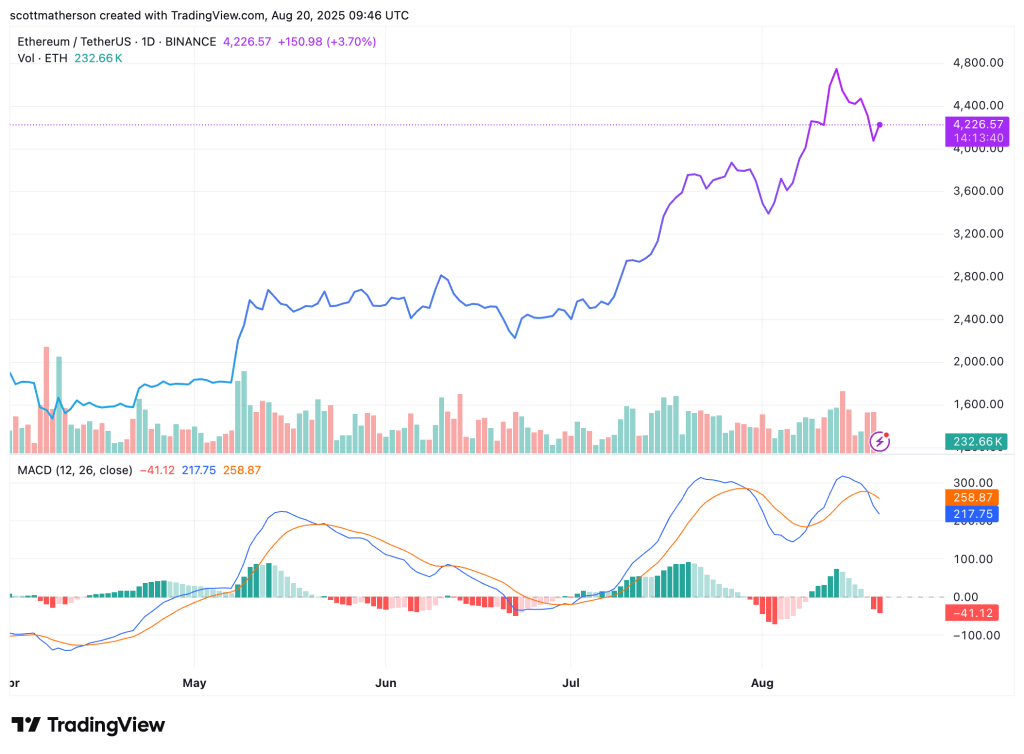
FONTE: TRADING VIEW
Editorial Process for bitcoinist is centered on delivering thoroughly researched, accurate, and unbiased content. We uphold strict sourcing standards, and each page undergoes diligent review by our team of top technology experts and seasoned editors. This process ensures the integrity, relevance, and value of our content for our readers.
Clara Rosati

Clara Rosati

Copywriter
Follow

Ha conseguito una laurea magistrale con una tesi sull’evoluzione della tecnologia blockchain, approfondendo in particolare le sue applicazioni nei sistemi economici digitali. Ha collaborato con diverse testate scrivendo articoli su criptovalute, finanza decentralizzata e innovazione tecnologica, e ha partecipato come relatrice a conferenze dedicate all’ecosistema Ethereum.

Related Reads

Investment Philosophy of Gavin Baker, an Early Nvidia Investor: Long AI Infrastructure Bottlenecks, Short Overall Market Risk

Gavin Baker, an early investor in Nvidia and founder of Atreides Management, outlines his investment philosophy: going long on AI infrastructure bottlenecks while hedging against broader market risk. He argues AI is not a bubble but a supercycle driven by constraints in power, wafers (semiconductors), and compute efficiency (tokens per watt). True alpha, he believes, lies not in application-layer companies like OpenAI but in "picks and shovels" providers—companies solving physical bottlenecks in GPU connectivity (e.g., Astera Labs), memory (Micron), inference chips (Cerebras, Positron), advanced manufacturing (TSMC, ASML), and energy supply. His portfolio reflects this barbell strategy: concentrated bets on key infrastructure players alongside a significant put position on the QQQ ETF to hedge overall market downside. Baker contends this cycle differs from the dot-com bubble because demand is fueled by the strong balance sheets of hyperscalers (Google, Meta, Amazon, Microsoft), not debt, and physical supply constraints (e.g., chip manufacturing capacity) prevent runaway overinvestment. He highlights the growing importance of inference (vs. pre-training), vertical/small language models, sovereign infrastructure deployment speed, and the convergence of energy and space (e.g., orbital compute). His long-term view is that performance-per-watt and token cost reduction will dictate winners as AI scaling hits fundamental physical limits.

marsbit11m ago

Investment Philosophy of Gavin Baker, an Early Nvidia Investor: Long AI Infrastructure Bottlenecks, Short Overall Market Risk

marsbit11m ago

Apple Re-invented Image Compression with AI: Same Quality, One-Third the File Size

Apple’s PICO: An AI-Powered Image Codec That Cuts File Size by Two-Thirds at Equal Perceived Quality In 2025, JPEG AI became the first international standard for learned image compression. However, it, like most codecs, still prioritizes mathematical metrics like PSNR over true perceptual quality—what the human eye finds pleasing. Apple researchers have introduced PICO (Perceptual Image Codec), a neural codec designed to optimize for human perception. It tackles key practical challenges: 1) Speed: A novel "one-shot context model" accelerates entropy encoding without sacrificing compression efficiency. 2) Artifacts: A dedicated TextFidelity loss preserves text clarity, and a TilingArtifact loss eliminates color seams between image tiles processed in parallel. 3) Control: It avoids the "hallucinations" common in GAN-based perceptual models. In a large-scale human evaluation (74,925 comparisons), PICO achieved the same perceived quality as standards like AV1, VVC, and JPEG AI while using only 30-43% of the bitrate. It also outperforms other learned perceptual codecs by 20-40%. Remarkably, it runs in 230ms (encode) and 150ms (decode) on an iPhone 17 Pro Max. While less efficient on synthetic graphics, PICO represents a significant shift from optimizing mathematical scores to directly targeting human visual experience, making high-quality perceptual compression practical for consumer devices. The work builds on expertise from WaveOne, whose team joined Apple and previously advanced neural video compression.

marsbit47m ago

Apple Re-invented Image Compression with AI: Same Quality, One-Third the File Size

marsbit47m ago

Shanghai's Leading Large Model Company Initiates A-Share Listing

Shanghai-based AI large language model leader MiniMax has initiated the process for an A-share listing in China, having filed a pre-IPO tutoring report with the Shanghai Securities Regulatory Bureau on May 29. This move positions it to compete with Zhipu AI for the title of the first major domestic LLM company to list on the A-share market. Having already completed an IPO in Hong Kong in January 2026, MiniMax's stock price has surged approximately 409% since its debut, with its market capitalization reaching around HK$263.45 billion (approximately RMB 227.55 billion) as of May 29. The company's rapid growth is supported by strong business performance. Its Annual Recurring Revenue (ARR) has grown over 100% in the past two months and now exceeds $300 million. It serves over one million global enterprise and developer clients and has around 300 million users worldwide. For the full year 2025, MiniMax reported revenue of $79.038 million, with a gross margin of 25.4%. While it reported an adjusted net loss of $250 million, the loss rate has narrowed significantly year-over-year. On the product front, MiniMax has released several flagship models this year, including MiniMax-M2.5, M2.6, and M2.7, with the first and last being open-sourced. Its models gained significant traction earlier in the year, briefly becoming the top model provider by usage share on the OpenRouter platform in February. The company has also upgraded its AI agent product, now named Mavis, and is preparing to launch its next-generation MiniMax-M3 model. Technical previews indicate M3 will feature a novel "MiniMax Sparse Attention" mechanism, promising substantial improvements in inference speed. MiniMax's push for an A-share listing reflects a broader trend among China's leading AI firms, including Zhipu AI, Moonshot AI, StepFun, and 01.AI, to seek public listings. This strategy aims to secure broader financing channels to support the immense computational costs and ongoing commercialization efforts inherent in developing advanced large language models.

marsbit49m ago

Shanghai's Leading Large Model Company Initiates A-Share Listing

marsbit49m ago

Trading

Spot
Futures

Hot Articles

Discussions

Welcome to the HTX Community. Here, you can stay informed about the latest platform developments and gain access to professional market insights. Users' opinions on the price of ETH (ETH) are presented below.

活动图片