New Solana Consensus Model ‘Alpenglow’ Enters Community Vote

bitcoinistPublished on 2025-08-18Last updated on 2025-08-18

Abstract

Solana core developers have pushed a sweeping consensus overhaul, “Alpenglow” (SIMD-0326), into the ecosystem’s formal governance track, setting up a...

Trusted Editorial content, reviewed by leading industry experts and seasoned editors. Ad Disclosure

Solana core developers have pushed a sweeping consensus overhaul, “Alpenglow” (SIMD-0326), into the ecosystem’s formal governance track, setting up a validator vote that, if approved, would replace TowerBFT and re-architect finality and validator incentives on mainnet-beta. The proposal’s authors—Quentin Kniep, Kobi Sliwinski, and Roger Wattenhofer—describe Alpenglow as “a major overhaul of Solana’s core consensus protocol,” designed to supplant “the existing Proof-of-History and TowerBFT mechanisms” with a design that targets block finalization “as low as 100–150 milliseconds.”

Voting Process For Solana ‘Alpenglow’ Starts

The governance post lays out a three-phase timeline: discussion through epochs 833–838, stake-weight capture in epoch 839, and a binding vote across epochs 840–842 using claimable vote tokens sent to “Yes,” “No,” or “Abstain” accounts. Passage hinges on a supermajority threshold: Yes must be at least two-thirds of Yes+No, with a 33% quorum that counts abstentions. As of today, Solana is in epoch 834, making the discussion window active and the vote window scheduled several epochs out.

At the heart of Alpenglow is Votor, a direct-vote, leader-pipelined finality protocol that shifts Solana away from on-chain vote transactions and heavy gossip toward off-chain vote exchange with local signature aggregation. Validators vote to notarize or skip blocks; leaders aggregate those votes eight slots later and submit compact proofs. The authors argue this design cuts latency dramatically and reduces bandwidth, while a “20+20” liveliness model aims to tolerate up to 20% adversarial and 20% unresponsive validators without halting progress. “Alpenglow… enables much lower latency, improved fault tolerance, and generally greater protocol efficiency,” the post asserts.

The upgrade also rewires validator economics. Because voting moves off-chain, the SIMD introduces a Validator Admission Ticket (VAT), a fixed per-epoch fee “initially set to 1.6 SOL per epoch,” burned to maintain an economic barrier roughly comparable to today’s on-chain vote-fee regime. Validators are “required to cast exactly one valid vote per slot”; conflicting votes are detectable, and persistent non-participation renders a validator ineligible for rewards and at risk of removal from the active set.

Leaders receive compensation equal to the per-slot vote rewards of the votes they aggregate, plus a flat bonus when they include fast-finalization/finalization certificates. In a follow-up thread post, Wattenhofer explains the 1.6 SOL figure as approximately 80% of current vote costs to ensure no operator is worse off at the “AlpenSwitch.”

If adopted, Alpenglow would make a visible semantic change at the client layer: the authors note that optimistic confirmation would be superseded by actual finality at sub-second timescales. The stated aim is to bring confirmation latencies in line with Web2 user expectations while tightening safety guarantees that were harder to formalize under TowerBFT. The proposal’s documentation points readers to a 50+ page white paper and independent analyses, but emphasizes that the initial rollout focuses on finalization and voting; a new data dissemination protocol, Rotor, would follow in a separate SIMD.

Governance mechanics for the vote mirror Solana’s prior advisory processes but with higher stakes. Vote tokens will be claimable via an adapted Merkle distributor; validators then send those tokens to the designated choice accounts during the epoch-bounded window. The foundation’s governance post states, “If the sum of Yes votes is equal to or greater than 2/3 of the total sum of Yes + No votes, the proposal will pass,” and “Abstain” contributes to quorum but not to the supermajority tally. Stake weights and a public tally script will be published for independent verification.

Community feedback has quickly homed in on operational risk and rollout discipline. One validator-oriented response urges the SIMD authors to embed “a testing, deployment and fallback plan” before a mainnet decision, likening the scope of change to other industry-scale protocol transitions. Others probe specifics around the VAT level, transaction expiry in a post-PoH world, leader equivocation handling, and effects on MEV auctions and client UX when slices of a block are ignored under certain failure modes. These threads underscore that while the performance headline—150 ms finality—is eye-catching, the vote will likely hinge on the comfort level with safety proofs, incentive edge-cases, and the migration path.

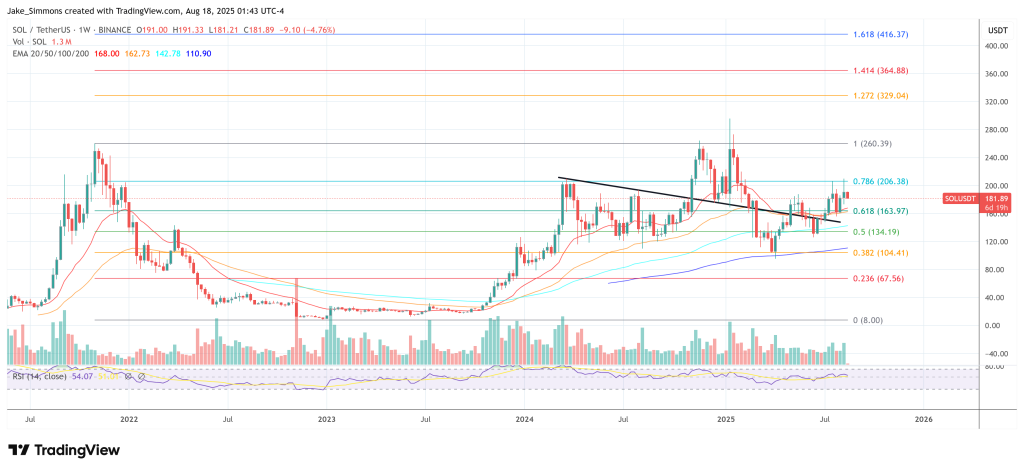
At press time, SOL traded at $181.89.
Solana price
SOL rejected at the 0.786 Fib, 1-week chart | Source: SOLUSDT on TradingView.com
Featured image created with DALL.E, chart from TradingView.com
Editorial Process for bitcoinist is centered on delivering thoroughly researched, accurate, and unbiased content. We uphold strict sourcing standards, and each page undergoes diligent review by our team of top technology experts and seasoned editors. This process ensures the integrity, relevance, and value of our content for our readers.

Jake Simmons has been a Bitcoin enthusiast since 2016. Ever since he heard about Bitcoin, he has been studying the topic every day and trying to share his knowledge with others. His goal is to contribute to Bitcoin's financial revolution, which will replace the fiat money system. Besides BTC and crypto, Jake studied Business Informatics at a university. After graduation in 2017, he has been working in the blockchain and crypto sector. You can follow Jake on Twitter at @realJakeSimmons.

Trending Cryptos

Related Reads

You Use Claude and Codex Every Day, but Meta Has Restricted Internal Use

In May, Meta imposed internal restrictions on its engineers regarding the use of Claude Code and Codex, two widely used AI programming tools. Despite being a major client, Meta's guidelines, still in effect, prohibit these external models from being used for specific tasks to prevent potential "escalations with partners." The core concern is "distillation"—the risk that outputs from Claude or Codex could inadvertently contaminate the training data and evaluation processes for Meta's in-house AI coding assistant, MetaCode. If MetaCode is trained or evaluated using data generated by these external models, it risks learning their capabilities rather than developing its own, blurring the line of intellectual origin. The restrictions are precise: engineers cannot use the external models to generate test questions, debug source code, or suggest test cases. AI-generated content is also barred from environments accessible to MetaCode. However, AI can still assist with peripheral tasks like workflow setup and code organization, provided all outputs are manually reviewed. This caution reflects a broader industry dilemma. While distillation is a common technique, using a competitor's model output for training raises legal and ethical questions about the ownership of derived capabilities. Contractual terms from companies like OpenAI and Anthropic explicitly forbid using their outputs to build competing products, putting enforcement power in the hands of rivals. The move is also financially motivated, as Meta seeks to reduce its hefty internal AI spending, estimated in the billions this year. Meta's policy illustrates the delicate balance companies must strike: leveraging powerful external AI tools while safeguarding the integrity and independence of their own AI development. As AI systems increasingly help build other AIs, distinguishing the origin of capabilities becomes a fundamental challenge for the entire industry.

marsbit1h ago

You Use Claude and Codex Every Day, but Meta Has Restricted Internal Use

marsbit1h ago

Why Do We Need an AI Content Perspective Today?

The article "Why Do We Need an AI Content Perspective Today?" explores the complex and often contentious integration of AI into the cultural and creative industries, particularly film and television. It begins with the cancellation of Amazon's AI-generated animation "Punky Duck," highlighting the ethical debates surrounding AI content. AI's rapid advancement is transforming video production, enabling cost-effective, full-length AI films (e.g., "RAPHAEL," "Dreams of Violets") while sparking industry resistance over issues like "synthetic actors." The core debate has shifted from whether to use AI to how to use it responsibly. The article analyzes why AI's entry into film is uniquely unsettling. It distinguishes between "cultural fast food" (short-form, fast-paced content like micro-dramas) and "cultural main courses" (traditional, long-form film/TV). AI currently excels at the former, matching its fragmented narratives, shallow emotional needs, and free-to-consumer models. However, venturing into the latter challenges the human-centric essence of storytelling—creativity, emotional depth, and the unique value of human labor and experience. While AI can generate massive volumes of content and lower costs, it risks devaluing human creativity, leading to homogenized output, and creating unfair competition through potential intellectual property infringement. Its efficiency also amplifies content safety risks, making preemptive governance crucial. To counter these risks, the article proposes establishing clear boundaries guided by a human-centered AI content perspective. It outlines four principles: 1) Amplify, rather than displace, human creative space; 2) Respect and protect human creative output; 3) Ensure human creative control and responsibility remain paramount; and 4) Guarantee transparency and traceability in AI creation. The conclusion emphasizes that humans must act as the "helmsmen" of technology, steering AI development to enhance, not replace, the core human values at the heart of cultural expression.

marsbit2h ago

Why Do We Need an AI Content Perspective Today?

marsbit2h ago

Trading

Spot

Hot Articles

Discussions

Welcome to the HTX Community. Here, you can stay informed about the latest platform developments and gain access to professional market insights. Users' opinions on the price of SOL (SOL) are presented below.

活动图片