Solaxy Presale Claim in 5 Hours: Last Chance to Buy Solana’s First-Ever Layer-2

bitcoinistPublished on 2025-06-23Last updated on 2025-06-23

Abstract

The Solaxy presale is nearing its end, with 5 left on the clock. This means it's the last chance to...

Trusted Editorial content, reviewed by leading industry experts and seasoned editors. Ad Disclosure

The Solaxy presale is nearing its end, with 5 left on the clock. This means it’s the last chance to buy Solaxy before the project goes public.

The presale has accumulated almost $58M, making it one of the best presales of 2025 by far. With a token price of $0.001766 and the promise of sustained chart performance post-launch, Solaxy presents itself as a great investment opportunity.

What Is Solaxy?

Solaxy ($SOLX) is the Layer 2 upgrade to the Solana ecosystem, promising to fix one of Solana’s most pressing problems: network congestion.

Network congestion is responsible for problems like slow transaction speeds, high network costs, and even downtime during periods of high trading volume.
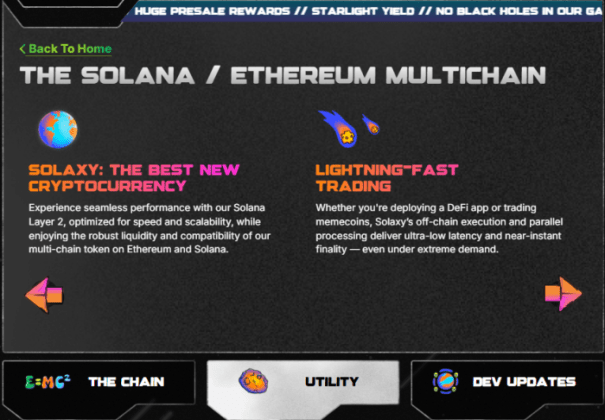
Solaxy's utility

Solaxy fixes these issues through off-chain execution and parallel processing to ensure low latency and near-instant finality. When implemented correctly, Solaxy will upgrade Solana’s performance and considerably cut down on-chain costs.

The project is undergoing continuous development, with the developers posting regular updates to record their progress.

One of the latest and most important ones occurred on June 10, 2025. The devs announced the implementation of the Hyperlane Bridge to ensure low-latency transfers and a user-friendly UX.

According to the project’s whitepaper, Solaxy’s roadmap consists of three phases:

  • Phase 1: Foundation – Launching the presale, set up the staking rewards, and create community engagement.
  • Phase 2: Expansion – Release the Token Generation Event (TGE) and list on CEXs and DEXs.
  • Phase 3: Deployment – Implement the Solaxy Layer 2 blockchain, onboard high-chain dApps, enable multi-chain integrations, and optimize performance.

The project has been audited by Coinsult, which deemed it safe for investors after discovering no issues or threats.

Solaxy’s Presale Numbers

Solaxy has accumulated almost $58M since it started, showcasing significant investor interest and upside potential post-listing.

The interest even ramped up during the presale’s final days, with some meaty whale buys going through:

Based on the project’s utility, presale performance, and projected post-launch chart numbers, our analysts predict that $SOLX will gain a lot of momentum in 2025.
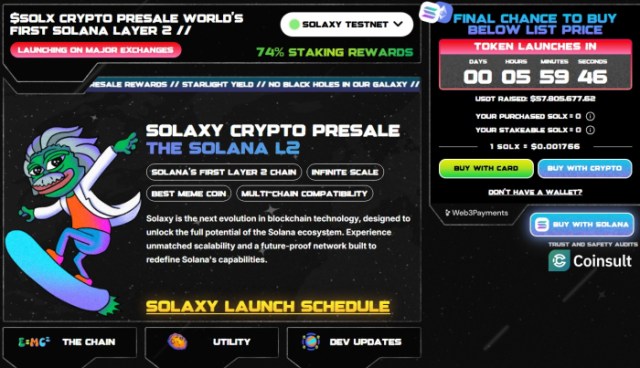
Solaxy presale page

The most reserved predictions place $SOLX around $0.032 by the end of 2025, which translates into a growth of 1,712% based on the current price or 3,100% based on the presale’s starting price of $0.001.

A year later, $SOLX could get as high as $0.2 or higher, making for an ROI of 11,225%. To put it into actual gains, a $100 investment could offer a return of $11,325 in just over a year.

Naturally, these approximations rely on the current data, the perceived market trend, and the hope that Solaxy’s implementation lives up to the expectations. Given that this is the crypto market we’re talking about, we should expect price swings along the way as well, so caution is advised.

Should You Invest in Solaxy?

So, based on the project’s facts, its presale performance, and $SOLX’s price prediction, should you invest in Solaxy ($SOLX)?

Let’s put it this way: Solaxy is a long-term project with actual chain utility that’s likely to grow organically, at a steady rate, following its gradual implementation into Solana’s ecosystem.

Long-term, $SOLX is great for portfolio diversification and a FOMO-inducing ROI once Solaxy catches steam. Ultimately, the decision is yours.

The Last Chance to Buy Solaxy ($SOLX)

This is literally the last chance to buy Solaxy ($SOLX) at its current presale price, with only 5 hours left on the clock.

If you want to tune in before the project goes public, head to the official presale website, buy your $SOLX, and consider staking them for the 74% dynamic APY.

Remember, this isn’t financial advice. Do your own research (DYOR) and invest wisely.

Editorial Process for bitcoinist is centered on delivering thoroughly researched, accurate, and unbiased content. We uphold strict sourcing standards, and each page undergoes diligent review by our team of top technology experts and seasoned editors. This process ensures the integrity, relevance, and value of our content for our readers.

As a crypto writer, Bogdan’s responsibilities are split between researching and writing articles and entertaining the team with his humor bordering on the politically incorrect, an aspiring Bill Burr, if you will. Thanks to his 12+ years of writing experience in just as many fields, including tech, cybersecurity, modelling, fitness, crypto, and other topics-that-shall-not-be-named, he's become a genuine asset to the team. While his position as a senior writer at PrivacyAffairs thought him valuable lessons about the power of self-management, his entire writing career was and is an exercise in self-improvement. Now, he's ready to sink his teeth into crypto and teach people how to take control of their own money on the blockchain. With fiat as an eternally devaluing currency, Bitcoin and altcoins seem like the best-fitting alternative for Bogdan. Bogdan’s biggest professional accomplishment, aside from securing a position as a main writer for Bitcoinist, was his 5-year run as a writing manager at Blackwood Productions, where he coordinated a team of four writers. During that time, he learned the value of teamwork and that of creating a working environment that breeds efficiency, positivity, and friendship.

Trending Cryptos

Related Reads

Claude Accused of Becoming Dumber by the Entire Internet, Anthropic Steps In to Reveal: It’s Not the Model That’s Tricking You

When users complained that Claude was "getting dumber," the root cause wasn't the AI model itself. In an official blog post, Anthropic clarified the critical difference between two key settings in Claude Code: Model and Effort. Model refers to the core "brain"—the fixed, trained weights of a specific AI (like Sonnet, Opus, or Fable). Changing the Model addresses *capability* ("can it do this?"), but its knowledge is static post-training. Effort, however, controls the AI's *approach and thoroughness* for a specific task. A higher Effort level instructs Claude to read more files, run tests, perform verification, and complete multi-step reasoning before responding, significantly increasing its "work output" for that job. Conversely, low Effort leads to quicker, less thorough replies. This distinction explains the March 2024 uproar where users experienced a sudden drop in Claude's performance. The cause was not a model change but Anthropic quietly lowering the *default* Effort setting from "high" to "medium" to reduce latency, which was later reverted. The key insight is that a smaller, capable model (like Sonnet) on high Effort can often outperform a larger, more powerful model (like Opus) on low Effort for many tasks. The article provides a practical troubleshooting framework: if Claude makes an error, first check the context and instructions. If it seems to skip necessary steps or validations, increase Effort. If it diligently attempts the task but fails conceptually or makes consistent factual errors despite good context, then consider switching to a more capable Model. The takeaway is a shift in focus: effective AI programming is less about always choosing the "strongest" model and more about intelligently *orchestrating* models and effort levels—acting like a project manager to assign the right "brain" with the right level of diligence for each job, optimizing both results and cost.

marsbit30m ago

Claude Accused of Becoming Dumber by the Entire Internet, Anthropic Steps In to Reveal: It’s Not the Model That’s Tricking You

marsbit30m ago

Will the Ethereum Foundation Evolve into a 'Mascot'? Diversified Organizations Are Fragmenting Its Functions

The Ethereum Foundation (EF) is undergoing significant internal turmoil and functional erosion. Following its largest-ever layoff of 54 staff (20% of its workforce) and a major organizational restructuring announced in June, its Protocol Support Team has been officially dissolved. This comes alongside the high-profile resignation of key figures like co-executive director Xiaowei Wang, bringing senior departures this year to at least eight. Criticism of EF's rigid structure, opaque decision-making, and perceived lack of a clear value narrative for ETH has intensified within the community. The layoffs have catalyzed the emergence of independent, non-profit organizations like Ethlabs and Ethereum Institutional, founded by former EF researchers and members. These entities are now taking on core functions such as protocol research/development and institutional adoption, effectively fragmenting the EF's traditional leadership role. Concurrently, EF's security team is adapting to technological change, deploying specialized AI agents to audit Ethereum's codebase, which successfully discovered a critical vulnerability (CVE-2026-34219). While EF states AI complements rather than replaces researchers, it signals a potential future shift in its operational model. Faced with these challenges—internal restructuring, talent drain, the rise of competing organizations, and AI integration—the Ethereum Foundation appears to be stepping back from a central commanding role. Analysts and community observers speculate it may increasingly transition towards a symbolic "ecosystem mascot" function, while decentralized initiatives drive Ethereum's future growth and institutional adoption.

marsbit56m ago

Will the Ethereum Foundation Evolve into a 'Mascot'? Diversified Organizations Are Fragmenting Its Functions

marsbit56m ago

Nearly a Hundred Players Rush into Embodied Data: With 4.47 Billion Yuan in Financing in One Year, Who Can Really Make Money by 'Selling Data'?

The domestic embodied AI data industry has attracted nearly 100 players, with 70 focused on data collection and 27 on data infrastructure. In the past year, 15 independent embodied data service providers raised approximately 4.47 billion yuan. Despite this growth, the sector remains early-stage, fragmented, and faces significant challenges. Data collection methods are diverse, categorized into four main routes: teleoperation of real robots, human demonstration without a robot (using motion capture, exoskeletons, etc.), simulation synthesis, and distillation from internet videos. Most companies (43%) adopt hybrid approaches, combining multiple routes, as no single method can meet all training needs. Teleoperation alone is pursued by 31% of players, often by state-owned platforms and robot companies, while newer firms favor asset-light, no-hardware human demonstration. Independent data service providers now form the largest player group (40%), indicating the emergence of a distinct industry segment rather than just a subsidiary function for robot makers. Two-thirds of all players are "embodied-native" startups, while one-third are companies that pivoted from fields like AI data annotation, which are more prevalent in the data infrastructure layer. Current annual industry capacity is estimated at 1.6-1.8 million hours plus 70-80 million data points, with a short-term goal to increase this 15-20 fold within 1-3 years. Data collection factories are spread across 20 provinces in China, concentrated in the Yangtze River Delta, Beijing-Tianjin-Hebei, and Pearl River Delta regions. Financially, the 4.47 billion yuan raised in the past year pales compared to the 43.8 billion yuan raised by the broader embodied intelligence sector in just the first half of 2026, highlighting that data remains a less "sexy" bet for investors. The 15 funded independent providers show clear stratification: a top tier led by a unicorn (Lightwheel Intelligence, 3.1 billion yuan), a middle tier of 11 firms raising tens to hundreds of millions, and an early-stage tier of 3 companies. Sixty-nine investment institutions have participated, but none have made concentrated bets, reflecting uncertainty about viable business models. Over half of these funded companies are less than a year old, most are at pre-A or A rounds, and profitability remains largely unproven. In summary, the embodied data industry has become an independent track creating jobs and local economic activity. However, it is still nascent, with unformed consensus, unsolved problems, and unproven business models. The coming 1-2 years will be a critical validation window to see if companies can build sustainable, profitable businesses purely by "selling data."

marsbit3h ago

Nearly a Hundred Players Rush into Embodied Data: With 4.47 Billion Yuan in Financing in One Year, Who Can Really Make Money by 'Selling Data'?

marsbit3h ago

Trading

Spot

Hot Articles

Discussions

Welcome to the HTX Community. Here, you can stay informed about the latest platform developments and gain access to professional market insights. Users' opinions on the price of S (S) are presented below.

活动图片