Ethereum Price Slips Below $2,500 — Sell Volume Suggests Mounting Bearish Pressure

bitcoinistPublished on 2025-06-21Last updated on 2025-06-22

Abstract

The Ethereum price struggled to break out of the $2,500 – $2,700 range over the past week, mirroring the sluggish...

Trusted Editorial content, reviewed by leading industry experts and seasoned editors. Ad Disclosure

The Ethereum price struggled to break out of the $2,500 – $2,700 range over the past week, mirroring the sluggish condition of the general market. On Friday, June 20, the altcoin succumbed to a fresh wave of bearish pressure, falling toward the $2,400 mark to close the week.

Unsurprisingly, this latest downturn appears to be forcing the hands of investors who have been banking on the $2,500 support level over the past few weeks. Here’s how the falling ETH price and the resulting sell-off could affect the altcoin’s future trajectory.

ETH Price At Risk As Taker Sellers Unload Their Tokens 

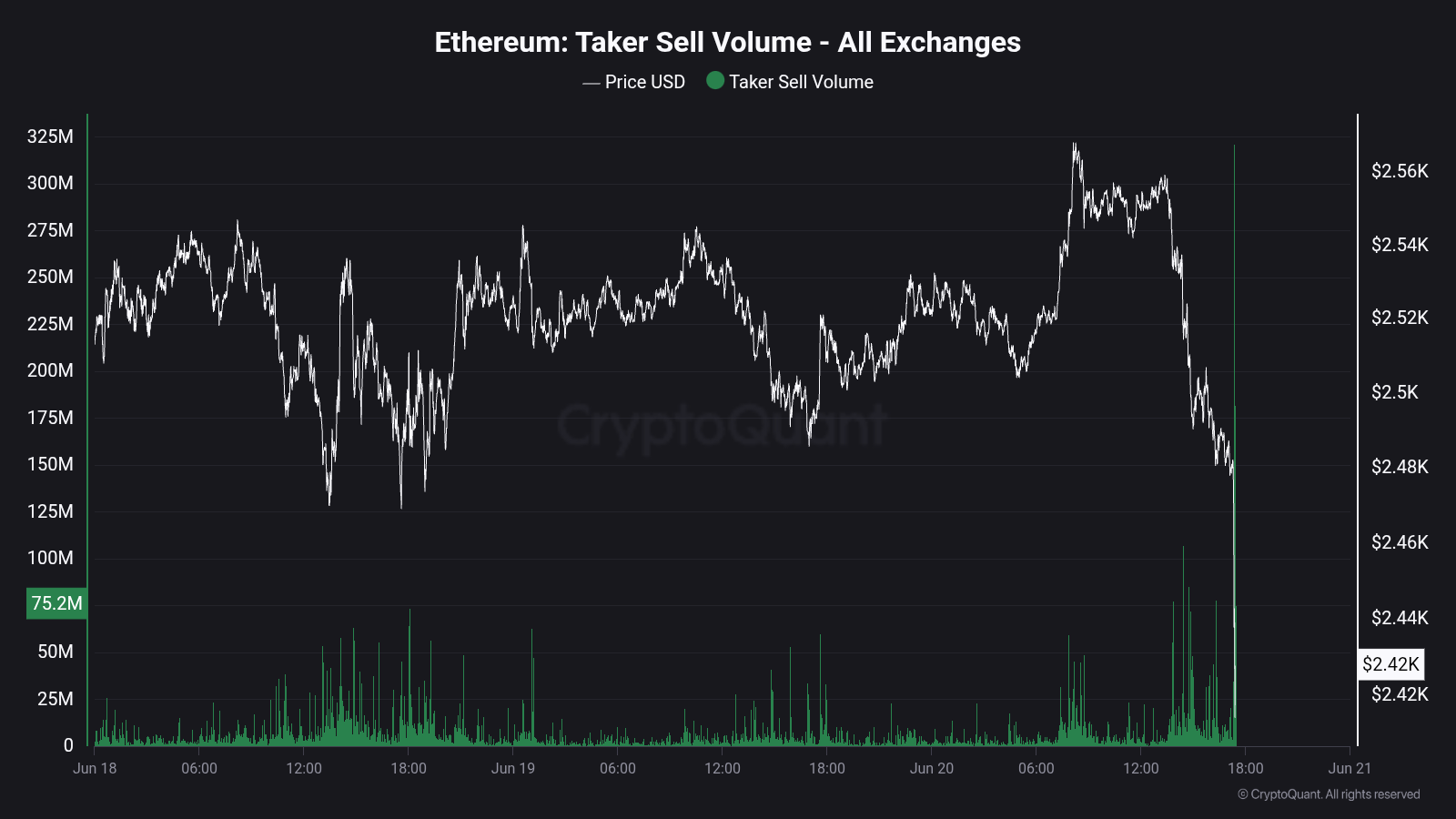
In a recent post on the social media platform X, on-chain analyst Maartunn revealed that a set of Ethereum traders might be on the move again. This on-chain observation revolves around a jump in the Taker Sell Volume, a metric that estimates the total volume of sell orders filled by takers in perpetual swaps of a specific cryptocurrency (ETH, in this case).

To provide some context, a taker refers to a market participant who places an order matched with an existing order on the order book. With this definition, the Taker Sell Volume represents the total amount of a cryptocurrency offloaded or sold by these market participants within a specific period.

In the post on X, Maartunn highlighted in his post that sell pressure is mounting in the Ethereum market, as taker sellers are beginning to dominate the buyers on exchanges. According to data from CryptoQuant, the ETH Taker Sell Volume on all centralized exchanges surged to around $321.3 million within a minute on Friday.
Ethereum

Source: @JA_Maartun on X

Typically, significant spikes in the Taker Sell Volume have often been followed by a period of downward pressure on the price of Ethereum. If history is anything to go by, investors might expect the second-largest cryptocurrency to struggle over the next few days.

Ethereum Price Overview

As of this writing, the price of ETH sits just above the $2,410 level, reflecting an almost 5% decline in the past 24 hours. According to data from CoinGecko, the altcoin is down by nearly 6% over the last seven days.

The Ethereum price has been stuck in consolidation within the $2,500 – $2,800 range over the past few weeks. With the token’s price now beneath a major support in $2,500 and the rising bearish pressure, the odds of ETH embarking on a sustained rally look slimmer.

Ethereum

The price of ETH on the daily timeframe | Source: ETHUSDT chart on TradingView

Featured image from iStock, chart from TradingView
Editorial Process for bitcoinist is centered on delivering thoroughly researched, accurate, and unbiased content. We uphold strict sourcing standards, and each page undergoes diligent review by our team of top technology experts and seasoned editors. This process ensures the integrity, relevance, and value of our content for our readers.

Opeyemi Sule is a passionate crypto enthusiast, a proficient content writer, and a journalist at Bitcoinist. Opeyemi creates unique pieces unraveling the complexities of blockchain technology and sharing insights on the latest trends in the world of cryptocurrencies. Opeyemi enjoys reading poetry, chatting about politics, and listening to music, in addition to his strong interest in cryptocurrency.

Trending Cryptos

Related Reads

Apple Sues OpenAI Sparking Feud, Musk Slams Altman for Fraud, Altman Retorts with 'Space Data Center' Boast

Apple Sues OpenAI as Musk-Altman Feud Escalates The public feud between Elon Musk and OpenAI CEO Sam Altman intensified, coinciding with their respective AI companies launching flagship models in the same week, highlighting fierce competition. On July 11, Musk posted on X, accusing Altman of taking "fraud to the next level" regarding OpenAI's commercial practices. Altman fired back, sarcastically suggesting Musk was the one selling "short-term space datacenter" concepts to public market investors. Musk countered with allegations that Altman "stole an open-source AI charity" and, amid Apple's recent lawsuit, "stole all of Apple's phone tech." He mockingly referenced Altman needing a "parole officer's" approval to travel. This exchange occurred against the backdrop of a significant legal development: Apple filed a lawsuit against OpenAI in a California federal court, alleging the AI company deliberately solicited Apple employees to leak confidential information on unreleased products to aid its own hardware plans. Apple demands OpenAI cease this activity, destroy proprietary materials, and redesign upcoming products. OpenAI responded, stating it has no interest in other companies' trade secrets and remains focused on innovation. This lawsuit could profoundly impact their two-year partnership where OpenAI provides key tech for Apple Intelligence and Siri. The rivalry extended to product releases. OpenAI launched GPT-5.6, while Musk's SpaceXAI unveiled Grok 4.5. Both are positioned as AI agents capable of multi-step tasks. GPT-5.6 is noted for strengths in broad reasoning, business workflows, and cybersecurity. Grok 4.5 is highlighted for higher efficiency in autonomous programming and developer workflows, with lower usage costs than GPT-5.6, though OpenAI's model reportedly still leads in areas like abstract reasoning. The differing strengths offer distinct choices for enterprises and developers based on their specific needs.

marsbit38m ago

Apple Sues OpenAI Sparking Feud, Musk Slams Altman for Fraud, Altman Retorts with 'Space Data Center' Boast

marsbit38m ago

Robinhood Chain's Success Proves Ethereum is Not Dead

Robinhood Chain's success demonstrates that Ethereum's L1+L2 model is thriving, not dying. Traditional crypto projects often focused on token sales and chose infrastructure to maximize token value. However, real-world businesses building cash-based products make different, pragmatic choices. When launching its chain, Robinhood chose Ethereum as its base layer and built a custom L2 using Arbitrum technology. It uses Ethereum blobs for data availability, ETH for gas, and relies on Ethereum for security. This mirrors Coinbase's earlier decision to build Base as an Ethereum L2. These are not ideological choices but sound business decisions driven by needs for security, liquidity, control, and predictable economics. The shift in the industry is from "token-centric" models to "cash business" models. Real companies serving broad user bases prioritize risk reduction, product improvement, and profit. For them, blockchain is infrastructure. The Ethereum L1+L2 "barbell" structure is ideal: the highly decentralized, neutral, and liquid L1 for settlement and security, combined with customizable, high-performance L2s for execution. This trend is positive for Ethereum and ETH. As more real businesses build on it, ETH becomes more integrated, distributed, and useful, strengthening its network effects and monetary premium. Robinhood's path—starting on an existing L2 and graduating to a dedicated one—is likely to become a standard playbook, proving the enduring utility of Ethereum's layered architecture for serious commercial adoption.

Odaily星球日报56m ago

Robinhood Chain's Success Proves Ethereum is Not Dead

Odaily星球日报56m ago

Tencent Heavily Invests in an IPO

"Tencent-Backed DPU Unicorn Leopard Cloud Intelligence Files for IPO on Shenzhen's ChiNext Board" Leopard Cloud Intelligence, a Shenzhen-based developer of Data Processing Unit (DPU) chips, has officially applied for an IPO on the ChiNext Board, aiming to become China's first publicly listed DPU company. Founded in August 2020 by Dr. Xiaoyang Xiao, a Stanford PhD graduate and serial entrepreneur who previously co-founded chip company RMI (acquired by Broadcom), the company focuses on the high-growth DPU sector. Its development accelerated following NVIDIA's formal introduction of the DPU concept in late 2020. The company has developed China's first high-performance, general-purpose programmable DPU SoC chip, boasting 400Gbps network bandwidth and claiming significant performance improvements and power savings over traditional solutions. Financially, Leopard Cloud's revenue grew exponentially from RMB 170,000 in 2023 to RMB 370 million in 2025, yet it remains unprofitable with substantial net losses. Its IPO application utilizes ChiNext's recently introduced fourth set of listing standards, which emphasize R&D and market valuation over short-term profitability. Tencent is the company's most significant backer and largest shareholder, holding a 19.78% stake after participating in multiple funding rounds. Other prominent investors include Sequoia Capital China, Shenzhen Capital Group, Five Dimensions Capital, and various government-guided funds from Shenzhen and Hangzhou. Pre-IPO, the company was valued at over RMB 14 billion. This listing is seen as a milestone for Shenzhen's semiconductor industry, complementing the recent successful IPO review of Yuexin Semiconductor (a Guangzhou-based wafer manufacturer) and signaling a wave of high-end hardware technology companies from the Greater Bay Area going public on the ChiNext Board.

marsbit1h ago

Tencent Heavily Invests in an IPO

marsbit1h ago

Trading

Spot

Hot Articles

Discussions

Welcome to the HTX Community. Here, you can stay informed about the latest platform developments and gain access to professional market insights. Users' opinions on the price of ETH (ETH) are presented below.

活动图片