Ethereum Co-Founder Predicts ETH Will Eclipse Global GDP

bitcoinistPublished on 2025-06-20Last updated on 2025-06-20

Abstract

Joseph Lubin, a co-founder of Ethereum and chief executive of Consensys, used an X post on 19 June to deliver...

Trusted Editorial content, reviewed by leading industry experts and seasoned editors. Ad Disclosure

Joseph Lubin, a co-founder of Ethereum and chief executive of Consensys, used an X post on 19 June to deliver what may be his most expansive valuation thesis yet for Ether. After praising a research note that likened ETH to “digital oil,” Lubin argued the author still “is not bullish enough” about Ethereum’s ultimate economic footprint.

“This is a very strong piece of work in so many ways,” he began. “Probably everyone who reads this work will learn something and be stoked by the thesis. But this top-tier thought piece has one major structural flaw—a pretty deep structural flaw: it is not bullish enough.”

Ethereum Could Outscale Global GDP

Lubin’s contention is that Ether will underpin a “hybrid human-machine intelligence society” whose value creation compounds far beyond the scope of today’s $113.8 trillion global economy. “It is not a great leap,” he wrote, “to suggest that the value resident on and flowing through Ethereum, which will constitute a large portion of Web3—the re-decentralised—will be orders of magnitude larger than today’s global GDP. Just look at how the energy, chips and data-centre spend is growing exponentially and how AI is accelerating everything.”

He revived the long-standing Bitcoin-versus-Ethereum dichotomy—BTC as “Gold 2.0,” ETH as the native asset of a programmable economy—but pushed it further. “While BTC should be valued as Gold 2.0,” Lubin reiterated, “ETH should be valued on the scale of the emergent decentralised global economy.” That framing, he said, must now be expanded to account for an AI-charged explosion in digital activity that will “grow largely on decentralised rails.”

Lubin devoted half of his post to a thought experiment first sketched on 4 June. “If there was a magical trust-diamond commodity and you could apply chips of this diamond to every transaction, agreement or relationship … how much value would that add? 10 % to global GDP? 100 %? 1,000 %? … The ticker of that commodity is ETH.”

In his view, Ethereum’s unusually decentralised validator set makes Ether “the highest-grade or gold standard of trust on the planet.” That “trust commodity” premium, layered atop the “digital-oil” demand for transaction fees, is what Lubin believes can propel ETH’s fully diluted value far beyond any historical asset benchmark.

Reality Check—Today’s Numbers

For now, the gap between aspiration and market capitalisation remains yawning. Ether’s float of roughly 120 million coins traded at $2,525 on 19 June, giving the network a market value near $307 billion and representing less than 0.3 % of world output. Yet even that float is shrinking: more than 35 million ETH—about 29% of supply—is now locked in proof-of-stake contracts, an all-time high reached this week.

Lubin regards such supply-side tightening as a preview, not a climax. “Both of these models,” he wrote of the digital-oil and trust-commodity frameworks, “will lead to a giant monetary premium for ETH.”

Whether Ether can plausibly “eclipse” worldwide output—a threshold no single asset has come close to—remains an open question. Lubin’s rhetorical diamond, however, sharpens the stakes: in a future where programmable trust becomes a primary input of production, valuing ETH merely as software gas may prove, to borrow his phrase, “not bullish enough.”

At press time, ETH traded at $2,523.
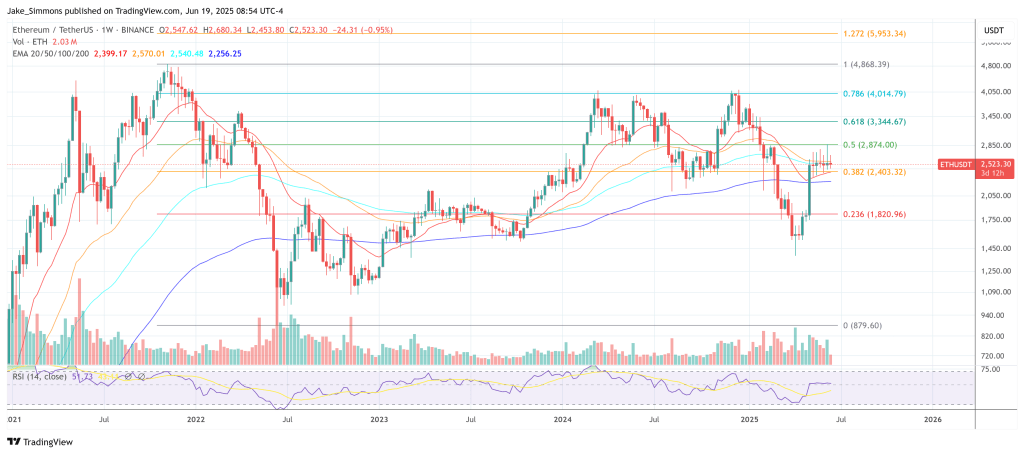
Ethereum price
ETH hovers below the 0.5 Fib, 1-week chart | Source: ETHUSDT on TradingView.com
Featured image created with DALL.E, chart from TradingView.com
Editorial Process for bitcoinist is centered on delivering thoroughly researched, accurate, and unbiased content. We uphold strict sourcing standards, and each page undergoes diligent review by our team of top technology experts and seasoned editors. This process ensures the integrity, relevance, and value of our content for our readers.

Jake Simmons has been a Bitcoin enthusiast since 2016. Ever since he heard about Bitcoin, he has been studying the topic every day and trying to share his knowledge with others. His goal is to contribute to Bitcoin's financial revolution, which will replace the fiat money system. Besides BTC and crypto, Jake studied Business Informatics at a university. After graduation in 2017, he has been working in the blockchain and crypto sector. You can follow Jake on Twitter at @realJakeSimmons.

Trending Cryptos

Related Reads

Dialogue with Multicoin Partner: The Crypto Market Has Bottomed Out, Favoring Three Cryptocurrencies in This Cycle

In a recent interview, Multicoin Capital managing partner Tushar Jain shared his views on the crypto market. He believes the market has bottomed and is at an inflection point, citing that negative news no longer causes significant price declines and application adoption continues to grow. Jain remains highly bullish on Solana, viewing it as the correct architectural choice for internet capital markets, particularly for spot and tokenized security trading. He is also positive on Hyperliquid, noting its leadership in decentralized derivatives trading. His investment approach focuses on concentrating capital in top convictions rather than equal allocation. A distinct opportunity he highlights is Zcash (ZEC), which he sees as a return to the industry's cypherpunk ethos and a potential top-five asset by market cap. For assets like Zcash without cash flows, his valuation framework is based on relative market cap ranking. Regarding investment strategy, Jain employs a "three-part" entry method to avoid timing pitfalls and emphasizes long-term "active management" over "active trading." He outlines four sources of investment edge: informational, analytical, behavioral/psychological, and structural. On portfolio management, the fund uses Bitcoin as its "cash," selling assets into Bitcoin during market euphoria to reduce beta risk and using Bitcoin to buy dips. Sales occur only if a better opportunity arises, the investment thesis breaks, or valuations become excessively overheated. While respectful of Ethereum's resilience, he questions its unclear scaling roadmap. Finally, Jain reaffirms his commitment to the thesis that blockchains will form the foundational architecture for future capital markets.

marsbit18m ago

Dialogue with Multicoin Partner: The Crypto Market Has Bottomed Out, Favoring Three Cryptocurrencies in This Cycle

marsbit18m ago

Behind Robinhood's Chain Launch and Tokenized Stocks: No Equity Rights, How Far Can This Packaging Game Go?

Robinhood is launching its own Layer 2 blockchain (Robinhood Chain) and "tokenized stocks," but these are not actual equity shares. The tokens are legally structured as debt securities or derivatives, offering economic exposure to a reference stock without granting voting rights or direct ownership. This move represents Robinhood's strategy to expand from a traditional brokerage into a "financial super app," building a user-friendly, programmable financial interface on top of complex, legally compliant, and jurisdiction-specific backend structures. The company's existing business remains strong, driven by options, event contracts, and stock trading. The new blockchain and tokenization efforts are an ambitious layer of infrastructure built atop this core, aiming to make financial products more portable and globally accessible via crypto rails. Key components include the Robinhood Wallet, Bitstamp acquisition (for institutional reach), the Lighter perpetual contracts platform, and Robinhood Earn (DeFi yield). The central challenge is the "brokerage chain paradox": maintaining a simple, intuitive user experience while the underlying assets are highly structured, regulated, and legally distinct from direct ownership. The success of this strategy depends on users, developers, and regulators accepting this model. If the complexity is misunderstood or deemed misleading, it could create product liability issues and stall expansion. The initiative is a significant infrastructure play, but its long-term viability hinges on navigating this fundamental tension between simplicity and legal reality.

marsbit1h ago

Behind Robinhood's Chain Launch and Tokenized Stocks: No Equity Rights, How Far Can This Packaging Game Go?

marsbit1h ago

Zhipu, Afraid of Becoming the Next MiniMax

Title: Zhipu, Fearing to Become the Next MiniMax In July 2026, amid the success of its coding-focused AI, Zhipu's founder, Tang Jie, issued an internal letter titled "The Giant Wave Has Come." It notably avoided celebrating recent triumphs, such as Zhipu's trillion-HKD market cap and booming MaaS revenue driven by its GLM-5.2 model in coding applications. Instead, the letter pivoted the narrative to future-oriented concepts like Long Horizon Task, Autonomous Agents, Self-Evolving systems, and AGI. This strategic shift in messaging followed the sharp devaluation of its competitor, MiniMax. After its lock-up period expired, MiniMax's stock plummeted as the market began evaluating it with traditional SaaS metrics like ARR and user growth, rather than as a frontier AI pioneer. Seeing this, Tang Jie aimed to preempt a similar revaluation of Zhipu. He fears that if the market starts viewing Zhipu primarily as a profitable "AI coding company," its valuation would become anchored to conventional financial metrics, losing the premium associated with AGI potential. Therefore, the letter reframed Zhipu's mission. While acknowledging that coding was the current commercial driver, Tang positioned Zhipu on the "infrastructure path," akin to OpenAI and Anthropic. The new focus is on developing agents capable of complex, long-term planning and autonomous operation—moving from assisting individuals (OPC: One Person Company) to automating entire organizations (NPC: No People Company). This "Touch High" plan explicitly prioritizes long-term AGI research over short-term monetization. The article frames this as a critical divergence in China's AI landscape: the "commercialization path" (exemplified by MiniMax) versus the "infrastructure path" (chosen by Zhipu). The former risks being judged harshly by internet-era metrics once growth slows, while the latter risks failing if technological breakthroughs stall. Tang Jie's letter is thus a calculated move to secure Zhipu's identity as an AGI contender, buying time before the inevitable market demand for commercial proof. The core question remains: can Zhipu's "mo gao" (reach high) plan achieve genuine technological leaps fast enough to outpace the market's diminishing patience for stories over substance?

marsbit1h ago

Zhipu, Afraid of Becoming the Next MiniMax

marsbit1h ago

Trading

Spot

Hot Articles

Discussions

Welcome to the HTX Community. Here, you can stay informed about the latest platform developments and gain access to professional market insights. Users' opinions on the price of ETH (ETH) are presented below.

活动图片