Donald Trump’s Tariffs, Bitcoin, And The Crypto Market: Everything You Should Know About Why The Market Crashed

bitcoinistPublished on 2025-04-04Last updated on 2025-04-04

Abstract

Bitcoin, along with the entire crypto market, was sent into another brief disarray in the past few hours after a...

Trusted Editorial content, reviewed by leading industry experts and seasoned editors. Ad Disclosure

Bitcoin, along with the entire crypto market, was sent into another brief disarray in the past few hours after a new wave of bearish sentiment hit through, causing all large-market cap cryptos to bleed red. This sea of red followed an interesting announcement by former President Donald Trump, who introduced what is being called one of the largest tariff policies in U.S. history.

Speaking at the “Make America Wealthy Again” event, Trump revealed a plan to impose tariffs on 185 countries, a move that immediately rattled global financial markets, especially equities and digital assets.

The Real Tariff Shock: A Chain Reaction That Started With A Poster

The crypto industry dropped as much as 2% in the past 24-hour timeframe, with Bitcoin falling as low as $82,277. At the center of the storm was the term “reciprocal tariffs,” a strategy by Donald Trump’s government that goes far beyond the baseline 10% that the Wall Street Journal initially reported. The narrative shifted when Trump clarified that the tariffs were not flat tariffs but reciprocal tariffs.

This means the U.S. would impose duties at half the rate other countries currently impose on American goods. As such, for countries like China, which Trump claimed charges the U.S. 67%, there would be a 34% U.S. tariff in response. The European Union was next in line with a proposed 20% tariff.

As the announcement unfolded, the S&P 500 futures erased $2 trillion in market cap in under fifteen minutes. What turned market sentiment violently was the visual aid Trump held up at exactly 4:26 PM ET. Just moments before that, S&P futures were up 2%. By 4:42 PM ET, they had fallen by 4%. Interestingly, the Nasdaq 100 futures is also on track to plunge by over 900 points.

Donald Trump 1

Bitcoin’s reaction was just as swift as that of traditional markets. As risk-off sentiment swept through global markets, Bitcoin saw a sharp decline in tandem with the sell-off in tech stocks. The recent strengthening correlation between Bitcoin and U.S. tech equities meant that the downturn in Nasdaq and S&P 500 spilled directly into digital asset territory. 

Donald Trump 2
Source: X

Timeline Of Tariff Implementation And Repercussions On Investors

Trump announced that the 10% baseline tariff will take effect on April 5th, with higher reciprocal tariffs rolling out on April 9th. Exemptions have been granted to specific categories such as pharmaceuticals, semiconductors, copper, and lumber, while countries like Canada and Mexico have escaped new tariffs entirely, thanks to USMCA compliance. Even Russia was left out of this tariff round, at least for now. 

Despite Trump’s simultaneous promise of historic tax cuts, markets are still deep in the red. The long-term implications are difficult to quantify, but analysts interpreting the policy’s economic scope have already floated a 150 basis point reduction in GDP growth as a possibility.

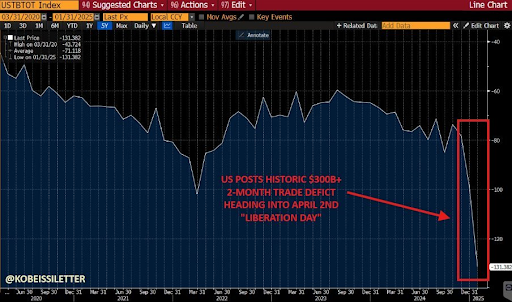
According to analysts at “The Kobeissi Letter,” the largest one-week trade deficit in US history should be coming in the next three days leading up to April 5th and 9th. They also expect the tariffs to cause a 150 basis point reduction of US GDP growth. As of today, the US posted a historic $300 billion two-month trade deficit. 
Donald Trump 3
Source: X

Bitcoin is trading at $83,569 and has slightly recovered from its intraday low of $82,277.

Trump’s tariffs rock btc with a crash | Source: BTCUSDT on TradingView.com

Chart from TradingView.com

Editorial Process for bitcoinist is centered on delivering thoroughly researched, accurate, and unbiased content. We uphold strict sourcing standards, and each page undergoes diligent review by our team of top technology experts and seasoned editors. This process ensures the integrity, relevance, and value of our content for our readers.

Scott Matherson is a leading crypto writer at Bitcoinist, who possesses a sharp analytical mind and a deep understanding of the digital currency landscape. Scott has earned a reputation for delivering thought-provoking and well-researched articles that resonate with both newcomers and seasoned crypto enthusiasts. Outside of his writing, Scott is passionate about promoting crypto literacy and often works to educate the public on the potential of blockchain.

Related Reads

Retail Investors' 'Lead Brother' Serenity vs. Newly Minted Stock God Leopold: How Are the Two Top Hunters Mining AI's 'Physical Limits'?

The article profiles two prominent figures, Serenity and Leopold Aschenbrenner, who are gaining attention for their unconventional investment strategies focused on the physical constraints of the AI boom, moving beyond mainstream software narratives. Serenity, an anonymous online trader, advocates a "shiso leaf" theory. He targets small-cap companies with monopolies on critical, overlooked components in the AI hardware supply chain, such as specific semiconductor materials. His deep, technical analysis of bottlenecks in areas like co-packaged optics (CPO) has reportedly yielded massive returns, though his anonymity and focus on illiquid micro-cap stocks pose significant risks for followers. Leopold Aschenbrenner, a former OpenAI researcher, founded a multi-billion dollar hedge fund. His macro thesis argues that physical infrastructure—power grids, land, data centers—is the true bottleneck for AI growth, lagging far behind chip production. Consequently, his fund employs an infrastructure arbitrage strategy: heavily investing in storage and compute infrastructure companies while placing massive bearish bets (put options) against major semiconductor stocks, betting their valuations will correct as physical constraints become apparent. While their methods differ—Serenity drills into microscopic supply chain details, while Leopold takes a macroscopic, infrastructure-focused view—both share a core belief: the real power and investment alpha in the AI era lie in controlling scarce physical resources, not just software. The article concludes by noting the inherent risks in both approaches, such as liquidity issues for micro-caps and timing risks for macro bets, but suggests they signal a broader market re-evaluation of AI's foundational assets.

marsbit6h ago

Retail Investors' 'Lead Brother' Serenity vs. Newly Minted Stock God Leopold: How Are the Two Top Hunters Mining AI's 'Physical Limits'?

marsbit6h ago

Trading

Spot
Futures

Hot Articles

Discussions

Welcome to the HTX Community. Here, you can stay informed about the latest platform developments and gain access to professional market insights. Users' opinions on the price of S (S) are presented below.

活动图片