传言四起,特朗普取消加密利得税能落地吗?

Odaily星球日报Published on 2025-03-04Last updated on 2025-03-04

Abstract

梦想是好的,但或许还得等等。

原文作者:深潮 TechFlow

传言四起,特朗普取消加密利得税能落地吗?

市场是一个巨大的圣诞树。

昨天市场还沉浸在由特朗普支持加密货币而带来的利好中,只是还没高兴一天,比特币一路向下跌回原点,抹去由特朗普发声而带来的全部涨幅,画出一个让市场难受的门。

但市场好不容易抓住一根救命稻草,并未轻易放弃从特朗普身上挖掘出更多利好市场的可能。

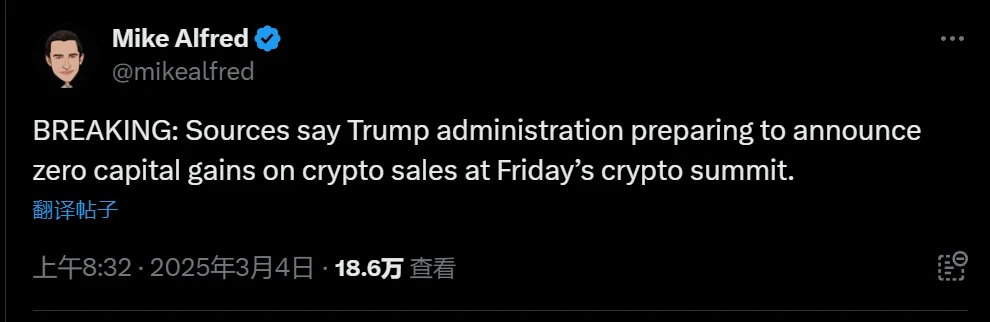
3 月 4 日上午,Alpine Fox LP 创始人 Mike Alfred 发推透露,特朗普政府或将在周五加密峰会上获奖宣布加密货币销售零资本利得税政策。

传言四起,特朗普取消加密利得税能落地吗?

而对于 Mike Alfred 所传“特朗普准备宣布加密货币零税率”一事,Cinneamhain Ventures 合伙人 Adam Cochran 更是直接开喷:“Mike 因为我反复核实他的事实而拉黑了我,但这并不能阻止我。总统不能单方面修改税法。只有国会才可以。这是宪法明确规定的少数国会权力之一。即使总统宣布该决定,或试图为其签署行政令,也不会使其成为法律。这并不比我宣称自己是一块纸杯蛋糕更有效。”

传言四起,特朗普取消加密利得税能落地吗?

取消加密资本利得税,无论对加密市场本身、对市场参与者还是对美国政府来说,都是一个大事。

对于此等大事的真实性,社媒自然争论不休。

抛开市场噪音,我们先看看如果加密免税事成,对市场会产生什么影响?如果不成,又是被哪些因素制约?

现在的加密货币税是怎么收的?

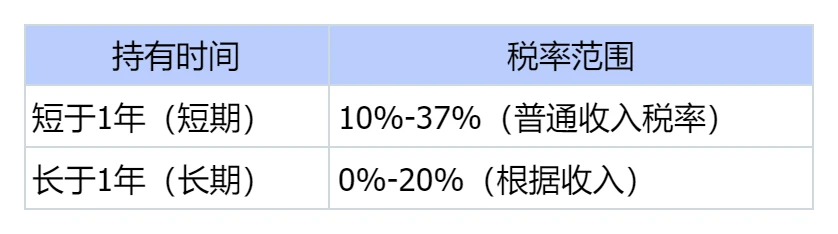
先说说现在的情况,据 Coinbase 税制指南,在美国,加密货币不是“货币”,IRS(美国国税局)将加密货币定义为“财产”看。你要是买了比特币,涨了价卖出去,那赚的钱就得交资本利得税。税率也取决于你持币的时间:

传言四起,特朗普取消加密利得税能落地吗?

也就是说某位美国民众买了一万元的比特币,三个月后涨到两万,卖了赚一万,这净赚的一万元就得按普通收入税率交税(10% -37% ),可能几千块没了。如果在手中钻了一年后卖,税率低点,可能就交个一两千,甚至收入低的话还能免税。但无论如何,税是少不了的。

当然,不仅是交易,加密货币的普通收入税适用于挖矿、质押、工资支付、空投等各种以加密货币为媒介的活动,个人都需要按收到时的公平市场价值申报,按照普通收入税率交税(10% -37% )。

如果真的零利得税会怎样?

假设特朗普真把对于加密资产的资本利得税给取消了,会有啥影响?暂且撇开高大上的分析,接地气点,聊聊市场和普通人会咋样。

对市场来说,取消税收限制自然让更多的美国热钱敢于进场投资,同时短期交易行为因为没有税收限制而增长,市场短期波动随之放大。而更多加密项目团队也会被零税政策吸引,大项目迁移美国,美国也将成为特朗普许诺的“加密资产之都”。

只是对市场让利基本等于让政府割肉,少了原本每年从加密税里收的几十亿美金,政府公共预算得重新算,基建、医疗等各项支出可能得从别处挤。如果是作为不接触加密货币的普通纳税美国民众,得知炒币的富豪们免税,而自己却还得老老实实交所得税,也难免产生心理不平衡。

总而言之,如果现在美国的加密资本利得税对你没有任何影响,那(可能出现的)免税政策对你个人的加密资产收益的影响还得具体情况具体分析,单纯用利好或利空来表述并不妥当。

风言风语不断,但最终能成吗?

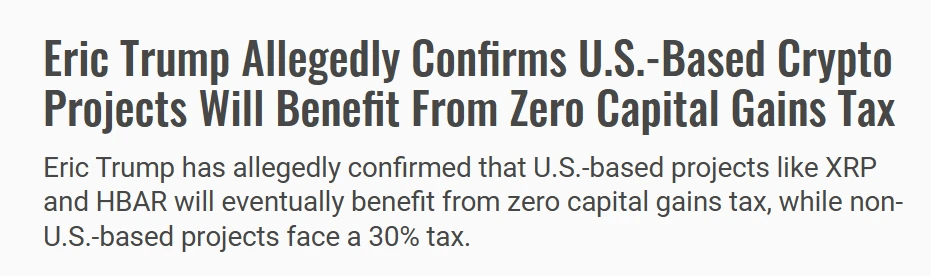
此前就一直有相关消息围绕着对于加密货币税的更改做文章。1 月,The Street 就曾报道热衷于参与加密活动的特朗普之子 Eric Trump 证实如 XRP、HBAR 等美国顶级加密项目将享受零资本利得税的优待,而非美国项目将面临越 30% 的资本利得税。

传言四起,特朗普取消加密利得税能落地吗?

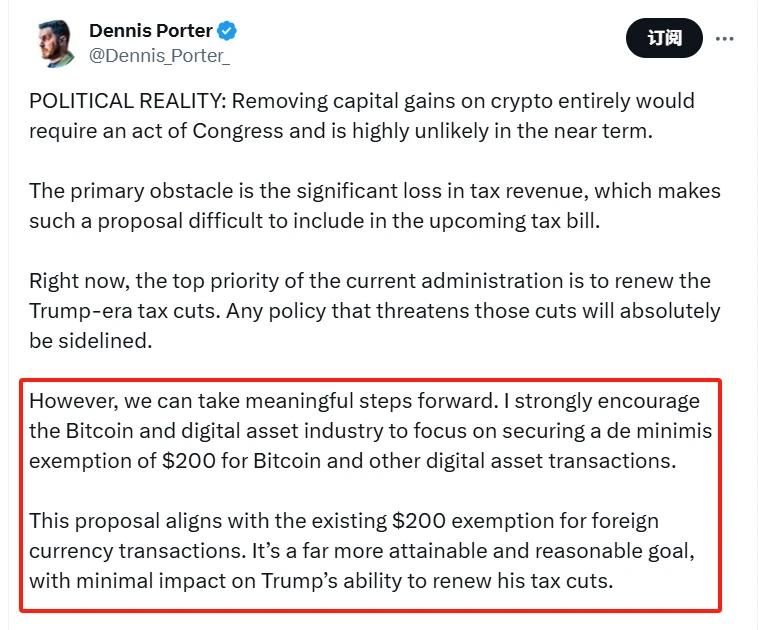
而 Satoshi Action Fund 联创 Dennis Porter 表示完全取消加密税在短期不切实际,但如“最低豁免额”之类的改变是可以争取一下的。

传言四起,特朗普取消加密利得税能落地吗?

所以,就算口号喊得响,但税法并不是特朗普一人说了算。

美国宪法规定税收政策的变更得经由国会点头,就算共和党会支持,但民主党可能不干。

而本身美国地方税法体系复杂,各州的具体政策不一,如何统一意见更是冗长的问题。

结语:梦想是好的,但或许还得等等

单看取消加密资本利得税,对广大市场参与者而言是一个无比美好的愿望。如果成真,固然能把现在艰难喘息的市场拉起来再战一把。但回归现实,零税率之后带来的市场变动以及一系列社会问题都是政策制定者绕不过的坎,所以但这个愿望在短期之内或许只能抱有期许。

在笔者看来,这更像给加密市场画的众多大饼的其中一个,看着是香,但最终能不能顺利吃到还得看国会的心情。对于我等散户来说,梦可以做,但钱包也要捂紧,不要听到些许风声就梭哈自己的未来。

传言四起,特朗普取消加密利得税能落地吗?

Trending Cryptos

Related Reads

Anthropic Creates an AI Jailbreak 'Penal Code': Your Requests, Four Ways to Die

Anthropic has publicly detailed its security measures and a new "Cyber Jailbreak Severity" (CJS) framework following the controversial takedown of its Fable 5 model. The incident, triggered by simple user requests like counting letters or stating a profession, highlighted overzealous safety filters. Anthropic classifies cybersecurity-related prompts into four tiers: malicious activities (blocked), high-risk dual-use (like pentesting, with strict limits), low-risk dual-use (often blocked by "safety margin" errors), and harmless tasks (theoretically allowed but still frequently flagged). The company admits its classifiers are tuned for high sensitivity, leading to many false positives. The newly proposed CJS framework aims to objectively score the severity of AI "jailbreaks" (prompts that bypass safety rules) on a 0-10 scale across four dimensions: Capability Gain (does it grant new attack abilities?), Breadth (does it work across multiple attack types?), Weaponization Ease (how hard is it to turn into a real attack?), and Discoverability (how easy is it to find?). The score determines the response, from no action (CJS-0) to a potential model takedown (CJS-4). The score is context-dependent; for example, discovering a major unknown vulnerability today scores high, while asking about a well-known one scores low. The article raises concerns about Anthropic's dual role: it is both creating powerful models (like the restricted Mythos 5) and defining the rules (CJS) for judging their misuse, potentially giving it disproportionate influence. This is set against the backdrop of U.S. export controls, which for the first time directly restricted API access to a model (Fable 5), creating a "tiered" system where public models are heavily filtered and advanced ones are limited to vetted partners. The CJS framework is portrayed as potentially providing regulators with a metric to justify future API shutdowns. For users, the advice is to carefully phrase prompts, watch for signs of being downgraded to a weaker model, and wait indefinitely for promised filter improvements.

marsbit24m ago

Anthropic Creates an AI Jailbreak 'Penal Code': Your Requests, Four Ways to Die

marsbit24m ago

$100M Annual Revenue, Two Berkeley Roommates in Their 20s Build the Most Profitable AI Business

Arena, the AI model ranking platform, has become a $100 million annual revenue business just eight months after launching its commercial service. Originally a UC Berkeley open-source research project called Chatbot Arena, it created a "battle arena" where users blind-test and vote on anonymous AI model responses. This has generated a highly trusted, community-driven leaderboard based on over 10 million user evaluations and 82 million votes. Major AI companies like OpenAI, Google, and Anthropic submit their flagship models to be ranked. The core monetization strategy is its AI Evaluations service, where model developers and large enterprises pay for in-depth performance analysis from Arena's massive user community. This provides real-world feedback on model strengths, weaknesses, and hallucinations—a critical service as models become more complex. The company, spun out from Berkeley in early 2025, quickly raised $100 million in seed funding at a $600 million valuation and later secured a $150 million Series A at a $1.7 billion valuation. The founding team includes CEO Anastasios Angelopoulos, a mathematician focused on rigorous model evaluation; CTO Wei-Lin Chiang, creator of the popular Vicuna chatbot; and co-founder Ion Stoica, a renowned Berkeley professor. Arena is now expanding beyond chat benchmarks into "Agent Mode," evaluating AI agents on complex, multi-step tasks like coding and research. The company's success illustrates the growing value and cost of independent, real-world AI model evaluation as the industry intensifies.

marsbit29m ago

$100M Annual Revenue, Two Berkeley Roommates in Their 20s Build the Most Profitable AI Business

marsbit29m ago

Racking Up 24,000 Stars: With One Command, AI Can Now Find Its Own Skills

Vercel, known for its developer tools like Next.js, has launched 'skills', a package manager for AI coding agents, garnering 24,000 GitHub stars. It allows developers to add specialized capabilities, such as React best practices, to AI assistants like Claude Code or Cursor with a single command: `npx skills add <package>`. Skills are shareable, reusable modules that define an AI agent's behavior for specific tasks, moving beyond one-off prompt engineering towards standardized 'capability engineering'. A key innovation is the 'find-skills' skill, which acts as an internal search engine, allowing an agent to autonomously find and install the right skill for a user's request. This lowers the barrier for non-developers to leverage advanced AI coding assistance. However, this 'npm moment' for AI brings significant security risks. Security audits of thousands of skills on platforms like skills.sh and ClawHub found over 30% contained security flaws, with about 13% classified as severe. Threats include malicious scripts that can access local files and credentials, and prompt injection hidden within skill documentation. Unlike traditional code packages, skills blend instructions, code, and system access, posing a direct risk to user machines and data. Experts advise treating skills like code—reviewing them carefully before installation, especially their scripts, and being wary of excessive permissions. Ultimately, Vercel's initiative represents a major shift towards modular, reusable AI capabilities, but its rapid adoption requires developers to bring the same caution used in managing traditional software dependencies.

marsbit30m ago

Racking Up 24,000 Stars: With One Command, AI Can Now Find Its Own Skills

marsbit30m ago

Claude Engineer Finally Unveils Fable 5's Ultimate Strategy, Teaching You How to Bridge the Information Gap with AI Models

This article, titled "Claude Engineer Finally Releases Fable 5 'Skill-Burning' Guide, Teaching How to Bridge the Information Gap with Models," details a blog post by Claude Code engineer Thariq Shihipar. The core concept is the "information gap" or "unknowns"—the disconnect between a user's instructions (the "map") and the actual task requirements (the "territory"). The article argues that with powerful models like Claude Fable 5, work quality depends on the user's ability to identify and clarify these unknowns. Shihipar categorizes unknowns into four types: Known Knowns (explicit instructions), Known Unknowns (awareness of gaps), Unknown Knowns (implicit, unstated knowledge), and Unknown Unknowns (unforeseen issues). The blog provides a framework for addressing these gaps throughout the workflow: * **Before Implementation:** Techniques include "Blindspot Scanning" to uncover Unknown Unknowns, brainstorming/prototyping for visual or complex tasks, having Claude ask clarifying questions, using reference code/examples, and creating implementation plans. * **During Implementation:** Maintaining an "implementation notes" file for Claude to document deviations and decisions made due to encountered edge cases. * **After Implementation:** Creating summary documents for review and having Claude generate quizzes to ensure the user fully understands the completed changes. The article concludes that as models become more capable, the key to success is systematically discovering and defining these unknowns through low-cost methods like prototyping and planning, allowing for more effective collaboration.

marsbit34m ago

Claude Engineer Finally Unveils Fable 5's Ultimate Strategy, Teaching You How to Bridge the Information Gap with AI Models

marsbit34m ago

Trading

Spot

Hot Articles

What is $BITCOIN

DIGITAL GOLD ($BITCOIN): A Comprehensive Analysis Introduction to DIGITAL GOLD ($BITCOIN) DIGITAL GOLD ($BITCOIN) is a blockchain-based project operating on the Solana network, which aims to combine the characteristics of traditional precious metals with the innovation of decentralized technologies. While it shares a name with Bitcoin, often referred to as “digital gold” due to its perception as a store of value, DIGITAL GOLD is a separate token designed to create a unique ecosystem within the Web3 landscape. Its goal is to position itself as a viable alternative digital asset, although specifics regarding its applications and functionalities are still developing. What is DIGITAL GOLD ($BITCOIN)? DIGITAL GOLD ($BITCOIN) is a cryptocurrency token explicitly designed for use on the Solana blockchain. In contrast to Bitcoin, which provides a widely recognized value storage role, this token appears to focus on broader applications and characteristics. Notable aspects include: Blockchain Infrastructure: The token is built on the Solana blockchain, known for its capacity to handle high-speed and low-cost transactions. Supply Dynamics: DIGITAL GOLD has a maximum supply capped at 100 quadrillion tokens (100P $BITCOIN), although details regarding its circulating supply are currently undisclosed. Utility: While precise functionalities are not explicitly outlined, there are indications that the token could be utilized for various applications, potentially involving decentralized applications (dApps) or asset tokenization strategies. Who is the Creator of DIGITAL GOLD ($BITCOIN)? At present, the identity of the creators and development team behind DIGITAL GOLD ($BITCOIN) remains unknown. This situation is typical among many innovative projects within the blockchain space, particularly those aligning with decentralized finance and meme coin phenomena. While such anonymity may foster a community-driven culture, it intensifies concerns about governance and accountability. Who are the Investors of DIGITAL GOLD ($BITCOIN)? The available information indicates that DIGITAL GOLD ($BITCOIN) does not have any known institutional backers or prominent venture capital investments. The project seems to operate on a peer-to-peer model focused on community support and adoption rather than traditional funding routes. Its activity and liquidity are primarily situated on decentralized exchanges (DEXs), such as PumpSwap, rather than established centralized trading platforms, further highlighting its grassroots approach. How DIGITAL GOLD ($BITCOIN) Works The operational mechanics of DIGITAL GOLD ($BITCOIN) can be elaborated on based on its blockchain design and network attributes: Consensus Mechanism: By leveraging Solana’s unique proof-of-history (PoH) combined with a proof-of-stake (PoS) model, the project ensures efficient transaction validation contributing to the network's high performance. Tokenomics: While specific deflationary mechanisms have not been extensively detailed, the vast maximum token supply implies that it may cater to microtransactions or niche use cases that are still to be defined. Interoperability: There exists the potential for integration with Solana’s broader ecosystem, including various decentralized finance (DeFi) platforms. However, the details regarding specific integrations remain unspecified. Timeline of Key Events Here is a timeline that highlights significant milestones concerning DIGITAL GOLD ($BITCOIN): 2023: The initial deployment of the token occurs on the Solana blockchain, marked by its contract address. 2024: DIGITAL GOLD gains visibility as it becomes available for trading on decentralized exchanges like PumpSwap, allowing users to trade it against SOL. 2025: The project witnesses sporadic trading activity and potential interest in community-led engagements, although no noteworthy partnerships or technical advancements have been documented as of yet. Critical Analysis Strengths Scalability: The underlying Solana infrastructure supports high transaction volumes, which could enhance the utility of $BITCOIN in various transaction scenarios. Accessibility: The potential low trading price per token could attract retail investors, facilitating wider participation due to fractional ownership opportunities. Risks Lack of Transparency: The absence of publicly known backers, developers, or an audit process may yield skepticism regarding the project's sustainability and trustworthiness. Market Volatility: The trading activity is heavily reliant on speculative behavior, which can result in significant price volatility and uncertainty for investors. Conclusion DIGITAL GOLD ($BITCOIN) emerges as an intriguing yet ambiguous project within the rapidly evolving Solana ecosystem. While it attempts to leverage the “digital gold” narrative, its departure from Bitcoin's established role as a store of value underscores the need for a clearer differentiation of its intended utility and governance structure. Future acceptance and adoption will likely depend on addressing the current opacity and defining its operational and economic strategies more explicitly. Note: This report encompasses synthesised information available as of October 2023, and developments may have transpired beyond the research period.

617 Total ViewsPublished 2025.05.13Updated 2025.05.13

What is $BITCOIN

Discussions

Welcome to the HTX Community. Here, you can stay informed about the latest platform developments and gain access to professional market insights. Users' opinions on the price of BTC (BTC) are presented below.

活动图片