揭秘:8家头部VC持仓资产及近期操作

Odaily星球日报Published on 2024-10-15Last updated on 2024-10-15

Abstract

自2021年达到资产巅峰后,多数风投机构仍处于资产价值低点。

原文来源: @thedefiedge

编译: Odaily星球日报 Wenser(@wenser 2010 

揭秘:8家头部VC持仓资产及近期操作

编者按:比特币涨至 7 月底以来高点,顶级风投机构也再一次迎来账面浮盈。加密 KOL DeFi Edgy 近期对 8 大头部加密风投机构相关链上资产进行了追踪调查,借此,我们可以一窥这些“身处食物链顶端”的行业角色目前的资产配置以及投资偏好。以下为全文内容,供读者参考。Odaily星球日报提醒:以下仅为视角分享,不构成投资建议。

8 大顶级风投钱包背后的真相:只是“广撒网、早盈利”?

这是迄今为止最奇怪的周期——没人知道接下来会发生什么。

在这种时候,了解其他人在做什么会很有帮助。所以,我花了整个周末深入研究风投大佬们最近在做什么。现在,我知道你们有些人会想:“他们只是撒网式投资,从早期介入中获利。”

听着,我不认为他们是加密货币这一行业里最聪明的人,尤其是在经历了上个周期(Odaily星球日报注:指此前一系列机构连环暴雷等相关事件)之后。但我们仍然应该关注他们:他们确实有信息优势,资金充足,而且比我们更接近项目方。

我在思考:

• 他们是否在进行一些有趣的操作?

• 他们是否像我们一样也在玩山寨币?

• 还是他们仍然持有一些过去的老牌价值币?

所以,让我们看看这些穿着西装的“投机分子”在搞什么鬼。

注意:

  • 不要照搬风投的交易操作。他们能接触到比我们更好的交易机会,而且他们玩的是不同的游戏,这只是为了让我们更了解这个领域的其他参与者。

  • 我们并没有他们全部的钱包信息。我们尽最大努力使用众包标签和自己的链上分析,但你不可能抓住所有的地址来做分析。

  • 我们选择了几家头部基金,并按规模大小进行了排序。我们会介绍每个基金的资产总额、主要资产、小额资产以及任何有趣的近期操作。

8 家顶级加密风投公司及其主要资产持仓

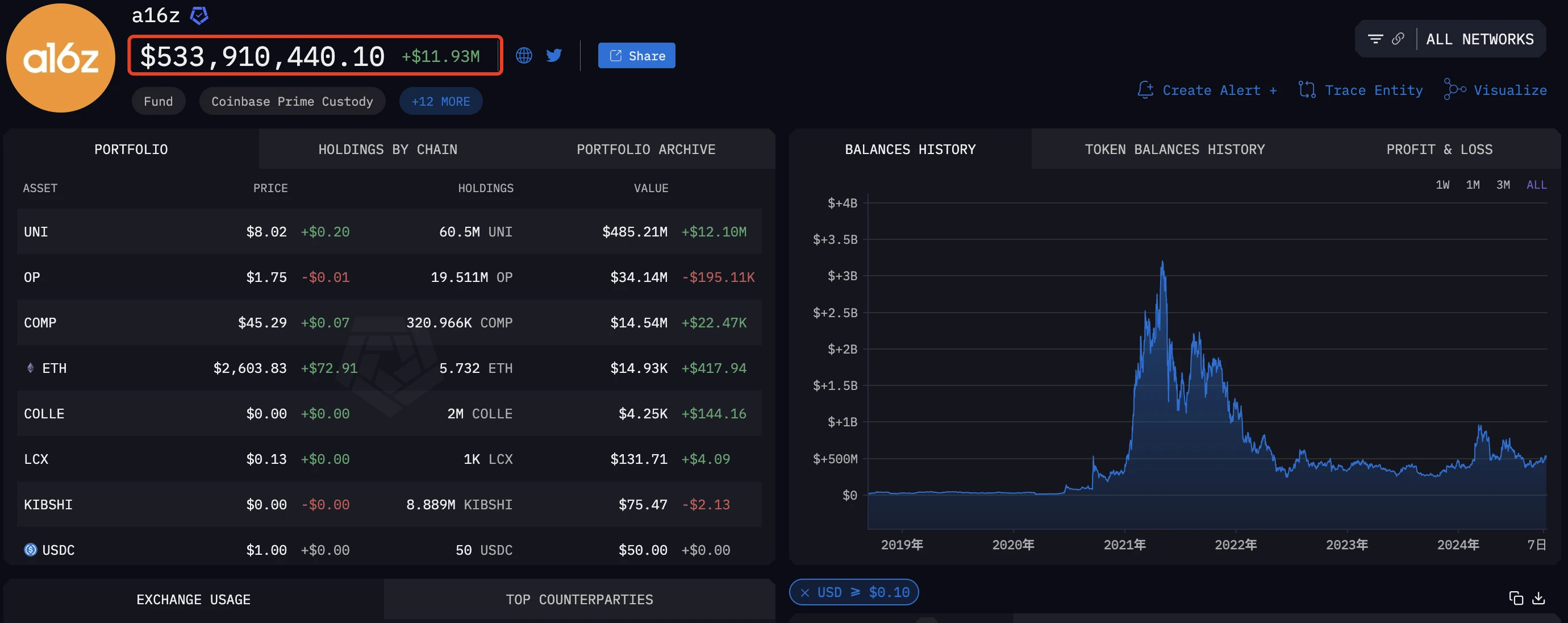
1. a16z(4.823 亿美元)

主要资产:

- UNI: 4.36 亿美元

- OP: 3100 万美元

- COMP: 1400 万美元

小额资产:ETH(1.4 万美元),COLLE(6000 美元)

A16z是市场上最大的 UNI 代币持有者之一,这意味着他们有足够的能力影响该社区的提案,因为 4% 的 UNI 供应量就能达到法定投票人数,而且他们已经持有 UNI 代币很多年了。a16z 的钱包最近变化是他们仍在持有的 OP 代币的初始解锁部分。

查询链接:https://d1x7dwosqaosdj.cloudfront.net/images/2024-10-15/bd25d998a5aed6371fc27343113a0a5c

Odaily星球日报注:随着 BTC 近日的连续上涨,a16z 的资产总额上涨至 5.34 亿美元左右。
揭秘:8家头部VC持仓资产及近期操作

a16z 资产余额面板

2. Galaxy Digital(3.645 亿美元)

主要资产:

- BTC: 1.94 亿美元

- ETH: 1.15 亿美元

- USDC: 4000 万美元

- USDT: 500 万美元

- AVAX: 400 万美元

- USDC: 130 万美元

- AAVE: 114 万美元

值得一提的小额资产(10 万-50 万美元):MKR、OXT、UNI、TOKE;

他们持有的代币都经过了巨额交易量的洗礼,主要是稳定币和 BTC,推测可能是在分发代币和进行一些套利策略。

最近,他们从币安提取了价值 330 万美元的 AVAX。

查询链接:https://d1x7dwosqaosdj.cloudfront.net/images/2024-10-15/9b40329caa2b7dcf9246adb10a723a3b

近日,或受市场行情回暖影响,Galaxy Digital 曾多次转出 BTC、ETH、USDT、USDC 等各类代币,目前其余额减少至 3.54 亿美元。

揭秘:8家头部VC持仓资产及近期操作

Galaxy Digital 提取 AVAX 记录

3. Jump Trading(2.864 亿美元)

主要资产:

- USDC: 7800 万美元

- USDT: 7038 万美元

- stETH: 7038 万美元

- ETH: 5490 万美元

- T: 215 万美元

- WETH: 124 万美元

- SHIB: 120 万美元

- SNX: 116 万美元

小额持仓包括(20 万-70 万美元):MKR、LDO、GRT、DAI、UNI、KNC、HMT、BNB、CVX、COMP、INJ、MNT。

Jump 的投资组合非常典型,主要是 ETH 和稳定币。有趣的是,他们还持有 Threshold Network、SHIB 和 SNX 等非主流代币。尽管此前有人声称 Jump 已经离开了加密领域,但他们现在仍在进行大量操作。

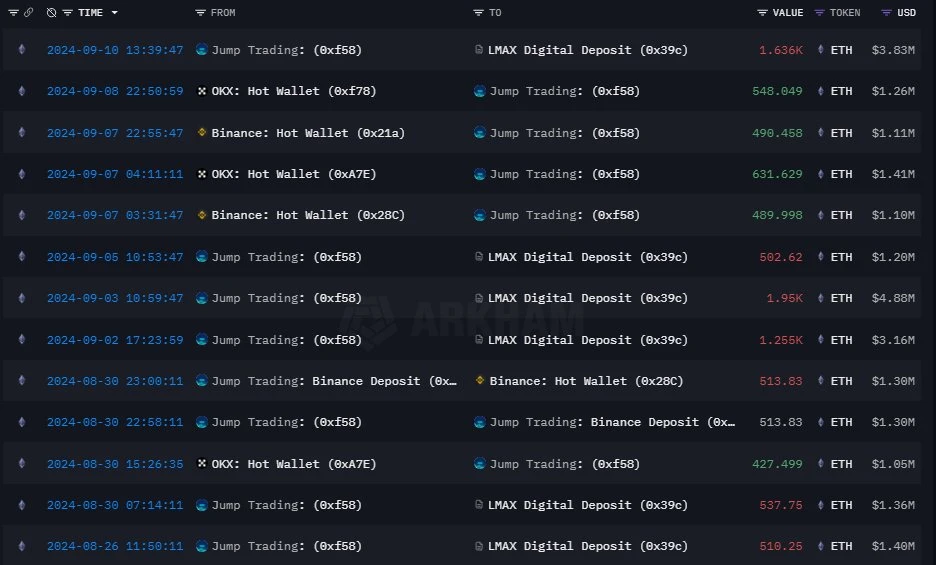
此外,Jump 近期还开始将 ETH 存入 LMAX(一个机构加密交易所)。

查询链接:https://d1x7dwosqaosdj.cloudfront.net/images/2024-10-15/961e973965c0492fd33e8234db823876

近日,或受市场行情回暖影响,Jump Trading 的资产总额上涨至 3.5 亿美元。
揭秘:8家头部VC持仓资产及近期操作

Jump 转出操作记录

4. Wintermute(1.598 亿美元)

主要资产:

- USDC: 1660 万美元

- WBTC: 1115 万美元

- PEPECOIN: 1052 万美元

- ETH: 1039 万美元

- USDT: 911 万美元

- TKO: 467 万美元

- CBBTC: 463 万美元

- MATIC: 441 万美元

- BMC: 436 万美元

- NEIRO: 348 万美元

小额资产(20 万-300 万美元)包括 BASEDAI、TON、ZK、MOG、stETH、ARB、ENA、ARKM、APE、LDO、ONDO 等。

Wintermute 在迷因代币上下重注。除了他们最大的持仓(PEPECOIN - 这不是 PEPE,是另一个迷因币),他们在 MOG、NEIRO、COQ、APU、SHIB、BENJI 等上也有相当规模。

他们以作为 Meme 币项目的做市商而闻名。

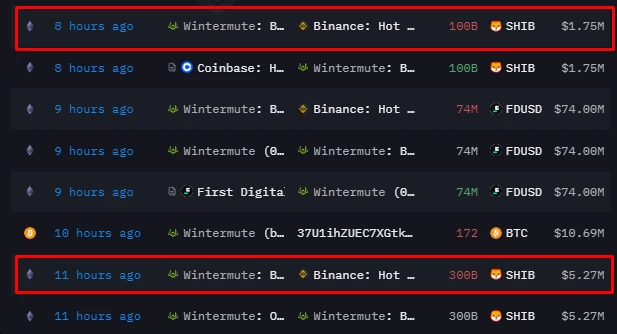
Wintermute 最近在他们的钱包中积累了一定量的 cbBTC(Coinbase BTC)和 BTC;此外,他们还向币安发送了超过 600 万美元的 SHIB。

查询链接:https://d1x7dwosqaosdj.cloudfront.net/images/2024-10-15/35aa0b77635aa7135e5588aa050c3091

近日,或受市场行情回暖影响,Wintermute 的资产总额上涨至 2.29 亿美元。
揭秘:8家头部VC持仓资产及近期操作

Wintermute 操作记录

5. Pantera Capital(1.6115 亿美元)

主要资产:

- ONDO: 1.52 亿美元

- ETHX: 440 万美元

- SD: 111 万美元

- ECOX: 941.6 万美元

- LDO: 38.8 万美元

- PERC: 37.5 万美元

- NOTE: 27.4 万美元

最近,Pantera 将近 300 万美元的 MATIC 转移到了 Coinbase 交易所;最近其还将 100 万美元的 LDO 转移到 Anchorage(一个面向机构的加密质押平台)。有趣的是,他们大部分的 ETH 都被转移到了中心化交易所。

除此之外,我们还可以看到他们在 ONDO 上的投资资金价值缩水了 56% 。值得注意的是,Pantera 是 ONDO 的早期私募投资者之一。

查询链接:https://d1x7dwosqaosdj.cloudfront.net/images/2024-10-15/c90d583425e34eee3fd01484bf28b031

近日,或受市场行情回暖影响,Pantera 的资产总额上涨至 1.789 亿美元。

揭秘:8家头部VC持仓资产及近期操作

Pantera 卖出 LDO 操作记录

6. Blockchain Capital(6710 万美元)

主要资产:

- AAVE: 3280 万美元

- UNI: 1835 万美元

- ETH: 416 万美元

- UMA: 212 万美元

- SAFE: 189 万美元

- 1INCH: 188 万美元

- COW: 162 万美元

- FORT: 131 万美元

- USDC: 100 万美元

小额资产(10 万-60 万美元):SUSHI、BAL、PSP、USDC、PERP

占据其最大持仓的 AAVE 代币很有意思,Blockchain 已经持有 AAVE 很多年了,由于最近其价格持续上涨,可能值得仔细关注。此外,和 Pantera 一样,Blockchain 此前曾将价值超过 500 万美元的 ETH 转移到了 Anchorage 交易所。

查询链接:https://d1x7dwosqaosdj.cloudfront.net/images/2024-10-15/9a95c3e556cd295a456375c08489c241

近日,或受市场行情回暖影响,Blockchain 的资产总额上涨至 7573 万美元。

揭秘:8家头部VC持仓资产及近期操作

Blockchain 转移 ETH 操作记录

7. Spartan Group(3538 万美元)

主要资产:

- PENDLE: 1693 万美元

- GAL: 265 万美元

- MNT: 249 万美元

- OP: 140 万美元

- IMX: 118 万美元

- WILD: 109 万美元

- GRT: 104 万美元

- AEVO: 98.2 万美元

- USDC: 84.1 万美元

- PTU: 80 万美元

- RBN: 77.8 万美元

- 1INCH: 70 万美元

小额资产(10 万-50 万美元)包括:MAV、CHESS、MPL、G、DYDX、ALI、BETA、PSTAKE、ETH。

可以看到的是,Spartan Group 重仓了 Pendle。除此之外,我们没有看到太多重大交易。他们主要在进行 USDC 的套利策略交易。

有趣的是,他们已经将所有的 BEAM 资产转移到了 Sophon,这是一个即将推出的链,你现在就可以开始存入资产来参与空投交互。

查询链接:

近日,或受市场行情回暖影响,Spartan Group 的资产总额上涨至 3803 万美元。

揭秘:8家头部VC持仓资产及近期操作

Spartan 也“撸空投”?

8. DeFiance Capital(3360 万美元)

主要资产:

- PYUSD: 2000 万美元

- LDO: 608 万美元

- BEAM: 394 万美元

- USDC: 110 万美元

- TBILL: 104 万美元

小额资产(5 万-30 万美元)包括 VIRTUAL、AVAX、BAL、MCB、USDT、INSUR。

DeFiance 在游戏代币上下注颇多,他们最近的交易涉及到了几笔来自 Shrapnel(一个Web3射击游戏)的转账。

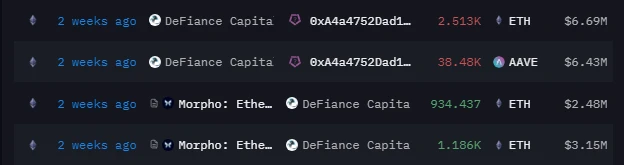
此外,他们最近还从 Morpho 收到了了大量 ETH。

查询链接:https://d1x7dwosqaosdj.cloudfront.net/images/2024-10-15/adcaa1a12b112b5c04a36d4e8f9b77ed

近日,或受市场行情回暖影响,DeFiance 的资产总额上涨至 3480 万美元。
揭秘:8家头部VC持仓资产及近期操作

Morpho 与 DeFiance 存在“内幕交易”?

透视风投持仓整体趋势:

根据以上信息,我们可以看到——

  • 共同持仓:a16z、Jump、Wintermute 和 Blockchain Capital 偏好头部 DeFi 代币(UNI、AAVE)、ETH 和稳定币。可能是由于在熊市时,以上机构更为关注流动性和 DeFi 协议。

  • 长期持有:a16z和 Blockchain Capital 属于“行业钻石手”——他们分别持有 UNI 和 AAVE 等资产多年。

  • 稳定币套利:许多机构都在进行这一操作,这从他们高额的稳定币交易量可以看出。

  • 比特币二层网络:该赛道继续收到了大量投资。BTC L2公司和项目此前共筹集了 9460 万美元,环比增长 174% 。

  • 早期投资仍然占主导地位:近 80% 的投资资本和种子前轮交易占所有投资操作的 13% 。

  • 热门投资领域转向:尽管 2021 年 NFT 和 GameFi 赛道大热,但这两大领域在 2024 年已经极速降温;现在风投更倾向于 AI、基础设施甚至 Meme 币等热点趋势赛道

我们最近研究了 Galaxy 关于“ 2024 年风投趋势”的一份报告,以下是值得分享的一些亮点:

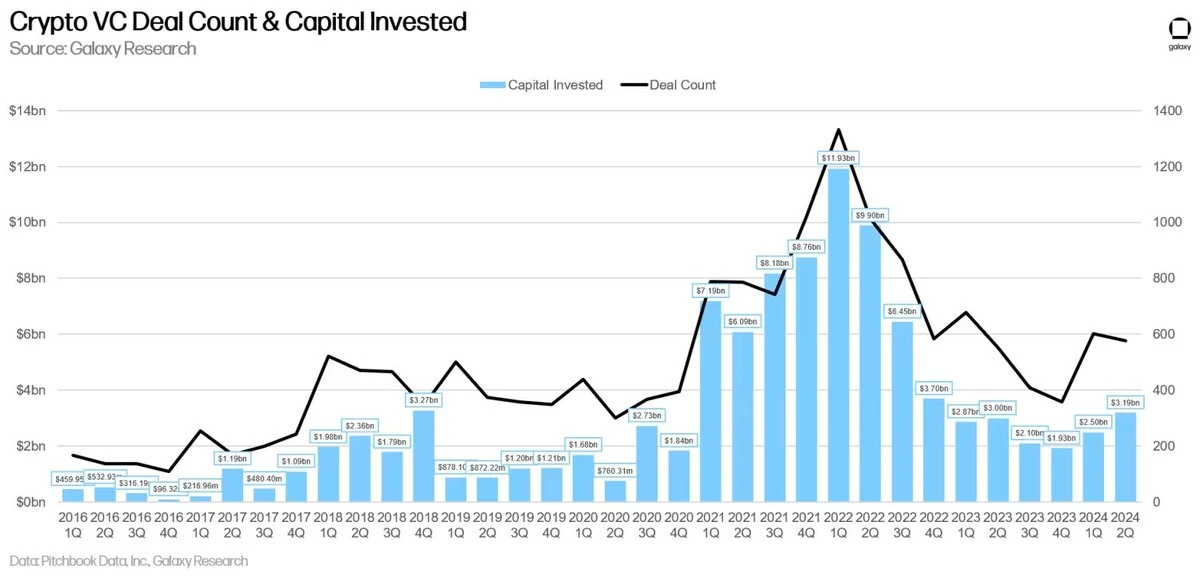
与 2021-2022 年同期相比,风投投资金额大幅下降。尽管如此,风投在 2024 年第二季度仍投出了 31.9 亿美元(环比上涨 28% )。
揭秘:8家头部VC持仓资产及近期操作

风投投资金额及投资案例数量统计

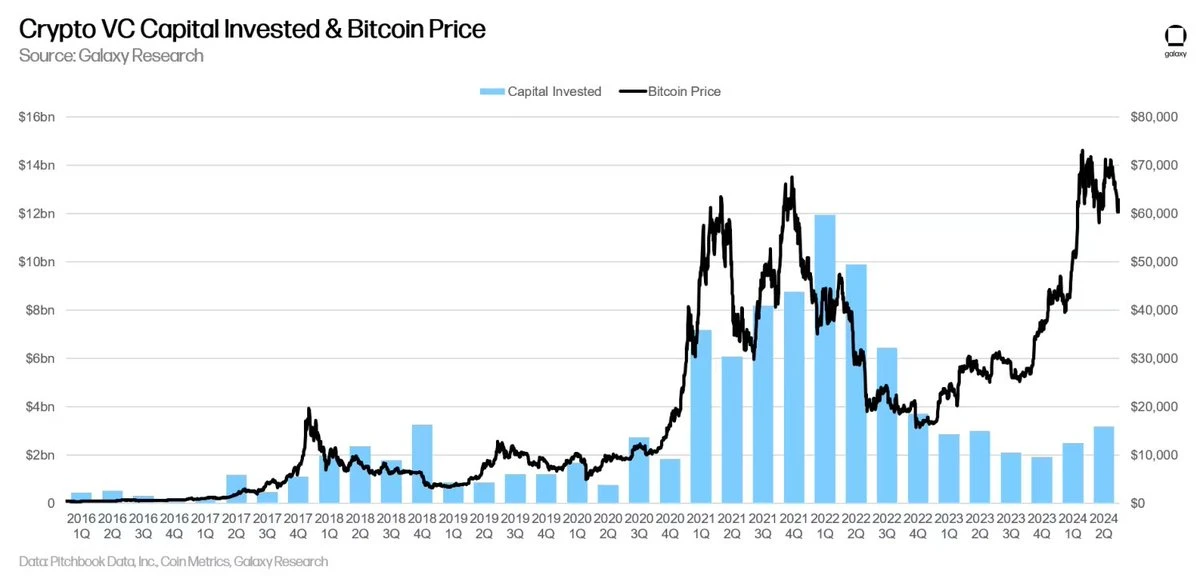
有趣的是,投资规模并不完全跟随 BTC 价格涨跌而增加或减少。过去这种相关性更准确,但现在看来风投资金更加紧张,流动性较为紧缺。
揭秘:8家头部VC持仓资产及近期操作

风投投资规模与 BTC 价格相关性图表

大多数投资仍集中在 NFT/游戏/DAO 等赛道,其次是基础设施。据报告数据,“2024 年第二季度,‘Web3/NFT/DAO/元宇宙/游戏’类别的公司和项目筹集了最大份额的加密风投资金(占比为 24% ),总计 7.58 亿美元。该类别中最大的两笔交易是 Farcaster 和 Zentry,分别筹集了 1.5 亿美元和 1.4 亿美元。”
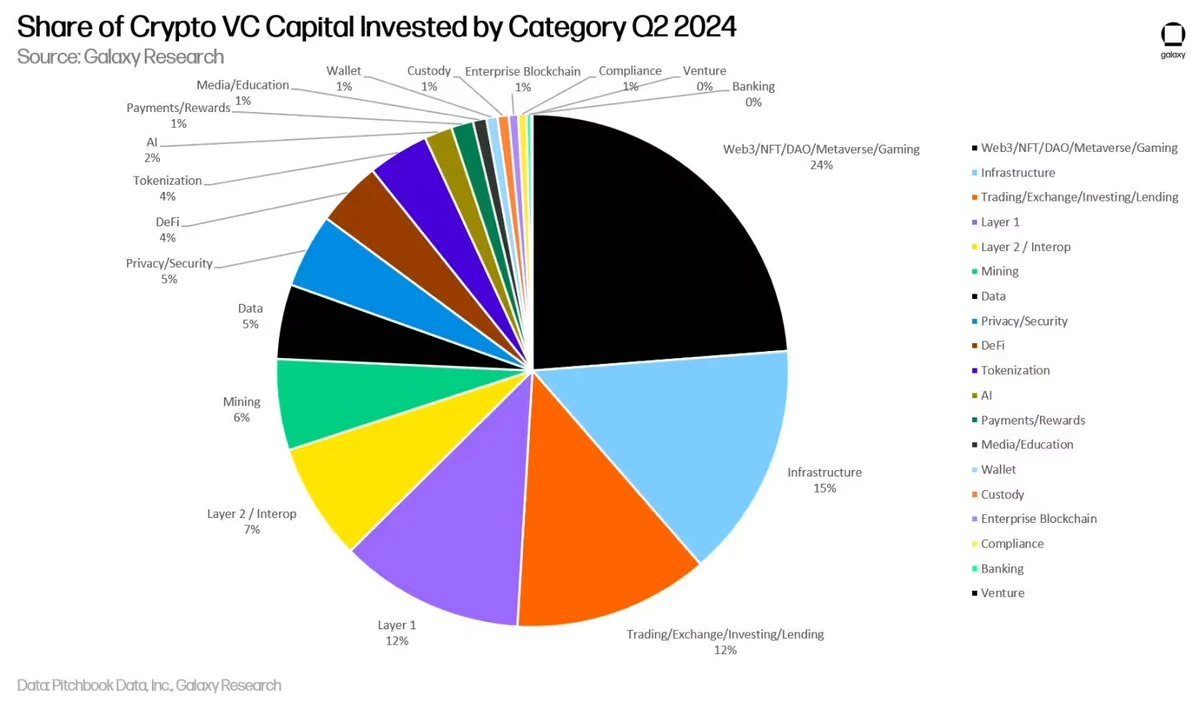
揭秘:8家头部VC持仓资产及近期操作

不同赛道所获投资占比饼状图

希望这份深度分析报告能为你提供关于风投如何在加密领域出手的有效信息。这项分析的关键是让你透过他们的投资行为与交易操作等表象,预测一些潜在趋势并了解风投机构的运作方式。

永远记住:不要盲目跟随风投交易,而是将其作为一种信息资源来增强你研究的深度与有效性。

相关工具参考:

@DeBankDeFi

@ArkhamIntel

@etherscan

Related Reads

Six Complaints from an Ethereum Developer

A disgruntled early Ethereum developer and token holder presents six core criticisms of the project's trajectory, contrasting it with Solana's rise. 1. **Premature Complacency**: The Ethereum Foundation shifted from a "building" to an "infrastructure" mindset too soon, adopting a passive, "retired chairman" posture before securing market dominance, reflected in ETH's ~65% decline against BTC post-Merge. 2. **Misguided Messaging**: The Merge was marketed primarily on ESG (99.95% energy reduction) rather than user benefits like speed or yield, appealing to internal ideals instead of market demands. 3. **Delayed Execution**: Proof-of-Stake, on the roadmap since 2015, took seven years to launch, ceding critical narrative and development windows. Competitors like Solana built entire ecosystems in that time. 4. **Poor Native Staking UX**: Years after the Merge, there is still no first-party, user-friendly staking application, forcing reliance on centralized services like Lido and undermining ETH's "sound money" narrative. 5. **Managed Decline**: The rollup-centric roadmap deliberately weakens the base layer's fee capture, outsourcing value and profitability to L2s like Arbitrum and Base, which issue their own tokens and fragment capital. 6. **Ideology Over Product**: Ethereum culture prioritizes philosophical purity ("credible neutrality," "public goods") over competitive product delivery that meets user demands (e.g., financialization), while Solana's ecosystem focuses on coordinated execution. The diagnosis is accumulated execution debt, not a coordination failure. Ethereum possessed a structural advantage in 2021 but spent years in governance debates, while Solana efficiently executed. The current market cap reflects these specific strategic failures, not abstract theory.

marsbit2h ago

Six Complaints from an Ethereum Developer

marsbit2h ago

Six Complaints from an Ethereum Developer

Six Grievances from an Ethereum Developer The author, an early investor and developer still building on Ethereum, expresses deep frustration with its trajectory and declining ETH/BTC price since the merge. The core argument is that Ethereum's current market position stems from concrete failures in execution and strategy, not abstract coordination problems. The first grievance targets a shift in the Ethereum Foundation's mentality from builders to "infrastructure," adopting a premature posture of a retired victor. Second, marketing the Merge around ESG (99.95% energy reduction) is seen as talking to its own conscience rather than the market, which prioritizes user experience and yield. Third, the seven-year delay in delivering Proof-of-Stake (PoS) ceded critical narrative and development time to competitors like Solana. Fourth, three years post-merge, there is still no user-friendly first-party staking application, forcing reliance on centralized services like Lido and undermining ETH's monetary narrative. Fifth, the rollup-centric roadmap has strategically surrendered base-layer fee capture to L2s, fragmenting value within the ecosystem while Solana demonstrates an integrated L1's value accrual. Finally, the author criticizes an institutional culture that prioritizes philosophical ideals (credible neutrality, pluralism) over competitive product delivery focused on what users actually want. The diagnosis is "accumulated execution debt." Ethereum possessed a structural advantage in 2021 but spent years in governance debates, while Solana's ecosystem coordinated efficiently to deliver and capture the next wave of value. The conclusion is that Ethereum's market cap reflects its abandonment of the fight for asset appreciation.

链捕手2h ago

Six Complaints from an Ethereum Developer

链捕手2h ago

Token Budget Wars: Enterprise AI Enters the 'Accounting Era'

Token Budget Wars: Enterprise AI Enters the "Accounting Era" Enterprise AI is shifting from the question of "whether to adopt" to "how to account for it." As AI inference costs evolve from experimental budgets into ongoing operational expenses, CEOs and CFOs are demanding proof of value: what tangible results does each dollar spent on tokens deliver? The core of "Token Budget Wars" is not simply about reducing AI bills, but about intelligently allocating compute resources. It involves determining which business processes warrant more computational power, which tasks can use cheaper models, which can be outsourced or handled manually, and which are merely inefficient consumption. A key insight is that AI usage (token consumption) does not equal value. While SaaS usage indicated software adoption, AI token usage only indicates the "meter is running." The same workflow can cost vastly different amounts due to factors like prompt quality, context, model choice, and retries. The critical metric for scaling is "marginal token utility"—the business value created per additional dollar of inference cost. However, this is difficult to measure due to challenges like the long tail of retries, context inflation (where costs can scale quadratically with context length), and inefficient model routing (defaulting to the most powerful model for all tasks). The competition for token allocation is intensifying because, in the AI era, influence is tied to how much intelligence one can command, not just team size. AI spending is essentially competing with labor costs, whether for replacing external BPOs, internal staff, or generating new revenue. BPO contracts provide a clearer benchmark as they are priced per completed unit. The missing layer is attribution from tokens to business outcomes. Companies need a system that connects inference spending to completed work and results, capturing the agent's decision trajectory—what it saw, retrieved, tried, and why it succeeded or failed. This recorded rationale becomes a valuable asset. Ultimately, those who master token-to-outcome attribution will control the allocation of AI resources within enterprises, deciding which workflows get more compute, which are capped, or which revert to humans. The first phase of enterprise AI proved models could do the work. The next phase will determine how much of that work is worth paying for.

marsbit2h ago

Token Budget Wars: Enterprise AI Enters the 'Accounting Era'

marsbit2h ago

Trading

Spot
Futures

Hot Articles

What is $BITCOIN

DIGITAL GOLD ($BITCOIN): A Comprehensive Analysis Introduction to DIGITAL GOLD ($BITCOIN) DIGITAL GOLD ($BITCOIN) is a blockchain-based project operating on the Solana network, which aims to combine the characteristics of traditional precious metals with the innovation of decentralized technologies. While it shares a name with Bitcoin, often referred to as “digital gold” due to its perception as a store of value, DIGITAL GOLD is a separate token designed to create a unique ecosystem within the Web3 landscape. Its goal is to position itself as a viable alternative digital asset, although specifics regarding its applications and functionalities are still developing. What is DIGITAL GOLD ($BITCOIN)? DIGITAL GOLD ($BITCOIN) is a cryptocurrency token explicitly designed for use on the Solana blockchain. In contrast to Bitcoin, which provides a widely recognized value storage role, this token appears to focus on broader applications and characteristics. Notable aspects include: Blockchain Infrastructure: The token is built on the Solana blockchain, known for its capacity to handle high-speed and low-cost transactions. Supply Dynamics: DIGITAL GOLD has a maximum supply capped at 100 quadrillion tokens (100P $BITCOIN), although details regarding its circulating supply are currently undisclosed. Utility: While precise functionalities are not explicitly outlined, there are indications that the token could be utilized for various applications, potentially involving decentralized applications (dApps) or asset tokenization strategies. Who is the Creator of DIGITAL GOLD ($BITCOIN)? At present, the identity of the creators and development team behind DIGITAL GOLD ($BITCOIN) remains unknown. This situation is typical among many innovative projects within the blockchain space, particularly those aligning with decentralized finance and meme coin phenomena. While such anonymity may foster a community-driven culture, it intensifies concerns about governance and accountability. Who are the Investors of DIGITAL GOLD ($BITCOIN)? The available information indicates that DIGITAL GOLD ($BITCOIN) does not have any known institutional backers or prominent venture capital investments. The project seems to operate on a peer-to-peer model focused on community support and adoption rather than traditional funding routes. Its activity and liquidity are primarily situated on decentralized exchanges (DEXs), such as PumpSwap, rather than established centralized trading platforms, further highlighting its grassroots approach. How DIGITAL GOLD ($BITCOIN) Works The operational mechanics of DIGITAL GOLD ($BITCOIN) can be elaborated on based on its blockchain design and network attributes: Consensus Mechanism: By leveraging Solana’s unique proof-of-history (PoH) combined with a proof-of-stake (PoS) model, the project ensures efficient transaction validation contributing to the network's high performance. Tokenomics: While specific deflationary mechanisms have not been extensively detailed, the vast maximum token supply implies that it may cater to microtransactions or niche use cases that are still to be defined. Interoperability: There exists the potential for integration with Solana’s broader ecosystem, including various decentralized finance (DeFi) platforms. However, the details regarding specific integrations remain unspecified. Timeline of Key Events Here is a timeline that highlights significant milestones concerning DIGITAL GOLD ($BITCOIN): 2023: The initial deployment of the token occurs on the Solana blockchain, marked by its contract address. 2024: DIGITAL GOLD gains visibility as it becomes available for trading on decentralized exchanges like PumpSwap, allowing users to trade it against SOL. 2025: The project witnesses sporadic trading activity and potential interest in community-led engagements, although no noteworthy partnerships or technical advancements have been documented as of yet. Critical Analysis Strengths Scalability: The underlying Solana infrastructure supports high transaction volumes, which could enhance the utility of $BITCOIN in various transaction scenarios. Accessibility: The potential low trading price per token could attract retail investors, facilitating wider participation due to fractional ownership opportunities. Risks Lack of Transparency: The absence of publicly known backers, developers, or an audit process may yield skepticism regarding the project's sustainability and trustworthiness. Market Volatility: The trading activity is heavily reliant on speculative behavior, which can result in significant price volatility and uncertainty for investors. Conclusion DIGITAL GOLD ($BITCOIN) emerges as an intriguing yet ambiguous project within the rapidly evolving Solana ecosystem. While it attempts to leverage the “digital gold” narrative, its departure from Bitcoin's established role as a store of value underscores the need for a clearer differentiation of its intended utility and governance structure. Future acceptance and adoption will likely depend on addressing the current opacity and defining its operational and economic strategies more explicitly. Note: This report encompasses synthesised information available as of October 2023, and developments may have transpired beyond the research period.

363 Total ViewsPublished 2025.05.13Updated 2025.05.13

What is $BITCOIN

Discussions

Welcome to the HTX Community. Here, you can stay informed about the latest platform developments and gain access to professional market insights. Users' opinions on the price of BTC (BTC) are presented below.

活动图片