Galaxy Weighs Theories After $8.3M Bitcoin Burn Mystery

bitcoinistPublished on 2026-05-28Last updated on 2026-05-28

Abstract

Galaxy Research is investigating a mysterious Bitcoin transaction where approximately 107 BTC (worth $8.3 million) was deliberately sent to a provably unspendable "burn" address. The primary question is the motive behind destroying such a large sum. Galaxy proposed several theories, including a tax-loss strategy (though deemed unlikely for old coins), a religious or ideological act, an attempt to dispose of illicit funds, or coercion. The firm suggested a plausible explanation could be an automated error, where a trading system mistakenly sent funds to a known burn address labeled "Counterparty" instead of the intended recipient. Galaxy acknowledged all theories are speculative, and the true reason may never be known.

Galaxy Research is trying to explain one of the stranger Bitcoin transactions of the year after five addresses sent roughly 107 BTC, worth about $8.3 million, to an old burn address, making the coins provably unspendable.
The move, flagged by Galaxy in a thread on X, immediately raised the question that sits at the center of the episode: why would anyone deliberately destroy a large amount of Bitcoin rather than sell it, move it, donate it, or leave it dormant?

“ACTUAL ONCHAIN BOATING ACCIDENT?” Galaxy Research wrote. “On Monday, 5 bitcoin addresses sent ~107 BTC ($8.3m) to an old burn address, making the coins provably unspendable. Why would someone do this? The Galaxy Research team’s best theories are in the thread below (spoiler: none are very good).”

The burn address in question is not merely a wallet whose owner lost a key. Galaxy said the address, 1111111111111111111114oLvT2, corresponds to a Hash160 value of twenty zero bytes. Encoding that with Bitcoin’s P2PKH version byte produces the address. In practical terms, spending coins from it would require finding a public key whose Hash160 is all zeros, an outcome Galaxy framed as computationally out of reach.

That makes the transaction different from a mistaken transfer to an exchange address, a wallet controlled by an unknown counterparty, or an address whose private key may exist somewhere. The coins were not simply moved into obscurity. They were sent to a destination designed to be unspendable.

Theories Why Someone Burns $8.3 Million In Bitcoin

Galaxy’s first theory was tax-related, but the firm appeared skeptical of its own explanation. A sender could have been attempting to create a tax loss by destroying the coins, the team wrote, but that logic weakens if the Bitcoin was acquired long ago. “Most are very old, so selling them would produce gains, not losses,” Galaxy said.

The thread then moved into more speculative territory. Galaxy suggested the burn could have been motivated by religious reasons, citing traditions in which adherents renounce possessions. But it also noted that giving assets away, rather than destroying them, is the more typical pattern. That distinction matters: a donation or transfer would move wealth to another party, while a burn removes it from circulation entirely.

Another possibility raised by Galaxy was that the coins were tied to illicit activity and that the sender concluded there was no viable path to launder or spend them. In that scenario, destruction would function less as a financial decision than as a risk-management act, eliminating the asset rather than attempting to move it through traceable channels.

Galaxy also floated darker explanations involving coercion. “Perhaps the sender was under some form of duress, such as torture or threat of kidnapping or bodily harm, and instead of making him spend the coins to the attacker, the attacker is sick and twisted and instead demanded the victim destroy his wealth. We sincerely hope it is not this one.” The firm added a related theory in which proof-of-burn was demanded as an initiation ritual for a club or cult.

The most striking theory, and the one Galaxy described as “perhaps among the most likely,” was not human ideology or criminal pressure but an automated error. The team imagined a large trading or Bitcoin operation using an agentic system to execute transfers. “Say you are running a big agentic trading or bitcoin operation, and you recently onboarded a new counterparty,” Galaxy wrote. “You instruct your agent to ‘send the counterparty 107 BTC’ and the [agent] accidentally sends it to the Countparty (Burn Address) instead of your counterparty.”

The typo-like logic behind that theory is notable. “Counterparty” is also associated with one of Bitcoin’s older burn mechanisms, and the address used here has long been known as a burn destination. If an automated system confused a real counterparty with a burn address label, the result could be catastrophic: an irreversible transfer with no recovery path.

Galaxy did not claim to have identified the sender, and the thread made clear that each theory remains conjecture. “We may never know who sent the 107 BTC or why, but these are the best we can come up with,” the firm wrote, inviting other explanations.

At press time, BTC traded at $72,828.
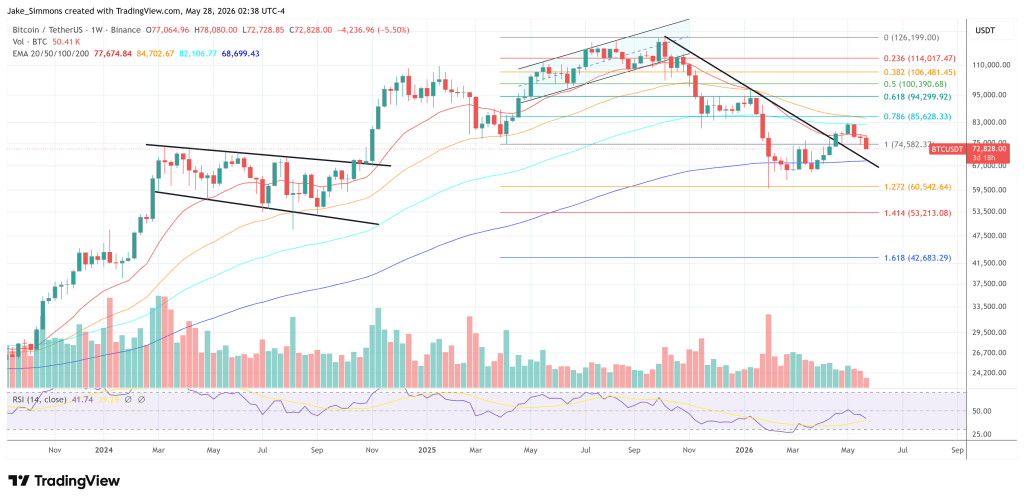
Bitcoin falls below the 1.0 Fib again, 1-week chart | Source: BTCUSDT on TradingView.com

Related Questions

QWhat is the unusual Bitcoin transaction described in the article, and why is it puzzling?

AThe transaction involved five addresses sending approximately 107 BTC (worth about $8.3 million) to an old burn address, making the coins provably unspendable. This is puzzling because it represents a deliberate destruction of a large amount of value, raising the question of why someone would do this instead of selling, moving, donating, or simply holding the assets.

QWhat makes the specific burn address used in the transaction uniquely unspendable?

AThe burn address (1111111111111111111114oLvT2) corresponds to a Hash160 value of twenty zero bytes. Spending coins from it would require finding a public key whose Hash160 is all zeros, which Galaxy Research describes as computationally out of reach. This is different from a transfer to a lost wallet, as it was designed from the start to be unspendable.

QWhat were some of the theories proposed by Galaxy Research to explain why someone might burn $8.3 million in Bitcoin?

AGalaxy proposed several theories: 1) A tax-loss motivation, though this is weak if the Bitcoin was acquired long ago. 2) Religious reasons involving renouncing possessions. 3) The coins were tied to illicit activity with no viable laundering path. 4) Coercion or duress forcing the destruction. 5) An automated error, such as an agentic system confusing a real counterparty with the burn address labeled 'Countparty'.

QWhich theory did Galaxy Research consider 'perhaps among the most likely'?

AGalaxy Research considered the automated error theory as perhaps among the most likely. They suggested a scenario where an agentic trading system, instructed to send Bitcoin to a new counterparty, accidentally sent it to the burn address (known historically as a 'Countparty' burn mechanism) due to a typo-like confusion.

QAccording to the article, what key distinction did Galaxy make between destroying assets and giving them away?

AThe key distinction is that a donation or transfer moves wealth to another party, while a burn removes it from circulation entirely. This matters because destroying assets, unlike giving them away, eliminates the value completely rather than redistributing it.

Related Reads

Six Complaints from an Ethereum Developer

A disgruntled early Ethereum developer and token holder presents six core criticisms of the project's trajectory, contrasting it with Solana's rise. 1. **Premature Complacency**: The Ethereum Foundation shifted from a "building" to an "infrastructure" mindset too soon, adopting a passive, "retired chairman" posture before securing market dominance, reflected in ETH's ~65% decline against BTC post-Merge. 2. **Misguided Messaging**: The Merge was marketed primarily on ESG (99.95% energy reduction) rather than user benefits like speed or yield, appealing to internal ideals instead of market demands. 3. **Delayed Execution**: Proof-of-Stake, on the roadmap since 2015, took seven years to launch, ceding critical narrative and development windows. Competitors like Solana built entire ecosystems in that time. 4. **Poor Native Staking UX**: Years after the Merge, there is still no first-party, user-friendly staking application, forcing reliance on centralized services like Lido and undermining ETH's "sound money" narrative. 5. **Managed Decline**: The rollup-centric roadmap deliberately weakens the base layer's fee capture, outsourcing value and profitability to L2s like Arbitrum and Base, which issue their own tokens and fragment capital. 6. **Ideology Over Product**: Ethereum culture prioritizes philosophical purity ("credible neutrality," "public goods") over competitive product delivery that meets user demands (e.g., financialization), while Solana's ecosystem focuses on coordinated execution. The diagnosis is accumulated execution debt, not a coordination failure. Ethereum possessed a structural advantage in 2021 but spent years in governance debates, while Solana efficiently executed. The current market cap reflects these specific strategic failures, not abstract theory.

marsbit2h ago

Six Complaints from an Ethereum Developer

marsbit2h ago

Six Complaints from an Ethereum Developer

Six Grievances from an Ethereum Developer The author, an early investor and developer still building on Ethereum, expresses deep frustration with its trajectory and declining ETH/BTC price since the merge. The core argument is that Ethereum's current market position stems from concrete failures in execution and strategy, not abstract coordination problems. The first grievance targets a shift in the Ethereum Foundation's mentality from builders to "infrastructure," adopting a premature posture of a retired victor. Second, marketing the Merge around ESG (99.95% energy reduction) is seen as talking to its own conscience rather than the market, which prioritizes user experience and yield. Third, the seven-year delay in delivering Proof-of-Stake (PoS) ceded critical narrative and development time to competitors like Solana. Fourth, three years post-merge, there is still no user-friendly first-party staking application, forcing reliance on centralized services like Lido and undermining ETH's monetary narrative. Fifth, the rollup-centric roadmap has strategically surrendered base-layer fee capture to L2s, fragmenting value within the ecosystem while Solana demonstrates an integrated L1's value accrual. Finally, the author criticizes an institutional culture that prioritizes philosophical ideals (credible neutrality, pluralism) over competitive product delivery focused on what users actually want. The diagnosis is "accumulated execution debt." Ethereum possessed a structural advantage in 2021 but spent years in governance debates, while Solana's ecosystem coordinated efficiently to deliver and capture the next wave of value. The conclusion is that Ethereum's market cap reflects its abandonment of the fight for asset appreciation.

链捕手2h ago

Six Complaints from an Ethereum Developer

链捕手2h ago

Token Budget Wars: Enterprise AI Enters the 'Accounting Era'

Token Budget Wars: Enterprise AI Enters the "Accounting Era" Enterprise AI is shifting from the question of "whether to adopt" to "how to account for it." As AI inference costs evolve from experimental budgets into ongoing operational expenses, CEOs and CFOs are demanding proof of value: what tangible results does each dollar spent on tokens deliver? The core of "Token Budget Wars" is not simply about reducing AI bills, but about intelligently allocating compute resources. It involves determining which business processes warrant more computational power, which tasks can use cheaper models, which can be outsourced or handled manually, and which are merely inefficient consumption. A key insight is that AI usage (token consumption) does not equal value. While SaaS usage indicated software adoption, AI token usage only indicates the "meter is running." The same workflow can cost vastly different amounts due to factors like prompt quality, context, model choice, and retries. The critical metric for scaling is "marginal token utility"—the business value created per additional dollar of inference cost. However, this is difficult to measure due to challenges like the long tail of retries, context inflation (where costs can scale quadratically with context length), and inefficient model routing (defaulting to the most powerful model for all tasks). The competition for token allocation is intensifying because, in the AI era, influence is tied to how much intelligence one can command, not just team size. AI spending is essentially competing with labor costs, whether for replacing external BPOs, internal staff, or generating new revenue. BPO contracts provide a clearer benchmark as they are priced per completed unit. The missing layer is attribution from tokens to business outcomes. Companies need a system that connects inference spending to completed work and results, capturing the agent's decision trajectory—what it saw, retrieved, tried, and why it succeeded or failed. This recorded rationale becomes a valuable asset. Ultimately, those who master token-to-outcome attribution will control the allocation of AI resources within enterprises, deciding which workflows get more compute, which are capped, or which revert to humans. The first phase of enterprise AI proved models could do the work. The next phase will determine how much of that work is worth paying for.

marsbit3h ago

Token Budget Wars: Enterprise AI Enters the 'Accounting Era'

marsbit3h ago

Trading

Spot
Futures

Hot Articles

What is $BITCOIN

DIGITAL GOLD ($BITCOIN): A Comprehensive Analysis Introduction to DIGITAL GOLD ($BITCOIN) DIGITAL GOLD ($BITCOIN) is a blockchain-based project operating on the Solana network, which aims to combine the characteristics of traditional precious metals with the innovation of decentralized technologies. While it shares a name with Bitcoin, often referred to as “digital gold” due to its perception as a store of value, DIGITAL GOLD is a separate token designed to create a unique ecosystem within the Web3 landscape. Its goal is to position itself as a viable alternative digital asset, although specifics regarding its applications and functionalities are still developing. What is DIGITAL GOLD ($BITCOIN)? DIGITAL GOLD ($BITCOIN) is a cryptocurrency token explicitly designed for use on the Solana blockchain. In contrast to Bitcoin, which provides a widely recognized value storage role, this token appears to focus on broader applications and characteristics. Notable aspects include: Blockchain Infrastructure: The token is built on the Solana blockchain, known for its capacity to handle high-speed and low-cost transactions. Supply Dynamics: DIGITAL GOLD has a maximum supply capped at 100 quadrillion tokens (100P $BITCOIN), although details regarding its circulating supply are currently undisclosed. Utility: While precise functionalities are not explicitly outlined, there are indications that the token could be utilized for various applications, potentially involving decentralized applications (dApps) or asset tokenization strategies. Who is the Creator of DIGITAL GOLD ($BITCOIN)? At present, the identity of the creators and development team behind DIGITAL GOLD ($BITCOIN) remains unknown. This situation is typical among many innovative projects within the blockchain space, particularly those aligning with decentralized finance and meme coin phenomena. While such anonymity may foster a community-driven culture, it intensifies concerns about governance and accountability. Who are the Investors of DIGITAL GOLD ($BITCOIN)? The available information indicates that DIGITAL GOLD ($BITCOIN) does not have any known institutional backers or prominent venture capital investments. The project seems to operate on a peer-to-peer model focused on community support and adoption rather than traditional funding routes. Its activity and liquidity are primarily situated on decentralized exchanges (DEXs), such as PumpSwap, rather than established centralized trading platforms, further highlighting its grassroots approach. How DIGITAL GOLD ($BITCOIN) Works The operational mechanics of DIGITAL GOLD ($BITCOIN) can be elaborated on based on its blockchain design and network attributes: Consensus Mechanism: By leveraging Solana’s unique proof-of-history (PoH) combined with a proof-of-stake (PoS) model, the project ensures efficient transaction validation contributing to the network's high performance. Tokenomics: While specific deflationary mechanisms have not been extensively detailed, the vast maximum token supply implies that it may cater to microtransactions or niche use cases that are still to be defined. Interoperability: There exists the potential for integration with Solana’s broader ecosystem, including various decentralized finance (DeFi) platforms. However, the details regarding specific integrations remain unspecified. Timeline of Key Events Here is a timeline that highlights significant milestones concerning DIGITAL GOLD ($BITCOIN): 2023: The initial deployment of the token occurs on the Solana blockchain, marked by its contract address. 2024: DIGITAL GOLD gains visibility as it becomes available for trading on decentralized exchanges like PumpSwap, allowing users to trade it against SOL. 2025: The project witnesses sporadic trading activity and potential interest in community-led engagements, although no noteworthy partnerships or technical advancements have been documented as of yet. Critical Analysis Strengths Scalability: The underlying Solana infrastructure supports high transaction volumes, which could enhance the utility of $BITCOIN in various transaction scenarios. Accessibility: The potential low trading price per token could attract retail investors, facilitating wider participation due to fractional ownership opportunities. Risks Lack of Transparency: The absence of publicly known backers, developers, or an audit process may yield skepticism regarding the project's sustainability and trustworthiness. Market Volatility: The trading activity is heavily reliant on speculative behavior, which can result in significant price volatility and uncertainty for investors. Conclusion DIGITAL GOLD ($BITCOIN) emerges as an intriguing yet ambiguous project within the rapidly evolving Solana ecosystem. While it attempts to leverage the “digital gold” narrative, its departure from Bitcoin's established role as a store of value underscores the need for a clearer differentiation of its intended utility and governance structure. Future acceptance and adoption will likely depend on addressing the current opacity and defining its operational and economic strategies more explicitly. Note: This report encompasses synthesised information available as of October 2023, and developments may have transpired beyond the research period.

363 Total ViewsPublished 2025.05.13Updated 2025.05.13

What is $BITCOIN

Discussions

Welcome to the HTX Community. Here, you can stay informed about the latest platform developments and gain access to professional market insights. Users' opinions on the price of BTC (BTC) are presented below.

活动图片












