新一代“Meme教父”Murad精选十大Meme币

Odaily星球日报Published on 2024-10-14Last updated on 2024-10-14

Abstract

对于Meme币,现在不是交易者的市场,而是信仰者的市场。

原创 | Odaily星球日报(@OdailyChina

素材来源 | Murad(@MustStopMurad

作者 | Asher(@Asher_ 0210 

新一代“Meme教父”Murad精选十大Meme币

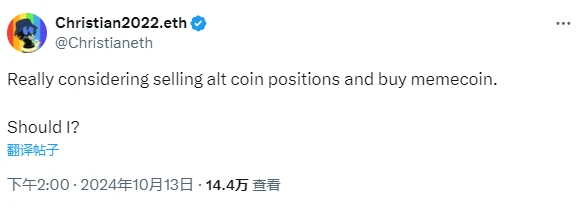
本轮牛市,Meme 板块可谓是表现最好的山寨板块,没有之一。伴随着数个涨幅超 30 倍、 50 倍、100 倍的 Meme 币的诞生,社交媒体中对于加密货币热门话题的讨论基本都聚焦于 Meme 币上,甚至大家所熟知的巨鲸们也开始对 Meme 币有很大兴趣。昨日,巨鲸 Christian 2022.eth 在 X 发文表示:“真的在考虑出售所有山寨币头寸,转而购买 Meme 币。我是否应该这样做?”
新一代“Meme教父”Murad精选十大Meme币

加密巨鲸开始对 Meme 币感兴趣

新一代“Meme 教父”Murad(对于 Murad 相关介绍可参考此文章:专访 Murad:Meme 超级周期里,如何挖掘千倍金狗?) 有资格回应这一问题。

他近日在 X 平台发文指出“不管你爱还是恨。在这一轮周期中,Meme 代币的表现将超越一切。目前仅仅是个开始。”尽管 Meme 币价格的亮眼表现引发了社区广泛关注,许多用户却因无法长时间盯盘、缺乏专业工具而频频踩雷,接盘了不少短期内归零的“土狗币”。因此,大多数用户更需要的是“热度高且能在短时间内存活的 Meme 币”。

针对这一需求,Murad 昨日在 X 平台再次分享了他精选的本轮牛市中的十大 Meme 币。下面,Odaily星球日报将带大家逐一解析新一代“Meme 教父” 的精选清单。

SPX 6900/$SPX(Ethereum)

项目简介+长期持有目标

$SPX 是全球第一个“运动币”,唯一一个拥有”颠覆股市“明确使命的币种

合约地址:0xE0f63A424a4439cBE457D80E4f4b51aD25b2c56C

Murad 首次提及时市值:1000 万美元;

撰稿时市值:7800 万美元;

Murad 目标市值:1000 亿美元。

GigaChad/$GIGA(Solana)

项目简介+长期持有目标

GigaChad/$GIGA 是全球第一个“男子气概币”。这是一场伟大的革命,一个具有高度精神力量,能激励和鼓舞人心的 Meme 币。

合约地址:63LfDmNb3MQ8mw9MtZ2To9bEA2M71kZUUGq5tiJxcqj9

Murad 首次提及时市值:1500 万美元;

撰稿时市值:4800 万美元;

Murad 目标市值:500 亿美元。

Mog Coin/$MOG(Ethereum)

项目简介+长期持有目标

Mog Coin/$MOG 是全球第一个“表情文化币”。该文化表情属于前五大表情文化之一。对普通人友好,却被极端玩家低估,同时非常适合在社交媒体上进行象征性传播。

合约地址:0xaaeE1A9723aaDB7afA2810263653A34bA2C21C7a

Murad 首次提及时市值:3.2 亿美元;

撰稿时市值:8.3 亿美元;

Murad 目标市值:320 亿美元。

Apu Apustaja/$APU(Ethereum)

项目简介+长期持有目标

Apu Apustaja/$APU 所使用的表情是 X 平台上使用最频繁的青蛙表情,拥有极其强大的文化社群,也是五大表情文化之一。

合约地址:0x594DaaD7D77592a2b97b725A7AD59D7E188b5bFa

Murad 首次提及时市值:1.4 亿美元;

撰稿时市值:2.9 亿美元;

Murad 目标市值:300 亿美元。

Popcat/$POPCAT(Solana)

项目简介+长期持有目标

Popcat/$POPCAT 是全球第一个“猫币”,因此没有什么能阻止这只“猫币”爆发。

合约地址:7GCihgDB8fe6KNjn2MYtkzZcRjQy3t9GHdC8uHYmW2hr

Murad 首次提及时市值:1.6 亿美元;

撰稿时市值:13.4 亿美元;

Murad 目标市值:250 亿美元。

HarryPotterObamaSonic10lnu/$BITCOIN(Ethereum)

项目简介+长期持有目标

HarryPotterObamaSonic10lnu/$BITCOIN 是全球第一“精神错乱币”,同属五大表情文化之一,并且是是标志性象征。想象一下错过比特币两次的感觉,这是“Shitcoin”中的“经典 Shitcoin”。

合约地址:0x72e4f9F808C49A2a61dE9C5896298920Dc4EEEa9

Murad 首次提及时市值:8500 万美元;

撰稿时市值:3.09 亿美元;

Murad 目标市值:200 亿美元。

Retardio/$RETARDIO(Solana)

项目简介+长期持有目标

Retardio/$RETARDIO 是全球首个“小丑世界/反觉醒币”,也是“Solana 链上最搞笑的币种”,拥有狂热的表情文化社群。

合约地址:6ogzHhzdrQr9Pgv6hZ2MNze7UrzBMAFyBBWUYp1Fhitx

Murad 首次提及时市值:1900 万美元;

撰稿时市值:1.65 亿美元;

Murad 目标市值:190 亿美元。

Lock in/$LOCKIN(Solana)

项目简介+长期持有目标

Lock in/$LOCKIN 是一个“成功币”、“短语币”。

合约地址:8Ki8DpuWNxu9VsS3kQbarsCWMcFGWkzzA8pUPto9zBd5

Murad 首次提及时市值:1000 万美元;

撰稿时市值:7700 万美元;

Murad 目标市值:30 亿美元。

Mini/$MINI(Solana)

项目简介+长期持有目标

Mini/$MINI 是一个“猫币”,该表情拥有大量现有的媒体资源和周边商品,兼具可爱和多功能性。

合约地址:2JcXacFwt9mVAwBQ5nZkYwCyXQkRcdsYrDXn6hj22SbP

Murad 首次提及时市值:500 万美元;

撰稿时市值:7600 万美元;

Murad 目标市值:20 亿美元。

American Coin/$USA(Solana)

项目简介+长期持有目标

American Coin/$USA 是一个“国家币”,未来有大量引发关注的催化剂。

合约地址:69kdRLyP5DTRkpHraaSZAQbWmAwzF9guKjZfzMXzcbAs

Murad 首次提及时市值:2500 万美元;

撰稿时市值:5520 万美元;

Murad 目标市值:17.76 亿美元。

Related Reads

Six Complaints from an Ethereum Developer

A disgruntled early Ethereum developer and token holder presents six core criticisms of the project's trajectory, contrasting it with Solana's rise. 1. **Premature Complacency**: The Ethereum Foundation shifted from a "building" to an "infrastructure" mindset too soon, adopting a passive, "retired chairman" posture before securing market dominance, reflected in ETH's ~65% decline against BTC post-Merge. 2. **Misguided Messaging**: The Merge was marketed primarily on ESG (99.95% energy reduction) rather than user benefits like speed or yield, appealing to internal ideals instead of market demands. 3. **Delayed Execution**: Proof-of-Stake, on the roadmap since 2015, took seven years to launch, ceding critical narrative and development windows. Competitors like Solana built entire ecosystems in that time. 4. **Poor Native Staking UX**: Years after the Merge, there is still no first-party, user-friendly staking application, forcing reliance on centralized services like Lido and undermining ETH's "sound money" narrative. 5. **Managed Decline**: The rollup-centric roadmap deliberately weakens the base layer's fee capture, outsourcing value and profitability to L2s like Arbitrum and Base, which issue their own tokens and fragment capital. 6. **Ideology Over Product**: Ethereum culture prioritizes philosophical purity ("credible neutrality," "public goods") over competitive product delivery that meets user demands (e.g., financialization), while Solana's ecosystem focuses on coordinated execution. The diagnosis is accumulated execution debt, not a coordination failure. Ethereum possessed a structural advantage in 2021 but spent years in governance debates, while Solana efficiently executed. The current market cap reflects these specific strategic failures, not abstract theory.

marsbit1h ago

Six Complaints from an Ethereum Developer

marsbit1h ago

Six Complaints from an Ethereum Developer

Six Grievances from an Ethereum Developer The author, an early investor and developer still building on Ethereum, expresses deep frustration with its trajectory and declining ETH/BTC price since the merge. The core argument is that Ethereum's current market position stems from concrete failures in execution and strategy, not abstract coordination problems. The first grievance targets a shift in the Ethereum Foundation's mentality from builders to "infrastructure," adopting a premature posture of a retired victor. Second, marketing the Merge around ESG (99.95% energy reduction) is seen as talking to its own conscience rather than the market, which prioritizes user experience and yield. Third, the seven-year delay in delivering Proof-of-Stake (PoS) ceded critical narrative and development time to competitors like Solana. Fourth, three years post-merge, there is still no user-friendly first-party staking application, forcing reliance on centralized services like Lido and undermining ETH's monetary narrative. Fifth, the rollup-centric roadmap has strategically surrendered base-layer fee capture to L2s, fragmenting value within the ecosystem while Solana demonstrates an integrated L1's value accrual. Finally, the author criticizes an institutional culture that prioritizes philosophical ideals (credible neutrality, pluralism) over competitive product delivery focused on what users actually want. The diagnosis is "accumulated execution debt." Ethereum possessed a structural advantage in 2021 but spent years in governance debates, while Solana's ecosystem coordinated efficiently to deliver and capture the next wave of value. The conclusion is that Ethereum's market cap reflects its abandonment of the fight for asset appreciation.

链捕手1h ago

Six Complaints from an Ethereum Developer

链捕手1h ago

Token Budget Wars: Enterprise AI Enters the 'Accounting Era'

Token Budget Wars: Enterprise AI Enters the "Accounting Era" Enterprise AI is shifting from the question of "whether to adopt" to "how to account for it." As AI inference costs evolve from experimental budgets into ongoing operational expenses, CEOs and CFOs are demanding proof of value: what tangible results does each dollar spent on tokens deliver? The core of "Token Budget Wars" is not simply about reducing AI bills, but about intelligently allocating compute resources. It involves determining which business processes warrant more computational power, which tasks can use cheaper models, which can be outsourced or handled manually, and which are merely inefficient consumption. A key insight is that AI usage (token consumption) does not equal value. While SaaS usage indicated software adoption, AI token usage only indicates the "meter is running." The same workflow can cost vastly different amounts due to factors like prompt quality, context, model choice, and retries. The critical metric for scaling is "marginal token utility"—the business value created per additional dollar of inference cost. However, this is difficult to measure due to challenges like the long tail of retries, context inflation (where costs can scale quadratically with context length), and inefficient model routing (defaulting to the most powerful model for all tasks). The competition for token allocation is intensifying because, in the AI era, influence is tied to how much intelligence one can command, not just team size. AI spending is essentially competing with labor costs, whether for replacing external BPOs, internal staff, or generating new revenue. BPO contracts provide a clearer benchmark as they are priced per completed unit. The missing layer is attribution from tokens to business outcomes. Companies need a system that connects inference spending to completed work and results, capturing the agent's decision trajectory—what it saw, retrieved, tried, and why it succeeded or failed. This recorded rationale becomes a valuable asset. Ultimately, those who master token-to-outcome attribution will control the allocation of AI resources within enterprises, deciding which workflows get more compute, which are capped, or which revert to humans. The first phase of enterprise AI proved models could do the work. The next phase will determine how much of that work is worth paying for.

marsbit1h ago

Token Budget Wars: Enterprise AI Enters the 'Accounting Era'

marsbit1h ago

Trading

Spot
Futures

Hot Articles

Discussions

Welcome to the HTX Community. Here, you can stay informed about the latest platform developments and gain access to professional market insights. Users' opinions on the price of MEME (MEME) are presented below.

活动图片