加密早报:CZ 已于今日出狱,Vitalik 发文提出以太坊对齐性概念

深潮Published on 2024-09-29Last updated on 2024-09-29

Eigen Foundation 发文表示,其将于 10 月 1 日 12 时解锁 EIGEN 转账限制。

作者:深潮 TechFlow

昨日市场动态

CZ 刑满释放后发布首条推文 “gm”

CZ 在 X 社交平台发布推文“gm”。

外媒:CZ 仍拥有币安约 90% 的股份,但不再参与任何决策

据 The Block 报道,币安现任 CEO Richard Teng 于本月早些时候在韩国首尔举行的韩国区块链周上表示:“与 CZ 担任首席执行官时相比,现在币安的公司结构完全不同,是董事会主导的结构。当然,CZ 作为股东保留其股东权利,但在日常工作中,我会与董事会密切合作,制定我们的全球战略。”币安现任区域负责人 Vishal Sacheendran 在此前接受 The Block 采访时表示:“CZ 不会参与币安的任何决策”。尽管如此,CZ 仍然是币安最大的股东,拥有约 90% 的股份。

Eugene Ng Ah Sio:大部分仓位已经出清,正等待市场的杠杆清洗

交易员 Eugene Ng Ah Sio 发布 9 月阶段性交易总结,他表示:“在 8 月经历了假突破后的震荡行情,减少了交易量。除了做了一些 SOL 的短线操作,取得了非常小的百分比收益。在资产选择方面,我几乎准确找出了每一个表现出色的资产,但在仓位管理上出了大问题。本月最大的错失包括 SUI、PEPE 和 ENA,尽管我在市场格局变化初期就已经发现了它们,并且在此之前也交易过这些标的。总的来说,我对本月的交易表现还是相当满意的,能够通过专注和坚持不懈保持领先于市场,并且坚持原定计划来确定止盈水平。我现在大部分已经出清仓位,但正在等待市场的杠杆清洗,我相信这会以相当大的确定性出现。”

被盗超 1.2 万枚 spWETH 地址或与神鱼相关联

9 月 28 日,Lookonchain 发文披露,由于网络钓鱼攻击,某地址损失了 12,083.6 枚 spWETH(约合 3233 万美元)。据 Arkham 称,该钱包可能与 Cobo 联合创始人兼 CEO 神鱼 ( @bitfish1 ) 有关。为了避免受到网络钓鱼,请不要点击任何未知的链接,也不要签署任何未知的签名。

Eigen 基金会:将于 10 月 1 日 12 时解锁 EIGEN 转账限制

9 月 28 日,Eigen Foundation 在社交媒体上发文表示,其将于北京时间 10 月 1 日 12 时(PST 时间 9 月 30 日 21 时)解锁 EIGEN 转账限制。据悉,若用户的 EIGEN 当前已质押,则取消质押 EIGEN 将有 7 天的提款期。

Vitalik 发文提出以太坊对齐性概念

以太坊联合创始人 Vitalik Buterin 在发布题为《使以太坊对齐性清晰化》(Making Ethereum alignment legible)的文章,讲述为解决如何平衡以太坊客户端团队、研究人员、Layer 2 团队、应用程序开发者、本地社区团体,确保所有这些项目集体构建的是一个统一的以太坊生态系统的问题,提出了以太坊对齐性(Ethereum alignment)这一概念,包括价值观对齐(例如,开源、最小化中心化、支持公共产品)、技术对齐(例如,采用全生态系统的标准)、经济对齐(例如,尽可能使用 ETH 作为代币)。

Coinbase 将 EigenLayer(EIGEN)列入上币路线图

Coinbase 将 EigenLayer(EIGEN)列入上币路线图。

10X Research:市场在 Q4 强劲上涨的可能性极高,大幅上涨可能即将到来

据 10X Research 发布的最新报告显示,自美联储 9 月中旬降息以及中国推出的刺激计划以来,比特币的强劲上涨已使其摆脱了下行趋势。随着比特币突破 65,000 美元,10x Research 预计它将迅速升至 70,000 美元,随后在短期内创下历史新高。10X Research 创始人 Markus Thielen 表示,美联储 7 月会议后稳定币铸造量急剧增加,当时美联储在会议上宣布维持利率不变,但暗示了 9 月可能会放松政策。随后几周稳定币铸造量接近 100 亿美元,为加密货币市场注入了流动性,并大幅超过现货 ETF 流量。特别值得注意的是,Circle 的 USDC 占近期稳定币流入的 40%,这一比例远高于正常水平,因为 USDC 的铸造可能表明 DeFi 活动有所增加。Markus 总结表示,市场在 Q4 强劲上涨的可能性极高,目前可能就是上涨初期,大幅上涨可能即将到来,从而引发加密货币领域更多的 FOMO。

不丹王国每周挖矿产出 55 至 75 枚 BTC,目前持有 13,119 BTC

不丹王国正积极进行比特币挖矿,每周产出 55 至 75 个比特币,价值约 360 万至 490 万美元。不丹利用 AntPool 等矿池进行挖矿,其优势在于廉价清洁的水电资源和 5 亿美元的基金支持。不丹主权控股公司 Druk Holdings 自 2021 年 2 月涉足加密货币,已挖出约 27,727 BTC (13.6 亿美元)。2021 至 2022 年间,不丹与多个借贷平台进行了超 8 亿美元的加密货币交易。目前,不丹持有 13,119 BTC (8.604 亿美元),占其总量近一半。自今年 6 月以来,Druk 每月向交易所存入比特币,总计 1,358.64 BTC(约 9000 万美元),超过同期挖矿产出。

行情动态
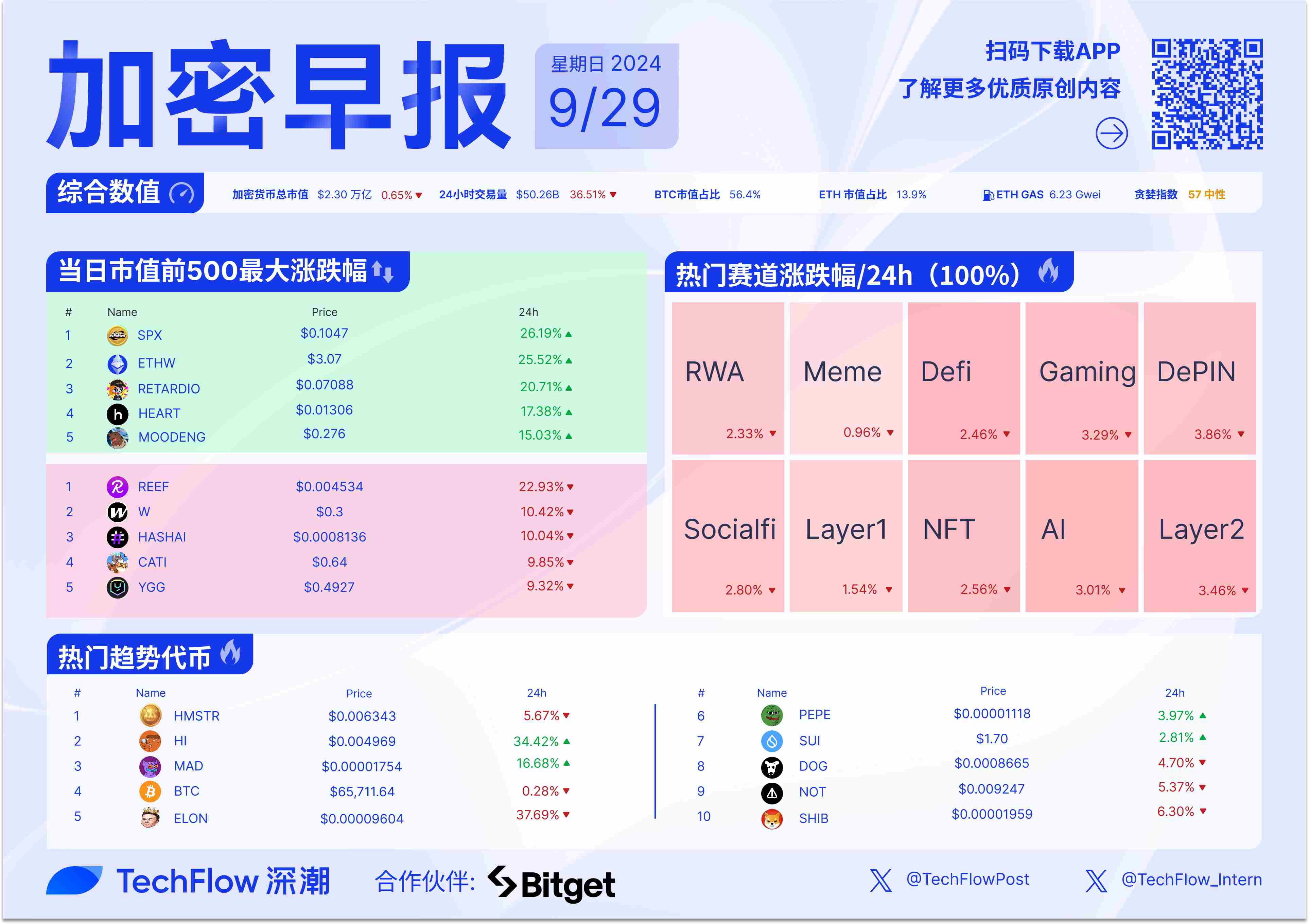
推荐阅读

从借贷产品到基础设施:Morpho 的金融复兴蝶变之路

市场状态分析:我们正处于牛市的哪个阶段?

迷因玩法又双叒叕不一样,现在都在炒什么?

链游又行了?前瞻第一款 PC 和主机同时上线的大逃杀游戏 Off The Grid

局面反转,东方流动性上升潮来了?

Related Reads

Retail Investors' 'Lead Brother' Serenity vs. Newly Minted Stock God Leopold: How Are the Two Top Hunters Mining AI's 'Physical Limits'?

The article profiles two prominent figures, Serenity and Leopold Aschenbrenner, who are gaining attention for their unconventional investment strategies focused on the physical constraints of the AI boom, moving beyond mainstream software narratives. Serenity, an anonymous online trader, advocates a "shiso leaf" theory. He targets small-cap companies with monopolies on critical, overlooked components in the AI hardware supply chain, such as specific semiconductor materials. His deep, technical analysis of bottlenecks in areas like co-packaged optics (CPO) has reportedly yielded massive returns, though his anonymity and focus on illiquid micro-cap stocks pose significant risks for followers. Leopold Aschenbrenner, a former OpenAI researcher, founded a multi-billion dollar hedge fund. His macro thesis argues that physical infrastructure—power grids, land, data centers—is the true bottleneck for AI growth, lagging far behind chip production. Consequently, his fund employs an infrastructure arbitrage strategy: heavily investing in storage and compute infrastructure companies while placing massive bearish bets (put options) against major semiconductor stocks, betting their valuations will correct as physical constraints become apparent. While their methods differ—Serenity drills into microscopic supply chain details, while Leopold takes a macroscopic, infrastructure-focused view—both share a core belief: the real power and investment alpha in the AI era lie in controlling scarce physical resources, not just software. The article concludes by noting the inherent risks in both approaches, such as liquidity issues for micro-caps and timing risks for macro bets, but suggests they signal a broader market re-evaluation of AI's foundational assets.

marsbit2h ago

Retail Investors' 'Lead Brother' Serenity vs. Newly Minted Stock God Leopold: How Are the Two Top Hunters Mining AI's 'Physical Limits'?

marsbit2h ago

Who Will Make Money in the Age of Agents?

In the Agents era of blockchain, traditional value capture theories face challenges. The "Fat Protocol" theory, dominant since 2016, suggested protocols capture most value as their tokens are essential for network use. However, the proliferation of interchangeable L1s, L2s, and modular layers has eroded protocol scarcity and pricing power. Conversely, the "Fat App" theory posits that applications capturing user relationships (like wallets and exchanges) become the primary value layer by controlling distribution and transaction flows. This aligns with the current "Great Repricing" cycle. Agents disrupt this logic. As software users, they lack brand loyalty, prioritize cost and efficiency, and switch between platforms seamlessly. This undermines the front-end UX moats that "Fat Apps" rely on. The article explores several potential futures: 1. **Headless Applications:** Current leading apps could strip their front-ends and become backend API infrastructure for Agents, preserving their role. 2. **Protocol Resurgence:** If integration becomes trivial, Agents might bypass aggregators and interact directly with protocols, reviving "Fat Protocol" dynamics. 3. **Pricing Power Collapse:** Agents' rational, frictionless routing could commoditize the entire stack, compressing margins toward cost and leaving little profit for intermediaries. 4. **Unprecedented Activity:** Agents may enable new, high-frequency, machine-to-machine economic activities, expanding the total value pie even if margins are thin. 5. **A New, Unnamed Model:** Historically, major tech shifts (like the internet's attention economy) create unforeseen business models. The Agents era may spawn entirely new ways to capture value. The most likely outcome is a coexistence where "Fat Apps" continue to serve human users valuing UX, while a separate, Agent-driven economy emerges governed by different rules—where loyalty is based on factors like liquidity, latency, and settlement guarantees rather than brand.

marsbit3h ago

Who Will Make Money in the Age of Agents?

marsbit3h ago

Trading

Spot
Futures

Hot Articles

Discussions

Welcome to the HTX Community. Here, you can stay informed about the latest platform developments and gain access to professional market insights. Users' opinions on the price of ETH (ETH) are presented below.

活动图片