XRP 在阻力位挣扎,行情是涨还是跌

金色财经Published on 2024-08-13Last updated on 2024-08-13

最近,瑞波币 [XRP]经历了大幅下跌,从 0.6480 美元的高位跌落。在市场从崩盘中恢复以及瑞波币与 SEC 达成和解后,XRP 的价格飙升。然而,该货币对难以维持近期涨幅,因此延续了之前的看跌势头。

v2-62c3210ec9f6cae11642c1827cfe41f4_720w.webp

尽管 XRP 未能维持涨势,但受 XRP ETF、#Ripple 稳定币的预期以及支付 1.25 亿美元罚款的推动,XRP 的价格可能会从 1 美元飙升至 10 美元甚至更高。

然而,就目前情况而言,AMBCrypto 的分析表明,山寨币正经历强劲的看跌趋势,近期的损失超过了近期的涨幅。

XRP 的价格图表表明了什么

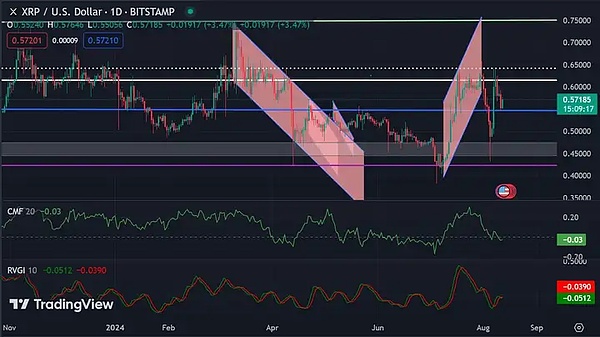
截至本文撰写时,XRP 交易价格为 0.5651 美元,在过去 24 小时内,XRP 的交易量也上涨了10.14%,达到 14 亿美元。尽管如此,但整体市场情绪仍看跌。CMF 为 -0.03。这表明抛售压力大于买入压力,形成了以卖方为主的看跌情绪。

v2-3a071be221acb78fdfde468733678984_720w.webp

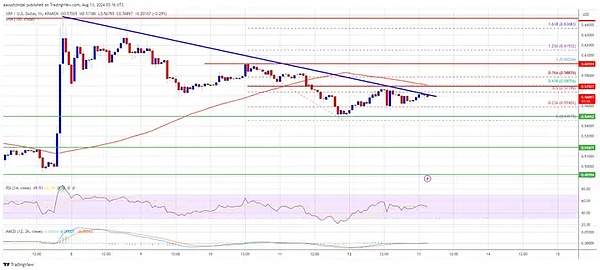
XRP 价格延续跌势,甚至跌破 0.550 美元的支撑区域。它测试了 0.5450 美元的水平。低点形成于 0.5457 美元,价格现在正试图像比特币和以太坊一样再次上涨。突破了 0.5600 美元的水平。价格攀升至从 0.6020 美元的高点到 0.5457 美元的低点的下行走势的 50% 斐波那契回撤位上方。然而,空头在 0.580 美元的阻力区附近活跃。

v2-50f38202e3675c33eee5565d341d2a10_720w.webp

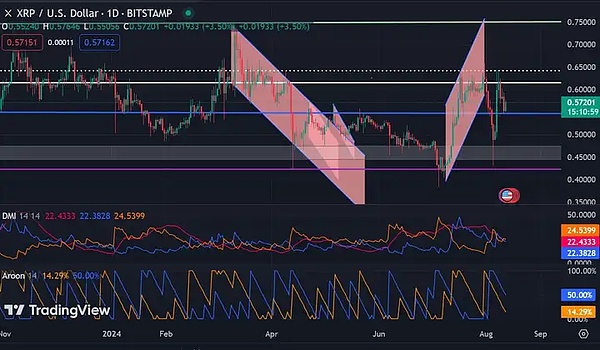
此外,RVGI 低于零,表明价格收盘价高于开盘价。这进一步证明抛售压力占主导地位,市场正在经历强劲的下跌趋势。XRP 的 DMI 和 Aroon 线进一步证明正在经历持续的下跌趋势。

v2-1aef04e0a6214563384d38f084206463_720w.webp

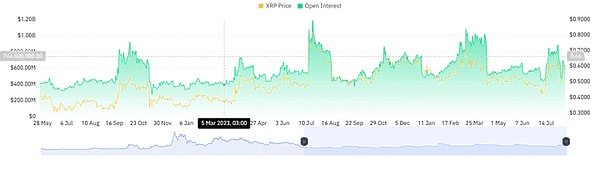
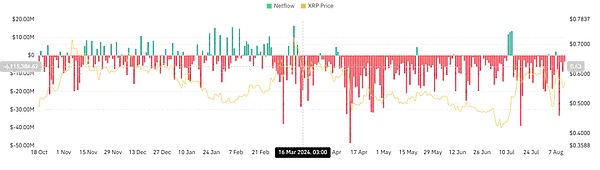
XRP 的未平仓合约已从 6.91 亿美元下降至 5.78 亿美元。这表明投资者正在平仓而不开设新仓位。同时,XRP 的净流量在过去一个月一直为负值。这表明投资者对山寨币缺乏信心,因此在将资产转移到交易所出售时抛售了头寸。

v2-3b7886094a0a8fc9090feae255392ba2_720w.webp

XRP/USD 对的小时图上还形成了一条关键的看跌趋势线,阻力位在 0.570 美元。目前价格低于 0.570 美元和 100 小时简单移动平均线。

上行方面,价格在 0.570 美元附近面临阻力。第一个主要阻力位在 0.580 美元附近。它接近从 0.6020 美元高点到 0.5457 美元低点的下行走势的 61.8% 斐波那契回撤位。

v2-a9668f6973e0bacaf06e3ac93209bca4_720w.webp

下一个关键阻力位可能是 0.5850 美元。如果能明显突破 0.5850 美元的阻力位,价格可能会涨向 0.6050 美元的阻力位。如果价格进一步上涨,短期内可能会跌向 0.6320 美元的阻力位,甚至 0.650 美元。

XRP 重新测试关键支撑位

XRP 价格在 0.5450 美元支撑位上方盘整。价格必须突破 0.5800 美元阻力位才能在短期内开始新一轮上涨。目前其正试图突破 0.57 美元的水平。如果日线蜡烛图收于 0.580 美元的支撑位上方,该货币对可能开始新一轮上涨,则可能反弹至下一个阻力位 0.6 美元左右。

然而,如果未能维持在 0.58 美元上方,则将跌至 0.55 美元附近的关键支撑位,跌破该水平将进一步将山寨币推至 0.52 美元。

简单来说

XRP 与 SEC 的诉讼在近期达成和解后,价格出现飙升。尽管近期有所上涨,但XRP 难以维持近期涨幅,整体市场趋势仍然看跌,因此延续了之前的看跌势头。目前 XRP 价格在阻力位挣扎,短期内技术支持看跌前景,不过受 XRP ETF、#Ripple 稳定币的预期以及支付 1.25 亿美元罚款的推动长期来看如果 XRP 价格收于0.58美元上方,将会引发新一轮的上涨,预计将会推动其上涨至 0.6 美元的阻力位。

Trending Cryptos

Related Reads

Deep Insight: Decentralized Inference is Not Hype, but a Key Track for AI to Break Through Centralized Monopoly

Decentralized Reasoning: Beyond the Hype, a Key to Breaking AI's Centralized Monopoly A future scenario where a powerful AI model is banned by a major government illustrates the core value proposition of decentralized AI: resistance to censorship. The core bet of decentralized inference networks is mitigating this risk, with other benefits like cost being secondary. The path is extremely difficult, involving four key challenges: 1. **Running Massive Models:** Distributing a single model across a decentralized GPU swarm requires sophisticated techniques like pipeline and speculative decoding to overcome crippling network latency, aiming for usable speeds (e.g., 30-40 tokens/second). 2. **Proving Model Integrity:** Verifying that a node runs the correct model is critical. Solutions range from cryptographically secure but slow ZKML to faster, economically-secure methods like statistical fingerprints, deterministic re-execution, or live-weight proofs, each involving trade-offs between integrity, latency, and cost. 3. **Ensuring Prompt Privacy:** Simply sharding a model does not protect user inputs from nodes. Robust solutions currently require trusted hardware (TEEs) or advanced cryptography (FHE), which are not yet widely deployed in consumer swarms. 4. **Building a Real Market:** Identifying the ideal customer is tough. Beyond speculative AI agents, the viable market currently consists of startups embedding AI and projects needing batch processing (e.g., synthetic data generation), where decentralized aggregation can be an advantage over low-latency needs. The article analyzes several projects tackling these problems, such as Dolphin Network (live-weight proofs), Inference.net (statistical verification), Morpheus (TEE-based), and Darkbloom (Apple Secure Enclave). It provides a framework: decentralization is a "tax" for latency-sensitive applications (e.g., chat) but a potential supply-side advantage for throughput-oriented tasks (e.g., batch processing). The long-term vision is a closed data loop where decentralized inference generates valuable data (traces, preferences) to feed decentralized training networks, which in turn produce better open-weight models for the inference networks. A due diligence checklist advises focusing on projects that: are truly decentralized at specific layers; have a credible integrity method; offer real cost benefits; ensure genuine privacy; handle node reliability; have paying users; and are built by teams with deep AI expertise. The ultimate goal should be products that appeal beyond the crypto-native audience, using crypto mechanisms invisibly to deliver better cost, performance, or privacy.

Foresight News10m ago

Deep Insight: Decentralized Inference is Not Hype, but a Key Track for AI to Break Through Centralized Monopoly

Foresight News10m ago

The Final Piece of Franklin Templeton's Crypto Ambition

Franklin Templeton Completes Crypto Ambition with Acquisition of 250 Digital On June 22, Franklin Templeton announced the acquisition of 250 Digital and established Franklin Crypto, a new division focused on actively managed cryptocurrency strategies for institutional investors. The unit is led by Christopher Perkins and Seth Ginns. This acquisition marks a key piece in Franklin Templeton's multi-year crypto strategy, which began in 2018 with a digital assets team. The firm's crypto product suite now spans three layers: tokenized funds like the blockchain-based money market fund BENJI (~$831M AUM); a series of passive ETFs including Bitcoin (EZBC, ~$368M), Ethereum (EZET), XRP (XRPZ, ~$252M), Solana (SOEZ), and a multi-crypto index fund (EZPZ); and the newly added active management strategies from Franklin Crypto. The company has also expanded its crypto ecosystem through investments in projects like Ethena and Crossmint, and collaborations with blockchains such as Aptos and Sui. With approximately $18B in digital asset AUM and a total firm AUM of ~$1.78T, Franklin Templeton is positioning itself as a comprehensive crypto asset manager for pensions and sovereign wealth funds. In contrast, competitor Fidelity Investments has taken a different path, focusing early on building its own custody and trading infrastructure. Fidelity's Bitcoin ETF (FBTC) holds over $11B, significantly larger than Franklin Templeton's equivalent offering. Both giants' moves underscore the deepening trend of traditional finance entering the crypto space.

Foresight News34m ago

The Final Piece of Franklin Templeton's Crypto Ambition

Foresight News34m ago

Trading

Spot
Futures

Hot Articles

What is XRP 2.0

XRP 2.0: A New Frontier in the Cryptocurrency Landscape Introduction to XRP 2.0 In the ever-evolving realm of cryptocurrency, new projects continuously emerge, vying for attention and adoption. One such promising initiative is XRP 2.0, a novel cryptocurrency project designed to leverage advanced blockchain technology and robust encryption methodologies. While the name draws parallels with Ripple’s XRP, it’s crucial to note that XRP 2.0 operates independently, focusing on enhancing transaction security, privacy, and scalability. As the digital financial landscape increasingly embraces decentralized solutions, XRP 2.0 aims to contribute meaningfully to web3 and the overall expansion of crypto projects. What is XRP 2.0? At its core, XRP 2.0 is a cryptocurrency project that aims to create a secure and decentralized digital currency ecosystem. Its foundational technology integrates sophisticated blockchain principles with cutting-edge encryption techniques. The overarching goal of XRP 2.0 is to establish itself as a reliable and efficient platform enabling swift transaction execution while prioritizing enhanced privacy protections for its users. The project is promoted as a solution to many limitations faced by existing cryptocurrencies, proposing a system that can handle a higher volume of transactions with improved speed and privacy. This versatility positions XRP 2.0 as a significant contender in a marketplace riddled with various digital currencies. Who is the Creator of XRP 2.0? The identity of the creator behind XRP 2.0 has been flagged as ‘Wilbur.’ However, comprehensive details regarding Wilbur or their associated entity remain elusive. The anonymity of many cryptocurrency creators is not an uncommon phenomenon in the industry, often designed to maintain a degree of privacy and security. Who are the Investors of XRP 2.0? As of now, specific information related to the investment foundations or organizations supporting XRP 2.0 is not publicly available. In the cryptocurrency sector, the backing by reputed investors can significantly influence a project's credibility and success, yet the transparency regarding the financial supporters of XRP 2.0 has not been established. How Does XRP 2.0 Work? XRP 2.0 stands out by employing a combination of blockchain technology and advanced encryption algorithms that ensures secure and decentralized transactions. Its innovative structure includes unique features designed to foster user engagement and broaden functionalities beyond conventional cryptocurrency transactions. Among these features, XRP 2.0 incorporates AI-powered capabilities, such as text-to-image and text-to-speech functionalities. These additions are designed to enhance the interactive experience for users, promoting broader applicability across various sectors. By bridging technological advancements with user-centered design, XRP 2.0 aims to capture the attention of a diverse range of individuals and enterprises looking to integrate cryptocurrency solutions into their operational frameworks. Timeline of XRP 2.0 Understanding XRP 2.0 requires examining the milestones that have defined its journey thus far: July 23, 2023: XRP 2.0 is introduced as a novel cryptocurrency project, aiming to revolutionize secure and decentralized transaction capabilities in the blockchain domain. September 8, 2023: The launching of another project, XRP20, occurs, marking the emergence of an ERC-20 token on the Ethereum blockchain that remains unrelated to XRP 2.0. November 13, 2023: The XRP Ledger undergoes a significant update with the release of rippled server software version 2.0.0. It is essential to note that this development is disconnected from the XRP 2.0 cryptocurrency project. Key Points About XRP 2.0 To distill the essence of XRP 2.0, several critical factors emerge: Unique Features: The inclusion of features like AI-powered text-to-image and text-to-speech further diversifies the potential applications of XRP 2.0. Blockchain Technology: The framework utilizes advanced blockchain mechanisms and encryption protocols, ensuring a secure and decentralized environment for transactions. Scalability and Privacy: XRP 2.0 prioritizes enhanced privacy protections in transaction processes and the scalability necessary to accommodate a growing user base. No Affiliation with Ripple: Importantly, despite its name, XRP 2.0 does not have any allegiance or collaboration with Ripple’s XRP, distinguishing its operational framework and objectives within the cryptocurrency ecosystem. Conclusion XRP 2.0 represents an ambitious venture into the cryptocurrency sphere, aiming to offer a combination of security, privacy, and efficiency in digital transactions. By integrating sophisticated technologies and user-friendly features, the project sets out to broaden the horizons of what cryptocurrency can achieve in today's digital economy. While the anonymity of its creator and lack of disclosed investors might raise questions for some, XRP 2.0's focus on advanced functionalities and decentralisation enhances its appeal amidst an increasingly crowded crypto market. As the cryptocurrency landscape continues to evolve, XRP 2.0 may yet emerge as a pivotal player in the expansion of secure and scalable blockchain solutions.

985 Total ViewsPublished 2024.04.01Updated 2024.12.03
What is XRP 2.0

Discussions

Welcome to the HTX Community. Here, you can stay informed about the latest platform developments and gain access to professional market insights. Users' opinions on the price of XRP (XRP) are presented below.

活动图片