21Shares Report: HYPE's P/S Ratio Only Half That of CME, Bull Market Target Price $70

marsbitPublished on 2026-05-22Last updated on 2026-05-22

Abstract

21Shares Research Report: HYPE's P/S Ratio Half of CME's, Bullish Target $70 A recent report from 21Shares highlights Hyperliquid's evolution from a crypto derivatives DEX into a 24/7 "everything exchange" for perpetual contracts across various asset classes. The platform gained prominence during a February geopolitical incident when it provided real-time price discovery for WTI crude oil while traditional markets like CME were closed. Non-digital assets now account for approximately 35% of its volume, with traditional commodities and indices featuring among its top-traded assets. Hyperliquid's business model is rapidly diversifying, significantly reducing its dependence on crypto market cycles. Its cumulative trading volume and revenue are approaching levels comparable to CME Group's crypto derivatives segment. A key feature is its Assistance Fund, which directs 97%-99% of protocol fees to automated HYPE token buybacks, creating a deflationary mechanism with an implied buyback yield significantly higher than CME's traditional share repurchase program. Despite strong fundamentals, HYPE currently trades at a Price-to-Revenue (P/R) ratio of ~10x, roughly half of CME's ~17x. The report outlines valuation scenarios: a bullish case targets $62-$70 based on annualized revenue reaching $12-$15B and applying CME's P/R multiple. A bear case considers $15-$19 if growth slows. Key risks include platform centralization during crises, regulatory uncertainty for on-chain commodities, de...

Author: 21Shares Research Team

Translation: TechFlow News

TechFlow Insights: The 21Shares research team has released an in-depth report on Hyperliquid, with the core argument being: Hyperliquid has evolved from a crypto derivatives DEX into a 7×24 operational exchange for all types of assets. During the February Iran airstrike, when CME was closed, Hyperliquid's WTI crude oil contract completed price discovery nearly 48 hours early. Traditional assets now account for 35% of trading volume, with revenue approaching CME's, yet its valuation multiple is only half. The report provides bull and bear scenario valuations, worth a serious read.

On February 28th, US-Israeli coalition airstrikes on Iran plunged traditional markets into darkness. The Chicago Mercantile Exchange (CME) was closed, its infrastructure unable to react. Hyperliquid didn't stop. This blockchain-based derivatives exchange operates 7×24, with its WTI crude oil perpetual contract pricing in real-time, surging to $111.53, while traditional market traders could only watch.

This event highlighted Hyperliquid's role as a crucial trading venue and price index during intensified geopolitical conflicts—it provided real-time price discovery during the weekend gap. By March 2nd, when traditional markets reopened, WTI had pushed above $110, and the spread between Hyperliquid and CME had closed. Hyperliquid wasn't just faster; it essentially priced in the shock nearly 48 hours ahead of the traditional system.

That narrative alone is compelling. But what turned it into an investment story is what happened next. Fast-forward two months, 24-hour trading volume for crude oil on Hyperliquid remains around $5 billion, with crude oil contracts still among the platform's top five traded assets.

Bitcoin remains the largest traded asset on Hyperliquid, but traditional assets—S&P 500, Silver, Nasdaq 100, WTI, and Brent Crude—now occupy half of the top ten spots. Individual stocks like Micron Technology (MU) even crack the top ten on certain days. We believe this demonstrates Hyperliquid's ultimate trajectory. Hyperliquid is not just an exchange for trading crypto perpetuals; it has fully evolved into an "exchange for everything," where users can trade perpetual contracts on almost any type of asset.
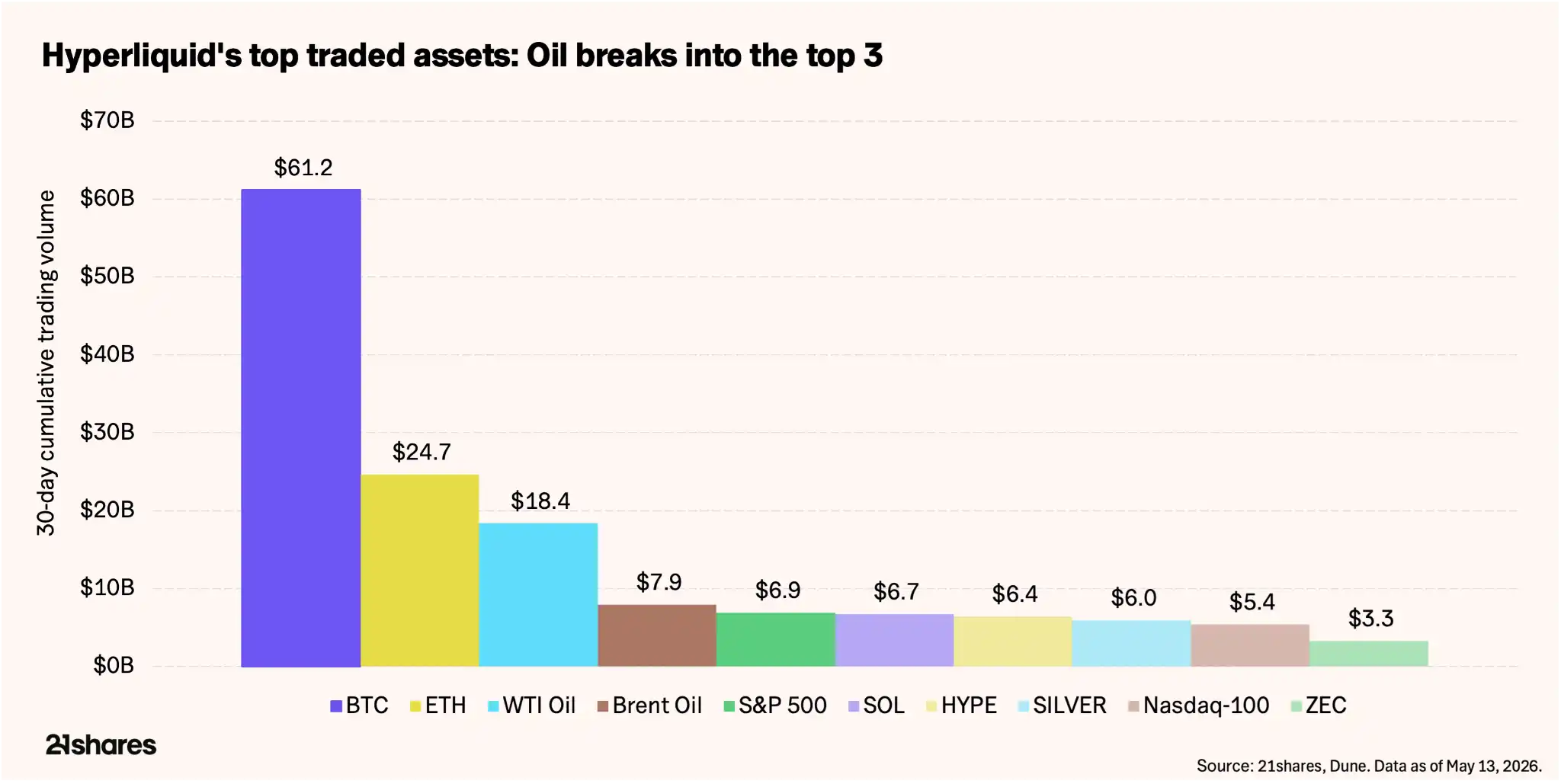
Caption: Distribution of Top Ten Traded Assets on Hyperliquid Platform

Hyperliquid's Business Model is Evolving

This report will help you understand how to reasonably value Hyperliquid and which key metrics and risks investors should monitor.

In the past, most of Hyperliquid's revenue came from digital asset trading, its business model highly correlated with overall crypto market trends. But the growth in non-digital asset trading volume fundamentally broadens the platform's core business model.

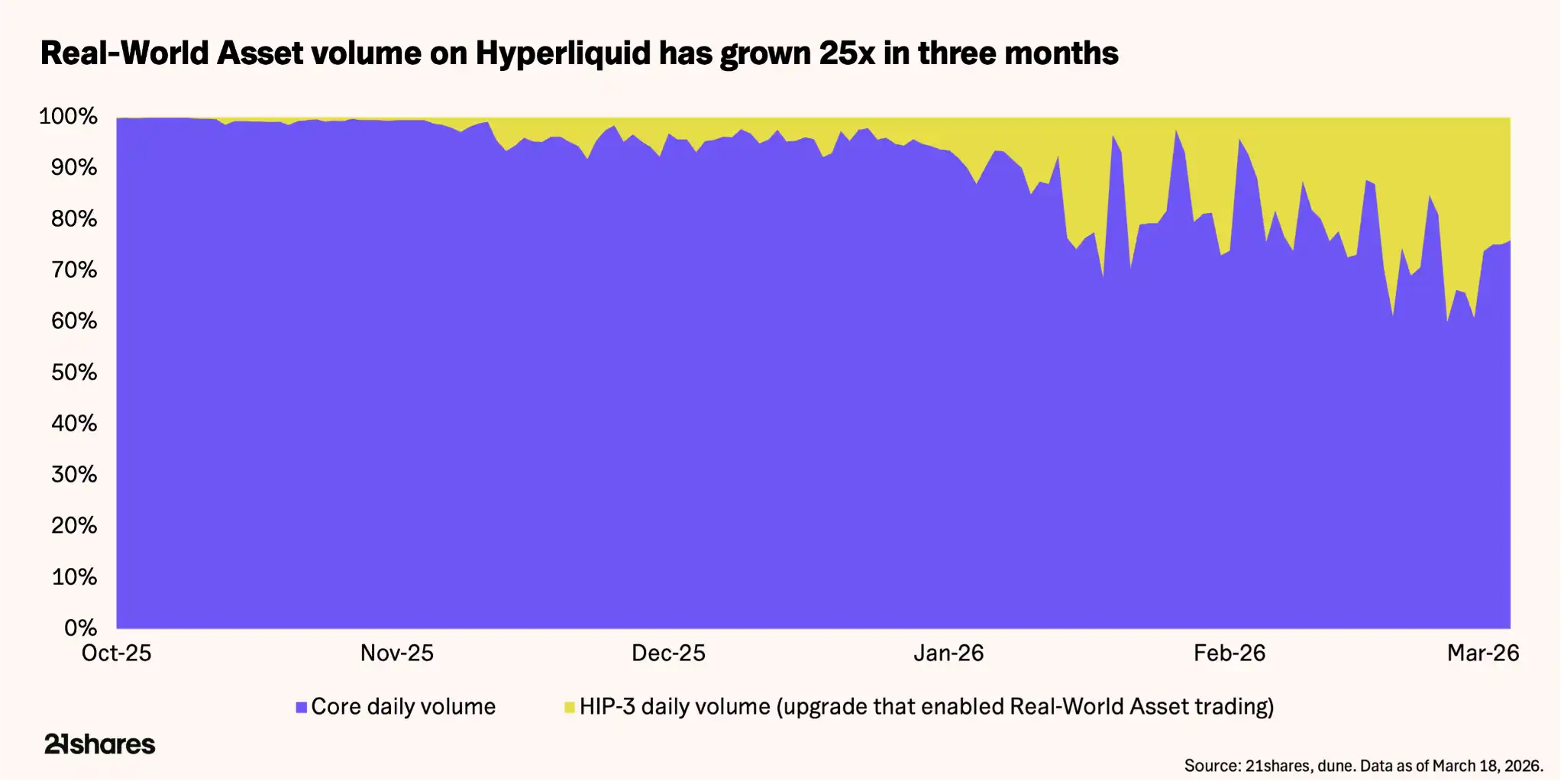
HIP-3 is the protocol's permissionless framework allowing anyone to list new perpetual futures markets. Currently, HIP-3 accounts for about 35%-37% of total trading volume, up 600%-800% from the end of 2025. Open Interest (OI) for these markets reached $1.7 billion in mid-May, growing over 150% since February. Commodities account for about $730 million of that, with crude oil alone making up roughly 20%.

The pace of change is rapid. Crypto trading pairs—the platform's original business—have seen their share drop from around 90% to about 65%. Five of the current top ten traded assets by volume are traditional market instruments, like commodities. A platform that once only offered crypto derivatives is increasingly resembling a macro exchange.

Hyperliquid's bull case is built on this asset class diversification. With the launch of HIP-4 in early May, focusing on prediction markets and options, Hyperliquid is accelerating its journey to becoming an "exchange for everything."

Follow the Money

Hyperliquid's metrics place it among the most profitable protocols in the digital asset space, even allowing comparison with leading traditional derivatives exchanges:

  • Cumulative Historical Total Trading Volume: $4.22 trillion. Of this, $2.9 trillion occurred in 2025, comparable to CME Group's $3 trillion in crypto derivatives contract volume.
  • Cumulative Protocol Total Revenue: $1.15 billion. Single-year revenue in 2025 was $873 million, compared to CME Group's $6.5 billion for the same period.

Furthermore, the HYPE token benefits from a consistent buy-side force and value return mechanism—the Assistance Fund. This fund channels 97%-99% of the platform's generated fees into automated token buybacks, having repurchased over $1.5 billion worth of HYPE to date. This "share buyback program" scales linearly with trading volume, requires no board approval, and directly impacts the token's supply dynamics with every trade.

At current operational pace, the implied buyback yield is approximately 13% of the circulating market cap. For comparison: CME Group approved a $3 billion stock buyback plan at the end of 2024 but only utilized $532 million. Annualizing this gives about $1.06 billion against a market cap of ~$105 billion, a yield of about 1%. Hyperliquid's capital return rate is roughly 13 times that of CME's, albeit with higher risk.

HYPE serves as both the medium for paying trading fees and the required collateral for deploying new HIP-3 markets. Currently, listing a new perpetual contract market requires locking 500,000 HYPE, valued at approximately $19.5 million. As the platform expands to more asset classes, HYPE is simultaneously drawn from circulation in multiple ways. At current trading volumes, the protocol is in a state of net deflation: monthly buybacks of approximately 1.95 million HYPE exceed unlocks and staking releases of about 1.75 million.

Doing the Math

HYPE's current circulating market cap is approximately $9.4 billion. Measured against the past 12 months' revenue of $944 million, Hyperliquid's Price-to-Revenue (P/R) ratio is about 10x—in contrast, the world's largest derivatives exchange, CME Group, trades at a P/R of 17.32x, with a market cap of ~$110 billion and 2025 revenue of $6.5 billion.
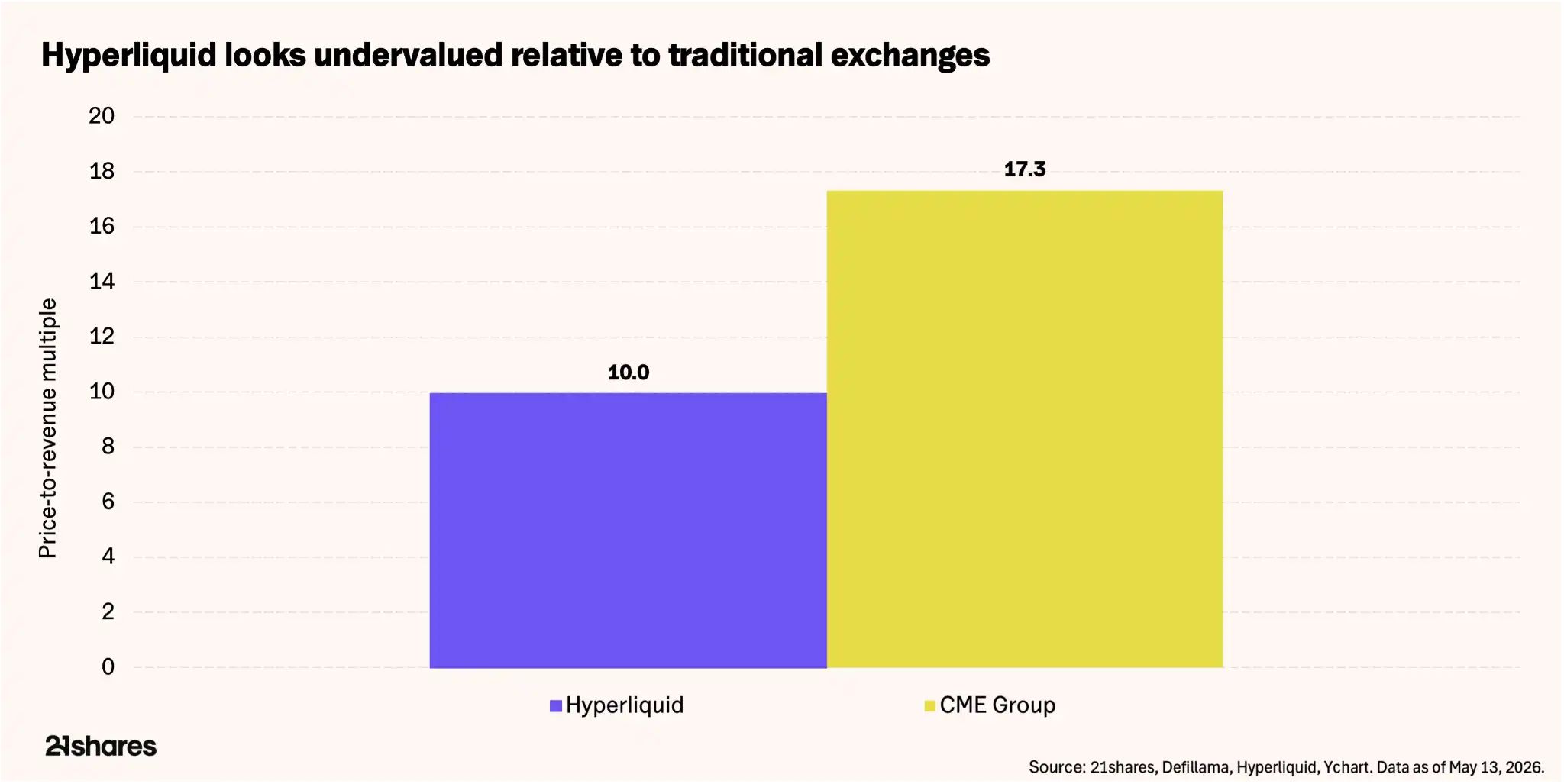
Caption: HYPE vs. CME P/R Ratio and Revenue per Employee Comparison

The market is already valuing HYPE using traditional exchange valuation frameworks. The real question is whether Hyperliquid's revenue quality justifies the comparison. To illustrate the efficiency advantage of blockchain infrastructure versus traditional systems: Hyperliquid's 2025 revenue of $873 million was generated by a team of just 11 people—$79.36 million per employee. CME Group's $6.5 billion revenue was supported by 3,875 employees, averaging $1.7 million per person. The difference is stark.

On a fully diluted basis—accounting for the full 1 billion HYPE token supply, most of which is not yet unlocked—the valuation stretches to approximately $37 billion, implying a 38-39x revenue multiple. This figure would only be justified if revenue grows significantly before all tokens enter circulation. But given Hyperliquid's annualized user growth exceeding 100%, coupled with expansion into new asset classes like commodities and prediction markets, this growth premium may be reasonable.

Rather than assigning a specific target price, consider the following scenarios:

Bull Scenario: If geopolitical tensions persist, commodity trading remains elevated, traditional asset traders continue to flock to Hyperliquid post-close, and HIP-3 Open Interest grows to $3-5 billion, annualized revenue could reach the $1.2-$1.5 billion range. Applying CME's 16-17x P/R multiple implies a market cap of $15-$17 billion, corresponding to a HYPE price of ~$62-$70. If options and prediction markets gain traction in the coming months, revenue acceleration could be even stronger.

Base Scenario: Under similar assumptions, with HIP-3 OI growing to $3.2-$5.3 billion, annualized revenue enters the $1.0-$1.1 billion range. At a 17x multiple, the implied market cap is ~$17-$18 billion, corresponding to a HYPE price of ~$75.
Caption: Three Valuation Scenarios Compared (Bull/Base/Bear)

Bear Scenario: If non-digital asset trading cools, buybacks may fail to offset token unlocks, and annualized revenue slides toward the $350-$450 million range. Applying a more conservative 10x multiple—reflecting slower growth and higher dilution—points to a market cap of ~$3.5-$4.5 billion, corresponding to a HYPE price of ~$15-$19, representing a 51%-62% drawdown from current levels. This still does not account for the revenue diversification from the upcoming launch of prediction markets and options trading.

The market is validating our bullish thesis: Bitcoin is down 9% year-to-date, while HYPE is up over 50%. This decoupling stems from HYPE's ongoing transition to diversified revenue streams. HYPE is not risk-free; it simply exchanges crypto beta risk for geopolitical volatility risk. Whether this trend can persist depends on the geopolitical landscape and team execution.

Risks That Must Be Acknowledged

HYPE carries several core risks that investors need to weigh against the protocol's growth:

Centralization & Attack Vectors: The 2025 JELLYJELLY and POPCAT token attack incidents nearly drained the $230 million liquidity vault, forcing validators to manually intervene and delist the assets. While effective, this exposed that the platform can act in a centralized manner when funds are threatened.

Regulation: Hyperliquid still geo-blocks US users, and on-chain commodities operate in a regulatory gray area. To resolve this, HYPE may need to acquire licenses, similar to how Polymarket acquired a CFTC-regulated entity to legally operate in the US market.

Geopolitical Shift: HIP-3 revenue benefits from global tensions. A cooling of macro volatility could quickly erode the "Geopolitical VIX" premium currently driving platform usage, impacting token value.

Issuance vs. Buybacks: Although the protocol is currently in net deflation, its ability to absorb ongoing token unlocks is entirely dependent on trading volumes remaining high.

Conclusion

The crude oil market trades on a blockchain not because of decentralization ideals, but because every other market was closed. This distinction—utility over ideology—is the core difference between Hyperliquid's current moment and previous DeFi narratives.

Valued at 13-15x annualized revenue, the market is pricing HYPE as a legitimate exchange business, not a speculative altcoin. The margin of safety depends on whether non-crypto trading volume is sustainable, whether buybacks continue to outpace dilution, and the execution of new features.

The data itself, at the very least, warrants a serious look at HYPE. As for whether it deserves a place in your portfolio, that depends on your judgment of the world beyond the charts.


Related Questions

QAccording to the report, what key event demonstrated Hyperliquid's role as a critical pricing venue during market closures?

AThe report highlights that during the US-Israel coalition airstrike on Iran on February 28th, when the CME was closed, Hyperliquid remained operational. Its WTI crude oil perpetual contract provided real-time price discovery, with its price spiking to $111.53, effectively pricing in the shock nearly 48 hours before traditional markets reopened.

QWhat is the core argument of 21Shares regarding Hyperliquid's evolution and business model?

A21Shares' core argument is that Hyperliquid has evolved from a crypto derivatives DEX into a 7x24 'exchange for everything'. Its business model is diversifying beyond digital assets, with traditional assets (like commodities and indices) now accounting for ~35% of volume through its permissionless HIP-3 framework, fundamentally broadening its revenue base.

QHow does the valuation of HYPE (using P/R ratio) compare to CME Group, and what is the implied price target in the bull case scenario?

AHYPE's Price-to-Revenue (P/R) ratio is approximately 10x, which is about half of CME Group's 17.32x. In the bull case scenario, with annualized revenue reaching $12-15 billion and applying CME's 16-17x P/R multiple, the implied market cap is $150-170 billion, corresponding to a HYPE price target of $62-70.

QWhat is the function of the HYPE token's 'Assistance Fund', and how does its implied buyback yield compare to CME's stock repurchase?

AThe Assistance Fund channels 97%-99% of platform fees into automated token buybacks, acting as a continuous 'share repurchase program'. Its implied buyback yield is approximately 13% of the circulating market cap. In contrast, CME Group's approved stock repurchase plan translates to a yield of only about 1% of its market cap.

QWhat are two major risks identified for HYPE and the Hyperliquid protocol in the report?

ATwo major risks identified are: 1) Centralization and attack vectors, as evidenced by the JELLYJELLY/POPCAT token attacks which forced validators to intervene centrally, revealing potential centralization in crisis. 2) Regulatory uncertainty, as Hyperliquid geo-blocks US users and its on-chain commodity trading exists in a regulatory gray area, potentially requiring licenses for broader legality.

Related Reads

Female Crypto Mogul Survived Mining Crackdown and Market Plunge, but Paid a $60 Million Tuition to a U.S.-Style 'Pig-Butchering' Scam

An 80s-born Chinese entrepreneur, Fiona Lyu (also known as Lv Yongshuang), CEO of the mining firm Chengdu Valarhash Technology, was defrauded of over $9.4 million (approx. RMB 60 million) in the US, according to a Caixin report. Lyu's company once operated the 1THash and Bytepool mining pools, which collectively controlled about 9% of the global Bitcoin hash rate at their peak in early 2020. The scam began in 2021 after China's crackdown on crypto mining forced Lyu to seek overseas relocation for her operations. She was introduced to Zubair Al Zubair, who posed as an "UAE royal family member" with connections to Middle Eastern capital and US local government resources. He and his brother, who impersonated a hedge fund manager, orchestrated a fake contract signing for a mining facility in Ohio, witnessed by local officials. Lyu transferred millions in contract payments. The brothers, both US citizens with fabricated backgrounds, later fraudulently sold 1,067 of her miners for $6.17 million. The scheme involved bribing a mayor's chief of staff for legitimacy. In May 2026, US courts sentenced Zubair to 24 years in prison, his brother to 23 years, and the official to 8 years. Simultaneously, Lyu faced a separate legal battle in China. A subsidiary of listed company ST Zhongchang sued her firm, seeking refunds for a 2021 contract involving Bitcoin mining equipment. Chinese courts ruled the mining contract invalid and ordered a refund of nearly RMB 19.3 million. This dual blow marked a stark downturn for the once-prominent figure in the crypto mining industry.

Foresight News12m ago

Female Crypto Mogul Survived Mining Crackdown and Market Plunge, but Paid a $60 Million Tuition to a U.S.-Style 'Pig-Butchering' Scam

Foresight News12m ago

Trade.xyz Pricing Controversy Exposes Fatal Weakness of Pre-IPO Perpetual Contracts

The Trade.xyz pricing controversy surrounding its SPCX (SpaceX) pre-IPO perpetual contract on Hyperliquid has exposed a critical vulnerability in decentralized finance (DeFi) platforms offering such instruments. The dispute erupted after SpaceX's updated filing revealed its total shares outstanding were approximately 10% higher than market estimates. While centralized exchanges (CEXs) paused trading and repriced contracts based on the new data, Trade.xyz maintained its position that its "IPOP" contract tracks market expectations for the per-share price, not the company's fundamental valuation or share count. This discrepancy triggered cross-platform arbitrage and led to significant losses for leveraged long positions on Trade.xyz, as the contract price gaped down without a value-neutral adjustment mechanism. The incident highlights the absence of a "Rebase" function—a mechanism that proportionally adjusts contract prices and user positions to reflect corporate actions like share count changes—within many decentralized perpetual exchanges (Perp DEXs). Unlike CEXs, which can centrally execute such adjustments, implementing Rebase on-chain involves significant technical complexity, gas costs, and potential security risks. Trade.xyz's architecture, which allows independent market deployment, further complicates platform-wide Rebase implementation. The controversy underscores broader challenges for Perp DEXs venturing into real-world assets (RWA) like pre-IPO shares. It raises questions about pricing reliability, transparent rule disclosure, and the ability to handle corporate events, testing user trust and the long-term viability of these synthetic markets for price discovery before official listings.

链捕手28m ago

Trade.xyz Pricing Controversy Exposes Fatal Weakness of Pre-IPO Perpetual Contracts

链捕手28m ago

When AI Traffic Surpasses Humans, How Do You Prove You're Human?

As AI-generated web traffic now surpasses human activity, the internet's foundational business models—built on human attention, browsing, and advertising—face severe disruption. AI agents crawl websites at immense scale without generating ad revenue, while AI summaries divert traffic from original content sites. In response, over 2.5 million sites are blocking AI crawlers, and protections like Cloudflare's "honeypot" traps have emerged, though advanced AI can bypass these. The collapse of traditional CAPTCHAs, which assumed machines were weaker than humans, has led to a shift toward behavioral biometrics for human verification. Companies like IBM and BioCatch now analyze unique human patterns—cursor movements, typing rhythms, keystroke dynamics, and even cognitive delays like the Stroop effect—to distinguish real users from bots. These biometric signatures are difficult to fake or alter, offering a new layer of security but raising significant privacy concerns. Two competing visions for a reliable human verification system are emerging. One, exemplified by Sam Altman’s World (formerly Worldcoin), uses centralized iris scanning to generate unique credentials, though it faces bans and criticism over unauthorized data collection. The other employs cryptographic zero-knowledge proofs, allowing users to prove they are human without revealing identity or biometric data, as advocated by Vitalik Buterin. However, decentralized approaches risk exploitation through identity renting in economically unequal regions. The central dilemma is between a scalable but privacy-invasive centralized system that permanently controls users' biometric data, and a privacy-preserving cryptographic system vulnerable to real-world economic manipulation. The author expresses a preference for the cryptographic path, arguing that despite its flaws, it avoids the irreversible biometric surveillance inherent in centralized alternatives.

Foresight News36m ago

When AI Traffic Surpasses Humans, How Do You Prove You're Human?

Foresight News36m ago

Crypto Primary Market Investment and Financing Forward-Looking Weekly Report | Stablecoin Regulation Nears Implementation, ETF Funds Continue to Withdraw, Capital Begins Betting on Payment and Cash Flow

Crypto Market Weekly Report (Jun 1-7, 2026): Capital Shifts Focus to Payments & Cash Flow Market data indicates a significant divergence: while traditional institutional funds continue exiting via BTC and ETH ETFs (recording net outflows of $1.72B and $168M this week, respectively), stablecoin supply continues growing. This suggests capital is shifting from speculative asset allocation toward defensive positioning within on-chain liquidity, awaiting new, concrete opportunities. This trend is reflected in venture capital focus. Weekly fundraising fell 27% to $302M, with investments concentrating on infrastructure with tangible revenue potential: 1. **Stablecoin Infrastructure (28% of funding):** Projects like M0 Protocol ($35M raise) are gaining attention as regulatory clarity (e.g., the GENIUS Act) nears, shifting the focus from legitimacy to building payment and settlement networks. 2. **AI Agent Infrastructure (26%):** Investments are moving from conceptual AI Agents towards the execution and economic layers required for a functional "Agent economy." Key raises include OpenRouter ($40M) and Halliday ($20M). 3. **Real World Assets (RWA) (18%):** The search for on-chain yield and cash flow drives continued interest in RWA platforms like Ondo Finance. Security threats are evolving from smart contract exploits toward key management failures, permission control issues, and regulatory execution risks (e.g., court-ordered asset freezes). **Key Takeaways:** The investment thesis is shifting from narrative-driven bets to revenue and cash-flow-generating protocols. Future attention should be on the progression of stablecoin regulations, the commercial validation of AI Agent economies, and the performance of high-revenue protocols like derivatives platforms.

marsbit43m ago

Crypto Primary Market Investment and Financing Forward-Looking Weekly Report | Stablecoin Regulation Nears Implementation, ETF Funds Continue to Withdraw, Capital Begins Betting on Payment and Cash Flow

marsbit43m ago

Trading

Spot
Futures

Hot Articles

Discussions

Welcome to the HTX Community. Here, you can stay informed about the latest platform developments and gain access to professional market insights. Users' opinions on the price of S (S) are presented below.

活动图片