灰度传出“喜讯”,能打破比特币9月魔咒吗?

PanewsPublished on 2023-08-31Last updated on 2023-08-31

Abstract

Butterfill 预测,9 月初市场仍将以波动为主。 他预计交易员会在对 ETF 批准的兴奋和对 SEC 批准的怀疑之间摇摆不定。

比特币在九月向来表现不佳,这是历史趋势。

Grayscale 最近在 ETF 案件中取得的胜利也不太可能阻止比特币在 8 月份以负回报率结束,8 月初 BTC 高于 29,000 美元,但现在徘徊在 27,000 美元以上。
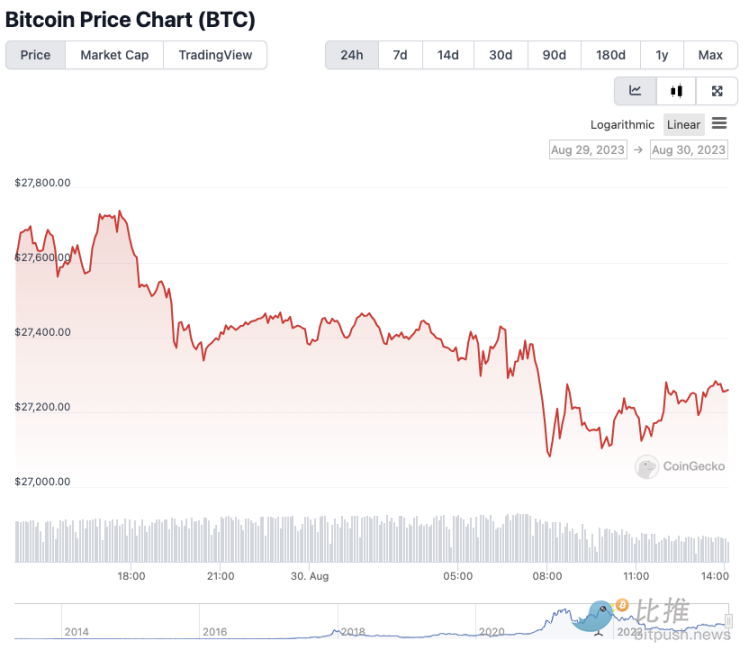
8 月份的表现给即将迎来的 9 月份带来了不确定性。 8 月的特点是波动性创历史新低,交易量下降,以及导致 BTC 价格跌至 25,000 美元区域的闪电崩盘。

CoinShares 研究主管 James Butterfill 表示,8 月份的价格下跌「凸显了比特币在较大交易中的脆弱性,而当前的低交易量加剧了这种脆弱性。」

Butterfill 预测,9 月初市场仍将以波动为主。 他预计交易员会在对 ETF 批准的兴奋和对 SEC 批准的怀疑之间摇摆不定。 尽管周三法院的裁决有利于 Grayscale,但 Butterfill 告诉 The Block,「不太可能加快 SEC 批准的时间表,因为仍有可能上诉。」

美元走强打压风险资产

在最近的一份报告中,Butterfill 质疑 9 月份的市场状况是否能够维持比特币当前的价值。 他的评估的关键是「美元指数上涨,影响了整个风险资产」。

在美联储上周五发表更多鹰派言论后,美元近期走强。 美元指数走强会降低与比特币相关的风险调整回报,从而使数字资产变得不那么受欢迎。

Butterfill 还指出,比特币交易量低于去年同期,这是一个负面信号。 他补充道:「这不仅仅是季节性的影响,」 据研究人员称,去年夏天比特币交易量平均每天 75 亿美元,而今年夏天则为 40 亿美元。

Butterfill 解释说,多种因素共同导致了数字资产目前的不活跃。 链上数据显示,投资者处于持有状态,等待 SEC 关于批准美国现货 ETF 的决定。他强调,最近的监管打击对美国的交易量产生了影响。 他还指出,币安的费用促销活动「从 2022 年 3 月开始,到 2023 年 3 月结束,导致交易量急剧下降。」

9 月带来市场不确定性

从历史趋势来看,比特币在九月向来表现不佳。

Krown Trading 的 Eric Crown 在 X(以前的 Twitter)上发帖指出,「之前 9 月份的 13 个月份中,有 9 个开盘到收盘时的回报率为负,平均亏损回报率为 -12.80%。」

因此,投资者仍对额外的下行压力保持警惕。

一位分析师预计 9 月份的交易量和波动性将会上升。 YouHodler 风险经理 Sergei Gorev 告诉 The Block:「我们预计 9 月份的波动性不会像 8 月份那么低。」 他补充说,鉴于美国下个月结束的财政年度,交易员将清算更多头寸。

Gorev 补充道:「固定一般投资组合利润的事实可能会影响加密货币的销售,特别是在 9 月份,这可能会导致加密货币市场出现负面动态。」

James Butterfill 强调,9 月份是「基金经理在假期结束后进行配置的时期,鹰派言论可能会影响他们的投资决策」。

不过,Butterfill 对 10 月和 11 月的比特币有着更为乐观的预测。他说:「我怀疑,随着宏观数据恶化,央行可能会很快开始转向。这将更有利于比特币。不过时机很棘手,我们可能必须等到 10 月和 11 月才能看到这种情况的发生。」

根据 CoinGecko 的数据,截至周三美股收盘,比特币的 24 小时波动率不到 2%,交易价格为 27,258.65 美元。

Trending Cryptos

Related Reads

Hubei State-Owned Assets Achieve the Largest Return in History

After years of anticipation, Yangtze Memory Holdings Co., Ltd. (YMTC) has filed for an IPO on Shanghai's STAR Market, seeking to raise 33 billion yuan—the largest offering in the board's history. This move follows the recent listing of its peer, ChangXin Memory Technologies (CXMT), which reached a market valuation exceeding 4 trillion yuan. Dubbed the "twin stars of domestic memory," both companies, founded in 2016 in Hefei and Wuhan respectively, symbolize China's push for semiconductor self-sufficiency. YMTC's journey began with its predecessor, Wuhan Xinxin, established in 2006. Backed by substantial state investment from Hubei and Wuhan, it evolved into a national memory base. The company achieved key technological breakthroughs, and now ranks as the world's third-largest and China's top NAND Flash manufacturer by sales. Its recent financials are strong, with Q1 2026 revenue of 47.04 billion yuan and net profit of 33.38 billion yuan. Post-IPO, its market value is widely expected to surpass 1 trillion yuan. The potential windfall highlights the success of long-term, patient capital from Hubei's state-owned entities. Key shareholders like Hubei Changsheng, Xintech, and government-backed funds have supported YMTC through years of development. Their collective stake could be worth hundreds of billions after the listing. This model mirrors other successes in Wuhan, such as Huagong Tech, where local state investment during a low point later yielded massive returns. The story reflects a broader national trend of regional transformation through strategic, high-tech investments. Hefei's bet on CXMT, now worth over 3.7 trillion yuan, propelled the city's A-share market cap to 4th nationally, showcasing how a major firm can reshape an entire local industry ecosystem. Similarly, Wuhan's photoelectronics cluster, now worth over 850 billion yuan, aims to become a world-class hub. The takeaway is clear: in the reshuffling of Chinese cities, patient, courageous state investment in core technologies—from memory chips to advanced manufacturing—is proving to be a decisive factor, turning long-term visions into economic reality.

marsbit47m ago

Hubei State-Owned Assets Achieve the Largest Return in History

marsbit47m ago

Trading

Spot

Hot Articles

What is $BITCOIN

DIGITAL GOLD ($BITCOIN): A Comprehensive Analysis Introduction to DIGITAL GOLD ($BITCOIN) DIGITAL GOLD ($BITCOIN) is a blockchain-based project operating on the Solana network, which aims to combine the characteristics of traditional precious metals with the innovation of decentralized technologies. While it shares a name with Bitcoin, often referred to as “digital gold” due to its perception as a store of value, DIGITAL GOLD is a separate token designed to create a unique ecosystem within the Web3 landscape. Its goal is to position itself as a viable alternative digital asset, although specifics regarding its applications and functionalities are still developing. What is DIGITAL GOLD ($BITCOIN)? DIGITAL GOLD ($BITCOIN) is a cryptocurrency token explicitly designed for use on the Solana blockchain. In contrast to Bitcoin, which provides a widely recognized value storage role, this token appears to focus on broader applications and characteristics. Notable aspects include: Blockchain Infrastructure: The token is built on the Solana blockchain, known for its capacity to handle high-speed and low-cost transactions. Supply Dynamics: DIGITAL GOLD has a maximum supply capped at 100 quadrillion tokens (100P $BITCOIN), although details regarding its circulating supply are currently undisclosed. Utility: While precise functionalities are not explicitly outlined, there are indications that the token could be utilized for various applications, potentially involving decentralized applications (dApps) or asset tokenization strategies. Who is the Creator of DIGITAL GOLD ($BITCOIN)? At present, the identity of the creators and development team behind DIGITAL GOLD ($BITCOIN) remains unknown. This situation is typical among many innovative projects within the blockchain space, particularly those aligning with decentralized finance and meme coin phenomena. While such anonymity may foster a community-driven culture, it intensifies concerns about governance and accountability. Who are the Investors of DIGITAL GOLD ($BITCOIN)? The available information indicates that DIGITAL GOLD ($BITCOIN) does not have any known institutional backers or prominent venture capital investments. The project seems to operate on a peer-to-peer model focused on community support and adoption rather than traditional funding routes. Its activity and liquidity are primarily situated on decentralized exchanges (DEXs), such as PumpSwap, rather than established centralized trading platforms, further highlighting its grassroots approach. How DIGITAL GOLD ($BITCOIN) Works The operational mechanics of DIGITAL GOLD ($BITCOIN) can be elaborated on based on its blockchain design and network attributes: Consensus Mechanism: By leveraging Solana’s unique proof-of-history (PoH) combined with a proof-of-stake (PoS) model, the project ensures efficient transaction validation contributing to the network's high performance. Tokenomics: While specific deflationary mechanisms have not been extensively detailed, the vast maximum token supply implies that it may cater to microtransactions or niche use cases that are still to be defined. Interoperability: There exists the potential for integration with Solana’s broader ecosystem, including various decentralized finance (DeFi) platforms. However, the details regarding specific integrations remain unspecified. Timeline of Key Events Here is a timeline that highlights significant milestones concerning DIGITAL GOLD ($BITCOIN): 2023: The initial deployment of the token occurs on the Solana blockchain, marked by its contract address. 2024: DIGITAL GOLD gains visibility as it becomes available for trading on decentralized exchanges like PumpSwap, allowing users to trade it against SOL. 2025: The project witnesses sporadic trading activity and potential interest in community-led engagements, although no noteworthy partnerships or technical advancements have been documented as of yet. Critical Analysis Strengths Scalability: The underlying Solana infrastructure supports high transaction volumes, which could enhance the utility of $BITCOIN in various transaction scenarios. Accessibility: The potential low trading price per token could attract retail investors, facilitating wider participation due to fractional ownership opportunities. Risks Lack of Transparency: The absence of publicly known backers, developers, or an audit process may yield skepticism regarding the project's sustainability and trustworthiness. Market Volatility: The trading activity is heavily reliant on speculative behavior, which can result in significant price volatility and uncertainty for investors. Conclusion DIGITAL GOLD ($BITCOIN) emerges as an intriguing yet ambiguous project within the rapidly evolving Solana ecosystem. While it attempts to leverage the “digital gold” narrative, its departure from Bitcoin's established role as a store of value underscores the need for a clearer differentiation of its intended utility and governance structure. Future acceptance and adoption will likely depend on addressing the current opacity and defining its operational and economic strategies more explicitly. Note: This report encompasses synthesised information available as of October 2023, and developments may have transpired beyond the research period.

2.1k Total ViewsPublished 2025.05.13Updated 2025.05.13

What is $BITCOIN

Discussions

Welcome to the HTX Community. Here, you can stay informed about the latest platform developments and gain access to professional market insights. Users' opinions on the price of BTC (BTC) are presented below.

活动图片