Iranian Rial Plunges to Record Low Amid New Sanctions Targeting Its "Lifeline" — Bitcoin Mining

cryptonews.ruОпубліковано о 2026-08-26Востаннє оновлено о 2026-08-26

Анотація

The Iranian rial hit a record low, falling to approximately 2.02 million rials per dollar following new U.S. sanctions under Operation 'Economic Outcast.' The sanctions target over 60 entities, including Iran's digital assets sector for the first time, alongside gold and shipping. U.S. Treasury Secretary Scott Bessent aims to cripple Iran's central bank, warning of secondary sanctions. The IMF projects Iran's 2026 inflation at 68.9% and a 5.4% economic contraction. Iran has leveraged Bitcoin mining since 2019, with state-linked entities controlling an estimated 65% of its mining capacity. This sector, along with Iran's broader crypto ecosystem valued at $7.78 billion last year, has been a lifeline for the regime and its currency. The U.S. has been systematically disrupting this network, sanctioning key exchanges like Nobitex and seizing nearly $500 million in crypto assets. Despite these pressures, Iran has historically adapted to sanctions. However, its mining operations are now vulnerable due to strain on the national power grid and potential secondary sanctions against trading partners, threatening its ability to convert crypto assets into cash. The fall of the rial marks the latest chapter in this ongoing financial conflict.

Earlier this week, the open market exchange rate of the Iranian rial fell to approximately 2.02 million rials per dollar, down from 1.53 million in the first quarter of this year. This drop occurred the same week the Trump administration launched Operation "Economic Outcast" — a comprehensive sanctions package first announced on August 19, which added over 60 organizations to the Treasury Department's blacklist.

Notably, it for the first time designated digital assets as a sector subject to sanctions, alongside technology, gold, aviation, and shipping.
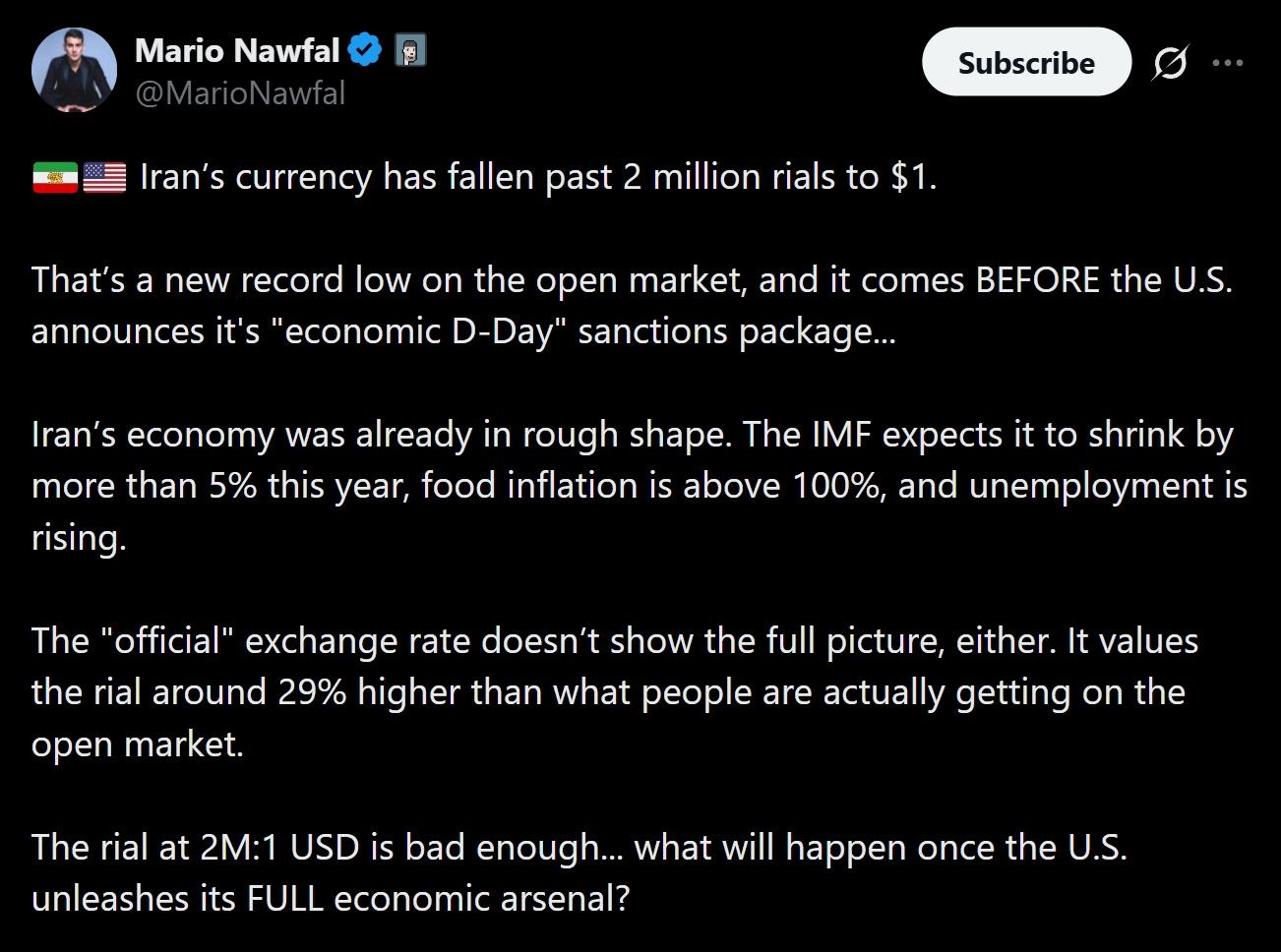
Treasury Secretary Scott Bessent stated that the goal is to force the Iranian state-owned "Bank Melli" to "shut down and cease operations" or lose all access to the dollar entirely, warning that secondary sanctions on Iran's trading partners could follow within weeks. The International Monetary Fund currently forecasts Iran's annual inflation to average 68.9% in 2026, with the economy contracting by 5.4%; prices for rice and beef have already surged sharply since the pressure intensified.

The IRGC's Bitcoin Mining Machine

None of this is news to Iran's cryptocurrency sector, which has for years been devising ways to circumvent restrictions. In more detail, Tehran legalized Bitcoin mining back in 2019, allowing licensed operators to use industrial electricity at a rate of about $0.004 per kilowatt-hour in exchange for selling the mined coins to the central bank.

State-linked farms controlled by the Islamic Revolutionary Guard Corps (IRGC) are currently estimated to control 65% of this mining capacity, with Iran's share of the global Bitcoin hashrate ranging from 3% to 7% since 2019, mining coins worth between $1.35 and $3.15 billion at various periods.

Beyond mining, the total value of Iran's cryptocurrency ecosystem reached $7.78 billion last year; Chainalysis estimates that over $3 billion flowed into wallet addresses linked to the IRGC in Q4 2025 alone, while Elliptic separately determined that the Central Bank of Iran had accumulated at least $507 million in USDT to support the rial's exchange rate.

Washington's Crypto Crackdown to Date

Washington has been gradually dismantling this network for months, as evidenced by the Treasury's Office of Foreign Assets Control (OFAC) sanctioning Nobitex, Wallex, Bitpin, and Ramzinex in June.

Nobitex alone handled over half of the digital asset inflow into Iran and helped the central bank move hundreds of millions in stablecoins, while also providing regime representatives access to international exchanges.

This move followed the Treasury's seizure in April of nearly $500 million worth of cryptocurrency assets linked to Iran after a cyberattack that stole over $90 million from Nobitex itself (in mid-2025), forcing the central bank to reroute its stablecoin flows across several blockchains to keep the system functioning.

TRM Labs separately found that Iran's total cryptocurrency flows in 2025 actually shrank to $3.7 billion, as the Nobitex hack, Tether fund freezes, and mounting geopolitical risk undermined confidence in the system.

Can Iran Withstand the Pressure?

Bessent has floated the idea of secondary sanctions against countries continuing to trade with Tehran, which would hit the very intermediaries Iran's crypto network relies on to convert stablecoins into cash. Iran's mining operations are vulnerable at a more basic level as well: for instance, the country's power grid is already strained, and further military escalation or power rationing due to blackouts could have a greater impact on shutting down IRGC-linked mining farms than any sanctions list ever could.

Put simply, the rial's plunge and the new sanctions package are just the latest chapter in a struggle our department has tracked for years, one where every crackdown on Iran's "cryptocurrency lifeline" has so far met a new workaround.

end-content

Пов'язані питання

QWhy did the Iranian rial fall to a record low recently?

AThe Iranian rial fell to a record low against the U.S. dollar following the Trump administration's launch of the 'Economic Outcast' sanctions package, which targeted Iran's 'lifeline' of Bitcoin mining and over 60 entities.

QWhat specific sector was newly targeted in the latest U.S. sanctions against Iran?

AThe latest U.S. sanctions explicitly targeted the digital assets sector for the first time, alongside technology, gold, aviation, and shipping.

QHow significant is Iran's role in global Bitcoin mining, and who controls most of it?

AIran's share of the global Bitcoin hash rate has been estimated at between 3% and 7% since 2019. Approximately 65% of Iran's mining capacity is controlled by state-linked farms under the Islamic Revolutionary Guard Corps (IRGC).

QWhat measures has the U.S. taken to disrupt Iran's cryptocurrency network prior to the latest sanctions?

APrior measures include sanctions on Iranian crypto exchanges like Nobitex, Wallex, Bitpin, and Ramzinex in June, and the seizure of nearly $500 million in Iran-linked crypto assets in April following a cyberattack.

QAccording to the article, what are the vulnerabilities of Iran's cryptocurrency mining operations beyond sanctions?

AIran's mining operations are vulnerable due to the country's strained power grid. Further military escalation or electricity rationing due to blackouts could have a greater impact on shutting down IRGC-linked farms than sanctions lists.

Пов'язані матеріали

Circle CEO: Stablecoins Are at the Internet's 2002 Stage, Will Reach Trillions of Dollars in the Future

Circle CEO Jeremy Allaire, in a Q2 2026 earnings AMA, discussed the current state and future of stablecoins and Circle's strategy. He compared stablecoins today to the internet in 2002, predicting they will grow from hundreds of billions to trillions of dollars. Key points include: * **Current Use Cases**: Stablecoins have achieved product-market fit in digital asset markets (for trading/settlement), as a digital dollar store of value in emerging markets, and for cross-border payments and settlement. * **Future Growth Areas**: Allaire highlighted opportunities in the AI agent economy, merchant payments (especially via QR codes and stablecoin cards), and the convergence of traditional and on-chain finance. * **Circle's Strategy**: Circle aims to grow USDC through global partnerships. Its economic engines will include reserve income, transaction fees from its on-chain payment network (CPN), and its upcoming "economic operating system," Arc. * **Arc's Vision**: Arc, launching its mainnet on September 16, is a stablecoin-native blockchain designed for seamless user and developer experience. It aims to power the future "on-chain" economy where businesses and AI agents operate. * **Global Adoption**: Allaire emphasized that stablecoin adoption is a global phenomenon, driven by regulatory clarity in regions like Europe (MiCA) and the US (GENIUS Act), and will continue regardless of specific US legislation like the CLARITY Act. * **EURC Growth**: Circle's euro stablecoin, EURC, has surpassed €400 million in circulation, benefiting from early preparation for European regulations and existing distribution networks. Allaire expressed confidence in Circle's execution, citing strong team cohesion and the adoption of AI tools, while identifying cybersecurity and global local operations as key areas for continued strengthening.

marsbit3 хв тому

Circle CEO: Stablecoins Are at the Internet's 2002 Stage, Will Reach Trillions of Dollars in the Future

marsbit3 хв тому

With Revenue 3.8 Billion Lower Than CXMT, Net Profit Is 8.6 Billion Higher: What Secrets Are Hidden in YMTC's IPO?

Chinese NAND flash giant Changcun Holdings has submitted its IPO prospectus to the Shanghai Stock Exchange. In Q1 2026, the company reported revenue of 47.042 billion yuan and a net profit attributable to parent company shareholders of 33.379 billion yuan. This presents a striking contrast with its competitor Changxin Technology, which had higher revenue (50.8 billion yuan) but a significantly lower net profit of 24.762 billion yuan. The key to this discrepancy lies in their ownership structures of core assets. Changcun Holdings fully owns its main operating entity, Yangtze Memory Technologies Co., Ltd., allowing nearly all group profits to flow to the parent company. In contrast, Changxin Technology controls but does not fully own its key production subsidiaries, meaning a substantial portion of its consolidated profits (approximately 8.25 billion yuan in Q1 2026) belongs to minority shareholders, reducing its reported net profit. Despite Changcun's higher net profit, its pre-IPO valuation is estimated lower than Changxin's. Analysts attribute this to differing market expectations: Changxin, focused on DRAM and the high-growth HBM market for AI servers, is seen as having greater long-term growth potential. Changcun, while dominant in NAND flash, operates in a market with inherent size constraints, making its future valuation more dependent on successfully upgrading its product mix toward higher-value segments like enterprise SSDs.

marsbit14 хв тому

With Revenue 3.8 Billion Lower Than CXMT, Net Profit Is 8.6 Billion Higher: What Secrets Are Hidden in YMTC's IPO?

marsbit14 хв тому

Perpetual Contract Liquidation Wave Resurges, Bitcoin $62k - $67k May Become the 'Disaster Zone'

A wave of liquidations has hit the crypto perpetual futures market, with analysts warning of continued volatility. Following Bitcoin's drop below $76,000 and subsequent rebound, over $84 million in long positions were liquidated in one hour, demonstrating the amplified impact of leverage. The U.S. CFTC's recent approval of a spot Bitcoin perpetual contract on the Kalshi exchange has opened this "previously closed" asset class to American institutions, with the platform reporting $5.5 billion in volume in its first two weeks. However, critics like Better Markets warn that perpetuals are "among the most dangerous crypto products" for retail investors due to a lack of enhanced protections. Recent price action saw a massive $529 million in hourly liquidations, predominantly longs. Analysts note that while a $3.3 billion short squeeze cleared liquidity above $80,000, a significant pool of long liquidations now sits between $62,000 and $67,000, posing a downside risk if key resistance holds. Experts caution new traders against using leverage or options, which can expire worthless, without proper experience and risk management. Despite the dangers, the demand for leveraged products persists, with some institutional players preferring on-chain platforms for their transparency and self-custody. As Kalshi expands its perpetual offerings beyond crypto, the core warning remains: leverage can lead to sudden, severe losses for unprepared investors.

marsbit15 хв тому

Perpetual Contract Liquidation Wave Resurges, Bitcoin $62k - $67k May Become the 'Disaster Zone'

marsbit15 хв тому

Торгівля

Спот
活动图片