Solana sees $70B USDC surge: Bullish catalyst or ‘hidden’ risk for SOL?

ambcrypto发布于2026-07-19更新于2026-07-19

文章摘要

Solana has seen over $70 billion in USDC minted on its network in 2026, boosting liquidity sharply. However, this surge in stablecoin supply contrasts with declining on-chain activity and trading volumes. Despite adding millions of active users, Solana's transaction count and overall trading volume have slowed, while SOL's price remains down more than 35% year-to-date. This divergence indicates the new liquidity may be fueling speculation rather than sustainable network growth or price recovery. If this trend continues, the massive USDC inflow could become a headwind for SOL in the second half of the year.

As H2 unfolds, liquidity is emerging as the market’s defining variable.

From a technical standpoint, the TOTAL crypto market cap has fallen more than 25% from its $3.3 trillion peak. That coincided with Bitcoin’s [BTC] nearly 35% decline from its $97k high in H1, marking its worst first-half performance since the 2022 bear market, when BTC ended the year down 65%. So, if the market sees another H1-style sell-off in H2, it could match or even exceed the losses from the 2022 bear cycle.

The key question is: What are the odds? Notably, liquidity is where the picture begins to change. The stablecoin market has contracted by nearly $15 billion so far in 2026, pulling the total stablecoin market cap below $310 billion. In essence, stablecoin outflows suggest capital is leaving the crypto ecosystem, reducing the liquidity available to support a sustained market recovery.
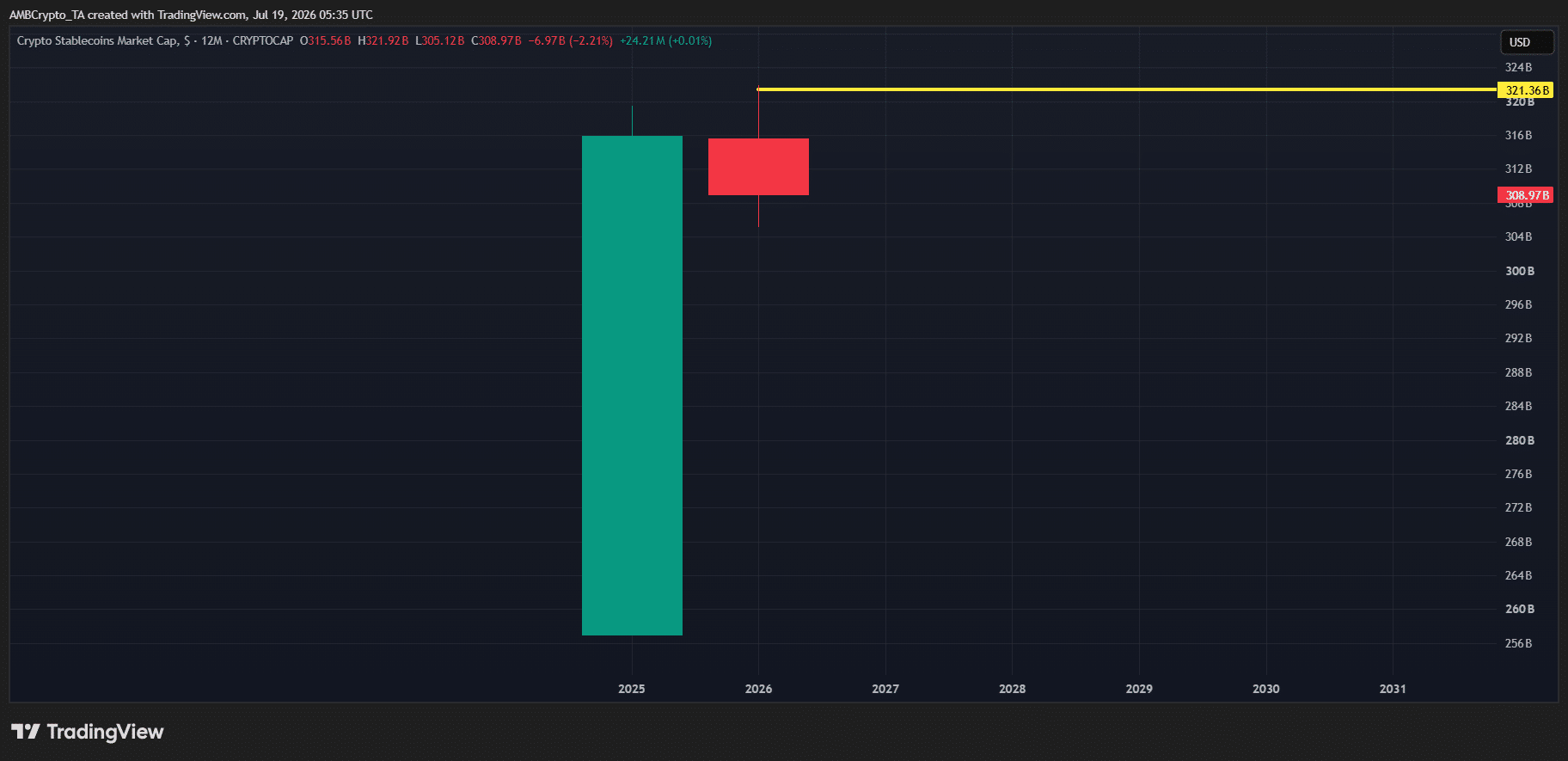
Source: TradingView (STABLE.C/USDT)

Solana [SOL], however, is telling a different story.

According to SolanaFloor, Circle minted another $250 million worth of USDC on Solana over the past 24 hours, pushing the network’s stablecoin market cap back above $15 billion. More notably, Circle has minted over $70 billion worth of USDC on Solana so far in 2026. In essence, while liquidity is tightening across the broader market, it continues to flow in the Solana ecosystem.

Notably, this liquidity growth has been accompanied by strong on-chain activity. Solana’s monthly active users, for instance, are back above 100 million, with the network adding another 37 million monthly active users in just the past month. This alignment between rising USDC supply and growing network usage suggests fresh liquidity is being deployed rather than sitting idle.

The key question is whether USDC supply is emerging as Solana’s key H2 catalyst.

Growing USDC supply is reshaping Solana’s H2 outlook

Typically, rising liquidity across a Layer 1 network is a bullish signal.

However, Solana’s price action hasn’t caught up. Despite a sharp increase in USDC liquidity, SOL remained down more than 35% in 2026, underperforming Bitcoin’s decline by over 1.3x. The divergence suggests liquidity alone hasn’t been enough to drive a sustained recovery.

The same trend appears on-chain. Solana processed 25.3 billion transactions in Q1, followed by 24.3 billion in Q2. Q3 has recorded 4.9 billion transactions so far, pointing to a slowdown in network activity. The slowdown is also evident in trading activity. As the chart below shows, Solana’s trading volume declined by 50% QoQ, falling from $410 billion in Q1 to around $284 billion in Q2.
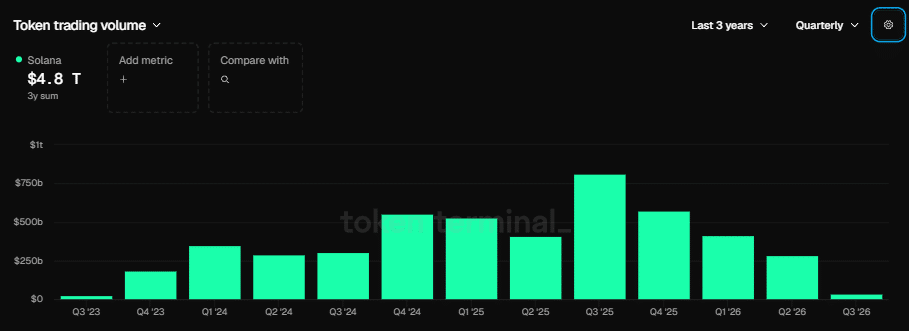
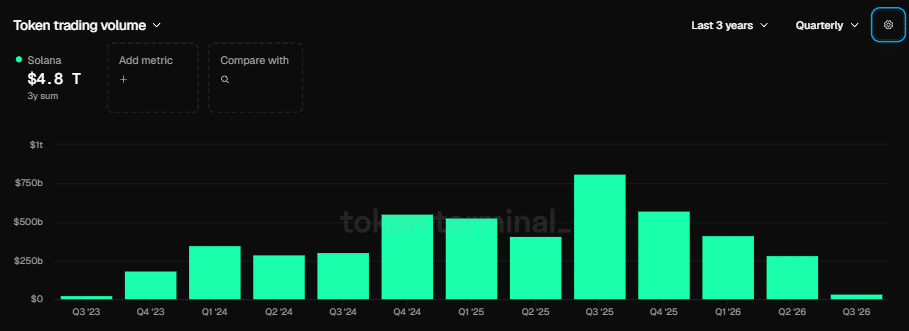
Source: Token Terminal

In essence, rising USDC supply isn’t translating into rising on-chain activity.

At the same time, monthly active users tell a different story. The divergence suggests speculative activity is picking up, even as transaction count and trading volume remain below their Q1 levels. This imbalance helps explain SOL’s technical weakness.

While Circle has minted $70 billion USDC on Solana, the liquidity has yet to translate into a meaningful recovery in on-chain activity or sustained price strength. If speculation continues to dominate, the growing USDC supply could become a headwind for SOL, weakening its H2 outlook.


Final Summary

  • Circle has minted over $70 billion in USDC on Solana in 2026, driving a strong increase in network liquidity.
  • However, weaker on-chain activity and SOL’s 35% decline suggest the extra liquidity hasn’t translated into stronger demand.


热门币种推荐

相关问答

QWhat is the main contradiction or 'hidden' risk highlighted in the article regarding the $70 billion USDC surge on Solana?

AThe main risk is that despite the massive $70 billion USDC liquidity injection onto Solana in 2026, it has not translated into a sustained recovery in on-chain activity (like transaction count and trading volume) or SOL's price, which remains down over 35%. This divergence suggests the liquidity may be fueling speculation rather than genuine demand, potentially becoming a headwind.

QAccording to the article, what is the broader market trend for stablecoins in 2026, and how does Solana's situation contrast with it?

AThe broader stablecoin market cap has contracted by nearly $15 billion in 2026, falling below $310 billion, indicating capital is leaving the crypto ecosystem. In contrast, Solana has seen over $70 billion worth of USDC minted on its network, with its stablecoin market cap rising above $15 billion, showing liquidity is flowing into the Solana ecosystem.

QWhat key on-chain metrics for Solana show a slowdown, despite the growth in monthly active users?

AKey slowing metrics are transaction count and trading volume. Solana processed 25.3B transactions in Q1, 24.3B in Q2, and only 4.9B so far in Q3. Trading volume fell 50% QoQ from $410B in Q1 to ~$284B in Q2. This contrasts with monthly active users rising above 100 million, adding 37 million in the past month.

QHow has SOL's price performance in 2026 compared to Bitcoin's, according to the article?

ASOL has underperformed Bitcoin significantly. SOL is down more than 35% in 2026, which is over 1.3 times worse than Bitcoin's decline from its peak. This underperformance persists despite the large influx of USDC liquidity on the Solana network.

QWhat is the article's concluding perspective on whether the growing USDC supply is a bullish catalyst for Solana in H2?

AThe article concludes it may not be a clear bullish catalyst. While liquidity growth is typically positive, the failure of this liquidity to boost on-chain activity or SOL's price suggests it might be supporting speculation. If this continues, the growing USDC supply could actually become a headwind, weakening Solana's H2 outlook.

你可能也喜欢

3%返现、6%年息与借记卡:埃隆·马斯克在美国推出X Money

2026年7月27日,社交媒体X(原Twitter)在美国推出内置金融服务X Money,目前仅向美国地区的Premium和Premium+订阅用户开放。创始人埃隆·马斯克强调了此举对平台的重要性。 服务核心是X Card借记卡,支持虚拟和实体金属卡形式,基于Visa网络。主要功能包括:用户间免费即时转账、大部分消费3%现金返还、全球ATM免费取现、免跨境手续费,以及支持Apple Pay/Google Pay。账户余额可享最高6.00%的年收益率(APY),Premium+用户直接获得,Premium用户需满足合格直接存款条件方可达成最高利率。 用户资金并非由X保管,而是存放在FDIC成员银行Cross River Bank,享受最高25万美元的存款保险。通过现金归集计划,资金可分散至多个合作银行,理论上能将总保险额度提升至1000万美元。服务还提供提前两天收到工资、电汇、支票邮寄和账单支付等功能。 安全方面,采用生物识别或设备PIN码的通行密钥登录,并支持自定义交易限额及Visa的零责任防欺诈政策。此次公开上线前,X已于2026年6月底在部分Premium+用户中进行了小范围测试。 分析认为,X此举延续了科技平台将金融功能整合进社交应用的尝试。与Meta曾推出但很快失败的Novi钱包不同,X Money选择通过与持牌银行合作的传统银行架构,而非自有加密货币,这降低了部分监管风险,但大规模处理用户资金仍将使其面临美国金融监管机构的密切关注。

cryptonews.ru48分钟前

3%返现、6%年息与借记卡:埃隆·马斯克在美国推出X Money

cryptonews.ru48分钟前

交易

现货

热门文章

相关讨论

欢迎来到HTX社区。在这里,您可以了解最新的平台发展动态并获得专业的市场意见。以下是用户对SOL(SOL)币价的意见。

活动图片