Qualcomm and Arm Fall Together: The Bill for Memory Price Hikes Finally Arrives at Mobile Chip Companies

marsbitPublié le 2026-07-30Dernière mise à jour le 2026-07-30

Résumé

After posting Q2 FY2026 results, Qualcomm and Arm both saw their shares decline, reflecting the impact of memory price increases on the smartphone chip sector. Qualcomm's revenue of $9.95B slightly beat expectations, but EPS of $2.21 fell short. More concerning was its guidance for next quarter, with EPS projections below analyst estimates. The company directly attributed a >$1.50 per share annual EPS headwind to rising memory costs and supply constraints in Android phones, prompting planned price hikes. While automotive revenue grew 61% and is approaching one-third of phone revenue, the mobile segment declined 20%. Qualcomm also confirmed a significant reduction in its modem share for the upcoming iPhone and outlined a plan for data center revenue to replace all Apple-related income by FY2027. Arm's results surpassed expectations with revenue of $1.29B and EPS of $0.45, and its guidance was also strong. However, its stock fell. Key concerns included royalty revenue failing to set a new record and a downward revision to full-year royalty growth guidance from ~20% to the high-teens, citing weak smartphone demand and high memory prices. Despite robust growth in its data center business, Arm's premium valuation (over 100x forward P/E) means even beating expectations isn't enough to push the stock higher, as any sign of uncertainty is magnified. Ongoing global antitrust investigations add another risk factor. The situation highlights a broader shift. Memory price surges, which...

After the U.S. stock market closed on July 29th, Qualcomm and Arm released their earnings reports one after the other.

Starting with Qualcomm. Its revenue was $9.947 billion, exceeding the consensus estimate of $9.67 billion. However, non-GAAP earnings per share (EPS) were $2.21, missing the expected $2.23. More crucially, the guidance for the next fiscal quarter is revenue of $9.7 billion to $10.5 billion and EPS of $2.05 to $2.25. According to Reuters' statistics, the market consensus was $2.36 per share, meaning even the upper end of Qualcomm's guidance is below expectations. This isn't 'beating expectations'; it's revenue beating, profits slightly missing, and guidance significantly missing.

Now, Arm. Its shareholder letter was clean, with revenue of $1.289 billion and adjusted EPS of $0.45 both exceeding expectations, and next-quarter guidance also beating. Its stock price fell 8.11% that day, a drop that occurred during the regular trading session before the earnings release. After the report came out, the stock barely moved, but then fell another 7% to 8% in after-hours trading following the conference call. A Bloomberg news article URL still contained the phrase 'beat doesn't impress', while the displayed headline had been changed to 'Arm Drops as Smartphone Slowdown Outweighs Data Center Growth'.

What happened in between? Both companies mentioned the same word in their reports: memory.

Phone Shrinks, Cars Keep It Alive

A page in Qualcomm's official earnings presentation materials specifically addressed the Android phone business. It stated that due to memory price increases and supply constraints, Android phone revenue for the QCT segment in fiscal 2026 is expected to decline approximately 20% year-over-year, dragging down full-year EPS by more than $1.50. It also announced price increases for its products effective September 1st to pass on rising input costs.

This page is the most direct evidence in these two reports. The memory price surge translated to KRW 89.49 trillion in operating profit for Samsung, and here for Qualcomm, it's a bill itemized down to $1.50 per share.

It's also visible in gross margins. Qualcomm's GAAP gross margin this quarter was 53.1%, compared to 55.6% last year. According to a transcript of the call, management described QCT gross margins as 'slightly below our historical range', attributing it to rising memory and other input costs.
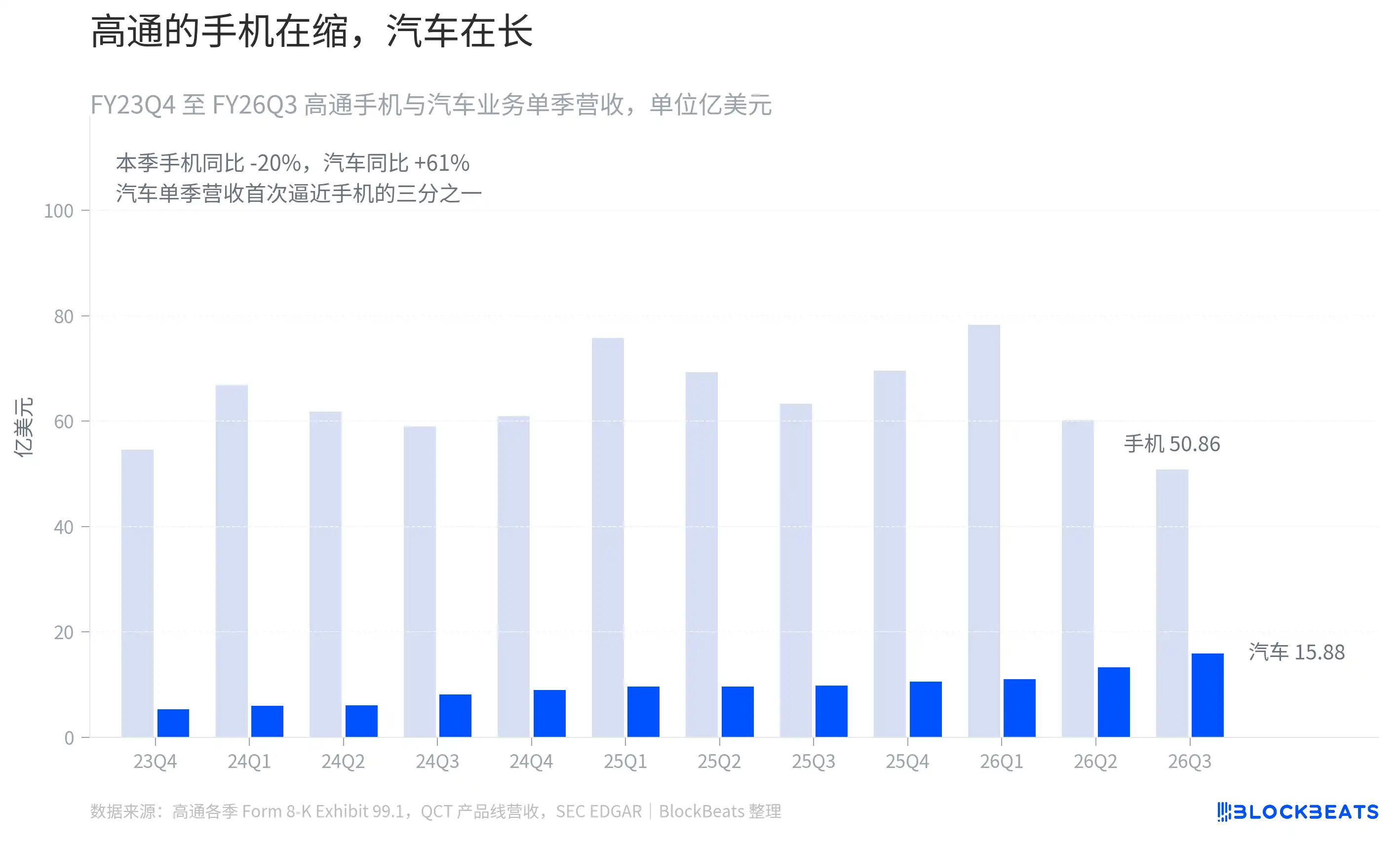
This quarter, handset revenue was $5.086 billion, down 20% year-over-year. Automotive revenue was $1.588 billion, up 61%, marking the 23rd consecutive quarter of double-digit growth. The distance between these two bars on the chart is narrowing rapidly, with automotive quarterly revenue approaching one-third of handset revenue for the first time.

There's a longer-term issue on the phone side as well. The official presentation states that due to supply constraints, the decline in revenue from Apple products will accelerate starting in the fourth fiscal quarter, "Our share of modems on the upcoming iPhone is expected to be significantly lower than the previous 20% estimate." According to the call transcript, CFO Akash Palkhiwala said Apple revenue will decline by about 50% from the September quarter to the December quarter.

CEO Cristiano Amon offered an even more memorable line during the call. According to Reuters, he said, "We've essentially replaced Apple with data center." The official statement was more cautious, with the presentation materials stating that the year-over-year increase in non-handset revenue in fiscal 2027 will replace all Apple product revenue from fiscal 2026.

The data center line is currently a timeline. The official revenue path is approximately $300 million in fiscal 2026, $5 billion in fiscal 2027, and over $15 billion in fiscal 2029. Of the $5 billion in fiscal 2027, there are custom chips for two hyperscale customers, each contributing over $1 billion. One has been made public: Meta signed a strategic agreement with Qualcomm for a multi-generation CPU roadmap, with the first Dragonfly C1000 not entering production until the second half of 2028.

Seaport Global analyst Jay Goldberg was less generous in his assessment to Reuters, stating Qualcomm "is seeing Android share shift away from it and already lost nearly all of its remaining share at Apple."

Arm's Conference Call Had a Problem

Arm's shareholder letter contained some very nice numbers. Data center royalties more than doubled year-over-year, the second consecutive quarter of doubling. Cumulative shipments of Neoverse architecture cores exceeded 1.5 billion, with the most recent 500 million cores shipped in just 9 months, while the first 1 billion took 6 years. The letter also cited IDC data, stating that spending on Arm-based accelerated server platforms nearly doubled in the past two quarters and has already surpassed x86 platforms.
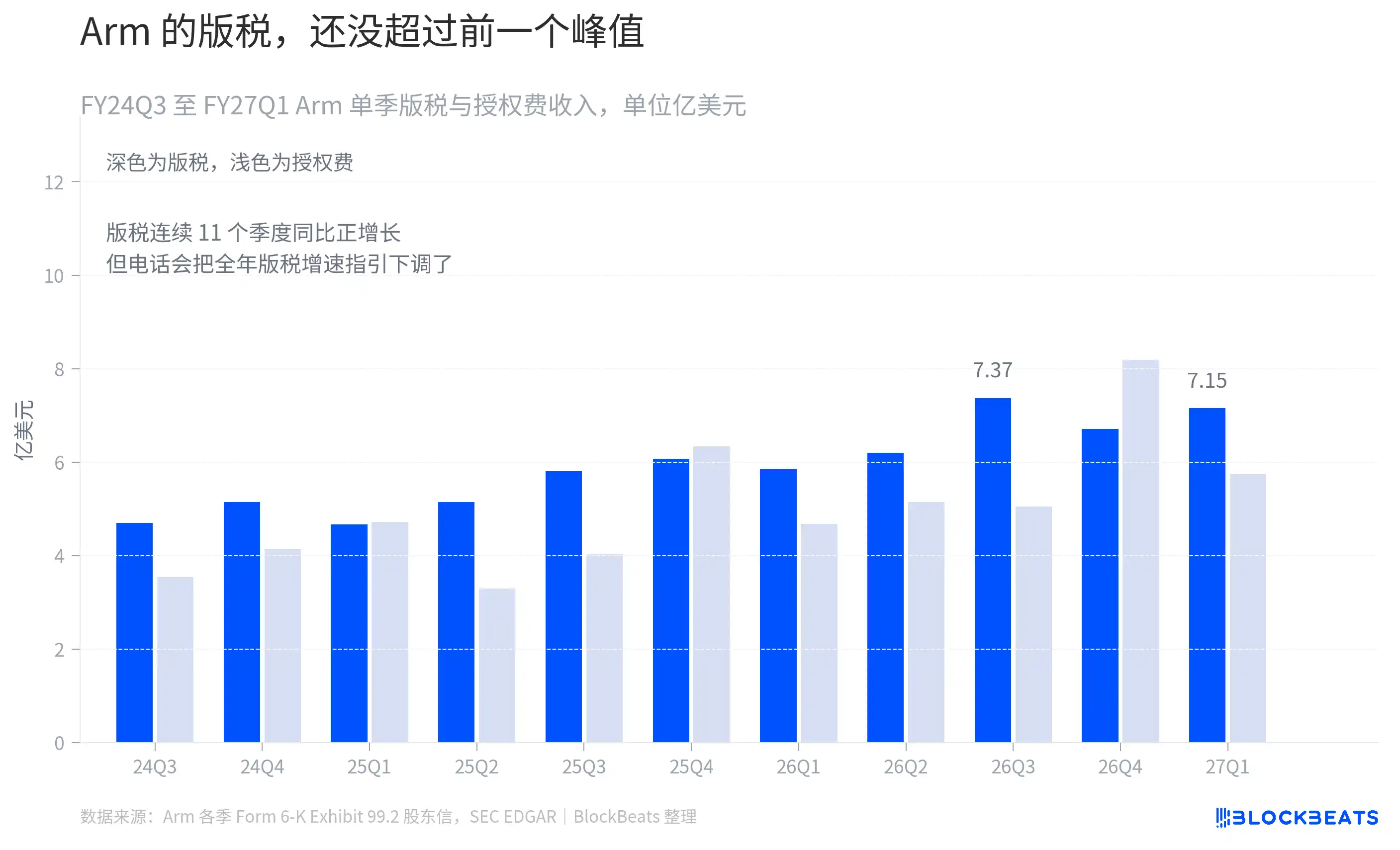
The dark line on the chart tells a different story. This quarter's royalty revenue was $715 million, up 22% year-over-year, but it did not surpass the $737 million from Q3 of fiscal 2026. That remains Arm's quarterly royalty peak. The licensing fee line has always been volatile, with year-over-year growth swinging between -15% and +72%. The market has always focused on the smoothly ascending royalty line, and this quarter that line did not hit a new high.

What really turned the stock lower was a guidance cut during the call. According to the call record, Arm lowered its full-year royalty growth guidance from approximately 20% previously to the high teens, citing weakness in the smartphone market and high memory prices, and expecting a double-digit decline in the phone market. For the next quarter's segment guidance, licensing fees are expected to grow about 30% year-over-year, while royalties are only in the low teens percentage.

Why No Rally Even After Beating Expectations?

Based on the July 29th close, Arm's forward price-to-earnings (P/E) ratio is 103.66 times, Qualcomm's is 15.22 times—a difference of 6.8 times. Another comparison is more telling: Arm's forward P/E is 5.4 times higher than Nvidia's 19.07 times, while Nvidia's trailing twelve-month revenue is $253.49 billion, 49 times that of Arm.
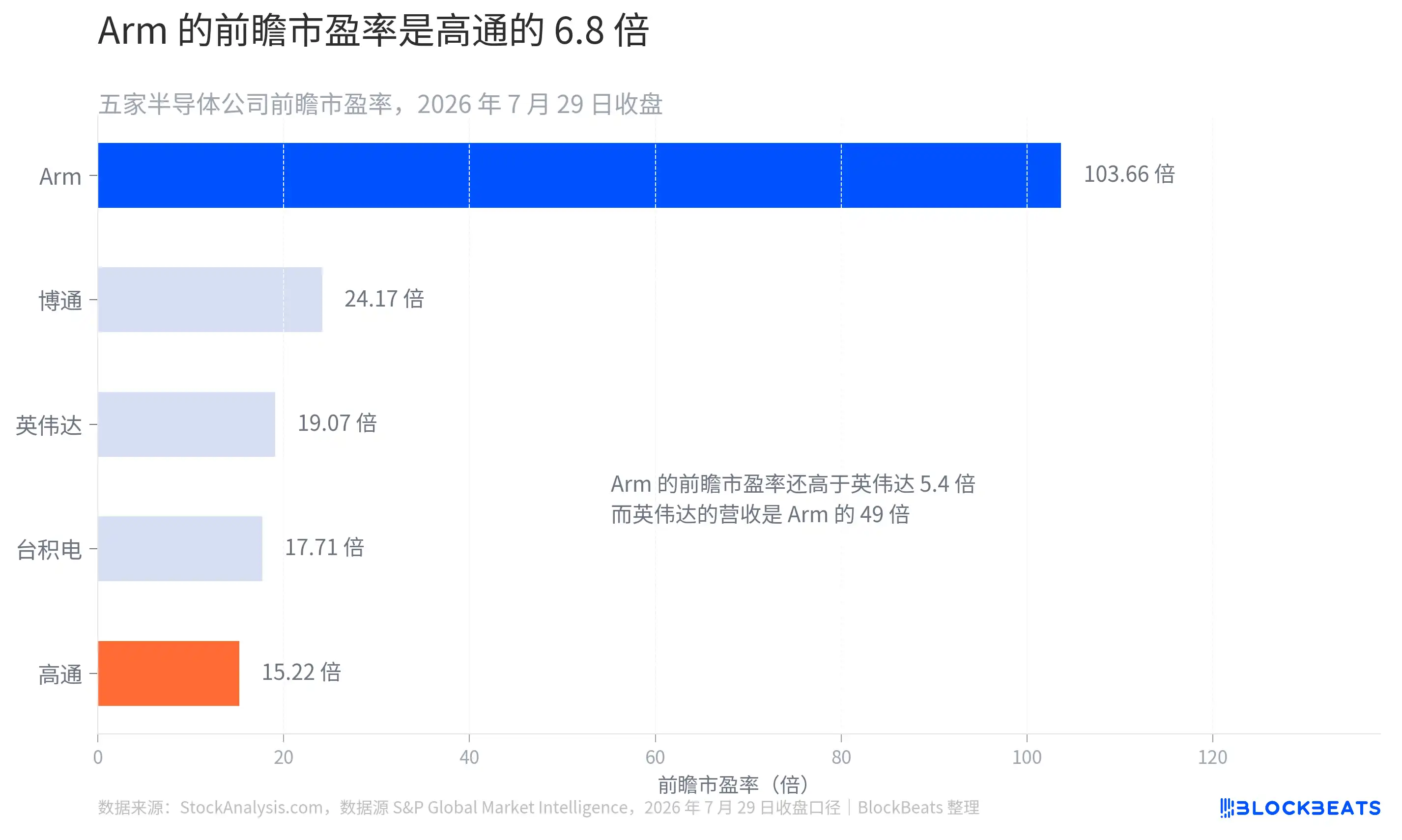
A TechTimes post-earnings analysis explained this mechanism clearly, stating that at a forward P/E of 100 to 120 times, "a clean beat no longer pushes the stock price higher." This sentence explains a class of phenomena, not just Arm's. When valuation has already discounted growth for several years into the future, the function of earnings reports shifts from providing surprises to confirming assumptions, and any deviation from confirmation gets amplified.

There's another variable most reports didn't mention. According to reports, the U.S. Federal Trade Commission launched a formal antitrust investigation into Arm starting in May 2026, examining whether its launch of in-house AGI CPUs could weaken or lead to refusal to license CPU architecture to competitors, with parallel investigations in Korea and by the European Commission. If regulators ultimately mandate non-discriminatory pricing, the margin assumptions in Arm's long-term model targeting $25 billion revenue by fiscal 2031 would need to be recalculated.

Arm's in-house chip line did see progress this quarter. The shareholder letter said customer demand for its AGI CPUs now exceeds $2 billion, spanning fiscal years 2027 and 2028, double the $1 billion opportunity disclosed last quarter, with new customers including multiple clients in the U.S. and China. Jefferies' estimate to Reuters was more optimistic than the company's, suggesting this business could reach $18 billion by fiscal 2031, above Arm's own $15 billion estimate.

It's Not Just About Two Companies

According to statistics, the Philadelphia Semiconductor Index fell 18.2% in July, after doubling in the first half of this year. Nineteen tech stocks fell more than 25% in July, most of them semiconductors, and seven of those still have triple-digit gains year-to-date.

The arrangement of points in the chart below is clear: the ones that fell the most in July are generally the ones that rose the most this year. SanDisk fell 40.4% in July but is still up 471% year-to-date. Micron fell 26.5% in July, up 197% year-to-date. Arm fell 36.6% in July, up 105.7% year-to-date.
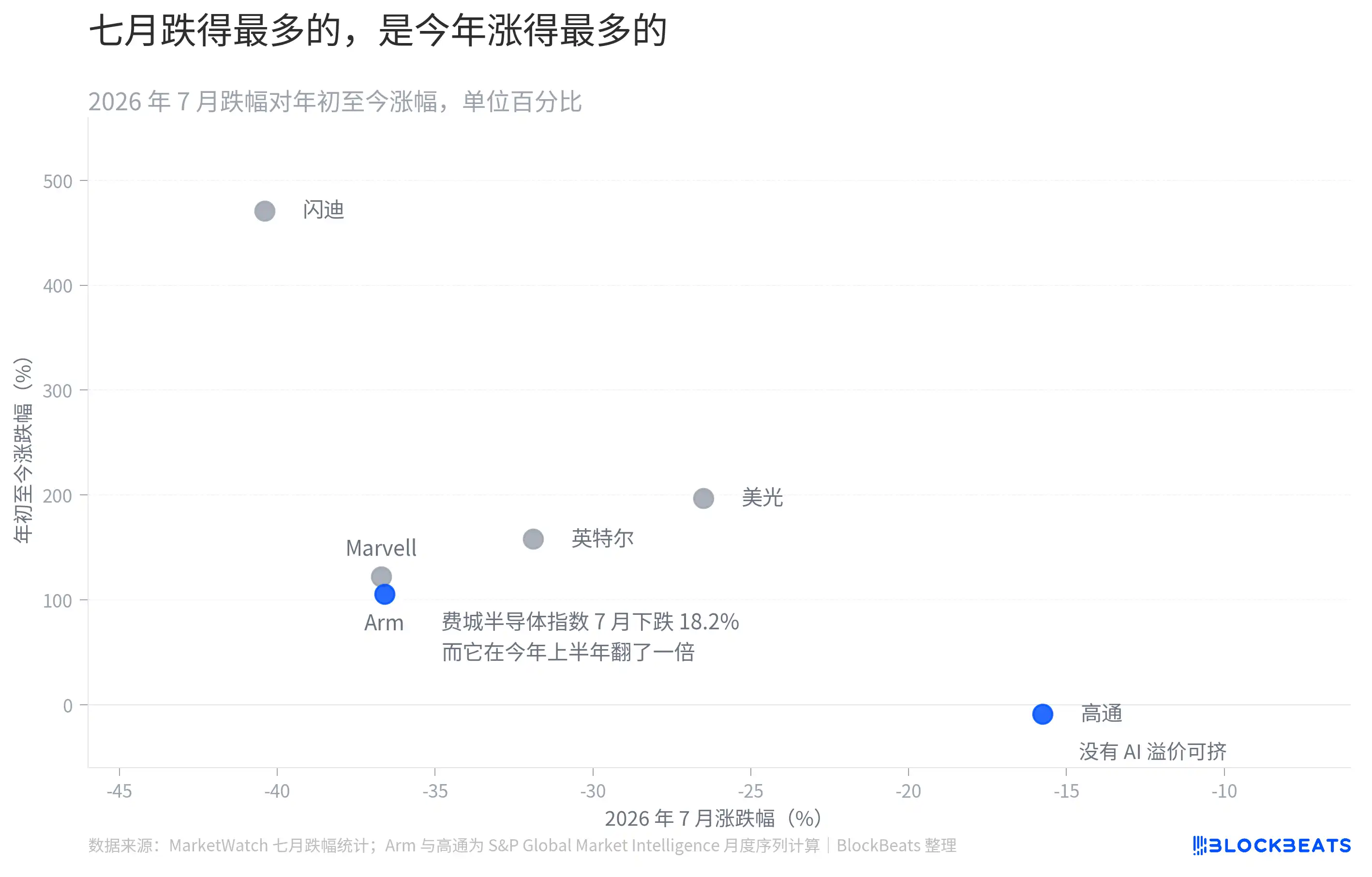
Qualcomm is the exception. It fell 15.75% in July and is down 8.99% year-to-date. It's not in the group with squeezed valuations because it has no AI premium to squeeze. The consensus rating from thirty-six analysts is Hold, with an average target price of $220.57, about 40% above the current price. Forty analysts give Arm a consensus Buy rating.

Two other earnings reports from the same day can be viewed together. Microsoft revenue of $90 billion, Azure growth of 43%, its stock rose about 8% after hours at one point. Meta revenue of $60.8 billion, growth of 28%, but net profit declined, its stock fell 8% to 10% after hours. Samsung's operating profit hit a record, but its stock barely moved that day.

The memory price surge allowed Samsung to earn in one quarter what Nvidia earned at its peak, while the other half of the same bill was accounted for by Qualcomm and Arm, each writing it once in their respective reports.


Cryptos en tendance

Questions liées

QWhy did Qualcomm's stock decline despite its revenue beating expectations?

AQualcomm's stock declined because its future guidance was significantly below market expectations. While its revenue of $99.47 billion exceeded estimates, its Q2 EPS guidance of $2.05 to $2.25 was below the consensus estimate of $2.36. Furthermore, the company cited rising memory costs and supply constraints negatively impacting its Android phone business, expecting a ~20% year-over-year revenue decline in FY2026 and a drag of over $1.50 on full-year EPS. The loss of significant Apple modem share and a faster-than-expected decline in Apple revenue also contributed to investor concerns.

QWhat specific factor negatively impacted both Qualcomm and Arm's financial results according to their reports?

ABoth Qualcomm and Arm explicitly cited rising memory (storage) costs and supply constraints as key factors negatively impacting their financial results. Qualcomm noted it contributed to a lower Android phone revenue forecast and pressured gross margins. Arm attributed its downgraded royalty growth guidance partly to weak smartphone market conditions driven by high memory prices.

QHow did Arm's performance differ between its royalty and licensing businesses in the reported quarter?

AArm's performance showed divergence. Its licensing fee revenue, which is volatile, grew. However, its more stable and closely watched royalty revenue of $715 million, while up 22% year-over-year, did not reach a new all-time high, falling short of the $737 million peak from the previous quarter (Q3 FY2026). This failure of the royalty stream to set a new record was a point of concern for investors.

QWhy didn't Arm's stock price rise even though it reported earnings that beat expectations?

AArm's stock did not rise because, at a forward P/E ratio of over 100 times, its valuation had already priced in significant future growth. A simple earnings beat was no longer sufficient to drive the price higher. Instead, the market focused on negatives such as the downgraded full-year royalty growth guidance and the failure of royalty revenue to hit a new record. Additionally, potential regulatory risks from antitrust investigations into its AGI CPU business posed a threat to its long-term profitability model.

QWhat contrasting trend is highlighted in the semiconductor sector's performance for July versus the first half of the year?

AThe article highlights a sharp reversal in the semiconductor sector. The Philadelphia Semiconductor Index fell 18.2% in July, following a performance where it had doubled in the first half of the year. Many semiconductor stocks that rose the most in the first half (e.g., Arm, Micron, SanDisk with triple-digit gains) were among the biggest decliners in July, indicating a market correction or valuation squeeze, particularly for stocks with high AI-related premiums. Qualcomm was an exception as it lacked such a premium and had underperformed year-to-date.

Lectures associées

La Banque d'Italie ne voit pas d'avantages systémiques des stablecoins dans les transferts

L'étude de la Banque d'Italie conclut que les stablecoins n'offrent pas d'avantage systémique durable en termes de coût et de rapidité pour les transferts d'argent. Les avantages potentiels sont annulés par les frais de conversion vers et depuis les monnaies fiduciaires et par l'efficacité des infrastructures de paiement locales. La recherche a comparé des transferts de 200 USDC sur 10 couloirs bilatéraux (Italie vers Brésil, Argentine, Japon, Émirats Arabes Unis, Afrique du Sud). Le coût total des transferts en stablecoins variait de 0,3% à près de 9%. Les délais étaient inférieurs à 20 minutes dans les pays dotés de systèmes de paiement instantané, mais pouvaient atteindre 1 à 2 jours ouvrables ailleurs. Les principaux coûts et retards sont liés au change de devises et à la qualité de l'infrastructure locale, plutôt qu'aux frais de blockchain. Bien que souvent moins chers que la moyenne mondiale des transferts (6,65%), les stablecoins n'étaient plus avantageux que dans 3 cas sur 7 par rapport au service Wise. Les auteurs estiment que l'utilité serait plus forte si les stablecoins pouvaient être dépensés directement, sans reconversion. Ils notent également qu'une réglementation trop restrictive complique l'usage pour les clients tout en n'éliminant pas la demande. Le marché des stablecoins a enregistré en juillet sa plus forte baisse mensuelle depuis l'effondrement de Terra, perdant plus de 10 milliards de dollars.

cryptonews.ruIl y a 2 h

La Banque d'Italie ne voit pas d'avantages systémiques des stablecoins dans les transferts

cryptonews.ruIl y a 2 h

Le « boom du Bitcoin » en plein essor : Une nouvelle déclaration de Saylor suscite des spéculations sur des achats

Michael Saylor, président exécutif de MicroStrategy (MSTR), a relancé les spéculations sur un nouvel achat de bitcoins par la société en publiant le message « Bitcoin Drive engaged » le 2 août, accompagné de son tableau de suivi habituel. Cette pratique précède généralement les annonces officielles du trésor. Le rapport affiché montrait que les réserves de MicroStrategy s'élevaient à 843 775 BTC, d'une valeur marchande d'environ 53,25 milliards de dollars, avec un prix d'acquisition moyen de 75 653 dollars et une perte non réalisée de 10,58 milliards de dollars. Cependant, le registre public en temps réel de la société indique deux ventes récentes totalisant 3 588 BTC, ramenant le stock de 847 363 à 843 775 BTC. Ces ventes, déclarées à la SEC, visaient à financer des dividendes d'actions privilégiées et à reconstituer les réserves en dollars, qui s'élèvent désormais à environ 3,75 milliards de dollars. La société a subi une perte opérationnelle de 8,33 milliards de dollars au deuxième trimestre 2026, en grande partie due à une perte non réalisée sur ses actifs numériques. La direction pourrait vendre jusqu'à 1,25 milliard de dollars de bitcoins supplémentaires pour ses obligations en cash. L'annonce attendue lundi révélera si le message « Bitcoin Drive » signale une reprise des achats d'accumulation, alors que MicroStrategy équilibre son énorme stock de bitcoins avec ses engagements financiers croissants.

cryptonews.ruIl y a 2 h

Le « boom du Bitcoin » en plein essor : Une nouvelle déclaration de Saylor suscite des spéculations sur des achats

cryptonews.ruIl y a 2 h

Le motif « Tête et Épaules inversé » sur le graphique du Bitcoin annonce une montée vers 67 200 $

Malgré un léger recul début août, les graphiques de prix, notamment celui du Bitcoin, forment un modèle de renversement baissier. Actuellement, le BTC oscille autour de 63 200 $, formant l'épaule droite de la classique figure inversée "tête et épaules". L'analyste Axel Kibard de TechCharts voit là la seule réelle raison d'optimisme à court terme pour les haussiers ce mois-ci. La question principale est de savoir si les acheteurs auront la force de pousser le Bitcoin vers le niveau clé de 67 000 $. Parallèlement, dans la paire ETH/BTC, un fond de renversement similaire a déjà été franchi à la hausse. L'Ethereum, en tendance haussière, se dirige vers un objectif technique de 0,0312, indiquant que les grands capitaux préfèrent actuellement investir dans l'ETH plutôt que dans le Bitcoin, ce qui draine la liquidité et les volumes nécessaires à une reprise rapide du BTC. Face au dollar, l'Ethereum teste prudemment le niveau de support à 1 875 $, une résistance qui, si elle est maintenue, pourrait ouvrir la voie vers 2 163 $. Cette force relative de l'ETH est un signal positif pour le marché, mais la situation reste tendue pour les détenteurs de Bitcoin. Soit le BTC suit l'exemple de l'ETH et monte rapidement au-dessus de 67 200 $ pour confirmer le renversement, soit le modèle échoue. Selon Kibard, si une attaque de la ligne de cou (neckline) n'intervient pas dans les prochains jours, les baissiers reprendront le contrôle et pousseront le Bitcoin vers des niveaux de support solides à 60 000 $, voire 58 000 $.

cryptonews.ruIl y a 2 h

Le motif « Tête et Épaules inversé » sur le graphique du Bitcoin annonce une montée vers 67 200 $

cryptonews.ruIl y a 2 h

Les actions des entreprises d'IA se négocient comme des « mèmes cryptos », tandis que le Bitcoin reste stable – Revue de la semaine

Cette semaine, l'attention financière s'est largement détournée du Bitcoin, relativement stable autour de 64 000 $, pour se concentrer sur une volatilité extrême dans le secteur des actions liées à l'intelligence artificielle (IA). Les marchés asiatiques, notamment en Corée du Sud, ont subi des chutes sévères, en partie déclenchées par la liquidation forcée du fonds « Situational Awareness » de Leopold Aschenbrenner, entraînant des pertes massives. Le secteur des semi-conducteurs et de l'IA montre des signes de surchauffe, suscitant des débats sur un éventuel ralentissement. Dans le domaine des cryptomonnaies, l'ambiance reste difficile. Plusieurs plateformes d'échange (BitMEX, BitMart) ont annoncé leur fermeture, tandis que d'autres entreprises comme Coinbase et Uphold procèdent à des réductions de personnel. MicroStrategy continue sa stratégie d'accumulation de bitcoins et de rachat de ses propres actions. Les discussions portent également sur les risques potentiels pour des écosystèmes comme Solana si des applications populaires (Pump.fun, Trade.xyz) décidaient de lancer leur propre blockchain. Par ailleurs, une faille de sécurité majeure concernant le portefeuille matériel Coldcard a été mise en lumière, rappelant les risques du self-custody. Enfin, le projet d'IA décentralisée Bittensor (TAO) a attiré l'attention de certains investisseurs de capital-risque, mais des mises en garde sont émises contre un possible engouement spéculatif similaire à celui pour les memecoins. La semaine a été marquée par des interventions macroéconomiques, comme celle de la Japon pour soutenir le yen, et par les anticipations concernant la politique de la Fed.

cryptonews.ruIl y a 2 h

Les actions des entreprises d'IA se négocient comme des « mèmes cryptos », tandis que le Bitcoin reste stable – Revue de la semaine

cryptonews.ruIl y a 2 h

Trading

Spot

Articles tendance

Comment acheter CHIP

Bienvenue sur HTX.com ! Nous vous permettons d'acheter USD.AI (CHIP) de manière simple et pratique. Suivez notre guide étape par étape pour commencer votre parcours crypto.Étape 1 : Création de votre compte HTXUtilisez votre adresse e-mail ou votre numéro de téléphone pour ouvrir un compte sur HTX gratuitement. L'inscription se fait en toute simplicité et débloque toutes les fonctionnalités.Créer mon compteÉtape 2 : Choix du mode de paiement (rubrique Acheter des cryptosCarte de crédit/débit : utilisez votre carte Visa ou Mastercard pour acheter instantanément USD.AI (CHIP).Solde :utilisez les fonds du solde de votre compte HTX pour trader en toute simplicité.Prestataire tiers :pour accroître la commodité d'utilisation, nous avons ajouté des modes de paiement populaires tels que Google Pay et Apple Pay.P2P :tradez directement avec d'autres utilisateurs sur HTX.OTC (de gré à gré) : nous offrons des services personnalisés et des taux de change compétitifs aux traders.Étape 3 : stockage de vos USD.AI (CHIP)Après avoir acheté vos USD.AI (CHIP), stockez-les sur votre compte HTX. Vous pouvez également les envoyer ailleurs via un transfert sur la blockchain ou les utiliser pour trader d'autres cryptos.Étape 4 : tradez des USD.AI (CHIP)Tradez facilement USD.AI (CHIP) sur le marché Spot de HTX. Il vous suffit d'accéder à votre compte, de sélectionner la paire de trading, d'exécuter vos trades et de les suivre en temps réel. Nous offrons une expérience conviviale aux débutants comme aux traders chevronnés.

789 vues totalesPublié le 2026.04.21Mis à jour le 2026.06.02

Comment acheter CHIP

Discussions

Bienvenue dans la Communauté HTX. Ici, vous pouvez vous tenir informé(e) des derniers développements de la plateforme et accéder à des analyses de marché professionnelles. Les opinions des utilisateurs sur le prix de CHIP (CHIP) sont présentées ci-dessous.

活动图片












