Ether price trend forecasts triple-digit rally as ETH ETF inflows resume

cointelegraphPublished on 2025-12-11Last updated on 2025-12-11

Abstract

Ether (ETH) price is consolidating near $3,200 after facing resistance between $3,350 and $3,650, a zone aligned with the 200-day EMA. Despite this pullback, spot ETH ETF inflows have shown early signs of recovery, rising 28% from $16.8 billion to $21.5 billion since November 21. Net taker volume, while still negative at –$138 million, has improved significantly from October’s –$500 million, indicating reduced selling pressure and a potential shift in market structure. If this trend continues, it could signal a bullish breakout, reminiscent of early 2025 before ETH’s 3x rally. However, ETH is currently testing key support between $3,100–$3,180. A hold above this level could lead to a rebound toward $3,450 and possibly $3,900, while a breakdown might trigger a retest of $3,000. Derivatives data shows neutral but fragile sentiment, with mildly positive funding rates and near-neutral bid/ask ratios. The next major price move depends on whether improving ETF inflows and taker activity translate into sustained buying pressure.

Ether’s (ETH) price action cooled this week after a sharp rejection from the $3,650 to $3,350 supply zone, with the altcoin now hovering near $3,200. The rejection aligned with the 200-day exponential moving average (EMA), reinforcing overhead resistance just as spot exchange-traded funds (ETFs) flows began showing early signs of recovery.

Key takeaways:

  • Spot Ether ETF flows have risen from $16.8 billion to $21.5 billion since Nov. 21, a 28% increase.

  • Net taker volumes rose, signaling that aggressive sellers are weakening while taker buyers slowly return.
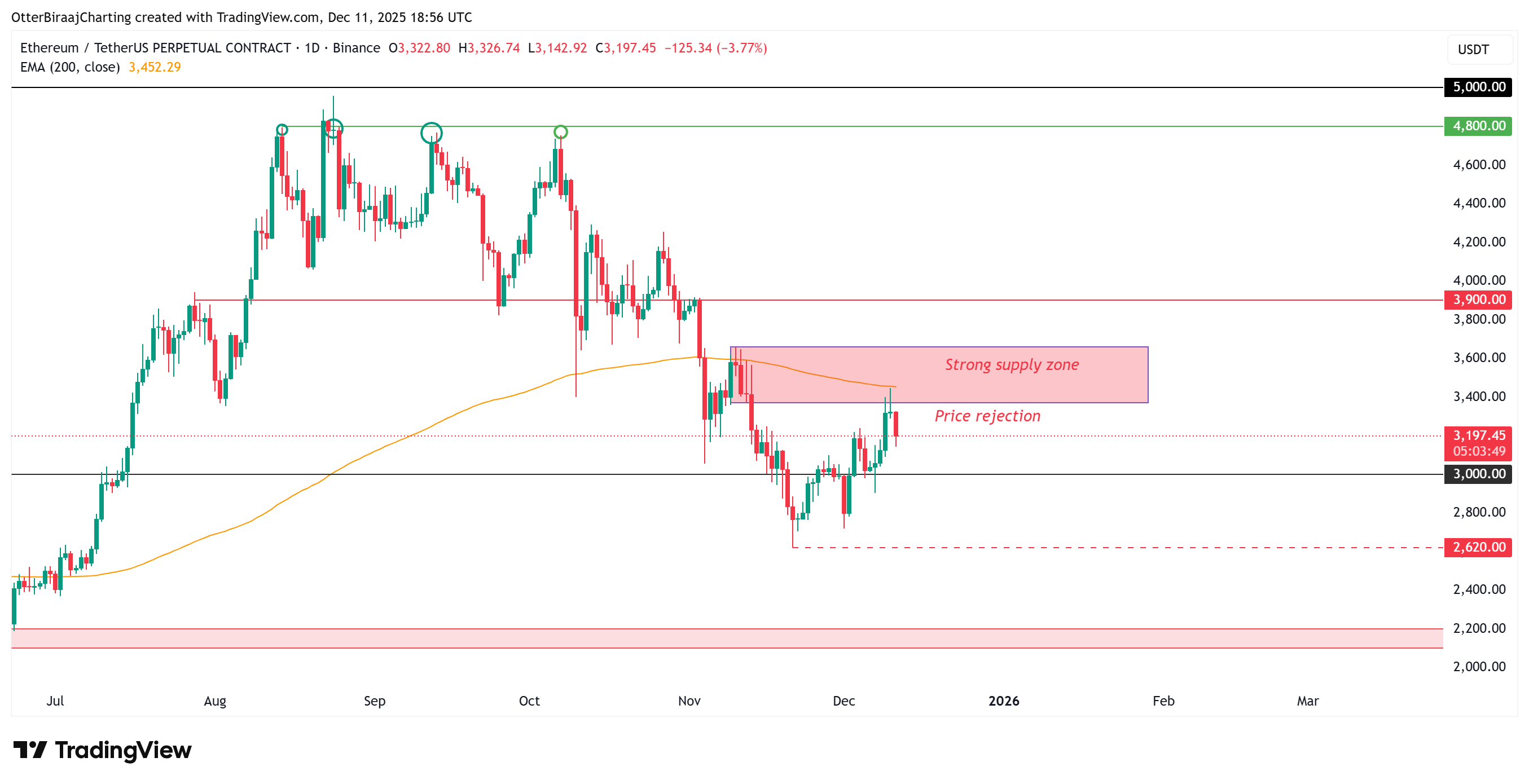
Ethereum one-day chart. Source: Cointelegraph/TradingView

ETF inflows resume, but ETH charts reflect traders’ fear

According to Glassnode, spot ETH ETFs are finally showing “the first signs of life” after several weeks of outflows. A 28% recovery since Nov. 21 in total net ETF assets hints at improving demand into year-end.

However, the rebound is still modest compared to the $32 billion peak in early October, suggesting that institutional conviction has not fully returned.
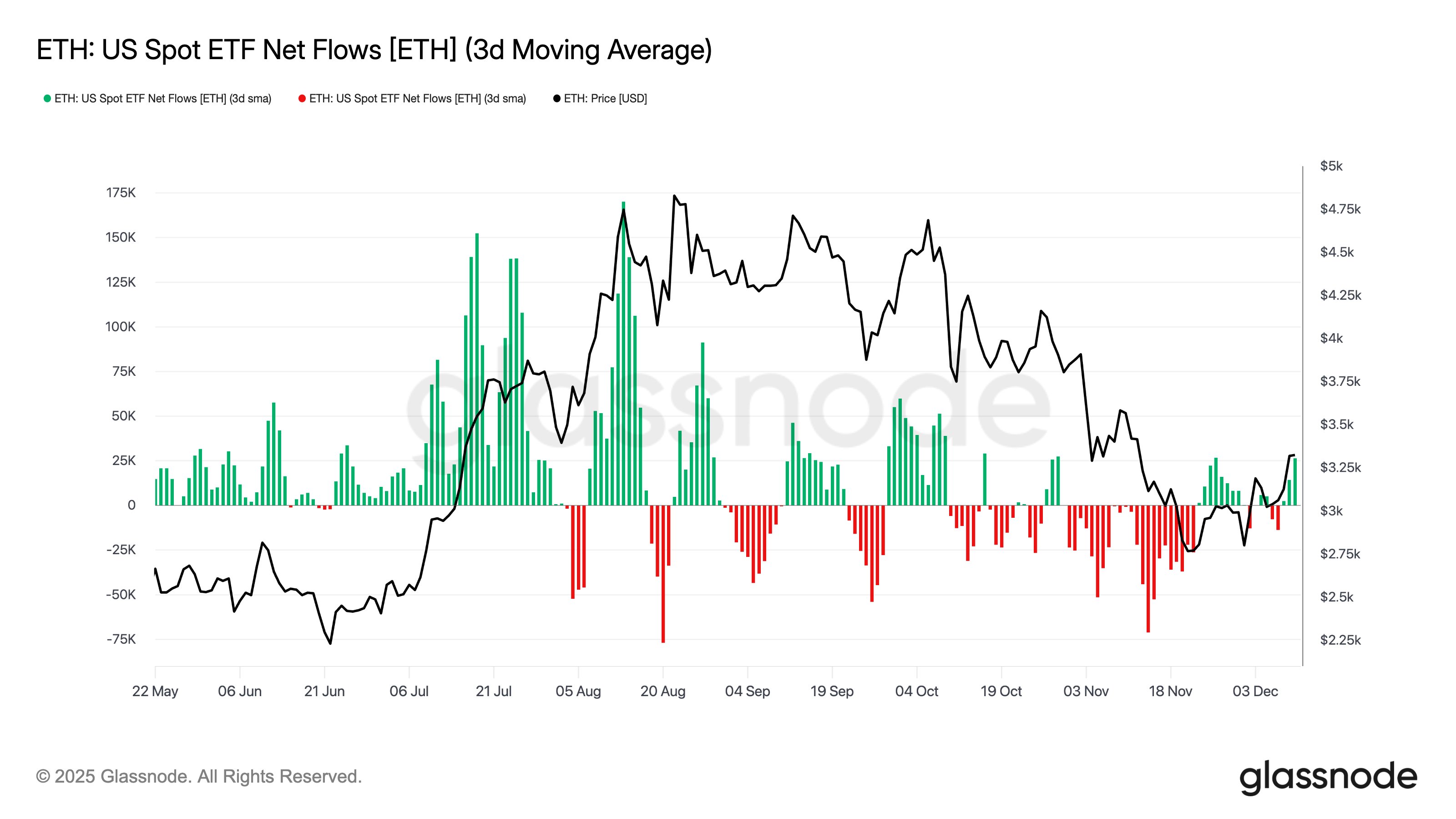
Spot ETH ETF net flows. Source: Glassnode

Data from CryptoQuant strengthened this narrative. The net taker volume remained negative at –$138 million, yet the improvement from October’s –$500 million extreme marks a structural shift. Aggressive sellers dominated the market during the September–October drawdown, but that dynamic is slowly fading.

The 30-day moving average of net taker volume also shows an ascending pattern in its lows, a structure last seen in early 2025, just before ETH launched a 3X rally and printed a new all-time high.

If the current trajectory holds, a positive flip in taker volume activity could be a high-probability trigger for another bullish breakout phase for ETH in the coming weeks.
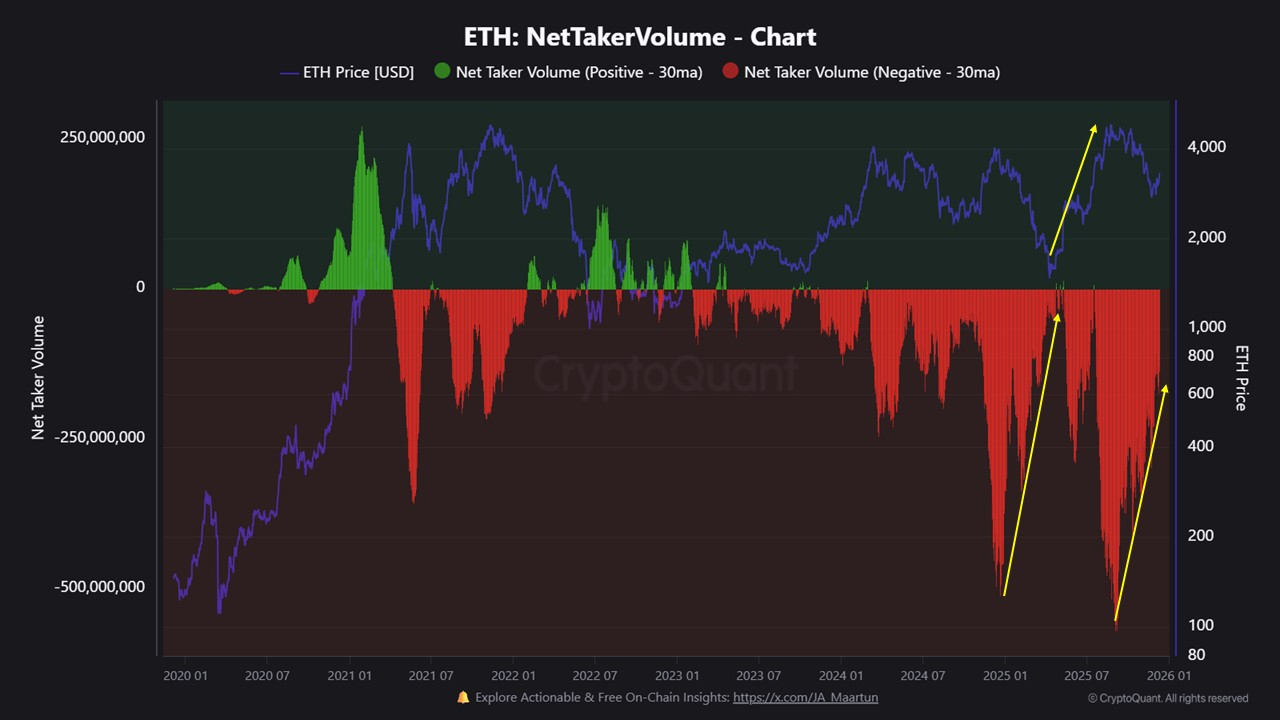
Ether Net taker volume data. Source: CryptoQuant

Related: Ether vs. Bitcoin: ETH price poised for 80% rally in 2026

ETH price compresses at support as derivatives cool off

Ether is currently testing the $3,100–$3,180 order block on the four-hour chart, a region that could serve as a demand zone. ETH price continued to respect its ascending channel, but momentum is clearly cooling. The market is now at a structural crossroads.
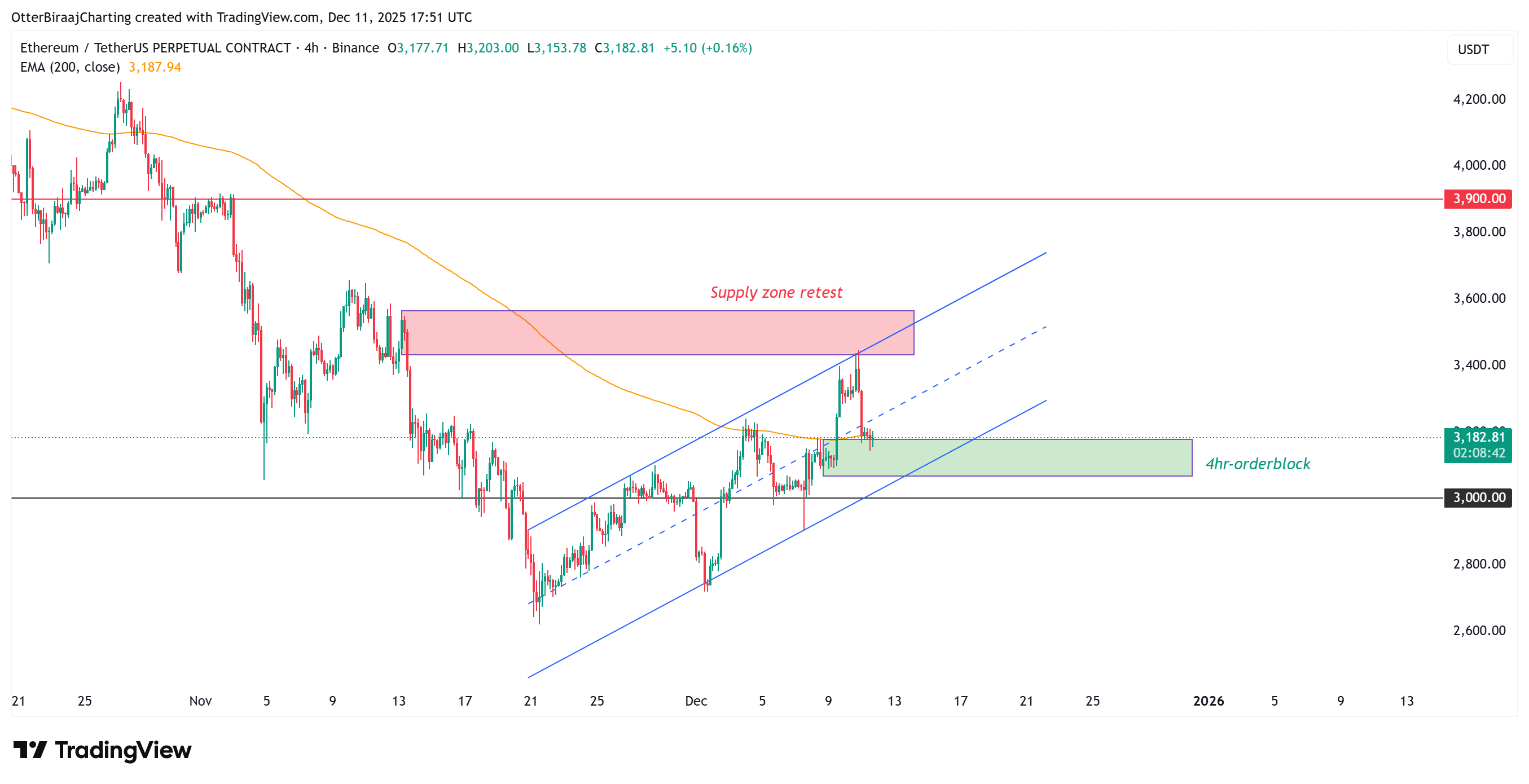
Ether four-hour chart. Source: Cointelegraph/TradingView

In a bullish scenario, holding the demand block and channel support would allow ETH to rebound toward the daily 200-EMA. A clean break above $3,450 would invalidate the rejection and reopen the path toward $3,900 resistance.

However, from a bearish standpoint, a breakdown below the ascending channel support exposes a bearish confirmation and a possible retest of $3,000, a key support level.

Data from Hyblock indicated that Ether derivatives support the neutral but fragile thesis. Aggregated open interest (OI) has unwound slightly after the rejection. The funding rate is mildly positive but not stretched, and the bid/ask ratio remains close to neutral, showing spot takers are not yet leaning aggressively bullish.
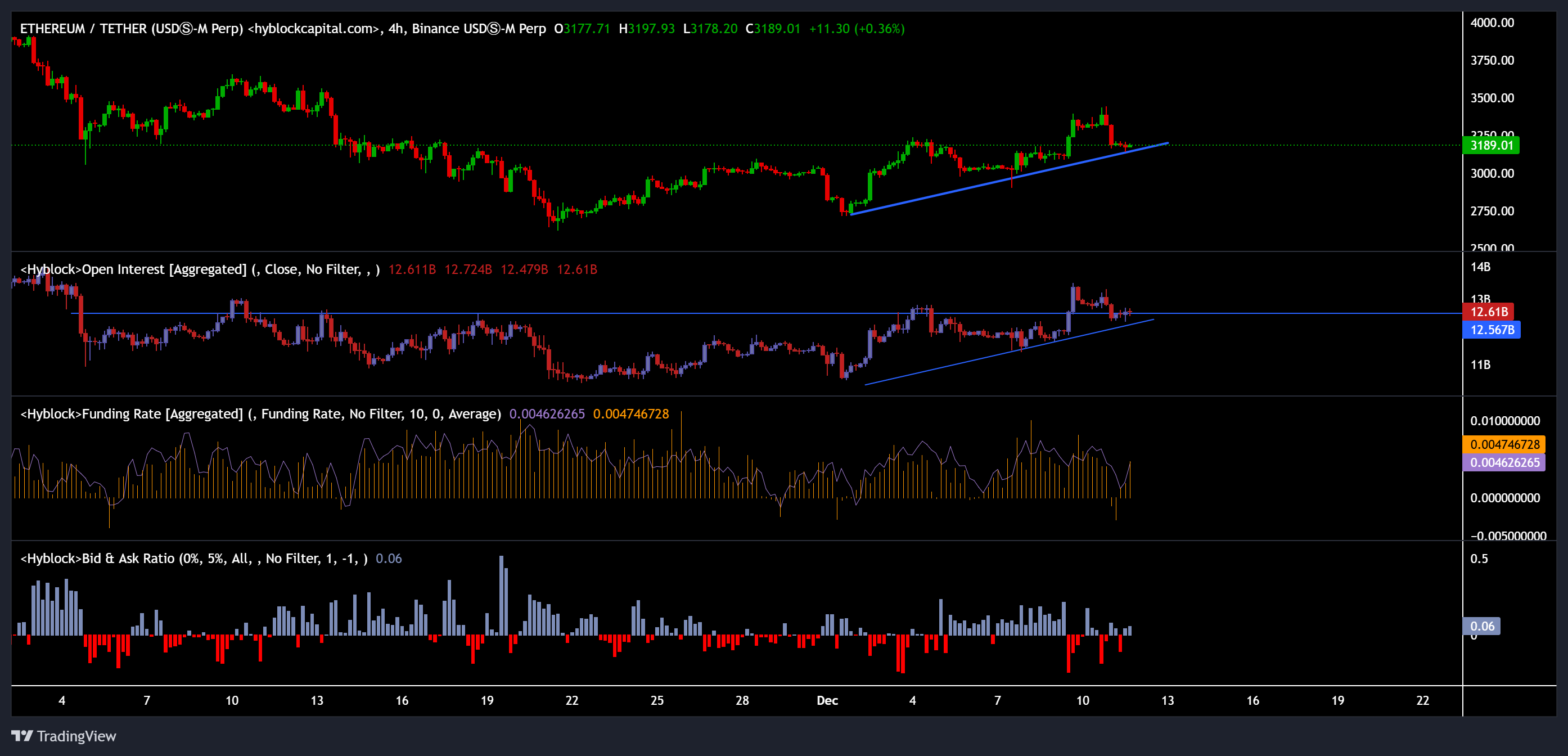
Ether futures data analysis. Source: Hyblock Capital

ETH’s next major move now depends on whether bulls can defend the demand zone long enough for improving taker flows and ETF demand to translate into sustained upside pressure.

Related: Bitcoin rallies fail at $94K despite Fed policy shift: Here’s why

This article does not contain investment advice or recommendations. Every investment and trading move involves risk, and readers should conduct their own research when making a decision. While we strive to provide accurate and timely information, Cointelegraph does not guarantee the accuracy, completeness, or reliability of any information in this article. This article may contain forward-looking statements that are subject to risks and uncertainties. Cointelegraph will not be liable for any loss or damage arising from your reliance on this information.


Related Reads

Top 10 Promising Emerging Hyperliquid Native Protocols to Watch

Title: A Review of 10 Emerging Native Protocols on Hyperliquid Hyperliquid is evolving beyond perpetual contracts into a comprehensive on-chain financial stack. This article highlights 10 key native protocols driving this growth: 1. **Monetrix**: A yield-optimizing protocol akin to Ethena, aggregating funding rates, HLP rewards, maker rebates, and HIP-3 into a single stablecoin yield. 2. **ROSETTA**: An automated stablecoin yield router, allocating USDC across top protocols (e.g., Felix, Aave, HLP) for optimal returns, factoring in gas and slippage. 3. **papertrade.xyz**: A fair-launched perpetuals protocol offering up to 1000x leverage, no funding rates, no slippage, and fully on-chain, oracle-based execution. 4. **alt.fun**: A launchpad where tokens are paired with leveraged perpetual positions (2x-5x), linking token price to trading activity and underlying position performance. 5. **Ventuals**: Pre-IPO perpetual contracts (built on HIP-3) allowing up to 10x leveraged speculation on valuations of private companies like SpaceX and Stripe. 6. **Liminal**: A delta-neutral yield protocol that captures funding rates via automated short positions and uses generated xTokens (xBTC, etc.) as DeFi collateral. 7. **Melt**: Brings tokenized stocks, commodities, and RWAs to Hyperliquid spot markets, enabling 24/7 trading alongside crypto assets. 8. **Chainsight**: An oracle and data infrastructure protocol providing low-latency (<3s) price feeds, volatility indices, and risk metrics for novel derivatives. 9. **rip.xyz**: Tokenized vault strategies on HyperEVM; its flagship rHYPURR offers liquidity and fractional exposure to a Hypurr NFT basket, priced hourly via NAV. 10. **Markets**: A perpetuals exchange (by Kinetiq) for trading stocks, forex, commodities, bonds, and crypto with up to 50x leverage, using USDH collateral and Kaiko oracles. These protocols form the foundational layer for generating real yield, liquidity, and innovative financial products natively on Hyperliquid.

marsbit46m ago

Top 10 Promising Emerging Hyperliquid Native Protocols to Watch

marsbit46m ago

Musk Posted a Recruitment Ad for SpaceX, and After Reading the Comments Section, I Understood

On May 20th, SpaceX filed for a landmark IPO with a $1.75 trillion valuation. Shortly after, Elon Musk posted a recruitment call on X, seeking "world-class engineers and physicists" for SpaceX. The application process was starkly simple: email with three bullet points proving "exceptional ability," with real, complex projects as a plus. Musk promised to review qualifying emails himself. The post garnered millions of views and thousands of replies, revealing a spectrum of responses. Most comments, including a highly-upvoted humorous one listing absurd "skills," merely listed credentials or experiences in a conventional, non-differentiating way. This highlighted a key insight: a traditional resume listing degrees and skills often fails to demonstrate true exceptionalism. Effective self-presentation requires "performance efficiency." A standout reply came from an OpenAI engineering lead, who simply stated "codex." This demonstrated that for those who have built significant, recognized products, the product itself becomes the ultimate resume. The article argues that in the AI era, any tangible, shareable output—a tool, research, or online project—serves as a living, self-evident credential more powerful than a list of attributes. However, a twist emerged when applicants found the provided email address non-functional, leading to speculation that the post might also serve as an IPO publicity stunt, projecting an image of aggressive talent acquisition to investors. Ultimately, the episode served as a microcosm: some participate through performance, others through proof of work, while some question the reality of the stage itself. It underscores the enduring challenge of defining and demonstrating value in an age of abundant, yet often superficial, content.

marsbit1h ago

Musk Posted a Recruitment Ad for SpaceX, and After Reading the Comments Section, I Understood

marsbit1h ago

Cutting Off OpenAI, Anthropic Acquires the Tool Provider Used by a Quarter of Global Developers

Anthropic has acquired Stainless, a developer tool company that automatically generated official SDKs (Software Development Kits) for AI giants including OpenAI, Anthropic, Meta, and Cloudflare. The deal, reportedly valued at around $300 million, marks a strategic shift for Anthropic as it builds its "AI agent" infrastructure. Stainless acted as a "translator," converting complex API specifications into ready-to-use code libraries for developers. Its tools indirectly reached about a quarter of professional software developers globally. Following the acquisition, Stainless will shut down its public products and its team will join Anthropic to focus on internal platform development, notably for the Claude Platform. Existing SDKs remain with their respective client companies but will no longer receive updates from Stainless. This move is part of Anthropic's broader 18-month strategy to assemble a complete "agent stack." The stack consists of the Claude model at its core, the newly acquired Stainless for standardized API interfaces, and the Model Context Protocol (MCP), an open standard for connecting agents to external tools and data. This contrasts with OpenAI's focus on model generations and consumer-scale compute. Anthropic believes an agent's ultimate utility depends on its ability to connect to external systems. By internalizing the SDK layer and promoting MCP as a connection standard, Anthropic aims to lock in long-term ecosystem advantages and create path dependency, moving beyond the transient lead provided by any single model generation.

marsbit1h ago

Cutting Off OpenAI, Anthropic Acquires the Tool Provider Used by a Quarter of Global Developers

marsbit1h ago

Trading

Spot
Futures

Hot Articles

Discussions

Welcome to the HTX Community. Here, you can stay informed about the latest platform developments and gain access to professional market insights. Users' opinions on the price of ETH (ETH) are presented below.

活动图片