The 'Trump Paradox' in the Midterm Elections: The Stronger He Is, the More Dangerous It Is for the GOP

marsbitОпубліковано о 2026-05-21Востаннє оновлено о 2026-05-21

Анотація

"The Trump Paradox: What's Good for Him Is Weighing Down His Party" This article examines the "Trump paradox": as former President Donald Trump's national approval declines, his grip on the Republican Party intensifies. However, his strategy of enforcing personal loyalty through primary challenges and endorsements risks harming the GOP's broader electoral prospects. Trump's recent victories in ousting critics like Representatives Thomas Massie and Bill Cassidy demonstrate his enduring command over the party's base. Yet, this focus on loyalty may alienate independent and moderate voters crucial for winning general elections. Furthermore, Trump's political weakness limits his ability to advance legislative priorities, creating tension with congressional Republicans. While solidifying his internal authority, Trump's influence may be pushing the party into a more difficult position for the upcoming midterms, where Democratic voters currently show higher enthusiasm. The article concludes that the GOP's greatest challenge may not be Democrats, but the narrowing electoral path shaped by Trump's dominance.

Original Title: The Trump paradox: What's good for him is weighing down his party

Original Author: the Washington Post

Translator: Peggy

Editor's Note: The political paradox surrounding Trump is becoming increasingly clear: while his approval rating among the national electorate continues to decline, his dominance within the Republican Party is growing ever stronger.

The core discussion of this article is not whether Trump can still influence the Republican Party, but rather how this influence is reshaping the party's electoral prospects. On one hand, he forces party candidates to pledge allegiance to him through endorsements, primary challenges, and political purges. On the other hand, this political vetting centered on personal loyalty may also weaken the Republican Party's competitiveness in the general election.

From Thomas Massie and Bill Cassidy, to the Indiana state senate and Texas Senate primaries, Trump's "politics of vengeance" continues to demonstrate his ability to mobilize the Republican grassroots. The problem, however, is that winning a party primary does not equate to winning a national election. For the GOP, the real risk is not that Trump cannot control the party, but that the deeper his control, the narrower the party's appeal may become among independent and moderate voters.

What is more noteworthy is that Trump's strength has not translated into effective legislative capabilities. On issues such as the gas tax, voting rights bills, immigration funding, and military action against Iran, there remains significant tension between him and congressional Republicans. This means that while Trump can force party members to declare their loyalty, he may not be able to make them bear the full political cost for his agenda.

Trump has built a party that is highly loyal to him. Even when his executive actions anger the broader public, Republicans still choose to follow him. This political structure, in turn, undermines his influence with voters beyond his base.

For the midterm elections, the biggest variable the Republican Party currently faces may not be the Democrats, but Trump himself. For Trump, victories in primaries are consolidating his authority within the party; but for the GOP, these victories may also be pushing it towards a more difficult general election to win.

The following is the original text:
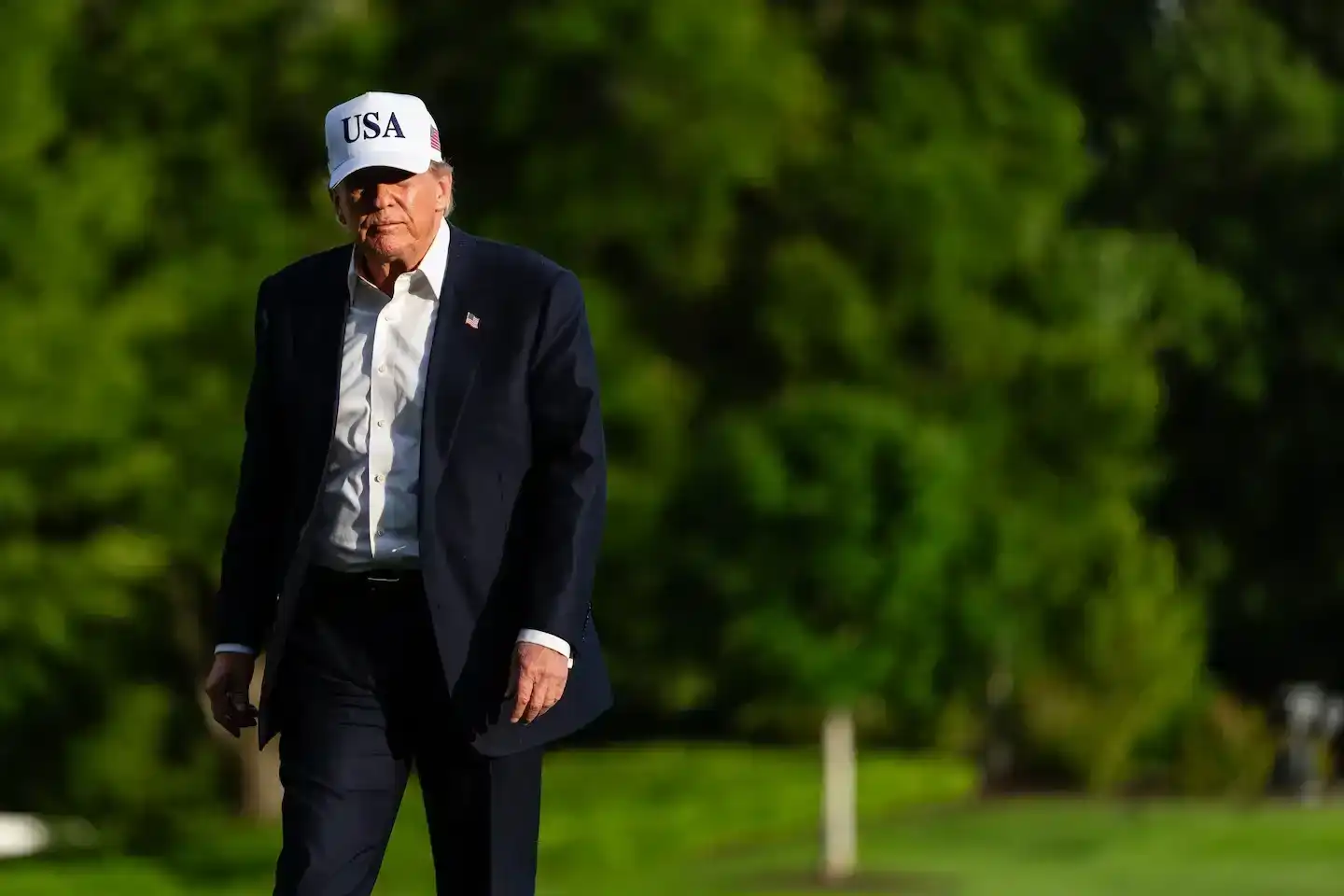
U.S. President Donald Trump walks on the South Lawn of the White House after arriving on Marine One on Friday. (Eric Lee/Pool/The Washington Post)

President Donald Trump does not believe in the so-called "laws of political gravity."

Nationally, as his standing sinks—multiple polls show his approval rating near historic lows—he is tightening his grip on the Republican Party, jeopardizing the electoral prospects this fall of the party that now obeys his will through a series of unpopular, and at times brazen, actions.

The result: a president who is historically powerful in demanding political fealty within his party, yet whose frequent executive actions continue to alienate the broader public. This paradox leaves him increasingly unwilling, and less able, to work through Congress on issues that matter most to voters. And it is a cycle that Trump appears neither willing nor able to break.

On Tuesday, Trump claimed one of his most coveted trophies: Libertarian Republican Rep. Thomas Massie (R-Ky.), an eight-term congressman who was one of Trump's most prominent GOP critics in the House and who led an effort to force the release of government files on the convicted sex offender Jeffrey Epstein, was ousted. Trump initially opposed the move, changing his stance only after he realized he could not stop it.

Massie was soundly defeated in the primary by a previously little-known political newcomer, former Navy SEAL Ed Garlean, who was personally selected by Trump and backed by tens of millions of dollars from Trump-aligned groups.

Massie's defeat came three days after Louisiana Republican Sen. Bill Cassidy also lost his race. Trump had called Cassidy "very disloyal." Five years ago, Cassidy voted to convict Trump in his second impeachment trial over the Jan. 6, 2021, attack on the U.S. Capitol. Though the senator had spent years trying—often awkwardly—to repair the relationship, he ultimately failed even to make a runoff.

Earlier this month, Trump's "revenge tour" swept through Indiana, where Republican voters heeded his call to oust five of seven state senators who had refused Trump's demands to redraw the state's congressional maps. One race remains unresolved, with the latest vote count showing just a two-vote margin between the two candidates.

On Tuesday, Trump again flexed his political muscle: In the Texas Republican Senate primary runoff, he announced his support for Texas Attorney General Ken Paxton over incumbent Sen. John Cornyn. The move frustrated many Republicans on Capitol Hill, who view Cornyn as the stronger general-election candidate; if Paxton wins, the GOP may have to spend hundreds of millions of dollars to ensure its candidate prevails in the deep-red state, money that may be needed to support candidates elsewhere.

But as often is the case, Trump made clear that the decision was personal, not tactical or policy-driven. Cornyn has occasionally criticized Trump in the past, though he has worked hard recently to curry favor, even recently introducing legislation to name one of the country's longest highways after Trump.

It did not work. In a social media post endorsing Paxton, Trump wrote, "John Cornyn is a good guy, and I have worked well with him, but he was not supportive of me during my difficult times."

"I actually think MAGA has never been more united," Trump told reporters Tuesday. But if Republicans are to maintain control of Congress in the fall election, they will need to secure a significant share of other voters. And in Trump's view, the election is tied to his own political survival.

In January, he told a gathering of Republican House members, "You've got to win the midterms, because if we don't win the midterms, then it's going to be—I mean, they'll find a reason to impeach me. I'll be impeached."

But right now, the biggest drag on Republicans' ability to maintain their narrow House and Senate majorities is Trump himself. A New York Times/Siena poll released Monday is just the latest evidence: The public is deeply unhappy with his handling of the war in Iran and the cost of living, and even on immigration, his strongest issue, Trump trails by 15 points.

Among crucial independent voters, Trump's approval rating has sunk to 26 percent. Forty-seven percent of respondents said his policies have hurt them, up from 41 percent last fall. And perhaps the most alarming poll number for Republicans: Democratic voters are more enthusiastic about voting this year, leading by 11 points on the hypothetical question of which party they would support if the election were held today.

At the same time, even Republicans have been unnerved by some of Trump's recent attention-grabbing actions. These include his $100 billion lawsuit against the IRS this year over leaked tax returns, which he settled.

The settlement will create an $1.8 billion taxpayer-funded compensation fund for those who claim they have been persecuted by a "weaponized justice system" like Trump. Beneficiaries are likely to include some of those charged in connection with the Jan. 6, 2021, attack on the U.S. Capitol, when Trump supporters tried to overturn his loss in the 2020 presidential election.

Senate Majority Leader John Thune (R-S.D.) told reporters Tuesday when asked about the fund, "I'm not a big fan."

Democrats were more blunt.

"The corruption has never been more naked, or more broad. But here is what is happening now: You write the checks, Trump and his cronies cash them. And the American taxpayer, already struggling with high prices, will pay the bill," said Sen. Patty Murray (D-Wash.) at a hearing featuring acting Attorney General Todd Branch.

Under the settlement, Trump and his sons are barred from personally receiving payments from the so-called "anti-weaponization" fund. But the IRS will also be "permanently barred and precluded" from collecting any unpaid taxes owed by Trump, his family members or his businesses that accrued before the settlement was reached.

And for all of Trump's strength on unilateral executive actions, his political weakness is also sapping his influence to get things done through the legislative branch. Much of his agenda is stalled in Congress.

Neither Thune nor House Speaker Mike Johnson (R-La.) has embraced Trump's call for a gas tax holiday. The Senate has resisted his demands to end the filibuster, which Trump wants to use to pass his high-priority Save America Act, which includes a provision requiring people to prove their citizenship when registering to vote. Trump has called the bill necessary to secure elections, but opponents argue it would lead to voter suppression.

Another recent point of frustration for Trump: The Senate parliamentarian has refused to allow hundreds of millions of dollars for security costs for his deeply unpopular White House ballroom project to be tucked into an immigration enforcement funding bill under consideration.

For Trump, beyond the "golden halo" that comes with defeating incumbent Republicans, there may also be a shadow. These members will remain in office until January, and presumably will be less afraid of him.

On Tuesday, Cassidy, who just lost his primary, mounted one act of public defiance: For the first time, he voted to advance a resolution to stop Trump from continuing to order strikes against Iran.

"In Louisiana, I've heard from many, including supporters of President Trump, who are concerned about this war," Cassidy said in a statement.

In February, Massie told The Washington Post, "I have colleagues who are just waiting for their primary to be over before they start to develop a more independent voice."

For their own political survival, they may have to.

Original link

Пов'язані питання

QWhat is the core argument of the article regarding Donald Trump's influence on the Republican Party?

AThe article argues that while Donald Trump has gained near-total dominance over the Republican Party, this influence paradoxically makes the party more vulnerable in general elections by alienating independent and moderate voters, thereby jeopardizing its electoral prospects.

QAccording to the article, how did Trump demonstrate his political strength within the GOP through primary elections?

ATrump demonstrated his strength by successfully endorsing and helping to defeat incumbent Republican critics in primaries, such as Representatives Thomas Massie and Bill Cassidy, several Indiana state senators, and by backing Texas Attorney General Ken Paxton over incumbent Senator John Cornyn.

QWhat is one key legislative area where Trump's agenda has stalled in Congress, as mentioned in the article?

AOne key area is his proposed 'Save America Act,' which includes a proof-of-citizenship requirement for voter registration. This bill has faced resistance in Congress, with opponents viewing it as voter suppression.

QWhat specific action by Trump, related to the IRS, caused concern even among some Republicans?

ATrump's settlement with the IRS, which created an $1.8 billion taxpayer-funded 'anti-weaponization' compensation fund potentially benefiting individuals charged in the January 6 Capitol attack, caused concern. Senate GOP leader John Thune stated he was 'not a fan' of the fund.

QWhat does the article suggest is the 'shadow' or potential downside for Trump after he defeats incumbent Republicans in primaries?

AThe article suggests that defeated incumbents, who will remain in office until January, may feel less beholden to Trump and could become more independent and vocal in their opposition to his agenda, as hinted by actions from Bill Cassidy and Thomas Massie.

Пов'язані матеріали

Putting Markets On-Chain: Canton Network Quietly Becomes the New Backbone of Institutional Finance

**Title: Letting the Market Itself Go On-Chain: Canton Network Quietly Becomes the New Backbone for Institutional Finance** **Summary:** The Canton Network, a blockchain platform designed for institutional finance, is gaining significant traction. A key sign of its maturity was Visa's recent entry as a super-validator, a proposal approved in just three days—highlighting prior, extensive collaboration between traditional finance and crypto. Unlike public chains like Ethereum that prioritize transparency and asset onboarding, Canton focuses on enabling confidential, compliant business operations for regulated institutions. Its core design features built-in **data visibility control**, meaning transaction details are only shared between direct counterparties. This privacy is fundamental, allowing competing institutions (like banks Goldman Sachs, JPMorgan, and BNP Paribas, all validators) to interact on the same network without exposing sensitive positions or strategies. Developed by Wall Street veterans at Digital Asset, Canton has taken a slow, deliberate approach to onboard real financial activity. It now handles over **$9 trillion monthly** in transaction volume, primarily from real-world institutional use cases like **tokenized repo agreements**, Treasury settlements, and collateral mobility. Major live applications include **JPM Coin** for institutional payments and **DTCC's tokenized U.S. Treasuries** project. Canton's native token, **CC**, is framed as a "network utility asset" with zero pre-mine or VC allocations. Its value is intended to be driven by the volume of real financial activity on the network. Looking ahead, Canton aims to become the invisible foundational layer for global finance—enabling atomic settlement (where payment and asset delivery occur simultaneously), 24/7 capital flows, and the native issuance and settlement of various asset classes, from corporate bonds to potentially equities. The main challenges are no longer technical but involve navigating fragmented global regulations and integrating with legacy financial systems.

marsbit6 хв тому

Putting Markets On-Chain: Canton Network Quietly Becomes the New Backbone of Institutional Finance

marsbit6 хв тому

It's Bankless That Needs Ethereum, Not Ethereum That Needs Bankless

Titled "Bankless Needs Ethereum, Not the Other Way Around," this article analyzes the significant recent news involving Bankless, a prominent crypto media outlet. Bankless co-founder David Hoffman announced the sale of all his ETH holdings, while the company also reportedly underwent major layoffs, with its founders parting ways. The news, likened to a high-profile defection, initially sent shockwaves through the Ethereum community, given Bankless's historical role as a key evangelist and "semi-official" narrative builder for Ethereum. For years, through its podcasts and writings, Bankless championed core Ethereum ideas like "ultrasound money" and the blockchain's role as a new financial settlement layer, acting as a crucial community hub and belief system during its growth phase. However, the article argues this development is not necessarily negative for Ethereum. It suggests Bankless's "first mission"—serving as Ethereum's passionate, inward-facing "propaganda department"—has largely been completed. As Ethereum matures and moves towards mainstream, institutional adoption, the narrative baton has shifted. Today, the value propositions of ETH are increasingly communicated to traditional finance by asset managers like BlackRock and VanEck, public companies adding ETH to their treasuries, and established financial figures. This represents a natural evolution towards a more decentralized, professional, and institutionally-focused narrative network. Therefore, while Bankless's retreat marks the end of an era, it signifies Ethereum's growing resilience and its reduced reliance on any single entity for belief, as its story is now carried forward by a broader and more mature ecosystem of advocates.

链捕手28 хв тому

It's Bankless That Needs Ethereum, Not Ethereum That Needs Bankless

链捕手28 хв тому

Google Officially Declares War

Google Declares War with AI-First I/O 2026 At its 2026 I/O developer conference, Google launched an aggressive, multi-pronged offensive, embedding AI across its ecosystem and challenging rivals on performance and price. The event showcased three major releases: Gemini 3.5 Flash, the video-centric Gemini Omni Flash, and the system-level AI assistant Spark. Gemini 3.5 Flash, despite being a smaller "Flash" model, outperforms its Pro counterpart in key benchmarks like mathematical reasoning (GSM8K) and coding (SWE-bench). Google attributes this to "extreme knowledge distillation" from a larger teacher model and a novel, highly granular MoE (Mixture of Experts) architecture with 256 experts, achieving sub-65ms response times. The native multi-modal model, Gemini Omni Flash, offers real-time video understanding with 120ms latency, enabling applications like preventing a cup from overfilling. The new Spark assistant gains deep Android system integration, allowing it to automate complex multi-app workflows based on voice commands. Complementing these, Google unveiled lightweight AI glasses featuring Micro-OLED displays and on-device Gemini chips for instant, offline translation and scene analysis. CEO Sundar Pichai announced Gemini has reached 900 million monthly active users, leveraged through integration into Chrome, Android, and Workspace. Google also slashed prices dramatically: the Gemini 3.5 Flash API is priced at a fraction of competitor rates. This price war is enabled by Google's vertically integrated TPU infrastructure. The strategy signals a shift: standalone AI models are becoming commoditized. Google's advantage lies in its "device + cloud + ecosystem + hardware" integration, aiming to reshape internet traffic from user-initiated searches to AI-driven service distribution. This move pressures pure-play AI firms like OpenAI and Anthropic on business models, and challenges Apple to respond in the next-generation, screen-less device race.

链捕手47 хв тому

Google Officially Declares War

链捕手47 хв тому

Top 10 Promising Emerging Hyperliquid Native Protocols to Watch

Title: A Review of 10 Emerging Native Protocols on Hyperliquid Hyperliquid is evolving beyond perpetual contracts into a comprehensive on-chain financial stack. This article highlights 10 key native protocols driving this growth: 1. **Monetrix**: A yield-optimizing protocol akin to Ethena, aggregating funding rates, HLP rewards, maker rebates, and HIP-3 into a single stablecoin yield. 2. **ROSETTA**: An automated stablecoin yield router, allocating USDC across top protocols (e.g., Felix, Aave, HLP) for optimal returns, factoring in gas and slippage. 3. **papertrade.xyz**: A fair-launched perpetuals protocol offering up to 1000x leverage, no funding rates, no slippage, and fully on-chain, oracle-based execution. 4. **alt.fun**: A launchpad where tokens are paired with leveraged perpetual positions (2x-5x), linking token price to trading activity and underlying position performance. 5. **Ventuals**: Pre-IPO perpetual contracts (built on HIP-3) allowing up to 10x leveraged speculation on valuations of private companies like SpaceX and Stripe. 6. **Liminal**: A delta-neutral yield protocol that captures funding rates via automated short positions and uses generated xTokens (xBTC, etc.) as DeFi collateral. 7. **Melt**: Brings tokenized stocks, commodities, and RWAs to Hyperliquid spot markets, enabling 24/7 trading alongside crypto assets. 8. **Chainsight**: An oracle and data infrastructure protocol providing low-latency (<3s) price feeds, volatility indices, and risk metrics for novel derivatives. 9. **rip.xyz**: Tokenized vault strategies on HyperEVM; its flagship rHYPURR offers liquidity and fractional exposure to a Hypurr NFT basket, priced hourly via NAV. 10. **Markets**: A perpetuals exchange (by Kinetiq) for trading stocks, forex, commodities, bonds, and crypto with up to 50x leverage, using USDH collateral and Kaiko oracles. These protocols form the foundational layer for generating real yield, liquidity, and innovative financial products natively on Hyperliquid.

marsbit1 год тому

Top 10 Promising Emerging Hyperliquid Native Protocols to Watch

marsbit1 год тому

Торгівля

Спот
Ф'ючерси
活动图片





