# Circuit Breaker Articoli collegati

Il Centro Notizie HTX fornisce gli articoli più recenti e le analisi più approfondite su "Circuit Breaker", coprendo tendenze di mercato, aggiornamenti sui progetti, sviluppi tecnologici e politiche normative nel settore crypto.

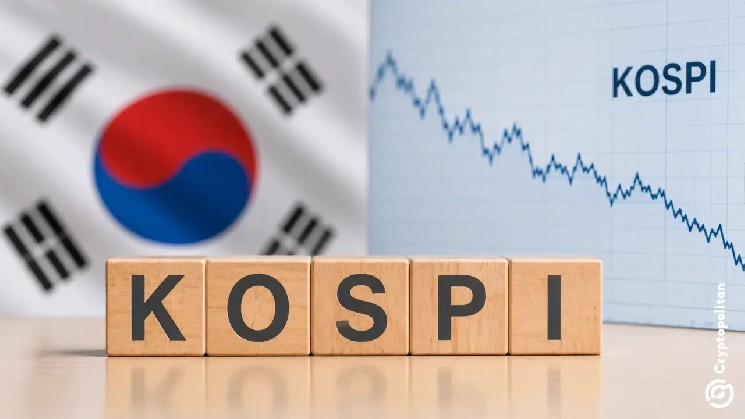
Kospi Index Drops Below 5,600 Mark Amid Record-Breaking Double Trigger of Circuit Breaker, While Bitcoin Price Surpasses $64,000

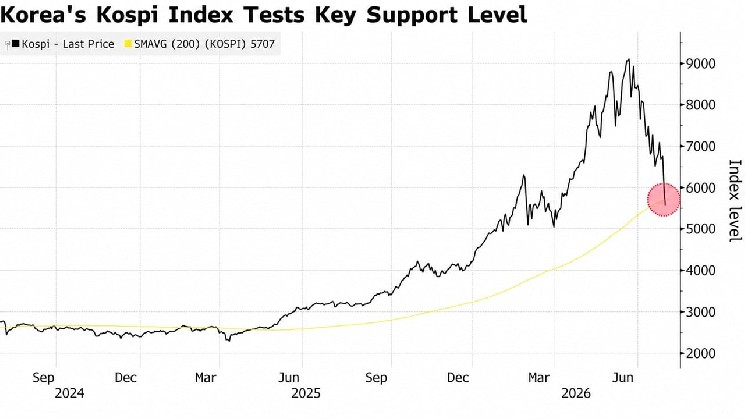
South Korea's stock market experienced unprecedented volatility as both the Kospi and Kosdaq indices triggered circuit breakers for two consecutive days. The Kospi plunged over 8% on Wednesday, falling below 5,600 points, following an over 8% drop the previous day. This historic dual halt was primarily driven by massive sell-offs in heavyweight semiconductor stocks like Samsung Electronics and SK Hynix. The selling pressure persisted despite SK Hynix reporting a 557% surge in quarterly profit, as the results failed to meet inflated market expectations fueled by AI-driven demand, highlighting a disconnect between stock valuations and fundamentals. In contrast, Bitcoin diverged from the equity market downturn. After initially dipping to around $63,000 amid the Kospi's fall and broader macroeconomic concerns, it rebounded to surpass $64,400 within 24 hours, even as South Korea's second circuit breaker was triggered. This marks a second instance in a week where Bitcoin held ground during an AI-related stock sell-off, suggesting its previously tight correlation with semiconductor and tech stocks may be weakening. Analysts note the relationship is complex and driven by shared investor bases rather than direct causality. The ongoing pressure on chip stocks, which dominate the Kospi index, raises the risk of further market halts before stability can return.

cryptonews.ru07/29 10:41

Kospi Index Drops Below 5,600 Mark Amid Record-Breaking Double Trigger of Circuit Breaker, While Bitcoin Price Surpasses $64,000

cryptonews.ru07/29 10:41

Frequent Trading Halts in the Korean Stock Market: Is a Global Financial Crisis Really Coming?

**Title: Frequent Circuit Breakers in South Korean Stock Market: Is a Global Financial Crisis Imminent?** This article examines the recent spate of trading halts in South Korea's stock market as a potential early warning sign for broader global financial instability. The author argues that due to its highly open and liquid capital markets with significant foreign ownership, South Korea often acts as the world's "spare cash pool." International institutions tend to sell their highly liquid Korean holdings first during global liquidity crunches to raise capital for domestic needs, irrespective of Korea's own economic fundamentals. Historically, Korean market stress preceded major crises like the 1997 Asian Financial Crisis, the 2000 Dot-com crash, the 2008 Global Financial Crisis, and the 2020 pandemic crash. The current trigger involves a semiconductor bubble and high domestic leverage, but the core issue is global capital withdrawal signaling tightening liquidity. Whether this evolves into a full-blown crisis hinges on the US Federal Reserve. If the Fed can and will intervene with supportive policies (like rate cuts), a crisis might be averted as in 2020. If not, contagion could spread. For individual investors, the key takeaway is not predicting the crisis but preparing for volatility. Recommendations include: avoiding high leverage, maintaining a significant cash reserve (e.g., 40%) for buying opportunities during market declines, and holding core long-term positions (e.g., 60% in indices like S&P 500 and Nasdaq 100). The author advocates for consistent investment through strategies like dollar-cost averaging, emphasizing that staying invested over decades has historically yielded positive returns despite high valuations or periodic crashes. The conclusion is to stay in the market, manage risk, and have dry powder ready instead of attempting to time the market perfectly.

marsbit07/29 10:21

Frequent Trading Halts in the Korean Stock Market: Is a Global Financial Crisis Really Coming?

marsbit07/29 10:21

How to Regulate Single-Stock Leveraged ETFs? On Thursday, the Entire Market Is Watching This Korean Government Meeting

The highest-level economic coordination body in South Korea, the "F4" comprising the Ministry of Economy and Finance, the Financial Services Commission, the Bank of Korea, and the Financial Supervisory Service, will hold an emergency meeting on Thursday to discuss regulatory measures for single-stock leveraged ETFs. These products, launched just six weeks ago, have been widely blamed for exacerbating market volatility. The KOSPI's 8% plunge on Monday triggered the year's seventh trading halt, intensifying scrutiny. Regulators have expressed rare public regret over approving the products. FSS Governor Lee Bok-hyun stated he "regretted not doing everything possible to prevent" their introduction and acknowledged structural problems, citing massive retail investments and legal complications from a rushed rollout. Possible countermeasures under discussion include raising margin requirements, imposing daily price limits, and adjusting leverage caps. However, officials admit these may be temporary fixes. Data confirms the amplified volatility. Since the ETFs' launch, days with KOSPI moves exceeding 3% have nearly doubled. Trading halts have reached record levels, surpassing the 2008 financial crisis peak. The products allow 2x leveraged bets on giants like Samsung Electronics and SK Hynix. Their daily rebalancing to match returns is seen as mechanically fueling market swings. The outcome of Thursday's F4 meeting is highly anticipated, with expectations leaning towards stricter controls on leverage, investor access, or other structural constraints to curb the products' market impact.

marsbit07/14 04:02

How to Regulate Single-Stock Leveraged ETFs? On Thursday, the Entire Market Is Watching This Korean Government Meeting

marsbit07/14 04:02

Black Tuesday in Japanese and Korean Stock Markets: South Korea Triggers Circuit Breaker, Nikkei Plummets, AI Boom Undergoes Phased Adjustment

"Black Tuesday" for Asian Markets: Korean Stocks Halted by Circuit Breaker, Nikkei Plunges as AI Rally Undergoes Correction Asian stock markets experienced severe turbulence on Tuesday, with South Korea's benchmark KOSPI index plummeting nearly 10% after triggering a market-wide trading halt when its losses exceeded 8%. Japan's Nikkei 225 index also fell sharply by approximately 3.5%, ending an eight-day winning streak. The sell-off was heavily concentrated in the technology and semiconductor sectors, with giants like Samsung Electronics and SK Hynix leading the declines. The plunge reflected a rapid reversal from recent highs, with the KOSPI having retreated over 12% from its mid-June peak. Analysts attribute the sharp correction to multiple converging factors. The direct trigger was weakness in U.S. tech stocks, which fueled profit-taking in overbought Asian markets. Furthermore, stronger-than-expected U.S. jobs data has reinforced expectations that the Federal Reserve will maintain or even raise interest rates, putting pressure on rate-sensitive growth stocks. Structural vulnerabilities also played a role, particularly in South Korea, where the market is highly concentrated in a few semiconductor heavyweights, making it susceptible to shifts in global AI demand and foreign capital outflows. Despite the short-term volatility, the long-term narrative for AI and semiconductors remains intact. Industry forecasts still point to massive growth in global AI capital expenditure over the coming years. South Korean firms like SK Hynix maintain a dominant position in critical segments like High Bandwidth Memory (HBM), with long-term orders secured well into 2027. While near-term fluctuations are expected to continue, driven by U.S. monetary policy signals and upcoming corporate earnings, the current correction may present a buying opportunity for quality assets tied to the enduring AI infrastructure build-out.

marsbit06/23 09:57

Black Tuesday in Japanese and Korean Stock Markets: South Korea Triggers Circuit Breaker, Nikkei Plummets, AI Boom Undergoes Phased Adjustment

marsbit06/23 09:57

'Black Tuesday' for Japanese and Korean Stock Markets: Korean Market Triggers Circuit Breaker, Nikkei Plunges, AI Frenzy Undergoes a Phased Adjustment

"Black Tuesday" for Japanese and South Korean Stock Markets: KOSPI Triggers Circuit Breaker, Nikkei Plunges as AI Rally Undergoes Correction Asian stock markets experienced severe volatility. South Korea's KOSPI index plunged over 8% intraday, triggering a 20-minute market-wide trading halt, and closed nearly 10% lower, marking its third-largest single-day drop this year. Japan's Nikkei 225 fell approximately 3.5%, ending an eight-session winning streak. The tech and semiconductor sectors led the decline, with heavyweights like Samsung Electronics and SK Hynix suffering double-digit losses, fueled by foreign investor selling and panic. The sell-off stemmed from multiple factors. A weak prior session for U.S. tech stocks, especially the "Magnificent Seven," raised concerns about AI's profitability timeline. Intense profit-taking followed massive year-to-date gains (KOSPI up over 80%, Nikkei hitting record highs). Hawkish signals from the Fed, suggesting potential rate hikes due to strong U.S. data, pressured rate-sensitive growth stocks. Structural vulnerabilities, like the high concentration of semiconductor giants in the KOSPI, amplified the drop, with foreign capital outflows exacerbating the move. Short-term volatility is expected to persist, contingent on U.S. market stability and Fed policy. However, the long-term AI narrative remains robust. Forecasts predict trillions in global AI capital expenditure through 2031. South Korea's leading position in critical areas like HBM memory, with major players' order books filled into 2027, provides fundamental support. This correction may represent a shift from speculative frenzy to a focus on tangible AI infrastructure, offering a potential entry point for long-term investors.

Odaily星球日报06/23 09:56
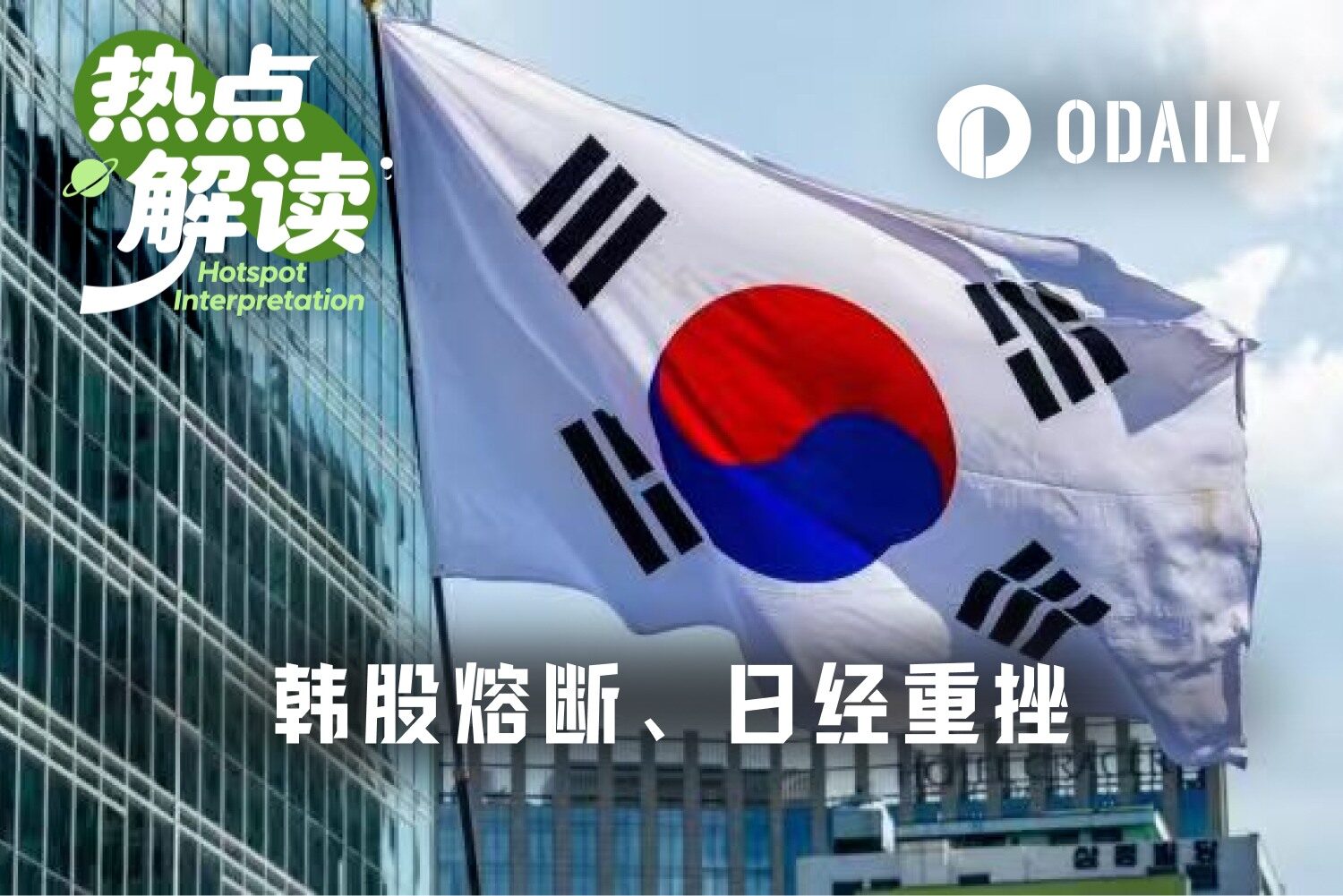
'Black Tuesday' for Japanese and Korean Stock Markets: Korean Market Triggers Circuit Breaker, Nikkei Plunges, AI Frenzy Undergoes a Phased Adjustment

Odaily星球日报06/23 09:56

South Korea's KOSPI Plunges 8.37% at Opening, Triggers Circuit Breaker: The 'Two Stocks' That Powered the Bull Market Recoil in a Single Day

On June 8th, South Korea's KOSPI index plunged 8.37% within minutes of market open, triggering a circuit breaker and halting trading. The crash was driven by a massive sell-off in heavyweight stocks Samsung Electronics and SK Hynix, which each fell 10%. These two chip giants alone account for over half of the KOSPI's total market capitalization and had contributed roughly 70% of the index's gains year-to-date, pushing it to become the world's sixth-largest stock market. The sell-off was ignited by negative guidance from U.S. chipmaker Broadcom on June 3rd, which sparked a global semiconductor stock rout. This shockwave hit South Korean markets on June 5th, with foreign investors leading a sustained exodus. The sharp decline on June 8th was exacerbated by high levels of retail margin debt (over 38 trillion KRW), forced liquidations, leveraged ETFs tied to the top stocks, and automated program trading, creating a vicious cycle. The Korean won also weakened significantly, further fueling foreign capital outflow. South Korean authorities issued emergency statements to calm markets, echoing recent warnings from the central bank governor about the risks of debt-driven investing. While some institutions like Goldman Sachs maintain long-term bullish targets for the KOSPI, the crash exposed the extreme market concentration and fragility behind its historic rally.

marsbit06/08 07:43

South Korea's KOSPI Plunges 8.37% at Opening, Triggers Circuit Breaker: The 'Two Stocks' That Powered the Bull Market Recoil in a Single Day

marsbit06/08 07:43

From 6000 Points to Two Circuit Breakers: A Missile Exposes South Korea's Stock Market Weakness

The South Korean Stock Exchange (KOSPI) experienced two consecutive trading halts (circuit breakers) on March 3 and 4, 2026, plunging nearly 13% from a recent high of 6,244 points. This sharp decline, triggered by escalating U.S.-Iran tensions and the closure of the Strait of Hormuz, exposed the extreme vulnerability of South Korea's stock market, which is heavily reliant on semiconductor stocks, particularly Samsung Electronics and SK Hynix. These two companies, dominating the global HBM (high-bandwidth memory) market crucial for AI and GPUs, had driven KOSPI's 75.6% surge in 2025. However, the market's concentration on chip exports, which account for over a third of total exports, became its Achilles' heel. The closure of the Strait of Hormuz—a vital shipping route for liquefied natural gas (LNG), which fuels nearly a third of Korea's power generation—threatened energy supplies and semiconductor manufacturing costs. While defense stocks surged on geopolitical tensions, foreign investors sold a record $8.5 billion in Korean shares over two days, highlighting the market's liquidity and its status as a prime target for rapid capital flight during global panic. Retail investors attempted to buy the dip, but were overwhelmed by the sell-off. The crash underscored deeper structural risks beyond corporate governance reforms: South Korea's market is exceptionally exposed to a single industry dependent on imported energy and vulnerable to global shocks. The incident demonstrated that while fundamentals may drive long-term growth, sentiment and geopolitics can erase gains rapidly.

比推03/04 13:31

From 6000 Points to Two Circuit Breakers: A Missile Exposes South Korea's Stock Market Weakness

比推03/04 13:31

活动图片