Kospi Index Drops Below 5,600 Mark Amid Record-Breaking Double Trigger of Circuit Breaker, While Bitcoin Price Surpasses $64,000

cryptonews.ruPubblicato 2026-07-29Pubblicato ultima volta 2026-07-29

Introduzione

South Korea's stock market experienced unprecedented volatility as both the Kospi and Kosdaq indices triggered circuit breakers for two consecutive days. The Kospi plunged over 8% on Wednesday, falling below 5,600 points, following an over 8% drop the previous day. This historic dual halt was primarily driven by massive sell-offs in heavyweight semiconductor stocks like Samsung Electronics and SK Hynix. The selling pressure persisted despite SK Hynix reporting a 557% surge in quarterly profit, as the results failed to meet inflated market expectations fueled by AI-driven demand, highlighting a disconnect between stock valuations and fundamentals. In contrast, Bitcoin diverged from the equity market downturn. After initially dipping to around $63,000 amid the Kospi's fall and broader macroeconomic concerns, it rebounded to surpass $64,400 within 24 hours, even as South Korea's second circuit breaker was triggered. This marks a second instance in a week where Bitcoin held ground during an AI-related stock sell-off, suggesting its previously tight correlation with semiconductor and tech stocks may be weakening. Analysts note the relationship is complex and driven by shared investor bases rather than direct causality. The ongoing pressure on chip stocks, which dominate the Kospi index, raises the risk of further market halts before stability can return.

The Korea Exchange halted trading on both the Kospi and the smaller Kosdaq indices for 20 minutes — a mechanism that automatically freezes the entire market for a fixed period once an index falls by a set percentage in a single trading session. The first to trigger the trading halt was the Kosdaq: at 12:19 local time, the index fell by 56.85 points, or 8.05%, to 649.00. Thirteen minutes later, the Kospi followed, dropping 491.33 points, or 8.15%, from Tuesday's closing level (6,023.66), reaching 5,532.33 at 12:32.

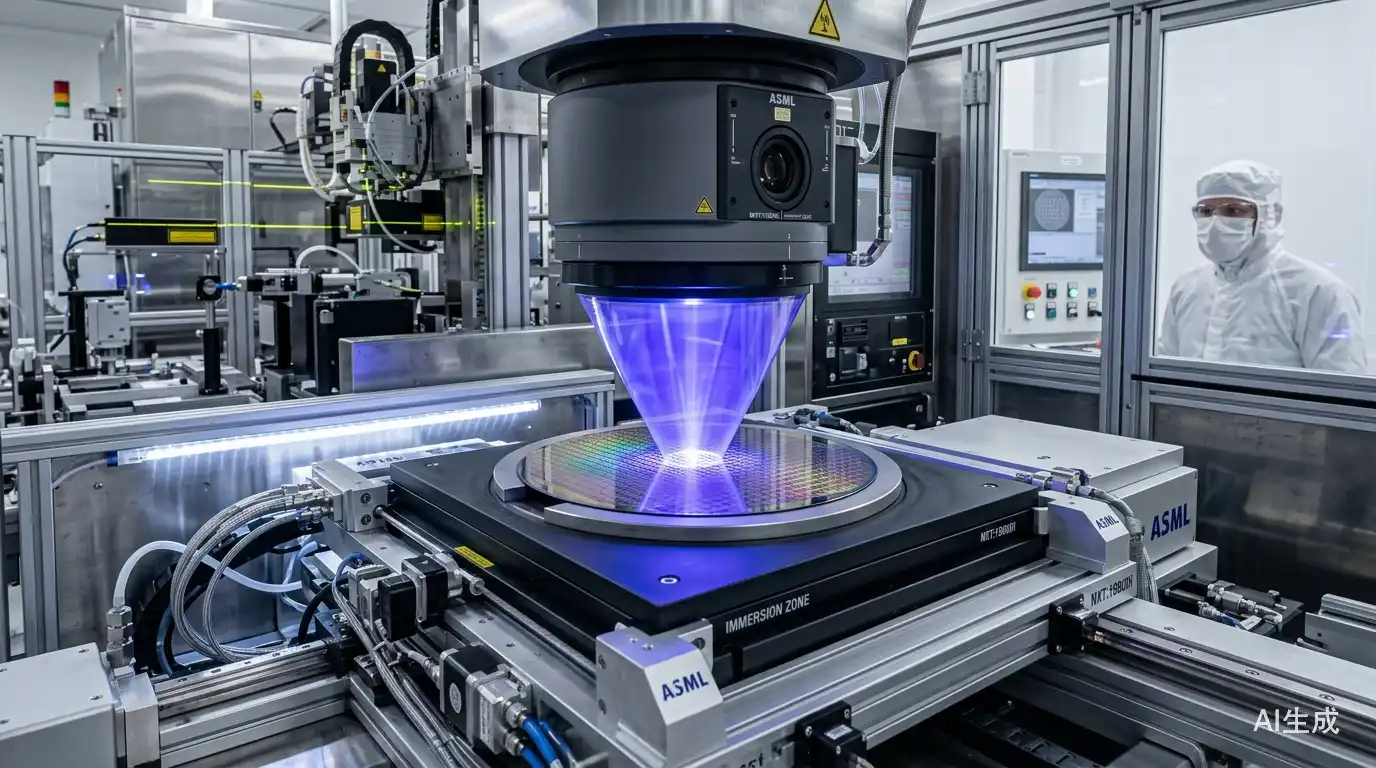
This marked the first time in the history of the Korean market that an index triggered the circuit breaker mechanism for two consecutive trading days. This collapse followed the eighth circuit breaker activation of the year on Tuesday, when the Kospi plummeted 8.02% intraday and closed down 10.8% after news broke that a Chinese company had begun mass production of its own deep ultraviolet (DUV) lithography equipment, threatening the dominant position of Samsung Electronics and SK Hynix in the memory chip export market.

Local media attributed Wednesday's continued sell-off to the persistent weakness in shares of major semiconductor manufacturers, active selling by foreign investors, and ongoing concerns about supply and demand pressure from leveraged single-stock exchange-traded funds (ETFs), whose volumes surged sharply earlier this year.

Earnings Beat That Wasn't Enough

The sell-off intensified even as SK Hynix reported record profits. The chipmaker's shares plunged sharply on Wednesday despite a 557% surge in quarterly profit — a result that still failed to meet the elevated expectations investors on Wall Street and in Seoul had built for the stock after months of AI-driven demand for memory chips.
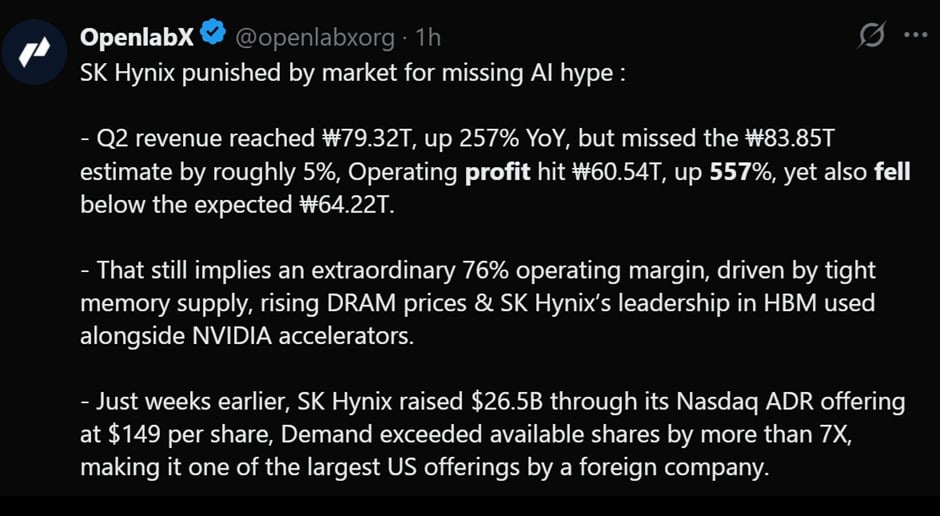
This mismatch once again highlighted how far ahead of fundamentals valuations for semiconductor stocks across Asia have run, leaving little room for the market to be satisfied unless results are simply spectacular.

Bitcoin Bucks the Trend

On Tuesday, bitcoin closely tracked the sell-off in the Korean market, falling roughly 2.7% to around $63,000, as the initial Kospi drop coincided with rising odds of a Federal Reserve rate hike and the delayed passage of the CLARITY Act, contributing to a wave of cryptocurrency liquidations. Subsequently, over the past 24 hours, the asset has climbed above $64,400, even as South Korea triggered its second consecutive 'circuit breaker'.
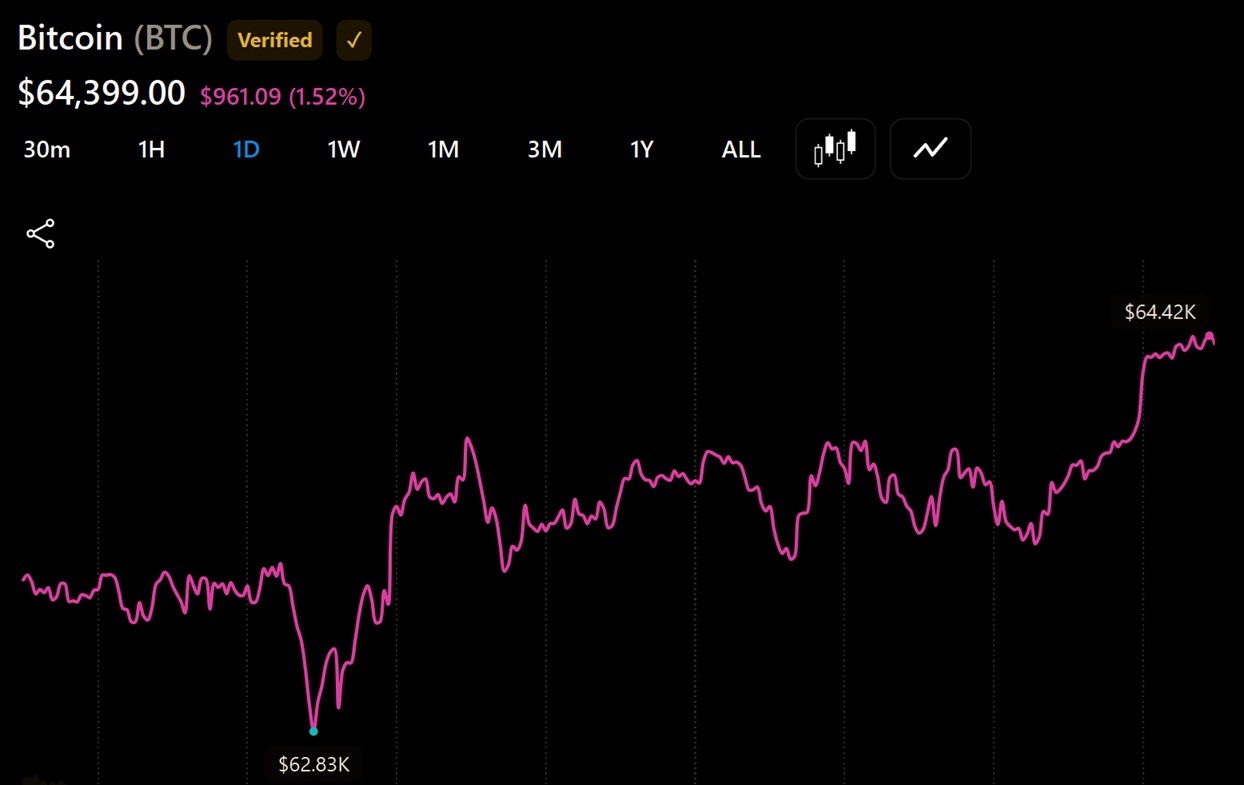
Meanwhile, Senate Majority Leader John Thune made it clear that the CLARITY Act bill would not pass the chamber before the August recess, after which the price recovered along with the broader crypto market.

Wednesday marked the second time in a week that the cryptocurrency held its ground amid a sharp sell-off in AI-related stocks — a trend suggesting the tight correlation bitcoin had with semiconductor and AI company stocks may be weakening. Analysts typically describe the link between KOSPI swings and bitcoin's movements as a correlation driven by a common investor base rather than a causal one — and the divergence seen on Wednesday complicates that picture without providing a complete answer.

Samsung Electronics and SK Hynix remain the two stocks with the highest weighting in the index, meaning another leg down in chipmaker shares could easily trigger another circuit breaker before Korean markets get a chance to stabilize.

end-content

Domande pertinenti

QWhat triggered the consecutive trading halts in the Korean stock market, and which indexes were involved?

AThe Korean stock exchange triggered a circuit breaker mechanism for the second consecutive day, halting trading for 20 minutes on both the Kospi and Kosdaq indexes. This occurs when an index falls by a set percentage in a single session. First, the Kosdaq fell 8.05% at 12:19 local time. Thirteen minutes later, the Kospi fell 8.15% from Tuesday's close.

QWhat was the main reason cited for the initial sharp sell-off in the Kospi index on Tuesday?

AThe initial sharp sell-off on Tuesday, where Kospi fell 8.02% intraday, was triggered by news that a Chinese company had begun mass production of its own deep ultraviolet (DUV) lithography equipment, threatening the dominant market position of Samsung Electronics and SK Hynix in memory chip exports.

QWhy did SK Hynix's stock price fall sharply despite reporting a 557% quarterly profit increase?

ASK Hynix's stock price fell sharply because the record 557% quarterly profit increase still failed to meet the exceedingly high expectations investors from Wall Street and Seoul had built up after months of AI-driven demand for memory chips.

QHow did Bitcoin's price action differ from the Korean stock market's performance on Wednesday?

AWhile the Korean stock market experienced a second consecutive day of severe sell-offs triggering circuit breakers, Bitcoin's price recovered, rising above $64,400 in the last 24 hours. This divergence suggests its tight correlation with semiconductor and AI-related stocks may be weakening.

QWhat factor contributed to Bitcoin's recovery mentioned in the article, separate from the Korean market events?

ABitcoin's recovery was partly attributed to comments from Senate Majority Leader John Thune, who indicated the CLARITY Act bill would not pass the House before the August recess. This eased regulatory concerns and supported a broader cryptocurrency market recovery.

Letture associate

A Brief History of the Lithography Machine: How a Beam of Light Walked Sixty-Nine Years

A Brief History of Lithography: 69 Years of Light In July 2026, reports of a Chinese state-backed company producing five immersion DUV lithography machines sent shockwaves through Wall Street, wiping roughly $44 billion from ASML's market cap in a single day. This event signaled a crack in the long-held assumption of Western monopoly over advanced chipmaking equipment. The journey began in 1957 when Jay Lathrop coined the term "photolithography." Early contact aligners (1960s) gave way to PerkinElmer's revolutionary projection aligners in 1973, boosting yields dramatically. GCA's step-and-repeat system (1978) established the modern stepper blueprint. However, within a decade, Japanese firms like Nikon and Canon, supported by a strong domestic market, captured nearly 90% of the global market from American pioneers, who ultimately exited the business. ASML, founded in a leaky shed in 1984, rose to dominance through key strategic moves: the TWINSCAN dual-stage platform (2001) and the acquisition of SVG, gaining access to Intel. A pivotal moment came in the early 2000s with the industry at a 193nm wavelength impasse. While most invested in the costly 157nm path, TSMC's Burn Lin proposed immersion lithography—using water between the lens and wafer. ASML bet on this simpler idea and, with Zeiss, delivered the first commercial immersion tool in 2004, effectively ending the 157nm roadmap and leaving competitors behind. The subsequent push for Extreme Ultraviolet (EUV) lithography was an even greater marathon. Deemed the least promising option in 1997, EUV's development, led by ASML, required vacuum chambers, reflective optics, and a complex tin-droplet laser plasma source. Critical to its eventual success (first high-volume manufacturing in 2018) was the 2012 "Customer Co-Investment Program," where Intel, TSMC, and Samsung provided upfront funding and equity, sharing the immense risk and cost. Today, ASML holds a near-total monopoly in EUV and immersion DUV. The core lesson of this 69-year history is not merely one of technological invention but of sustained partnership. Successive leaders—PerkinElmer, GCA, Nikon—were not ultimately defeated by superior technology but by losing the vital connection to customers willing to tolerate years of iteration, fund long-term R&D, and integrate early, imperfect tools into their production lines. The "light" that completed the journey was always carried by those patient, invested partners.

marsbit36 min fa

A Brief History of the Lithography Machine: How a Beam of Light Walked Sixty-Nine Years

marsbit36 min fa

CryptoQuant Analyst Claims 'Frightening Scenario and Simultaneously Promising Signal for Bitcoin' Reveals Ultimate Bottom Point! Here Are the Details

Bitcoin, the leading cryptocurrency, entered a bear market after hitting a historic high of $126,000 in October 2025 and has since fallen over 50%. As BTC recently dropped to around $57,000, opinions diverge on whether the bottom has been reached, with some expecting a drop closer to $50,000. According to a pseudonymous CryptoQuant analyst, the Bitcoin bear market may be nearing its end. The analyst notes that as selling pressure following the all-time high weakens, price corrections are becoming shorter and recovery periods more substantial. The July decline was only slightly below lows seen in early February, and BTC has remained relatively stable around $60,000 since, indicating diminished seller influence. Positive technical signals are also cited, with MACD and RSI showing bullish signals, positive divergences, and oversold conditions, collectively suggesting a potential bottom formation for BTC. However, the analyst does not rule out a final sell-off in the short term. They suggest the ultimate market bottom could be around $51,336, corresponding to the 61.8% Fibonacci retracement level. The $50,000 area is highlighted as a crucial historical support zone, aligning with the average investor cost basis and the 200-week moving average—conditions similar to bottoms in previous bear markets. *This is not investment advice.

cryptonews.ru1 h fa

CryptoQuant Analyst Claims 'Frightening Scenario and Simultaneously Promising Signal for Bitcoin' Reveals Ultimate Bottom Point! Here Are the Details

cryptonews.ru1 h fa

Trading

Spot
活动图片