KOSPI Index Halts Trading Due to Eighth Price Limit Up Circuit Breaker Trigger of 2026

cryptonews.ruPubblicato 2026-07-28Pubblicato ultima volta 2026-07-28

Introduzione

The South Korean KOSPI index has triggered a market-wide trading halt for the eighth time in 2026, falling another 8% and losing over 28% in the past month. This latest plunge is driven by a severe sell-off in semiconductor and AI-related stocks. Key contributors include a sharp decline in shares of SK Hynix (down 50% from its June high) and heavyweights like Samsung, which comprises 50% of the index. The drop followed a sector-wide weakness triggered by the IPO of Changxin Memory Technology and falling US chip stocks like Nvidia (-4.4%). Analysts point to massive AI financing deals (like Nvidia's $250B support for OpenAI) raising debt cost concerns and questioning AI scalability viability. The article notes Bitcoin's correlation with AI stocks has weakened, but KOSPI's volatility could redirect some liquidity to crypto markets. Blockchain-based exchanges are exploring KOSPI-linked perpetual futures to allow speculation on further declines or a short squeeze, as traditional altcoin trading in South Korea diminishes amid the index's dramatic swings.

The South Korean KOSPI index experienced its eighth volatility limit halt in 2026, losing an additional 8%. The index is being closely watched for signals to analyze the situation in the artificial intelligence and semiconductor sectors.

The South Korean KOSPI index hit a critical mark for the eighth time this year. The index plunged alongside other markets. The KOSPI's slump this year continued, coinciding with overall market weakness.

The KOSPI index lost 520 billion Korean won, or approximately 360 billion US dollars. Furthermore, some South Korean stocks were used as collateral, which could lead to further potential losses as leverage is unwound. During the market crash on July 9th, some considered this drop the last for KOSPI, but the index continued to decline, falling over 20% in recent weeks.
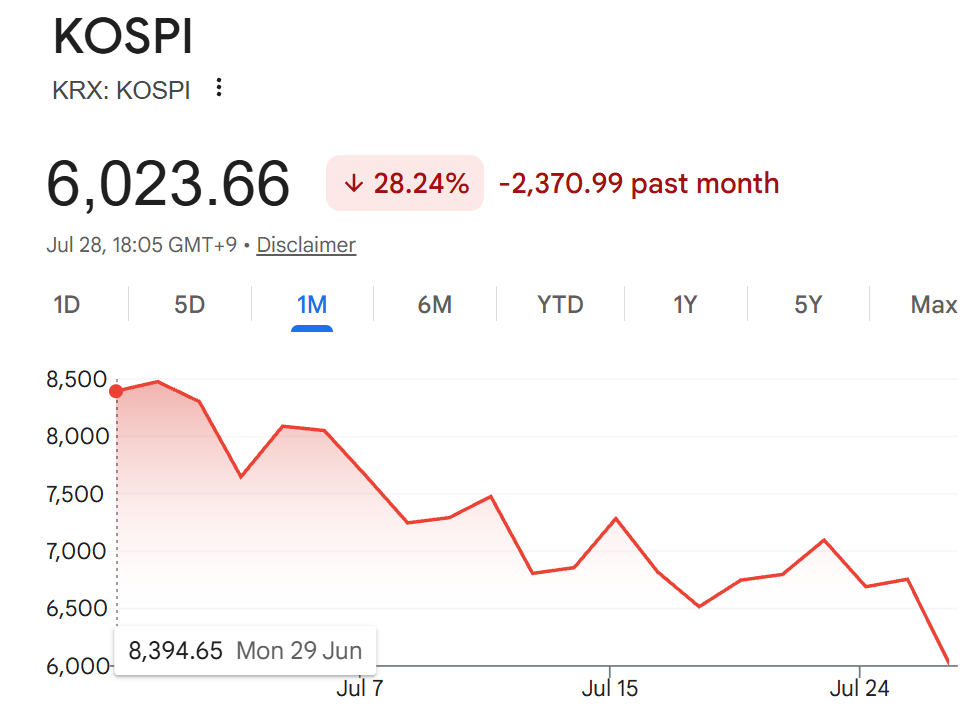
The KOSPI index lost more than 28% of its value over the past month, triggering another automatic trading halt mechanism. | Source: Google Finance

In addition, the SK Hynix index fell 50% from its June high due to weakness in the memory maker stock sector. Shares of many memory makers fell following the IPO of Changxin Memory Technology (CMXT) on Monday.

The South Korean market reacted to the reduction in shares of American chipmakers and a 4.4% drop in Nvidia (Nasdaq: NVDA) stock. Shares of Micron (Nasdaq: MU) and SanDisk (Nasdaq: SNDK) were also among the biggest decliners, falling 5% and 10% respectively.

Asian markets followed, with the Nikkei index falling 4%. At the same time, $BTC also broke out of its new price range and fell to $63,000.

Why Did the KOSPI Index Fall?

In 2026, the KOSPI index has exhibited extreme volatility, driven by both retail trading and the influence of semiconductor company stocks. As Cryptopolitan reported, just before the crash, KOSPI showed signs of recovery and closed in positive territory.

However, the recovery in AI and chipmaker stocks proved fragile. The cause of the fall was recent news that Nvidia supported OpenAI, allocating $250 billion to finance a new data center. Nvidia will also allocate $350 billion to purchase OpenAI's own chips, and the market has already priced in the "cyclical financing" of the AI economy.

These financial deals are leading to an increase in borrowing costs, calling into question the viability of AI scaling.

With Samsung accounting for 50% of the KOSPI index, the drop was rapid, leading to liquidations and the triggering of the automatic circuit breaker.

What Does the KOSPI Index Mean for the Cryptocurrency Market?

As of 2026, $BTC has lost its correlation with AI and chip development company stocks and has significantly lagged the trend. The KOSPI index crash may return some liquidity to the cryptocurrency market if the arguments for AI weaken.

The increased volatility of KOSPI is also not a problem for crypto traders. Blockchain-based exchanges have already taken up this challenge. Dextera Labs mentioned the possibility of launching a KOSPI-based perpetual futures market, potentially allowing bets on other dramaticmatic . A futures market for KOSPI could allow traders to speculate on a potential "short squeeze" or further decline.

Trading KOSPI via blockchain would be viable due totron directional movements of the index. Currently, the market is still awaiting the completion of the leverage unwinding process. Now KOSPI is also awaiting signals on whether a liquidity outflow will occur or simply a re-rating of risks in AI and memory company stocks.

Speculation on KOSPI has also crowded out token and altcoin trading, which remained popular among retail traders in South Korea.

end-content

Domande pertinenti

QWhat caused the KOSPI index to trigger its eighth trading halt mechanism in 2026?

AThe KOSPI index triggered its eighth trading halt mechanism in 2026 due to a significant market drop, losing an additional 8%. This decline was part of a broader downturn, with the index falling over 28% in the past month. The drop was heavily influenced by weakness in the semiconductor and memory stock sectors, notably following a major correction in related US stocks like Nvidia and domestic giants like Samsung, which constitutes 50% of the KOSPI.

QHow did the performance of major semiconductor stocks contribute to the KOSPI's decline?

AMajor semiconductor stocks significantly contributed to the KOSPI's decline. The SK Hynix index fell 50% from its June high due to weakness in memory stocks. The decline was exacerbated by a negative reaction to falling US chipmaker stocks, including a 4.4% drop in Nvidia and declines in Micron and SanDisk. As Samsung alone makes up 50% of the KOSPI, its sharp fall accelerated the index's drop, leading to liquidations and the trading halt.

QWhat potential impact did the article suggest the KOSPI crash could have on the cryptocurrency market?

AThe article suggested the KOSPI crash could potentially bring some liquidity back to the cryptocurrency market if the investment thesis for Artificial Intelligence (AI) weakens. While Bitcoin had lost its correlation with AI and chip stocks by 2026, a major shift away from these equities could redirect funds. Additionally, the high volatility of KOSPI has spurred discussions about launching blockchain-based perpetual futures markets for the index, which could attract crypto traders to speculate on its movements.

QWhat was the specific trigger mentioned for the market's fragile recovery in AI and chip stocks failing?

AThe specific trigger for the failure of the fragile recovery in AI and chip stocks was news related to Nvidia's massive financial commitment. Nvidia pledged $250 billion to finance a new data center for OpenAI and an additional $350 billion for OpenAI to purchase Nvidia's own chips. The market interpreted this 'circular financing' of the AI economy as unsustainable, raising the cost of borrowed funds and casting doubt on the viability of scaling AI, which led to the sell-off.

QWhat are some of the proposed blockchain-based financial products related to the KOSPI index mentioned in the article?

AThe article mentions proposed blockchain-based financial products related to the KOSPI index, specifically the potential launch of a KOSPI-based perpetual futures market. This would allow traders on decentralized exchanges to speculate on further dramatic moves in the index, such as a potential short squeeze or continued decline. The idea is considered viable due to the KOSPI's strong, often one-directional movements, and it represents an area where crypto trading infrastructure could intersect with traditional market volatility.

Letture associate

Saeed Al-Marri: How Tokenization Unlocks New Opportunities for Shipping Funds

Said Al-Marri: How Tokenization Opens New Opportunities for Shipping Funds For centuries, commercial shipping has been a capital-intensive asset class limited to institutional funds and shipping dynasties. Said bin Saleh Al-Marri, CEO of Ethra Invest and Ethra Ship, aims to break down these barriers by combining Real World Asset (RWA) tokenization with conservative private equity principles. This bridges decentralized finance (DeFi) with the physical realities of global trade. Tokenization allows fractional ownership of ships on a blockchain, giving smaller investors access to previously inaccessible markets. However, Al-Marri warns it is not a regulatory loophole or a cure for asset illiquidity. The core physical risks are isolated in Special Purpose Vehicles (SPVs) for qualified investors. While tokenization enhances transparency and ownership record-keeping, Al-Marri stresses that a liquid secondary market depends on transparent asset valuation and must not interfere with ship operations managed by professionals. Regarding legal enforcement, smart contracts cannot physically seize a ship. Legal recourse still relies on traditional maritime courts, ship mortgages, and flag state laws, with blockchain records needing to mirror legal ownership in the SPV perfectly. Beyond ownership, the industry faces administrative hurdles like paper-based bills of lading. Al-Marri argues the bottleneck is legal and operational standardization, not technology. He advocates for a hybrid model combining digital trade documents and programmable settlements with support from regulated financial institutions, rather than a full crypto replacement for tools like Letters of Credit. A major challenge is decarbonizing the global fleet by 2050. Transitioning to green fuels requires massive upfront investment. Al-Marri emphasizes a conservative, holistic approach to underwriting these projects, evaluating technology, fuel availability, safety, and resale value. Investments must be justified under conservative forecasts, not just optimistic ones. By combining pragmatic risk management with digital infrastructure, leaders like Al-Marri show that the evolution of maritime finance is about mobilizing capital to build a modernized and sustainable global fleet, not just putting ships on a blockchain.

cryptonews.ru7 min fa

Saeed Al-Marri: How Tokenization Unlocks New Opportunities for Shipping Funds

cryptonews.ru7 min fa

Six Years Later, UNI Finally Welcomes Its Own "Buyback Bull"

After years of debate, Uniswap's UNI token has finally entered a 'buyback bull' phase following the long-awaited activation of its fee-switch mechanism. The UNIfication proposal, executed in December 2025, redirected a portion of protocol fees from select pools and Unichain sequencer revenue into a treasury (TokenJar) dedicated to buying back and permanently burning UNI. Initial market reaction was muted due to modest early burn rates. A significant shift occurred in July 2026 with the launch of Robinhood Chain. Uniswap's immediate deployment there skyrocketed trading volume, making it a top fee-generator. Subsequently, governance votes extended the fee mechanism to v4 pools and Robinhood Chain, causing protocol revenue to nearly triple. Daily funds directed to UNI burns rose sharply, with Robinhood Chain contributing over half. This transitioned UNI's narrative from a governance token to a cash-flow asset backed by a perpetual automatic buyer. UNI's price, which had languished around $2.30 in early June, nearly doubled to approach $4.60 by late July. Analysts credit this to the tangible cash flow from fees rather than mere speculation. Unlike many newer projects where buybacks are offset by large investor unlocks, UNI's six-year history has resulted in a widely distributed and relatively clean supply, allowing the buyback pressure to effectively impact the secondary market. The key test will be whether trading activity, particularly on Robinhood Chain, sustains after its initial gas subsidies expire.

marsbit12 min fa

Six Years Later, UNI Finally Welcomes Its Own "Buyback Bull"

marsbit12 min fa

Only 153 Venture Capital Firms Invested in July: Is the Crypto VC Industry Experiencing a 'Mass Extinction'?

In July 2026, only 153 unique venture capital firms participated in disclosed crypto funding rounds, marking the lowest monthly count since November 2020. This figure represents an 87% decline from the peak of 1,177 firms in 2022. Overall, the first seven months of 2026 saw crypto projects raise approximately $11.78 billion across 481 rounds. This crypto VC contraction contrasts sharply with the broader venture capital landscape, where global VC investment reached a record $560.4 billion in H1 2026, heavily fueled by major AI company financings. This shift in capital allocation has drawn funds away from the crypto sector. Within crypto, funding is highly concentrated. Trading platforms, prediction markets, and payment sectors absorbed 53% of the total capital. While early-stage deals remain frequent, the largest sums flow to a few late-stage rounds and mergers & acquisitions, which surged to $7.23 billion in Q2 2026. The market is consolidating around top funds like a16z crypto and Dragonfly, which successfully raised new multi-billion dollar funds, while many smaller firms have retreated. Analysts describe this as a "great extinction" for crypto VCs, where capital is becoming more selective, favoring proven business models and assets over early-stage speculation. This raises the bar for project quality, funding efficiency, and viable exit paths.

marsbit33 min fa

Only 153 Venture Capital Firms Invested in July: Is the Crypto VC Industry Experiencing a 'Mass Extinction'?

marsbit33 min fa

Trading

Spot
活动图片