Strategy Watch #5

insights.glassnodeDipublikasikan tanggal 2026-06-26Terakhir diperbarui pada 2026-06-26

Abstrak

Strategy Watch #5 analyzes institutional digital asset trends in May, highlighting diverging flows. While corporate treasuries continued accumulating Bitcoin (BTC) and Ethereum (ETH), spot ETF investors reduced exposure. Market-neutral strategies benefited as CME basis yields turned positive, reviving cash-and-carry trades. A deep dive into DeFi notes that while outflows slowed, total value locked (TVL) continued declining. The report also covers fund performance, on-chain vault yields, manager positioning as cash balances rise, and new institutional expansion initiatives.

The full report is freely available in PDF format.

Download PDF version

Welcome to Strategy Watch #4

Strategy Watch was built to address a clear demand for high-signal, impartial analysis of fund-level performance and allocation trends in digital assets.

Our objective is straightforward — to make Strategy Watch a must-read monthly publication for the digital asset investment community.

This publication is strengthened by direct input from market participants. Funds and allocators that contribute data and insights help shape a more complete and valuable view of the landscape. If you have insights, data, or allocation updates worth sharing, we welcome your contribution.

Present your latest initiatives and updates to a curated audience of institutional allocators.

Share updates ↗

Inside the Latest Strategy Watch

The report is structured across six core sections, each focused on a distinct dimension of institutional activity in digital assets:

01 Institutional Flow Monitor | Institutional demand split by vehicle in May. ETF allocators reduced exposure while digital asset treasuries kept accumulating. What does this divergence signal for allocator positioning?

02 Fund and SMA Performance | Market-neutral strategies kept compounding gains, while the strongest directional returns came from stock selection rather than market beta.

03 Strategy Deep Dive: DeFi/Yield | A CIO's perspective on why fundamentals matter more than ever, and where the next wave of crypto value creation will accrue.

04 On-chain Vault Performance | On-chain credit continues to stabilize, but can vault yields compete with Treasury rates and native ETH staking?

05 Manager Monitor | Find out how managers are positioning as cash balances rise and fundraising conditions remain subdued.

06 Allocation Updates | Institutional expansion continued through new investment firms, dedicated crypto divisions, and quant fund launches.

in partnership with

The Premier Digital Assets Allocator Platform. Learn more


Institutional Flow Monitor

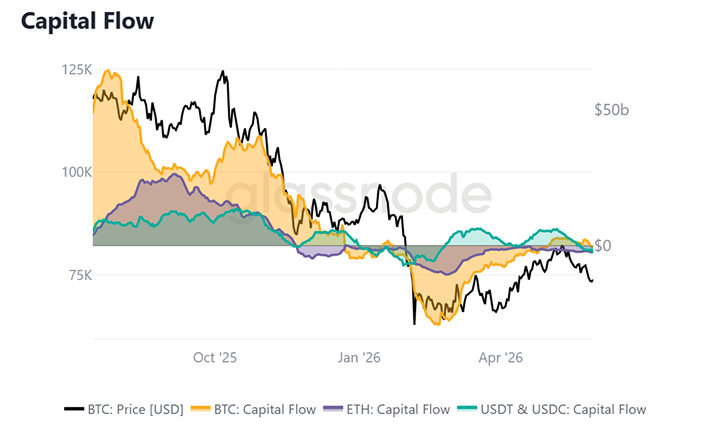
  • Bitcoin flows hovered near neutral while Ethereum outflows deepened and stablecoin inflows reversed sharply into month-end.

April's tentative stabilization carried into May for Bitcoin alone. BTC flows held close to neutral, spiking to +$2.9B on May 07 before drifting back to -$0.3B at the close. Ethereum again diverged, deepening from -$1.7B to a -$2.4B trough late in the month before ending at -$2.1B. The sharper signal came from stablecoins, which reversed from a +$6.1B peak early in May to -$2.5B by month-end, a decisive swing into net outflow. That rotation out of dollar liquidity points to allocators trimming risk into June rather than redeploying into spot.
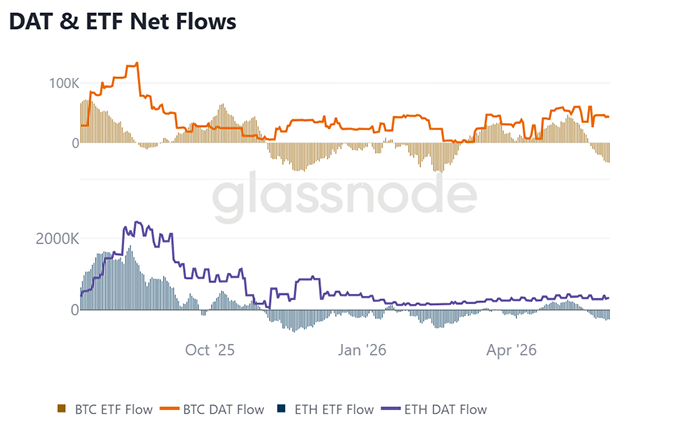
ETF & DAT Net Flows

  • Spot ETF flows for both Bitcoin and Ethereum swung from early-month highs into outflows while treasury vehicles kept accumulating.

Institutional demand split by vehicle in May. Spot ETF flows peaked early, with Bitcoin at +46.8k BTC and Ethereum at +283.4k ETH on May 05, before both rolled over into net redemptions, closing at -33.1k BTC and -261.5k ETH as ETF outflows reached a monthly record. Digital asset treasuries told the opposite story and stayed positive throughout. BTC DAT flows held between +26.1k and +60.4k BTC, ending at +42.9k, while ETH DAT flows ran from +302.4k to +439.2k ETH before settling at +330.8k. The divergence suggests balance-sheet buyers kept accumulating into weakness even as ETF allocators de-risked.
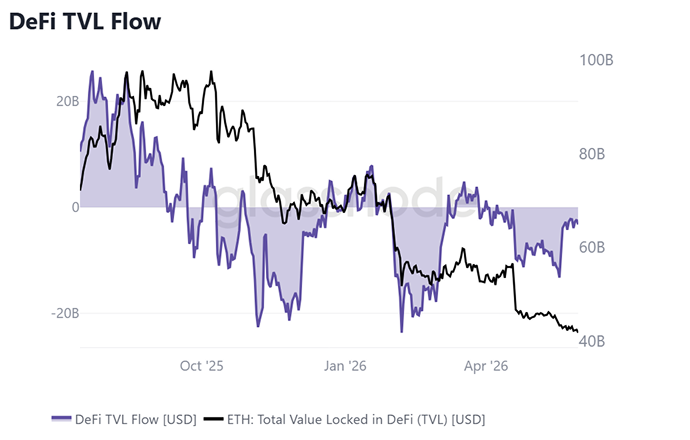
DeFi TVL & Stablecoin Cap

  • Ethereum DeFi TVL ground to new monthly lows even as the pace of net outflows eased through the second half of May.

The contraction that followed April's lending exploit persisted through May, though its intensity faded. Ethereum TVL slipped from $45.1B to $41.7B, closing at the monthly low after peaking at $46.1B on May 11. The flow picture was more constructive than the level implied. Thirty-day net flows stayed negative throughout but recovered from a -$13.3B trough on May 18 to -$3.2B by month-end, the shallowest outflow pace since the exploit. The combination of a falling TVL base alongside decelerating outflows suggests the forced deleveraging phase is largely complete, though fresh inflows remain absent.
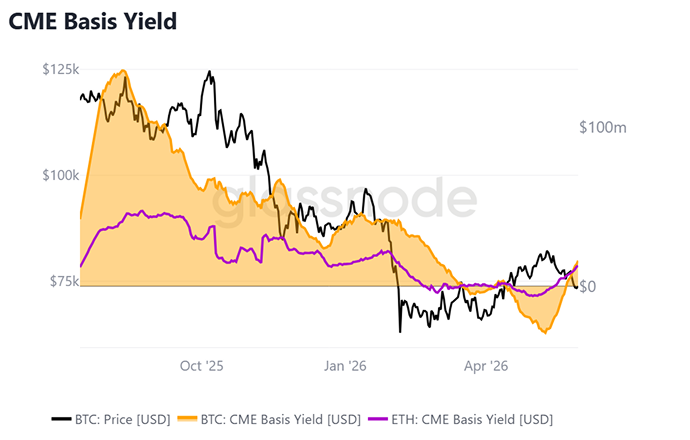
CME Basis Yield

  • CME basis yields for both Bitcoin and Ethereum climbed back into positive territory through May, reviving the cash-and-carry trade.

Here we measure the return available to institutions running cash-and-carry trades. After April left both curves in backwardation, May delivered a clean reversal. BTC basis yield bottomed at -$29.3M on May 09 before rising steadily to +$16.0M, the monthly high reached at the close. ETH followed the same path, recovering from -$6.2M at the open to +$12.8M by month-end. Both series finished May at their peaks, with futures reclaiming a premium to spot for the first time since March. The rebuild restores a positive carry to market-neutral strategies, and a continuation into June would mark the firmest premium environment in several months.


Disclaimer: This report does not provide any investment advice. All data is provided for information and educational purposes only. No investment decision shall be based on the information provided here and you are solely responsible for your own investment decisions.
Exchange balances presented are derived from Glassnode’s comprehensive database of address labels, which are amassed through both officially published exchange information and proprietary clustering algorithms. While we strive to ensure the utmost accuracy in representing exchange balances, it is important to note that these figures might not always encapsulate the entirety of an exchange’s reserves, particularly when exchanges refrain from disclosing their official addresses. We urge users to exercise caution and discretion when utilizing these metrics. Glassnode shall not be held responsible for any discrepancies or potential inaccuracies. Please read our Transparency Notice when using exchange data.

Pertanyaan Terkait

QWhat is the primary objective of the Strategy Watch publication, and how does it seek to strengthen its content?

AThe primary objective of Strategy Watch is to become a must-read monthly publication for the digital asset investment community by providing high-signal, impartial analysis of fund-level performance and allocation trends. It is strengthened by direct input and contributions of insights and data from funds and allocators.

QAccording to the report, how did the demand for Bitcoin and Ethereum ETFs versus Digital Asset Treasuries (DATs) diverge in May?

AIn May, demand diverged significantly. ETF flows for both Bitcoin and Ethereum peaked early before rolling over into net outflows. Conversely, Digital Asset Treasuries (DATs) kept accumulating throughout the month, with BTC and ETH DAT flows staying positive. This suggests balance-sheet buyers accumulated assets while ETF allocators were de-risking.

QWhat trend was observed in the CME basis yields for Bitcoin and Ethereum in May, and what is its significance?

AIn May, CME basis yields for both Bitcoin and Ethereum climbed from negative territory back into positive territory, reviving the cash-and-carry trade. This reversal restores a positive carry to market-neutral strategies, marking the firmest premium environment in several months.

QWhat is the current state of Ethereum DeFi Total Value Locked (TVL) based on the May data, and how did the outflow trends change?

AEthereum DeFi TVL continued to decline in May, grinding to new monthly lows, slipping from $45.1B to $41.7B. However, the pace of net outflows decelerated through the second half of the month, recovering from a -$13.3B trough to -$3.2B by month-end, suggesting the forced deleveraging phase is largely complete.

QWhat sharp signal from stablecoin flows did the report highlight as a key indicator of allocator behavior in late May?

AThe report highlighted that stablecoin inflows reversed sharply into month-end, swinging from a +$6.1B peak early in May to a -$2.5B net outflow by month-end. This decisive swing into net outflow points to allocators trimming risk into June rather than redeploying capital into spot markets.

Bacaan Terkait

Xing Bo Kembali Beraksi: Setelah ‘Mengkritik’ World Model, Kini Giliran Agent

Tahun lalu, profesor Xing Bo mengkritik arsitektur model dunia AI. Kini, ia dan tim kembali menerbitkan makalah "Kritik terhadap Model Agen", mempertanyakan apakah sistem yang saat ini disebut "agen" benar-benar memiliki kemampuan otonomi. Makalah membedakan dua jenis: sistem **agentic** (hanya tampak seperti agen, mengandalkan alur kerja eksternal) dan **agentive** (memiliki otonomi internal sejati). Sebagai contoh, insiden perusahaan PocketOS—di mana asisten AI menghapus basis data produksi—menunjukkan bahwa mengetahui aturan tidak sama dengan menginternalisasi dan mematuhinya. Kritik difokuskan pada lima aspek utama desain agen saat ini: 1. **Tujuan:** Dari instruksi langkah-demi-langkah menuju dekomposisi hierarkis tujuan jangka panjang. 2. **Identitas:** Dari identitas statis dalam "prompt sistem" menuju evaluasi diri yang berkembang berdasarkan pengalaman. 3. **Pengambilan Keputusan:** Dari Chain-of-Thought menuju penalaran berbasis **model dunia** untuk mensimulasikan konsekuensi tindakan. 4. **Alokasi Sumber Daya Kognitif:** Perlunya **modul meta-kognitif** (Sistem III) yang secara mandiri memutuskan kapan harus merencanakan secara mendalam atau bertindak cepat. 5. **Pembelajaran:** Dari pelatihan tetap menuju **pembelajaran mandiri yang berkelanjutan**, menggabungkan latihan di simulator dengan kalibrasi di dunia nyata. Berdasarkan analisis ini, tim mengusulkan arsitektur **GIC (Goal-Identity-Configurator)** yang mengintegrasikan enam komponen: encoder kepercayaan, dekomposer tujuan, evolusi identitas, konfigurator (Sistem III), perencana simulasi (Sistem II), dan pelaksana (Sistem I). Arsitektur ini menekankan pelatihan bertahap—seperti pilot—dari simulator ke dunia nyata, dengan keamanan yang dapat diaudit karena modul-modulnya eksplisit. Kesimpulannya, makalah ini menyerukan standar yang lebih ketat untuk istilah "agen". Otonomi sejati bukan tentang menyelesaikan tugas kompleks, tetapi tentang menginternalisasi tujuan, identitas, dan penilaian ke dalam struktur keputusan sistem itu sendiri.

marsbit8m yang lalu

Xing Bo Kembali Beraksi: Setelah ‘Mengkritik’ World Model, Kini Giliran Agent

marsbit8m yang lalu

Collector Crypt Bagaimana "Pembelian Kembali Berputar" Menciptakan Ilusi Pertumbuhan

**Ringkasan Artikel: Bagaimana Collector Crypt Menciptakan Ilusi Pertumbuhan dengan "Buyback Berulang"** Data menunjukkan bahwa pertumbuhan GMV Collector Crypt (CC) yang pesat terutama didorong oleh paket kartu bernilai tinggi ($250, $1.000, $2.500), yang memiliki tingkat retensi platform per dolar yang lebih rendah dibanding paket murah. Paket $2.500 "Mythic" menyumbang 36,7% GMV Juni hanya dalam 13 hari. Pertumbuhan ini didukung oleh sejumlah kecil pengguna dengan dompet besar dan frekuensi tinggi, bukan perluasan basis pengguna yang luas. Tingkat laba bersih CC turun dari 11,2% (Q3 2025) menjadi 5,6% (Q2 2026), meski GMV naik 4,7 kali. Penebusan kartu fisik menguras 41,6% dari pendapatan bersih pra-pembakaran Mei, menciptakan kebutuhan untuk mengisi ulang inventaris. Pada Juni, hanya 75 dari ~6.000 dompet yang melakukan penebusan fisik, dengan empat pengguna teratas menyumbang 47,1% dari total kartu yang ditebus pengguna. Model ekonomi CC rentan. Jika dua dari tiga tekanan berikut terjadi bersamaan, modelnya bisa menjadi negatif: biaya penggantian inventaris mendekati harga pasar, tingkat penebusan melebihi 9%, dan tingkat buyback paket tinggi tetap sekitar 93%. Pendapatan mitra kumulatif hanya $1,83 juta, sebagian besar terkait Moonbirds. Strategi API dan distribusi B2B belum membuktikan dapat menghasilkan pendapatan berulang yang ringan inventarisnya, karena integrasi yang terverifikasi masih sangat bergantung pada CC untuk penyediaan kartu, penyimpanan, pemenuhan, dan layanan buyback. Pertumbuhan CC saat ini bergantung pada siklus modal berulang oleh pengguna besar, bukan kedalaman pasar kolektor yang sebenarnya. Untuk berkelanjutan, CC perlu membuktikan partisipasi kolektor yang lebih luas, perdagangan sekunder yang lebih dalam, dan nilai kepemilikan on-chain, serta menghasilkan GMV tambahan tanpa terus menekan margin atau beban inventaris.

Foresight News31m yang lalu

Collector Crypt Bagaimana "Pembelian Kembali Berputar" Menciptakan Ilusi Pertumbuhan

Foresight News31m yang lalu

Penyelesaian Sepanjang Waktu Saham AS Telah Tiba, Mata Uang Kripto Tidak Berhasil Mendapatkan Tiket Masuk

Selama bertahun-tahun, industri kripto kerap mempromosikan aset digital sebagai pasar yang beroperasi 24/7 tanpa henti, berbeda dengan bursa tradisional yang tutup pada pukul 4 sore. Namun, narasi utama ini kini mendapat tantangan besar. Perusahaan penyelesaian terbesar di dunia, Depository Trust & Clearing Corporation (DTCC), melalui anak perusahaannya National Securities Clearing Corporation (NSCC), baru saja mengumumkan telah menerapkan sistem kliring yang beroperasi 24 jam selama lima hari kerja dalam seminggu. DTCC yang menangani transaksi senilai kuadriliun dolar setahun kini dapat memproses perdagangan saham secara *overnight*. Perpanjangan jam kliring ini mengurangi keunggulan diferensiasi pasar kripto. Satu-satunya kelebihan yang tersisa adalah kripto masih dapat diperdagangkan di akhir pekan, sedangkan DTCC saat ini belum. Namun, jika permintaan pasar tinggi, DTCC berpotensi membuka layanan kliring di akhir pekan di masa depan. Artikel ini juga menekankan bahwa langkah DTCC ini tidak berkaitan dengan adopsi blockchain publik atau aset kripto. DTCC secara konsisten memilih infrastruktur privat dan terizin untuk proyek-proyeknya, seperti platform Ion dan jaringan Canton untuk tokenisasi obligasi pemerintah AS, bukan menggunakan blockchain publik seperti Ethereum atau XRP Ledger. Harapan komunitas kripto, khususnya pemegang XRP, bahwa DTCC akan mengintegrasikan teknologi mereka, sekali lagi tidak terwujud. Kesimpulannya, pasar keuangan tradisional berhasil meluncurkan sistem kliring 24/5 dengan infrastruktur matang yang ada, tanpa melibatkan atau memberikan "tiket masuk" bagi industri kripto.

marsbit48m yang lalu

Penyelesaian Sepanjang Waktu Saham AS Telah Tiba, Mata Uang Kripto Tidak Berhasil Mendapatkan Tiket Masuk

marsbit48m yang lalu

Penelitian Terbaru Grayscale: Apa Mesin Pertumbuhan Selanjutnya untuk Solana?

**Ringkasan: Studi Terbaru Grayscale – Apa Mesin Pertumbuhan Selanjutnya untuk Solana?** Laporan terbaru Grayscale, "Solana: Crypto's Financial Bazaar", menandai pergeseran fokus dalam menilai Solana. Daripada sekadar menekankan performa teknis (TPS tinggi), laporan ini menyoroti evolusi Solana menjadi platform aplikasi yang menampung aktivitas ekonomi skala besar, bagaikan "pasar finansial digital" yang hidup. Kompetisi rantai publik kini memasuki babak baru: yang diperebutkan bukan lagi kecepatan, tetapi kelimpahan aktivitas ekonomi riil. Grayscale menggarisbawahi bahwa nilai jangka panjang ditentukan oleh pengguna aktif harian, volume transaksi, pendapatan, dan ekosistem aplikasi yang berkelanjutan. Laporan ini menguraikan tiga aplikasi perwakilan yang membentuk roda pertumbuhan Solana: 1. **Jupiter**: Agregator DEX yang telah menjadi pusat likuiditas dan infrastruktur keuangan inti bagi ekosistem DeFi Solana. 2. **Pump.fun**: Melampaui label "Meme", platform ini menunjukkan kemampuan Solana untuk menarik pengguna massal (2 juta pengguna aktif bulanan) dan menghasilkan pendapatan berkelanjutan, memvalidasi jaringan untuk aplikasi konsumen frekuensi tinggi. 3. **Helium & DePIN**: Mewakili perluasan batas Solana ke dunia nyata. Proyek DePIN (Infrastruktur Fisik Terdesentralisasi) menghubungkan sumber daya fisik seperti jaringan nirkabel dan layanan lokasi, membuka jalur pertumbuhan jangka panjang dengan mengaitkan blockchain ke ekonomi riil. Ke depan, naratif pertumbuhan Solana bergeser dari Meme ke area yang lebih berkelanjutan dan berorientasi kelembagaan: **AI Agent & Pembayaran Machine-to-Machine, Stablecoin & Pembayaran, serta Aset Dunia Nyata (RWA) dan Tokenisasi.** Fondasi Solana yang cepat dan murah dipandang cocok untuk menangani penyelesaian transaksi AI yang tinggi dan frekuensi tinggi, serta aplikasi pembayaran digital global. Minat institusional yang bangkit kembali didorong oleh kematangan model bisnis lapisan aplikasi, pematangan ekosistem stablecoin & pembayaran, dan komunitas pengembang yang tetap aktif. Tantangan tetap ada, seperti bagaimana jaringan menangkap nilai dari aktivitas ekonomi yang diciptakan dan membangun keberlanjutan di luar siklus hype. Namun, sinyalnya jelas: nilai Solana di masa depan akan lebih ditentukan oleh kemampuannya sebagai pasar ekonomi digital yang berkembang pesat daripada sekadar menjadi blockchain tercepat.

marsbit52m yang lalu

Penelitian Terbaru Grayscale: Apa Mesin Pertumbuhan Selanjutnya untuk Solana?

marsbit52m yang lalu

Trading

Spot
活动图片