Probability of Shutdown Plummets: Why Was the U.S. Government Shutdown Crisis Suddenly 'Resolved'?

比推Dipublikasikan tanggal 2026-01-29Terakhir diperbarui pada 2026-01-29

Abstrak

The risk of a U.S. government shutdown at the end of January has significantly decreased, with prediction markets showing the probability dropping from 80% to 42%. The potential shutdown stemmed from a partisan dispute over funding for the Department of Homeland Security (DHS), particularly related to the Immigration and Customs Enforcement (ICE) agency. Democrats sought to limit funding after a controversial ICE operation in Minnesota resulted in fatalities, while Republicans defended ICE's role in immigration enforcement. The shift in shutdown probability reflects a likely political compromise, as both parties recognize that a shutdown could harm their prospects in the upcoming midterm elections. Control of Congress is at stake, and neither side wants to be blamed for economic and operational disruptions. Democrats have proposed separating the DHS funding bill from other appropriations to avoid a full shutdown, and reports indicate negotiations are underway between the White House and Senate leaders to reach a short-term funding extension. The focus is on avoiding a repeat of the 43-day shutdown from late last year.

Author: Golem

Original Title: U.S. Government Shutdown Is Difficult Because Both Parties Have Already Calculated the Cost


A major macroeconomic event this month is whether the U.S. government will shut down at the end of January. Last October, the U.S. government shut down for 43 days, and it has been operating since then only after the passage of a temporary funding bill. January 30 is the expiration date of the temporary funding bill. If Congress fails to pass a formal funding bill or if there is no new temporary bill to extend it, the U.S. government will shut down again.

This time, the dispute between the two U.S. parties is mainly over funding for the Department of Homeland Security (DHS). Democrats believe that ICE (Immigration and Customs Enforcement) has problems with law enforcement in Minnesota, resulting in two deaths, and they want to strictly restrict funding and related operations. However, Republicans disagree, arguing that ICE is a key force in combating illegal immigration and welfare fraud. As a result, the two sides are at a stalemate. (For details on the dispute between the two U.S. parties, please read: "U.S. Government Shutdown Storm Is Brewing Again, Will the Crypto Circle Repeat the Crash Script?")

It is this confrontational state and the approaching expiration date of the temporary funding bill that caused the probability of a U.S. government shutdown at the end of January to rise sharply on prediction markets. However, this morning, Polymarket data showed that the probability of the U.S. government shutting down at the end of January has continued to decline and currently stands at 42%, down from a previous high of 80%.
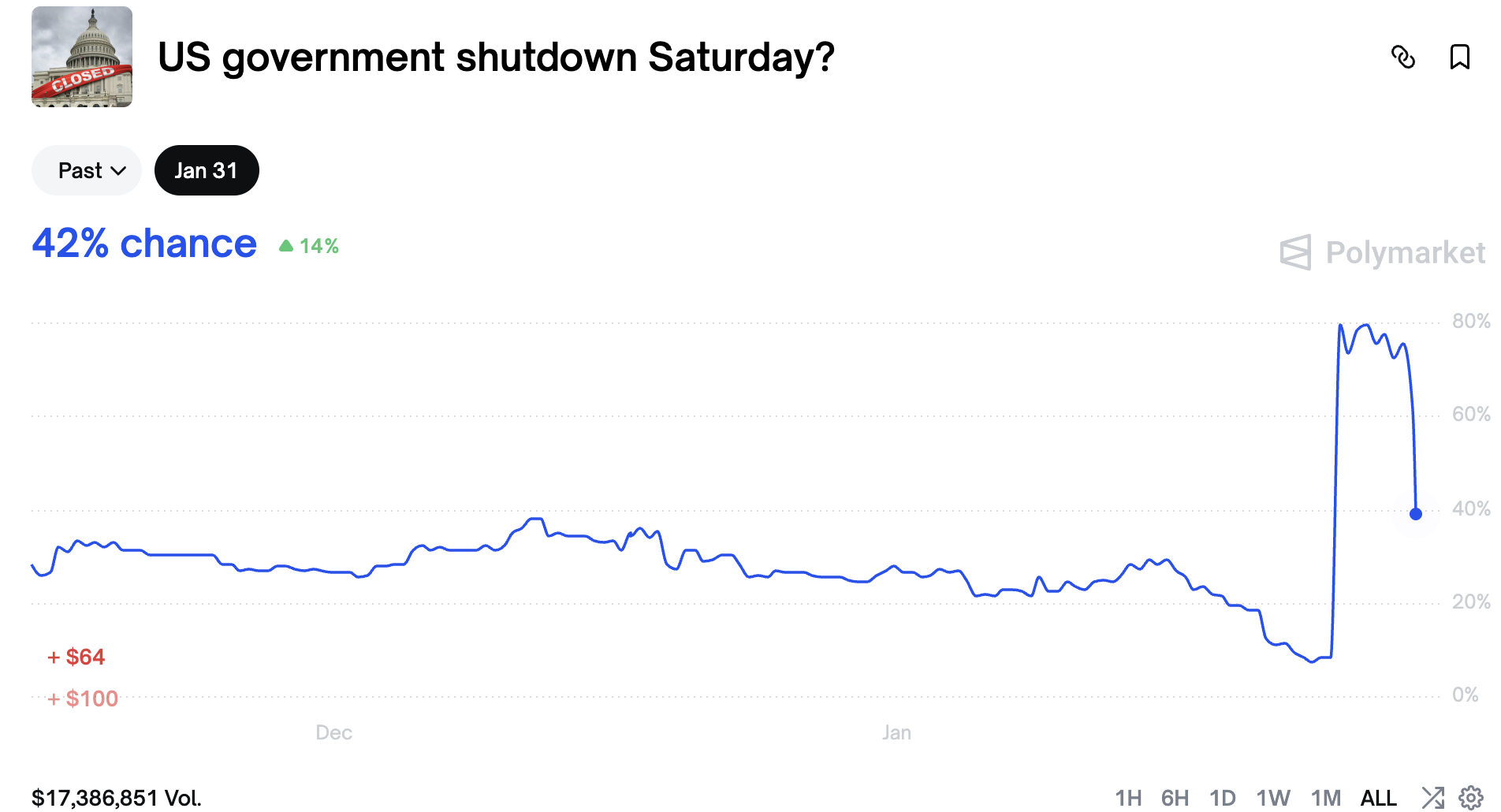
Price changes in prediction markets reflect the results of collective wisdom and博弈. The rising probability that the U.S. government will not shut down at the end of January indicates that people believe the high certainty of a government shutdown suggested by the prediction market probability no longer exists under the current U.S. political situation.

Midterm Elections Are the Key Focus for Both U.S. Parties

On January 28, regarding the risk of another possible U.S. government shutdown, U.S. Treasury Secretary Besant said the situation is still unclear but emphasized that President Trump has urged the Democratic side to avoid this outcome.

This government shutdown crisis is essentially because the Republicans were caught by the Democrats with a political counterattack handle. The shooting death of a U.S. citizen by ICE law enforcement officers in Minnesota on January 24 was essentially a result of the Trump administration's increased immigration enforcement efforts, which also led to large-scale public protests expressing dissatisfaction with the Trump administration. The Democrats reasonably seized this opportunity and used it as an excuse to block the passage of the funding bill in the Senate. Because it reflects the demands of voters, the Democrats' counterattack has taken the political initiative.

The Republicans have thus been put in a passive position. If the U.S. government does shut down as a result, the Democrats could blame all subsequent economic and livelihood problems caused by the shutdown (delayed release of economic data, large-scale flight delays at airports, etc.) on the incompetence of the Republican government.

And this series of possible chain reactions will also affect the issue that both U.S. parties truly care about this year: the U.S. midterm elections.

The U.S. "midterm elections" are held in the second year of a presidential term. All 435 seats in the House of Representatives will be re-elected, and approximately one-third of the seats in the Senate are usually re-elected. Currently, the Republicans hold a majority in both the House (218 seats) and the Senate (53 seats). For the Republicans to maintain their seat advantage after the midterm elections at the end of the year and reduce governance difficulties, they cannot accumulate too many "stains" politically this year.

At the same time, although the midterm elections do not involve the U.S. presidential election, they are also regarded as a "midterm referendum" on the incumbent president, which will affect the president's policy orientation in the latter two years and also reshape the intra-party power structure and the candidate landscape for the next presidential election. Therefore, it is extremely important for Trump as well.

From the above analysis, it can be seen that this government shutdown is no longer a simple funding issue but a political battlefield set up in advance by both U.S. parties for the midterm elections at the end of the year. The Republicans, who are in a passive position, are highly likely to compromise to resolve the crisis and矛盾.

For the Democrats, if the Republicans compromise, it would also be a political victory.

Compromise Is Already Underway

This U.S. government shutdown crisis will not be a "full shutdown" like last October (when all 12 funding bills expired). The scale of the shutdown may be much smaller. Funding for the Commerce Department (responsible for releasing GDP and other data) and the Agriculture Department (responsible for food benefits) has already been secured, but about 78% of federal government functions—involving the remaining 6 funding bills—may face funding cuts.

The Democrats have actually already given the Republicans a way out. Senate Minority Leader Chuck Schumer (D-N.Y.) said on January 28 that Senate Democrats are "prepared to quickly advance five funding bills by the January 30 deadline, separate from the Department of Homeland Security funding bill," which could be a way to avoid a large-scale government shutdown. However, Senate Republicans have not yet agreed to separate the DHS bill from the overall funding package.

On the other hand, it is unrealistic to demand changes to the DHS funding before January 30, as any changes to the remaining six funding bills must be submitted to the House of Representatives for approval, and the House will not reconvene until February 2.

For the Democrats, forcing the U.S. government into a shutdown state by being too rigid about amending the funding bill would not be of much benefit, and the "offensive and defensive态势" with the Republicans could even reverse. Therefore, the current consensus between the two U.S. parties may be to pass a temporary funding bill to first solve the potential government shutdown problem and postpone the矛盾 between the two parties.

And just as Odaily was writing this article speculating that the two parties might compromise to avoid a government shutdown, The New York Times also reported that Trump is reaching a possible agreement with Chuck Schumer to avoid a U.S. government shutdown.

According to two informed officials, under the plan being developed, the Senate would separate one bill from the six spending bills, which is intended to fund the Department of Homeland Security to maintain funding for the military, medical programs, and other federal agencies for the remainder of the fiscal year. The Senate will pass these bills by the Friday midnight deadline, and Congress will also consider a short-term extension of homeland security operations to prevent service disruptions at the TSA, Coast Guard, and Federal Emergency Management Agency.

It is still unclear how this potential agreement will affect this week's funding bill vote, but it at least indicates that the White House and the Senate are working towards resolving the crisis.


Twitter:https://twitter.com/BitpushNewsCN

Bitpush TG Discussion Group:https://t.me/BitPushCommunity

Bitpush TG Subscription: https://t.me/bitpush

Original link:https://www.bitpush.news/articles/7607037

Pertanyaan Terkait

QWhy did the probability of a US government shutdown at the end of January drop significantly?

AThe probability dropped because both political parties recognized that a shutdown could negatively impact the midterm elections. The Republican party, in particular, was in a politically vulnerable position and was likely to compromise to avoid the economic and public backlash associated with a shutdown.

QWhat was the main point of contention between Democrats and Republicans that threatened a government shutdown?

AThe main contention was over funding for the Department of Homeland Security (DHS), specifically related to the Immigration and Customs Enforcement (ICE) agency. Democrats wanted to restrict funding and actions for ICE following a fatal incident in Minnesota, while Republicans defended ICE's role in combating illegal immigration.

QHow are the upcoming US midterm elections connected to the government shutdown crisis?

AThe midterm elections are the key political priority for both parties. A government shutdown would create economic and logistical problems that could be used as political ammunition. Republicans, who control both chambers of Congress, want to avoid any 'stains' on their record to maintain their majority, making them more willing to compromise.

QWhat specific compromise was proposed by Democrats to avoid a full government shutdown?

ASenate Democratic Leader Chuck Schumer proposed separating the Homeland Security funding bill from the other five remaining appropriations bills. This would allow the non-controversial bills to pass quickly before the deadline, avoiding a full shutdown, while negotiations on DHS funding continued.

QWhat was reported that indicated a deal was being made to prevent the shutdown?

AThe New York Times reported that President Trump and Senator Chuck Schumer were working on a potential deal. The plan involved separating the Homeland Security appropriations bill from the others and passing a short-term extension for DHS to prevent service disruptions while a longer-term solution was negotiated.

Bacaan Terkait

Saham Momentum Teknologi AS Catat Kenaikan Terbesar dalam Sejarah dalam Satu Hari, Tapi Apakah Kejatuhan Sudah Berakhir?

Saham momentum teknologi AS mengalami reli dramatis pada Selasa (21 Juli), dengan Indeks Faktor Momentum TMT Morgan Stanley melonjak lebih dari 12% - kenaikan satu hari terbesar dalam catatan. Indeks momentum beta tinggi Goldman Sachs juga naik tajam. Reli ini didorong terutama oleh sektor semikonduktor, dengan indeks Philadelphia Semiconductor naik 4.6%. Aksi ini terjadi setelah tiga hari penurunan dan kejatuhan kumulatif 33% untuk saham momentum, yang memicu aksi 'short squeeze' dimana investor yang short terpaksa menutupi posisi mereka. Namun, kualitas reli dipertanyakan. Volume perdagangan rendah dan lebih banyak saham turun daripada naik di S&P 500, menunjukkan reli sempit yang dipimpin oleh sedikit saham besar. BTIG memperingatkan bahwa reli telah mencapai level resistensi kunci dan merekomendasikan untuk mengurangi eksposur, mengingat volatilitas ekstrem dan karakteristik yang mirip dengan periode gelembung dot-com. Di sisi lain, Goldman Sachs dan UBS melihat penjualan momentum mendekati akhir, dengan posisi yang telah berkurang drastis dan tidak ada katalis fundamental baru, sehingga mungkin menjadi peluang untuk menambah eksposur secara bertahap. Faktor kunci berikutnya adalah musim laporan keuangan, dengan laporan Alphabet tentang panduan belanja modal AI-nya menjadi sorotan. Sementara itu, pasar obligasi memberi sinyal peringatan, karena imbal hasil obligasi pemerintah AS naik, didorong oleh kenaikan harga minyak di atas $90 akibat ketegangan Timur Tengah. Beberapa analis memperingatkan bahwa kenaikan lebih lanjut dalam imbal hasil obligasi dapat membebani pasar saham.

marsbit28m yang lalu

Saham Momentum Teknologi AS Catat Kenaikan Terbesar dalam Sejarah dalam Satu Hari, Tapi Apakah Kejatuhan Sudah Berakhir?

marsbit28m yang lalu

Saham 'Teknologi Momentum' AS Catat Kenaikan Terbesar Sejarah dalam Sehari, tapi Apakah Jatuhnya Sudah Berakhir?

Saham momentum teknologi AS mengalami rebound dramatis pada Selasa (21/7). Indeks momentum TMT Morgan Stanley melonjak lebih dari 12%, rekor kenaikan harian terbesar dalam sejarah. Indeks momentum beta tinggi Goldman Sachs (GSCBHMOM) naik sekitar 8.5%, kinerja harian terkuat sejak April 2025. Sektor semikonduktor, dengan Indeks Semikonduktor Philadelphia naik 4.6%, menjadi pendorong utama. Rebound ini terjadi setelah penurunan selama tiga hari berturut-turut dan kejatuhan kumulatif 33% untuk saham momentum. Analis menyebut rebound ini didorong oleh "short squeeze" atau pemaksaan likuidasi posisi jual, terutama dari pedagang di Korea Selatan dan Jepang yang terkena margin call. Namun, kualitas rebound dipertanyakan karena volume perdagangan rendah dan lebih banyak saham yang turun daripada naik di S&P 500 meski indeks naik, menunjukkan kelemahan dalam keluasan pasar. Pandangan institusi keuangan terpecah. BTIG memperingatkan rebound telah mencapai level resistensi kunci dan merekomendasikan untuk mengurangi posisi. Sebaliknya, Goldman Sachs dan UBS percaya penjualan momentum mendekati akhir dan melihatnya sebagai peluang untuk membeli secara bertahap, meski dengan struktur terbatas risikonya. Laporan keuangan musim ini, terutama dari Alphabet yang dijadwalkan minggu ini, akan menjadi katalis kunci berikutnya. Pasar akan sangat memperhatikan panduan pengeluaran modal Alphabet untuk petunjuk arah pengeluaran AI. Sementara itu, pasar obligasi memberi sinyal peringatan dengan kenaikan imbal hasil obligasi AS, didorong oleh kenaikan harga minyak di atas $90 per barel akibat ketegangan geopolitik di Timur Tengah. Beberapa analis memperingatkan bahwa kenaikan lebih lanjut dalam imbal hasil obligasi jangka panjang dapat membebani pasar saham.

链捕手31m yang lalu

Saham 'Teknologi Momentum' AS Catat Kenaikan Terbesar Sejarah dalam Sehari, tapi Apakah Jatuhnya Sudah Berakhir?

链捕手31m yang lalu

Bersatu Terus Berpisah, Berpisah Terus Bersatu: Ketika L1 Menjadi Rollup Dirinya Sendiri, Apa Akhir dari Ethereum?

"Setelah sekian lama, akhirnya terpecah; setelah terpecah, akhirnya kembali bersatu." Judul artikel ini secara tepat menggambarkan tantangan dan evolusi dalam hubungan antara Lapisan 1 (L1) dan Lapisan 2 (L2) Ethereum. Artikel ini membahas bagaimana visi awal L2 sebagai solusi penskalaan utama Ethereum, yang bertujuan menyediakan ruang blok yang murah dan efisien, kini sedang ditinjau ulang seiring dengan peningkatan kapasitas penskalaan L1 itu sendiri. Dengan penggabungan rute pekerjaan protokol "Scale", Ethereum kini melihat penskalaan L1 dan L2 sebagai kerangka kerja yang terpadu. Hal ini menggeser peran L2 dari sekadar penyedia ruang transaksi yang lebih murah menjadi penyedia fungsi yang terdiferensiasi, seperti optimasi aplikasi tertentu, fitur privasi, dan model tata kelola yang lebih fleksibel. L2 kini dilihat sebagai spektrum lingkungan eksekusi yang membangun berbagai tingkat hubungan keamanan, penyelesaian, dan likuiditas dengan Ethereum L1. Masalah fragmentasi yang ditimbulkan oleh banyaknya L2 juga menjadi fokus penting. Pengalaman pengguna yang terfragmentasi, dengan aset dan aplikasi yang tersebar di berbagai rantai, mendorong pengembangan solusi interoperabilitas seperti kerangka Open Intents dan Ethereum Interoperability Layer (EIL). Tujuannya adalah untuk membuat interaksi antar-L2 terasa seperti bertransaksi pada satu rantai tunggal. Memperpendek waktu finalitas L1 menjadi detik juga merupakan target jangka panjang yang penting untuk meningkatkan kepercayaan dan efisiensi dalam berbagi status antar lingkungan eksekusi. Gagasan yang lebih mendalam adalah bahwa dengan masuknya sistem bukti (seperti zkEVM) ke dalam protokol inti, L1 Ethereum sendiri pada akhirnya dapat mengadopsi pola verifikasi yang mirip dengan Rollup, di mana sebagian node melakukan eksekusi berkinerja tinggi dan node lainnya memverifikasi bukti kriptografisnya. Ini mengaburkan batas tradisional antara L1 dan L2, mengubah Rollup dari sekadar hierarki di atas L1 menjadi arsitektur eksekusi dan verifikasi yang lebih universal. Kesimpulannya, masa depan Ethereum bukanlah tentang L1 yang menghilangkan kebutuhan akan L2, atau sebaliknya. Masa depan terletak pada pembentukan ekosistem di mana berbagai lingkungan eksekusi (L2) dengan fungsi dan kinerja yang berbeda-beda dapat hidup berdampingan, sambil berbagi fondasi keamanan, likuiditas, dan hubungan status yang kuat dengan hub global L1. Tantangan berikutnya adalah menyatukan kembali kapasitas yang telah dipecah ini menjadi pengalaman yang kohesif dan andal, sambil tetap mempertahankan keuntungan penskalaan yang telah diraih.

链捕手43m yang lalu

Bersatu Terus Berpisah, Berpisah Terus Bersatu: Ketika L1 Menjadi Rollup Dirinya Sendiri, Apa Akhir dari Ethereum?

链捕手43m yang lalu

Trading

Spot
活动图片





