Paradigm's New Arithmetic: When Crypto Can't Hold $12.7 Billion, AI Becomes the Answer

marsbitDipublikasikan tanggal 2026-02-28Terakhir diperbarui pada 2026-02-28

Abstrak

Paradigm, a major crypto-focused VC managing $12.7 billion in assets, is raising a new $1.5 billion fund to expand into AI, robotics, and frontier tech. This shift follows a contraction in its crypto-only strategy—its third fund was $850 million, down from $2.5 billion in 2021—reflecting a lack of sufficiently large and early-stage crypto opportunities. The 2022 FTX collapse, which cost Paradigm $278 million, prompted internal reevaluation. By 2023, the firm had quietly removing “crypto” and “Web3” from its website, signaling a broader investment focus. Co-founder Matt Huang later clarified that Paradigm remains excited about crypto but sees AI as too significant to ignore. Paradigm’s move isn’t a full pivot to AI; rather, it targets the intersection of AI and crypto. Investments like $50 million in AI infrastructure firm Nous Research and the development of Tempo—a stablecoin payment platform—highlight this strategy. The firm believes AI agents will require programmable money and on-chain execution, creating synergies between both fields. The new fund also serves a narrative purpose: offering LPs a compelling growth story amid crypto’s concentration of capital and AI’s dominance in venture funding (61% of global VC investments in 2025). Paradigm aims to leverage its crypto expertise to capture value at the convergence of AI and decentralized technologies.

First, let's do a math problem.

A VC firm manages $12.7 billion in assets. Its previous fund raised $850 million. The one before that was $2.5 billion.

The direction is reversed.

The scale is shrinking, not because it can't raise money, but because there aren't enough worthwhile targets to bet on. Now, this company wants to reverse this curve. Where does it need to go to find the next big enough pool?

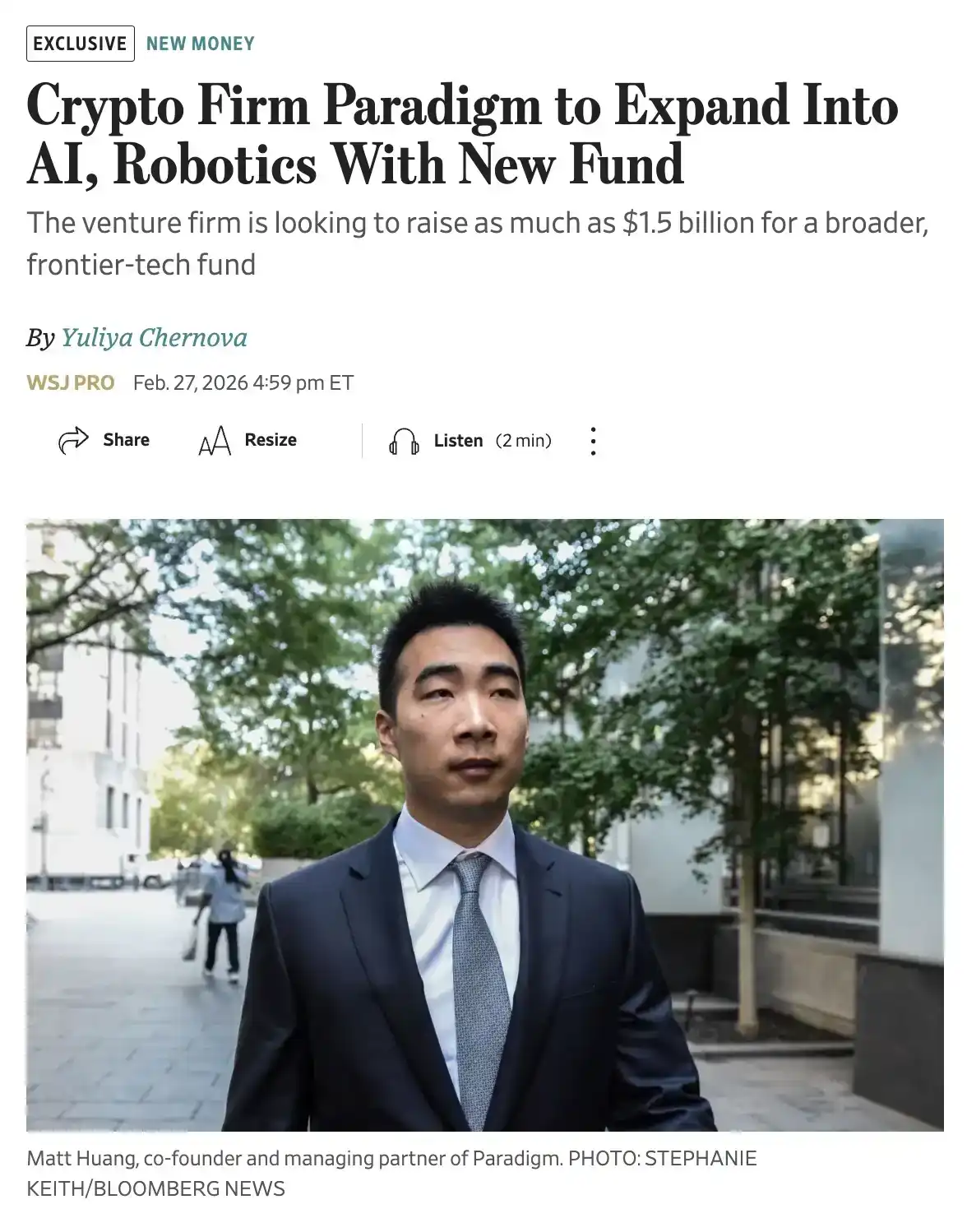
On February 28, 2026, The Wall Street Journal provided the answer: Cryptocurrency investment firm Paradigm is raising a new fund of up to $1.5 billion, expanding its investment focus to artificial intelligence, robotics, and other frontier technologies.
This is not a sudden decision. It's a math problem that started being calculated long ago, and the answer is only being announced today.

First, let's look at the numbers

In 2025, the total global VC investment in cryptocurrencies reached $49.8 billion. That sounds like good news. But if you only focus on that one number, you'll misjudge one thing.

In the same year, the number of crypto VC deals plummeted by about 60% year-over-year, from approximately 2,900 deals to 1,200 deals. Money is increasing, but the number of projects is decreasing. Funds flowing into the crypto space are increasingly concentrated in a few large deals rather than spread across hundreds of early-stage projects.

For the vast majority of small and medium-sized funds, this might not be a problem. But for Paradigm, this is a structural issue. Paradigm manages $12.7 billion in assets and is one of the world's largest crypto-dedicated VCs. Its problem isn't finding projects; it's finding enough large, early-stage projects to deploy this scale of capital while maintaining its expected returns.

In 2021, Paradigm raised the largest cryptocurrency fund in history, at $2.5 billion. In 2024, it announced its third fund, sized at $850 million—only one-third the size of the previous one.

This contraction is not a sign of weakness; it's an active adaptation to a narrower market. But it also illustrates one thing: relying solely on crypto, Paradigm is struggling to find an outlet for its scale.

After FTX, Paradigm started asking a question

To understand today's $1.5 billion, we must go back to November 2022.

That month, FTX collapsed. Sam Bankman-Fried's empire turned to ashes in a matter of days, burning the money of countless institutions along with it. Paradigm's paper investment in FTX was $278 million. Ultimately, it all went to zero.

For a top-tier firm known for being "research-driven" and priding itself on its technical vision, this wasn't just a bad debt. It was a public misjudgment that needed to be explained to LPs, to the market, and to itself.

What happened next seemed quite strange at the time. In 2023, people noticed that Paradigm's official website had quietly changed: all mentions of "crypto" and "Web3" were removed and replaced with the more neutral term "technology investment."

There was no official announcement about this change, but it was quickly discovered by the community and sparked intense discussion. The biggest doubt was: Is Paradigm running away?

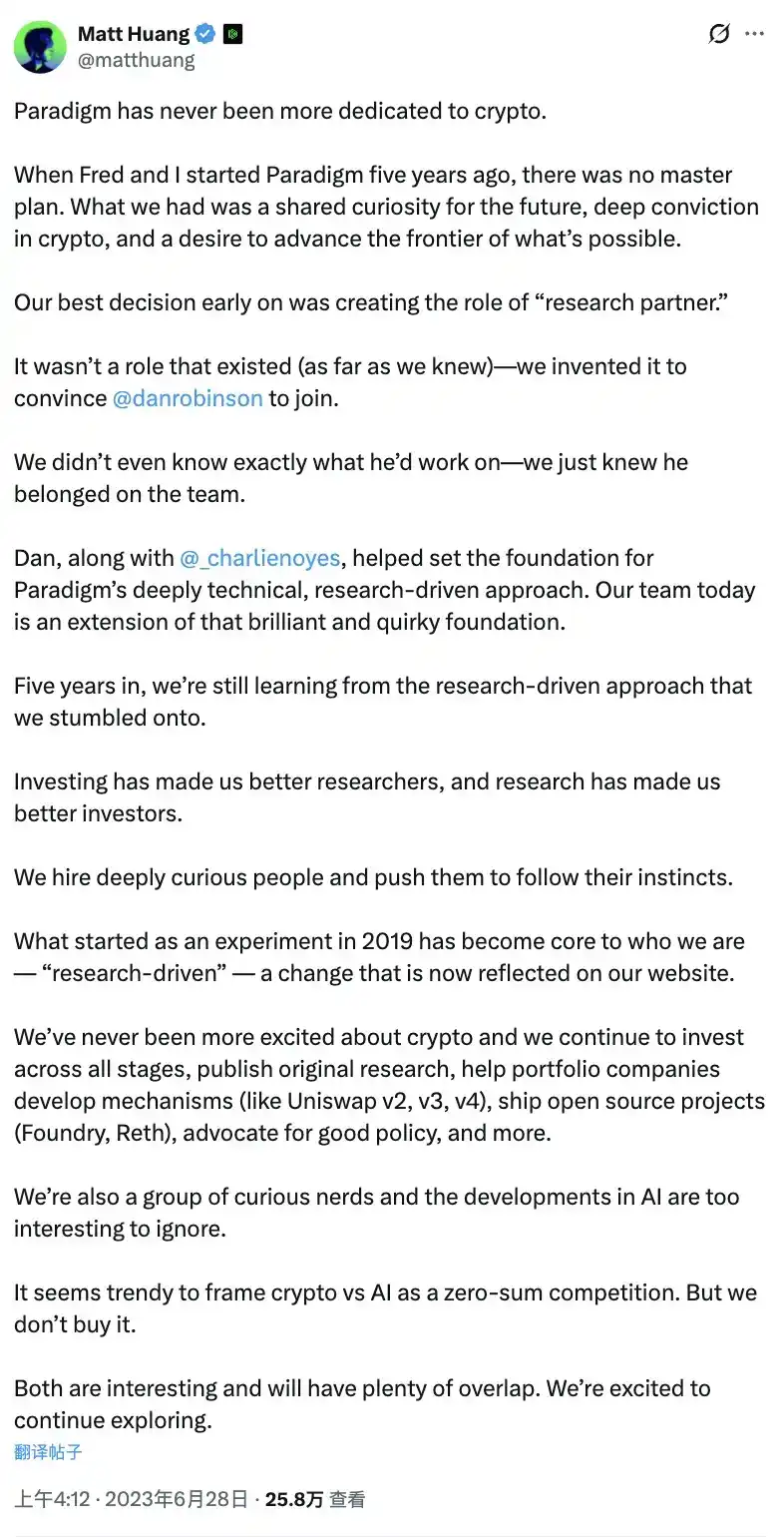
Co-founder Matt Huang had to put out the fire. He tweeted that Paradigm had "never been more excited about crypto," while adding: "The developments in AI are too compelling to ignore. Framing AI and crypto as a zero-sum competition is a popular but mistaken narrative. We don't buy it. Both are interesting and will have significant overlap."
This was a PR-driven clarification, but it also revealed something real: Paradigm was already seriously considering AI internally.

After FTX, the question it was forced to answer was: What to bet on for the next decade?

Matt Huang has already been working on the answer

If you only look at Paradigm's official announcements, the company's pivot seems to have started today. But if you look at Matt Huang's actual actions over the past two years, you'll find he has long been more than just a crypto investor.

In 2024, Paradigm invested $50 million in Nous Research. Nous Research is an AI infrastructure company focused on the research and development of open-source large language models. This wasn't an "exploratory" small test; $50 million is a serious bet at Paradigm's scale.

In February of this year, Paradigm also jointly released EVMbench with OpenAI, a benchmark tool to evaluate the ability of different AI models to detect and fix security vulnerabilities in smart contracts. The core infrastructure of cryptocurrency met AI capability assessment—two things were placed on the same table.

At the same time, Matt Huang is building another company: Tempo. This is a stablecoin payment infrastructure company; Matt Huang is a co-founder, and his role on Stripe's board is highly aligned with this direction. Stripe established a strategic partnership with Paradigm in 2025, and Stripe also launched its stablecoin payment product that year.

Looking at these together, Matt Huang isn't "going to invest in AI"; he has been living at the intersection of AI and crypto for at least two years.

He's not betting on AI alone, nor on crypto alone, but on the moment these two things collide. And when AI agents need to execute transactions on-chain, when robots need a programmable monetary system, that collision point is Paradigm's next main battlefield.

Why AI×Crypto, not a pivot to AI

Paradigm's move into AI doesn't mean it's competing with a16z or Sequoia for the same batch of projects.

There's a narrative mistake that's easy to make: interpreting Paradigm's new fund as "just another VC pivoting to AI." But if that were the case, it would have no advantage; the general AI track is already crowded with traditional VC giants with deeper backgrounds and stronger resources.

Paradigm's real logic is: it doesn't intend to fight for a piece of the general AI pie; it wants to bet on the intersection that others haven't yet clearly seen.

AI agents are one of the hottest concepts right now. These intelligent agents, capable of autonomously performing tasks, have already started replacing human labor in various scenarios: search, writing code, analyzing data, managing workflows. But there's one thing they haven't solved yet: money.

When an AI agent needs to pay, receive payments, or transfer funds between different services, what does it use? PayPal? Bank accounts? These systems are designed for humans, requiring identity verification, manual authorization, and are incompatible with the logic of autonomous machine execution.

But stablecoins can. Smart contracts can. Programmable money can.

This is why Matt Huang is simultaneously working on Tempo (stablecoin payments) and investing in Nous Research (AI infrastructure): he believes these two lines will eventually merge, and Paradigm can place bets on both sides, capturing the maximum return at the moment of merger.

This isn't a pivot; it's an expansion. An expansion into a place he believes others haven't fully figured out yet.

LPs need a new story

There's also a practical level that must be made clear.

Paradigm's LPs, the institutions and individuals who entrusted their money to it, saw the ambition of a $2.5 billion raise in 2021 and the restraint of a contraction to $850 million in 2024.

Such a vast difference in the size of two consecutive funds requires an explanation. Even more, it requires a persuasive narrative for the next fund.

"Continue investing in early-stage crypto projects"—this story was already difficult to support a $1.5 billion fundraising target in 2024. But "leveraging crypto's technical advantages to切入 (cut into) frontier tech at the hottest time for AI and robotics"—that can.

In 2025, 61% of global VC funding flowed into the AI sector, totaling approximately $258.7 billion. This is the largest pool in the venture capital field today. The $1.5 billion Paradigm is raising now is to draw water from this pool, not to continue guarding a shrinking lake. For LPs, this is a bigger story and a more credible growth logic.

Now we can go back to 2023. That year, when Matt Huang was forced to clarify the website revision incident, he said this: "AI and crypto are not a zero-sum competition."

At the time, this statement seemed more like a defense.安抚 (Reassuring) the community, preventing LP panic, while leaving room for itself to explore AI. But if you reread it in today's context, it sounds more like a预告 (preview/advance notice).

Paradigm took three years to walk out of the ruins of FTX. It didn't choose the simplest path of scaling down, focusing solely on crypto, waiting for the next bull market. It chose a harder path with greater想象空间 (imaginative space/potential): betting on the fusion of AI and crypto, establishing positions in both fields simultaneously, and then waiting for them to meet.

Today's $1.5 billion fund is a marker of this path at its current stage.

Matt Huang hasn't publicly responded to today's Wall Street Journal report yet. But his Tempo is still being built, Nous Research is still running, EVMbench has been released.

He doesn't need to explain anymore. Those actions have already spoken louder than any statement.

Pertanyaan Terkait

QWhy is Paradigm, a major crypto-focused investment firm, expanding its investment focus to include AI and other frontier technologies?

AParadigm is expanding because the crypto market, while seeing large total investment, has experienced a sharp decline in the number of early-stage projects. This makes it structurally difficult for a large fund like Paradigm to deploy its massive $12.7 billion in assets and achieve its desired returns. AI represents a much larger capital pool and a new frontier for growth.

QWhat was the significance of the FTX collapse for Paradigm, and how did it influence their strategic thinking?

AThe FTX collapse resulted in a total loss of Paradigm's $278 million investment. This was not just a financial loss but a public judgment error that forced the firm to re-evaluate its strategy. It prompted the internal question of 'what to bet on for the next decade,' leading to a broader exploration beyond pure crypto, including AI.

QAccording to the article, what is Paradigm's specific investment thesis regarding the intersection of AI and Crypto?

AParadigm's thesis is not to compete in general AI but to invest at the intersection of AI and Crypto. They believe AI agents will eventually need programmable monetary systems for autonomous transactions (e.g., payments, transfers), which crypto infrastructure like stablecoins and smart contracts can provide. They are betting on the moment these two fields converge.

QWhat evidence does the article provide that Paradigm's move into AI was a long-planned strategy rather than a sudden shift?

AThe article cites several pre-2026 actions: a 2023 website change removing 'crypto' and 'Web3' wording, a $50 million investment in AI infrastructure firm Nous Research in 2024, the co-development of the EVMbench AI evaluation tool with OpenAI, and Matt Huang's work on Tempo, a stablecoin payment infrastructure company.

QWhy does a $15 billion fundraise require a new narrative for Paradigm's Limited Partners (LPs)?

AAfter their fund size shrunk from $2.5 billion to $850 million, LPs needed a convincing story to justify a return to a larger $1.5 billion fund. The narrative focused solely on early-stage crypto investing was insufficient. The new narrative of leveraging crypto's technical advantages to invest in the massive, booming AI sector ($258.7 billion in VC funding in 2025) provides a more credible growth logic for LPs.

Bacaan Terkait

Goldman Sachs: Juli Menghancurkan Perdagangan Padat, Pasar Bull AS Tak Terputus Tapi Lebih Sulit

Menurut analisis Goldman Sachs, pasar saham AS pada Juli mengalami koreksi yang lebih didorong oleh penyesuaian posisi (deleveraging) ketimbang keruntuhan indeks utama. Meskipun S&P 500 relatif stabil (hanya turun <2% dari puncak), terjadi gejolak besar di bawah permukaan. Transaksi yang sebelumnya padat dan digerakkan momentum—seperti saham AI, teknologi berkecepatan tinggi, dan strategi Asia—mengalami tekanan likuiditas dan penjualan besar-besaran. Leverage pada sektor teknologi global turun ke level terendah dalam lima tahun terakhir, dan eksposur terhadap momentum berada pada persentil ke-28 dalam satu tahun terakhir. Perdebatan utama pada saham AI bergeser dari narasi menuju keberlanjutan profitabilitas, dengan kinerja perusahaan cloud seperti Microsoft dan Amazon yang lebih baik meredam kekhawatiran. Komunikasi Federal Reserve yang lebih hati-hati dan tekanan pada imbal hasil obligasi jangka panjang menambah ketidakpastian. Secara keseluruhan, dasar fundamental pasar saham AS masih solid didukung ekonomi dan pengeluaran modal AI, namun elastisitas kenaikan telah melemah. Tren bull market belum berakhir, tetapi periode ke depan akan lebih fluktuatif dan menuntut selektivitas yang lebih tinggi, bukan sekadar "beli dan tahan". Juli menjadi pengingat bahwa pasar tidak memberi imbalan untuk posisi yang terlalu padat dan leverage berlebihan.

marsbit55m yang lalu

Goldman Sachs: Juli Menghancurkan Perdagangan Padat, Pasar Bull AS Tak Terputus Tapi Lebih Sulit

marsbit55m yang lalu

RUU Kripto yang Ditunggu-tunggu, Dikenal sebagai 'RUU Kejelasan', Berada di Tahap Kritis: Gedung Putih Akan Membahasnya Akhir Pekan Ini

Masa depan U.S. Crypto-Asset Regulatory Clarity Act atau "CLARITY Act" berada di titik kritis, dengan keputusan Gedung Putih Trump diharapkan pada akhir pekan ini terkait proposal etika baru dari kedua partai. Proposal alternatif oleh Senator Republik Tom Tillis dan Senator Demokrat Ruben Gallego ini bertujuan mengatasi kekhawatiran Demokrat dengan memberi wewenang kepada jaksa agung negara bagian untuk menuntut pejabat federal jika Departemen Kehakiman gagal menegakkan aturan etika. Versi sebelumnya didukung Gedung Putih namun dikritik karena penegakan tetap di Departemen Kehakiman dan batas waktu yang berakhir Januari 2029. Jika kesepakatan etika tercapai, Senat dapat melakukan pemungutan suara untuk CLARITY Act, meski memerlukan dukungan 60 senator. RUU yang telah disetujui Komite Perbankan Senat ini bertujuan memperjelas yurisdiksi SEC dan CFTC atas aset kripto, menciptakan kerangka pasar, mengatur imbal hasil stablecoin, dan memberikan perlindungan hukum tertentu bagi pengembang perangkat lunak. Kompromi pada aturan stablecoin membatasi pembayaran mirip bunga yang hanya berdasarkan kepemilikan token, tetapi mengizinkan imbalan terkait transaksi, pembayaran, program loyalitas, atau penggunaan platform. Kegagalan mencapai kesepakatan etika dapat kembali menghalangi kemajuan RUU ini di Senat, memperpanjang ketidakpastian regulasi untuk imbal hasil stablecoin dan implementasi ketentuan terkait dalam GENIUS Act.

cryptonews.ru1j yang lalu

RUU Kripto yang Ditunggu-tunggu, Dikenal sebagai 'RUU Kejelasan', Berada di Tahap Kritis: Gedung Putih Akan Membahasnya Akhir Pekan Ini

cryptonews.ru1j yang lalu

Wawancara dengan Eksekutif Robinhood: Strategi Akusisi 'Barbel' dengan Meme + Tokenisasi Saham AS, Semua Lini Bisnis Capai Pendapatan Ratusan Juta Dolar

Wawancara dengan Johann Kerbrat, Wakil Presiden Senior Robinhood, mengungkap strategi mereka untuk mendorong adopsi crypto melalui "strategi barbell": memadukan meme coin untuk menarik pengguna DeFi dengan tokenisasi saham AS (RWA) untuk menjangkau pengguna global yang kesulitan mengakses pasar modal tradisional. Robinhood Chain, yang baru diluncurkan tiga minggu, telah mencatat volume perdagangan mingguan lebih dari $30 miliar dan lebih dari 1,05 miliar transaksi. Strategi intinya adalah memindahkan 27 juta akun berdananya ke ekosistem blockchain dengan menyederhanakan pengalaman DeFi. Produk seperti Robinhood Earn memungkinkan pengguna mendapatkan yield aset kripto tanpa harus mengelola dompet atau private key. Tokenisasi saham, yang kini mencakup 90+ saham di 120+ negara, menawarkan solusi seperti perdagangan 24/7 dan akses internasional. Kerbrat menekankan bahwa mereka memilih stack teknologi Arbitrum daripada membangun L1 sendiri untuk memanfaatkan keamanan Ethereum dan likuiditas EVM. Fokus mereka adalah memperluas pasar secara keseluruhan, bukan bersaing langsung dengan platform seperti Base. Kemitraan dengan proyek DeFi dipilih berdasarkan kesesuaian regulasi, kemampuan membangun pengalaman unik, dan diferensiasi. Visi jangka panjang Robinhood adalah menjadi "aplikasi super" yang memenuhi semua kebutuhan keuangan pengguna, dengan semua lini bisnisnya telah menghasilkan pendapatan miliaran dolar.

marsbit3j yang lalu

Wawancara dengan Eksekutif Robinhood: Strategi Akusisi 'Barbel' dengan Meme + Tokenisasi Saham AS, Semua Lini Bisnis Capai Pendapatan Ratusan Juta Dolar

marsbit3j yang lalu

Laporan Fidelity Q3: BTC, ETH, dan SOL Terus Membentuk Dasar, Seberapa Jauh Lagi Bear Market Kripto Saat Ini?

Laporan Q3 Fidelity menilai bahwa pasar kripto masih dalam fase penurunan (bear market), dengan BTC, ETH, dan SOL terus membentuk dasar. Indikator seperti NUPL Tertimbang yang turun ke -0.01 dan dominasi BTC yang naik ke 68% menunjukkan sentimen pasar yang melemah dan modal cenderung berkonsentrasi pada aset terbesar. Untuk Bitcoin, NUPL di 0.09 dan indikator Yardstick yang mendekati level historis rendah memberikan sinyal positif untuk investor jangka panjang, meski momentum harga masih negatif. Penyesuaian telah berlangsung sekitar 203 hari, dan mengacu pada siklus sebelumnya, Fidelity mencatat bahwa Oktober 2026 bisa menjadi jendela waktu yang patut diamati, namun bukan prediksi pasti bahwa dasar telah tercapai. Ethereum dan Solana menunjukkan tekanan lebih dalam dengan NUPL masing-masing -0.43 dan -0.72, mengindikasikan kerugian belum terealisasi yang signifikan. Namun, tingkat NUPL yang rendah ini secara historis dikaitkan dengan imbal hasil yang kuat di masa depan. Aktivitas penggunaan dan volume transfer stablecoin di kedua jaringan tetap tangguh, menunjukkan bahwa utilitas dasar terus berlanjut terlepas dari penurunan harga. Secara keseluruhan, laporan ini menggambarkan pasar yang sedang konsolidasi dengan beberapa indikator mendekati zona keputusasaan sejarah. BTC bertindak sebagai penstabil relatif, sementara ETH dan SOL menunjukkan tanda-tanda tekanan jual yang lebih berat namun dengan fundamental jaringan yang masih sehat.

marsbit3j yang lalu

Laporan Fidelity Q3: BTC, ETH, dan SOL Terus Membentuk Dasar, Seberapa Jauh Lagi Bear Market Kripto Saat Ini?

marsbit3j yang lalu

Trading

Spot
活动图片