Breaking the DeFi Cascading Liquidation Curse: Vitalik Proposes a New Solution

marsbitDipublikasikan tanggal 2026-06-05Terakhir diperbarui pada 2026-06-05

Abstrak

Vitalik Buterin has proposed a new DeFi design to eliminate the automatic liquidation mechanism that causes market instability during sharp downturns. The current system, used by protocols like Aave, triggers forced sales when collateral value falls below a threshold, often exacerbating price drops and creating systemic selling pressure. Buterin's alternative model is based on splitting an asset like ETH into two synthetic option-like tokens, P and N, pegged to a price index. Their combined value always equals one ETH. Instead of sudden liquidation, a position's value gradually drifts from its target peg if the market moves. Users must proactively rebalance their holdings to maintain their desired exposure, transferring the management burden from the protocol to the user or automated tools. A key advantage is the reduced reliance on real-time oracles. Pricing decisions are deferred until contract expiry, allowing for more robust, fault-tolerant oracle designs. This removes a clear liquidation threshold that speculators can target for manipulation or MEV extraction. However, significant challenges remain. Frequent rebalancing could incur high slippage and transaction costs, necessitating new liquidity provider models. The design is better suited for hedging instruments than for stablecoins requiring a rigid 1:1 peg. While not an immediate replacement for existing systems, the proposal challenges the foundational assumption that instantaneous forced liquidation is an unavoid...

Author: Liam Akiba Wright

Compiled by: Chopper, Foresight News

TL;DR

  • Vitalik Buterin proposes building synthetic assets based on options, fundamentally removing the automatic liquidation trigger mechanism from DeFi's design.
  • The real-world relevance of this design is confirmed by the recent market crash: concentrated forced liquidations amplify short-term declines, evolving into systemic selling pressure across the entire market.
  • Unresolved challenges remain, such as whether investors can tolerate asset value drift and rebalancing costs, and whether the new model may breed entirely new security vulnerabilities.

Vitalik Buterin is working to rewrite the long-standing risk control logic in DeFi: the classic mechanism where lending positions are automatically liquidated by the system when collateral price falls below a safety threshold. On June 1st, Vitalik published an article proposing to build synthetic assets pegged to an index with options as the underlying architecture, completely removing the collateralized lending structure from the product's native design.

This approach eliminates the rigid liquidation red line, replacing it with a buffer-type risk: the value of a user's position will gradually drift away from the target peg price as the market moves, unless the user actively rebalances.

This improvement logic has a strong real-world reference: the drawbacks of the old liquidation mechanism have been repeatedly exposed in extreme market conditions. On June 2nd, Bitcoin fell below $68,000, with liquidation volume across the entire market reaching $394 million within an hour, including approximately $87 million in Ethereum-related position liquidations. A large number of highly leveraged positions were liquidated by the system en masse.

This flash crash occurred the day after Vitalik's article, also serving as a wake-up call for the industry: crowded leveraged positions combined with a rapid price drop can turn concentrated automatic liquidations into a catalyst that worsens the short-term plunge.

The proposal is currently only at the theoretical research stage; it will not be immediately implemented on a protocol, nor is it part of the official Ethereum roadmap, and it will not directly replace existing projects like Aave, Maker, or mainstream stablecoins. Vitalik goes beyond conventional thinking of optimizing collateral buffers and upgrading oracle price feed speed, questioning from the architectural foundation: during extreme market conditions, is instantaneous forced liquidation necessarily the standard for DeFi risk control?

Why Traditional Liquidation Mechanisms Exacerbate Market Crashes

The underlying logic of the vast majority of DeFi lending products is similar: users pledge assets to borrow funds, and positions must be maintained above a specified safety threshold. Taking Aave's risk control rules as an example, a Health Factor measures position safety; when it falls below 1, liquidation is triggered: a liquidator repays the borrower's debt in exchange for the collateral plus a liquidation bonus.

This design was intended to ensure the platform's solvency but can easily trigger concentrated selling pressure during sharp market declines. Once collateral like ETH plummets rapidly, users lose the right to sell autonomously, and the system initiates forced liquidations. Liquidators compete to close eligible positions, potentially pushing the collateral into a market already suffering from a liquidity shortage.

An OECD working paper on DeFi liquidations found a positive correlation between liquidation activity and post-liquidation price volatility in major decentralized trading pools. The report also notes that liquidators heavily rely on market liquidity during extreme conditions; this mechanism, meant to repair platform risk, can also struggle to function in an illiquid environment.

Past cases confirm this risk. In 2025, an anomaly in Chainlink's oracle price feed led to over $500,000 in abnormal liquidations on Euler Finance, reigniting industry debate about oracle pricing rules in low-liquidity environments. In the same year, during a deep correction in Ethereum, nearly $320 million in Ethereum-based lending positions were within a 20% price drop of their liquidation thresholds, with many positions on MakerDAO and Compound stuck at critical price points.

The crux of all these problems lies in cliff-edged liquidations. DeFi indeed needs to handle insolvent positions, but the current model generally waits until the price breaches a threshold before enforcing a one-size-fits-all forced liquidation, simultaneously forcing borrowers, liquidators, oracles, and market makers to bear concentrated pressure at the same time. Sophisticated speculators can also closely monitor liquidation lines to strategically short the market.

From the user's perspective, platforms rely on liquidations to protect their capital pools, but ordinary borrowers are often forced to sell at the most unfavorable prices. Users might have originally intended to hold Ethereum long-term, hedge cash needs, or wait out severe price volatility. Once the threshold is exceeded, the system prioritizes solvency, completely disregarding the user's holding strategy.

The New Options Approach: Turning Cliff-Edge Liquidations into Gradual Value Drift

Vitalik's alternative approach starts with the definition of the underlying asset, abandoning the model of "liquidating a position when it becomes insolvent": it splits 1 ETH into two option-like assets, P and N, tied to a price index, a strike price, and an expiration date. At contract maturity, an oracle determines the index price, then divides the corresponding ETH rights between the P and N parties.

The core logic is that the rights of the P asset and the N asset always add up to 1 ETH. The system merely splits the original ETH ownership, eliminating the need to seize user collateral or forcibly close positions to cover losses, thereby removing liquidation events at the root.

The contrast with collateralized stablecoins is significant: in the traditional debt model, a user's position may seem stable, but if the collateral breaches the threshold, it is immediately subject to forced liquidation. The options architecture avoids sudden liquidations, but the target value the position is pegged to will gradually drift.

To illustrate, a user wanting to lock in a USD-denominated exposure around an ETH market price of $2500 could buy an option with a strike price of $1500; if ETH continues to fall towards the strike line, they could roll over to buy an option with a lower strike price. If the user does not actively rebalance, the hedging effect gradually diminishes, and the position's value slowly drifts away from the target. This is the core trade-off of the new model: risk is not released in a sudden, concentrated burst, but the position's value drifts gradually with the market.

Traditional liquidation hands the decision to close positions to platform rules and liquidators; the options approach transfers the right to rebalance back to users, market makers, or automated rebalancing tools.

Vitalik also acknowledges the limitations of the scheme in the stablecoin context. Minor annualized value drift might be acceptable for products used to hedge future expenses or seek relative price stability, but it is unsuitable for accounting or settlement stablecoins. Such currencies need to peg 1 USD for payments, bookkeeping, and tax reporting, and cannot tolerate continuous deviation from the peg.

Oracle Rules Face Transformation

Oracle optimization is a key highlight of this proposal. Collateralized liquidation heavily relies on real-time price feeds: platforms need instant prices to assess position risk and allow liquidators to execute. Vitalik argues that high-frequency, real-time quotes increase oracle security challenges, and there is insufficient time for dispute arbitration processes during price anomalies.

The options architecture defers the oracle's pricing decision until the contract's maturity date. Oracle risk still exists but is no longer pressured by instantaneous market conditions. The deferred settlement characteristic of the contracts allows projects to adopt more fault-tolerant quoting schemes, such as prediction market-style feeds, which are completely impractical in an instantaneous liquidation system.

Therefore, this proposal is not merely a tweak to stablecoins but a reconstruction of DeFi's overall risk control: moving away from the foundational logic that relies on instantaneous quotes to trigger irreversible liquidations. The existing liquidation mechanism easily breeds gray areas like price manipulation, MEV arbitrage, and oracle arbitrage, largely because clear liquidation points give speculators a trigger line to target.

The final outcome still depends on the specific implementation. Wrapper contracts that automatically rebalance for users can lower the barrier to entry but may also create new, predictable points that sophisticated traders could arbitrage. Pure, local user automation tools could hide rebalancing logic but introduce usability and execution cost challenges. DAO-driven on-chain wrapper contracts would require rigorous rules and sufficient liquidity to avoid becoming targets for precision shorting again.

The advantage of slower oracles depends on the accompanying design, which is also a challenge left for developers. While fault tolerance in price feeds increases, the market needs sufficient depth to support users rolling over their option positions, and supporting rules must avoid letting rebalancing actions become exploitable arbitrage signals. Past oracle failures were essentially a combination of incorrect price feeds meeting instantly enforceable liquidation rules; the options approach avoids instantaneous decisions, but project teams still need to solve problems like index maintenance, liquidity provision, and losses during extreme market moves.

Practical Validation Pending: Rebalancing Costs and Liquidity Are Key to Success

Whether this theory can compete with traditional collateralized lending systems ultimately depends on the supporting market ecosystem. Vitalik explicitly states that slippage is the primary concern: relying on regular AMMs for rebalancing, repeatedly rolling over options would incur high transaction costs, especially during periods of high volatility.

He suggests that the rebalancing market needs a new market-making model, favoring passive, one-sided order placement and long-term liquidity provision over instant order-taking spot trading. This is also a criterion for the scheme's practical implementation: if users avoid cliff-edge liquidations but are continuously eroded by value drift, high slippage, and cumbersome operations, then this design can only remain a theoretical paper, unsuitable for commercial deployment.

Product positioning determines its applicable scope. As a hedging tool or a product for pegged exposures, this logic has clear advantages; but as a general-purpose stablecoin aiming for a full 1 USD peg, its shortcomings are evident: a token with continuous drift and periodic rebalancing offers a completely different user promise compared to over-collateralized stablecoins redeemable for fiat or traditional CDP synthetic assets.

For the Ethereum ecosystem, the significance lies in the fact that top industry designers no longer view forced liquidation as an unavoidable, natural rule of DeFi, but rather as an architectural choice that can be replaced.

The next step is to watch whether any protocol team transforms the options model into a tested wrapper product, simulation program, or live market with sufficient liquidity to complete practical validation.

Until then, it's best to interpret this proposal as a direct challenge to DeFi's collapse mechanisms: the industry can continue trying to speed up liquidations and provide better collateral, or it can explore entirely new foundational designs that bid farewell to passive, concentrated liquidations.


Pertanyaan Terkait

QWhat is the core idea behind Vitalik Buterin's proposed solution to DeFi's forced liquidation mechanism?

AVitalik Buterin proposes creating synthetic assets based on options instead of the traditional collateralized lending structure. This new architecture eliminates the automatic forced liquidation trigger. Instead of a rigid liquidation line, it introduces a buffer-like risk where a user's position value gradually deviates from its target peg as the market moves, unless the user actively rebalances it.

QWhat key problem does the traditional DeFi liquidation mechanism exacerbate during market crashes?

AThe traditional forced liquidation mechanism exacerbates market crashes by creating concentrated selling pressure. When prices fall rapidly and many leveraged positions hit their liquidation thresholds simultaneously, the system's automated liquidations can flood the market with collateral sales, deepening the short-term price drop and turning into systemic selling pressure for the entire market.

QHow does the new options-based model change the role of the oracle compared to the traditional system?

AIn the traditional system, oracles must provide high-frequency, real-time prices to trigger immediate liquidations, which increases security risks and leaves no time for dispute resolution during price anomalies. The new model defers the oracle's price determination to the contract expiry date. This allows for more fault-tolerant oracle designs, such as prediction market-style price feeds, which are not feasible in an instantaneous liquidation setup.

QWhat are the main trade-offs or challenges users might face with Vitalik's proposed options-based system?

AUsers would face trade-offs such as tolerating gradual value deviation of their assets from the target peg, bearing the cost and complexity of frequent rebalancing (high slippage), and managing more complicated operations. The success of the model depends heavily on developing new market-making structures to provide deep liquidity with low transaction costs for these rebalancing actions.

QAccording to the article, why might this new model be unsuitable for a general-purpose stablecoin like USDT or USDC?

AThe new model might be unsuitable for a general-purpose, dollar-pegged stablecoin because such stablecoins require a strict, continuous 1:1 peg for payments, accounting, and taxation. The proposed system inherently involves gradual value deviation and requires periodic rebalancing, which does not meet the user expectation of a stable, always-redeemable asset like traditional over-collateralized or fiat-backed stablecoins.

Bacaan Terkait

Dia Adalah Pahlawan Dua Industri Besar Shanghai, Namun Meninggal dalam Keheningan dengan Penuh Penyesalan

Jiang Shangzhou, seorang mantan Wakil Direktur Komisi Ekonomi Shanghai, memainkan peran kunci dalam mengembangkan dua industri strategis di Tiongkok: sirkuit terintegrasi (chip) dan pesawat terbang komersial besar. Pada akhir 1990-an, ia dengan berani mengusulkan rencana ambisius untuk membangun 10 lini produksi chip 8 inci di Shanghai dalam lima tahun, melawan pandangan mainstream saat itu. Melalui upayanya, ia berhasil menarik talenta seperti Zhang Rujing dan mendirikan SMIC, serta mengundang Yin Zhiyao untuk mendirikan AMEC. Dalam waktu singkat, Shanghai melampaui target dengan 18 lini produksi. Ditengah perjuangan melawan kanker paru-paru, Jiang juga menjadi pendorong utama proyek pesawat terbang besar nasional. Sebagai ketua panel peninjauan proyek khusus negara, ia gigih memperjuangkan dimasukkannya "pesawat terbang sipil besar" ke dalam rencana pengembangan sains dan teknologi jangka panjang, yang akhirnya mengarah pada peluncuran proyek C919. Sepanjang karirnya, mulai dari Sanya, Hainan hingga Shanghai, Jiang sering dianggap terlalu visioner dan menghadapi berbagai tantangan. Ia meninggal pada tahun 2011 karena penyakitnya, tanpa sempat menyaksikan kesuksesan penuh dari dua industri yang ia rintis. Namun, fondasi yang ia bangun menjadikan Shanghai sebagai pemimpin nasional dalam industri chip dan pesawat terbang, mewariskan dampak mendalam bagi pembangunan industri Tiongkok.

marsbit9m yang lalu

Dia Adalah Pahlawan Dua Industri Besar Shanghai, Namun Meninggal dalam Keheningan dengan Penuh Penyesalan

marsbit9m yang lalu

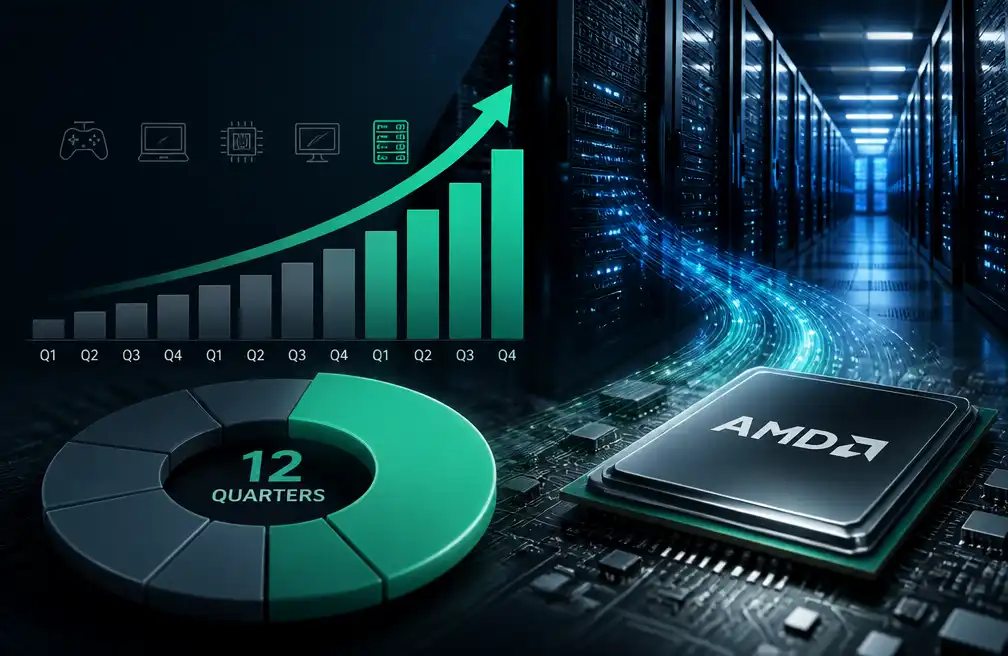
Bagaimana Fokus Pendapatan AMD Bergeser ke Data Center dalam 12 Kuartal

Laporan kuartal kedua AMD menunjukkan pergeseran signifikan dalam struktur pendapatannya. Dalam 12 kuartal terakhir, kontribusi bisnis *data center* terhadap total pendapatan perusahaan meningkat dari 27,6% menjadi 58,2%, menjadikannya segmen pendapatan terbesar sejak kuartal keempat 2025. Pada kuartal terakhir, pendapatan *data center* mencapai $6,718 miliar, meningkat 107% secara tahunan (YoY). Sementara itu, pendapatan segmen *gaming* turun 31% YoY menjadi $779 juta. Namun, penurunan ini tidak cukup besar untuk menjelaskan pertumbuhan pesat *data center*, mengindikasikan bahwa pertumbuhan perusahaan lebih didorong oleh perluasan basis pendapatan total, bukan hanya alih sumber daya internal dari satu segmen ke segmen lainnya. Pertumbuhan absolut total pendapatan AMD mendukung kesimpulan ini. Dibandingkan dengan pesaing, tren pertumbuhan pendapatan *data center* AMD memang kuat, namun skalanya masih jauh di bawah Nvidia ($75,2 miliar pada kuartal terakhir yang diungkapkan). Posisinya relatif lebih dekat dengan Intel, meski definisi segmen antar perusahaan berbeda dan periode pelaporan tidak selalu sepenuhnya sejalan. Secara keseluruhan, data menunjukkan bahwa *data center* kini telah menjadi pusat pendapatan AMD. Meski terjadi kontraksi di bisnis *gaming* pada periode yang sama, data laporan keuangan publik tidak cukup untuk membuktikan adanya pengalihan sumber daya secara langsung dan sederhana antara kedua divisi tersebut.

marsbit10m yang lalu

Bagaimana Fokus Pendapatan AMD Bergeser ke Data Center dalam 12 Kuartal

marsbit10m yang lalu

Diagram Wallet Cloudflare: Pemain Baru dalam Pembayaran Stablecoin dengan X402

Cloudflare meluncurkan Wallets, yang memungkinkan pengguna mengklaim "handle" untuk identitas dompet masa depan, namun fungsi inti seperti pengisian saldo, pembayaran, dan Virtual Wallet untuk agen AI belum tersedia. Produk ini merupakan bagian dari ekosistem pembayaran Cloudflare yang mencakup Stripe Projects (untuk perwakilan pembayaran kartu) dan Monetization Gateway (untuk penerimaan pembayaran via x402). Wallets dimaksudkan untuk melengkapi sisi pembayar dengan identitas dan aturan otorisasi. Protokol pembayaran x402 telah mencatat volume transaksi kecil yang signifikan (rata-rata $0,32 per transaksi), menunjukkan potensi untuk pembayaran API atau konten mikro. Namun, data ini tidak secara spesifik mencerminkan adopsi Cloudflare Wallets. Contoh implementasi menunjukkan alur pembayaran mikro sebesar $0,01, di mana agen menandatangani pembayaran setelah menerima kode status HTTP 402. Dalam pengembangan saat ini, kunci privat masih dipegang pengembang, dan Wallets bertujuan untuk memperkenalkan kontrol seperti Virtual Wallet terpisah, batas pengeluaran, dan daftar putih untuk keamanan yang lebih baik. Tiga jalur pembayaran oleh agen (Stripe Projects, x402 untuk pengembang, dan rencana Cloudflare Wallets) memiliki model keamanan dan ketersediaan yang berbeda. Wallets masih memerlukan pengembangan lebih lanjut mengenai mata uang kripto yang didukung, KYC, dan detail operasional lainnya.

marsbit31m yang lalu

Diagram Wallet Cloudflare: Pemain Baru dalam Pembayaran Stablecoin dengan X402

marsbit31m yang lalu

TradeXYZ dan Hyperliquid: Mengungkap Hubungan Simbiosis di Bawah Pembagian 50%

Pasar semakin berhati-hati. Di sisi tradisional, pengeluaran AI hanya dihargai jika mendorong pertumbuhan tanpa mengikis arus kas. Di sisi crypto, tekanan berlanjut dari aliran keluar dana ETF dan kenaikan imbal hasil. Dalam crypto, kepemimpinan bergeser kembali ke Solana dan DEX. Solana naik 8,5%, didorong oleh token seperti META, sementara sektor DEX naik 5,2% dengan Uniswap memimpin. Perdebatan utama berpusat pada TradeXYZ dan Hyperliquid. TradeXYZ, yang membangun di atas Hyperliquid, kini mendominasi lebih dari 50% volume perdagangan RWA di platform tersebut. Mereka diwajibkan membagikan 50% pendapatan HIP-3 mereka ke Hyperliquid. Muncul kekhawatiran apakah TradeXYZ akan meninggalkan Hyperliquid karena bagi hasil 50% ini, atau sebaliknya, Hyperliquid akan mengambil alih pasar RWA. Analisis menyimpulkan hubungan ini adalah simbiosis mutualistik. TradeXYZ bergantung pada infrastruktur dan basis pengguna Hyperliquid, sementara Hyperliquid diuntungkan oleh kesuksesan TradeXYZ. Meninggalkan satu sama lain akan merusak reputasi dan ekonomi kedua belah pihak. Hyperliquid juga mendapat nilai melalui cara lain di luar bagi hasil 50%, seperti biaya prioritas dan peningkatan pasokan USDC di chain, yang menghasilkan pendapatan tambahan. Pertanyaan menarik bukanlah tentang pembagian 50/50, tetapi bagaimana kedua pihak beralih dari mode pertumbuhan ke basis biaya yang lebih stabil dan tinggi.

marsbit46m yang lalu

TradeXYZ dan Hyperliquid: Mengungkap Hubungan Simbiosis di Bawah Pembagian 50%

marsbit46m yang lalu

Laporan: DeepSeek Mulai Kembali Pendanaan, Valuasi Sebelum Investasi 500 Miliar Yuan

Sejumlah sumber transaksi mengungkapkan kepada _Caijing_ bahwa perusahaan model besar DeepSeek telah membuka kembali putaran kedua pendanaannya. Putaran ini rencananya mengumpulkan dana 50 miliar yuan dengan valuasi pra-investasi sekitar 500 miliar yuan, dan ditargetkan menyelesaikan penandatanganan pada akhir Agustus. DeepSeek menyelesaikan putaran pertama pendanaan sebesar 50 miliar yuan pada Juni dengan valuasi melebihi 350 miliar yuan. Putaran kedua, yang sempat dijeda pada akhir Juli karena ketidakpuasan pendiri terhadap informasi yang beredar, kini telah diaktifkan kembali. Valuasi pra-investasi putaran kedua naik sekitar 43% dari putaran pertama. Jika berhasil, total pendanaan dari kedua putaran akan melebihi 1 triliun yuan. Investor putaran pertama termasuk Dana Industri Kecerdasan Buatan Nasional, Tencent, CATL, dan modal ventura lainnya. Meski dijalankan dengan lebih tertutup setelah diaktifkan kembali, minat investor tetap tinggi, dengan banyak lembaga yang sebelumnya tertarik masih mengantri. Di tengah persaingan ketat dengan perusahaan seperti Moonshot AI, yang juga sedang dalam proses pendanaan dan menuju IPO, kemampuan model dan efisiensi biaya menjadi penentu kunci valuasi. DeepSeek baru-baru ini merilis DeepSeek-V4-Flash versi final, yang menunjukkan peningkatan kemampuan agen dan menawarkan harga yang kompetitif. Model ini menduduki peringkat teratas dalam konsumsi token di platform OpenRouter, menunjukkan daya tariknya di pasar global.

marsbit1j yang lalu

Laporan: DeepSeek Mulai Kembali Pendanaan, Valuasi Sebelum Investasi 500 Miliar Yuan

marsbit1j yang lalu

Trading

Spot
活动图片