On August 26th, after the U.S. market closes, Nvidia will release its Q2 FY2027 earnings report. As one of the world's largest companies with a market capitalization of approximately $5.3 trillion (as of mid-August), its report is a bellwether for the entire AI trade. This time, however, market sentiment is unusually divided: almost no one doubts the numbers will be impressive, yet almost no one dares to predict the stock will rise.
This division has data to back it up. Morgan Stanley pointed out in its earnings preview: Nvidia's stock has fallen on the day following its earnings release for four consecutive quarters. Earnings beat expectations, guidance was raised—this has been the pattern for the past year, yet the stock price has repeatedly experienced a 'sell-the-news' reaction. For this quarter, Nvidia's revenue guidance is $91 billion (+/- 2%), the consensus estimate is around $91.9 billion, while Jefferies has an optimistic forecast of $95 billion. The numbers remain stellar, but the true suspense has shifted to: Rubin.
Rubin's technological generation gap and production ramp-up pace are both stronger than Blackwell's initial phase; the first quantification of Rubin revenue in the Q3 guidance will be the biggest variable in breaking the 'post-earnings slump' curse. However, the 'expectation gap' between guidance and consensus, coupled with margin erosion from memory price increases, also means this earnings battle is not one-sided.
Expectation Gap: Four Consecutive Quarters of 'Beat and Drop'
If the key lies with Rubin, why hasn't the market simply paid for 'beating expectations'? A set of past data provides the answer.
Nvidia's stock performance on the day after earnings for the past four quarters:
- FY2026 Q2 (released August 2025): fell 0.88% the next day;
- FY2026 Q3 (released November 2025): fell 3.15% the next day;
- FY2026 Q4 (released February 2026): fell 5.46% the next day, down 9.39% over two days;
- FY2027 Q1 (released May 2026): fell 1.77% the next day, down 3.64% over two days.
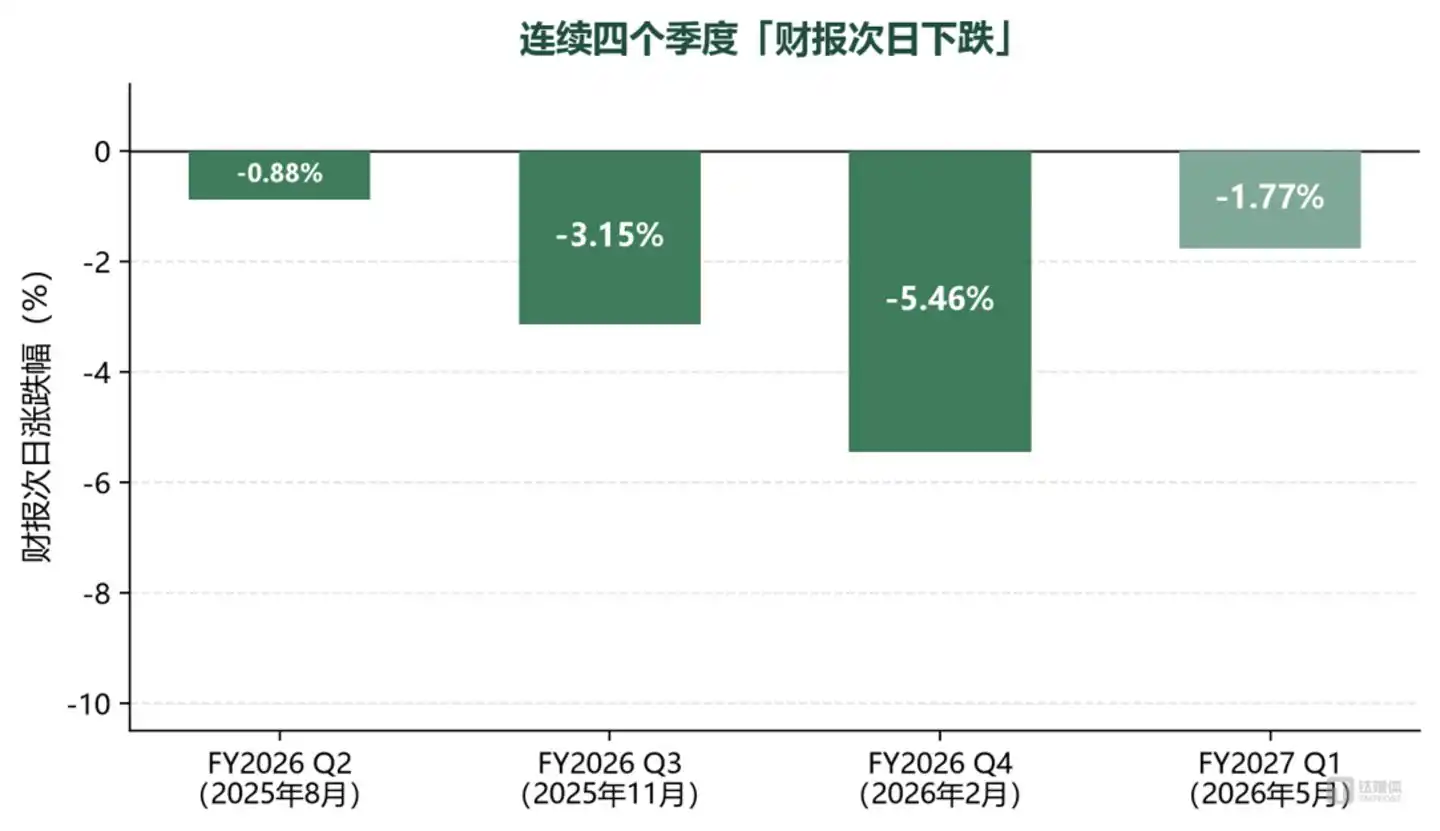
Four Consecutive Quarters of Stock Price Decline Post-Earnings
This 'post-earnings decline' was not due to missing expectations—on the contrary, Nvidia delivered results that met or exceeded expectations in all four quarters. The essence of the curse is the disappearance of the 'expectation gap': management's guidance was consistently revised upward by market consensus, but the magnitude of the beat shrank quarter by quarter. When the market has become accustomed to treating 'beating expectations' as the default setting, positive news can no longer easily translate into stock price gains, and any minor flaw can be magnified into a reason to sell.
Notably, this decline was more about sentiment realization than fundamental disproof—during these four declines, institutional earnings expectations actually increased rather than decreased.
This quarter, this tension reaches a delicate balance point. Nvidia's guidance of $91 billion, the market consensus of $91.9 billion, and Jefferies' optimistic forecast of $95 billion—the gaps between these numbers represent the scale of the 'expectation gap.' The approximately $0.9 billion gap between guidance and consensus implies that even if Nvidia slightly beats consensus, it may not guarantee a positive stock reaction; conversely, any unfavorable commentary regarding Rubin's ramp-up, gross margins, or the China market could become a trigger for a decline.
On a deeper level, the stock price has already priced in the future: the market isn't paying for the past quarter, but for the realization rate over the next two or three quarters. When the numbers themselves hold no surprise, the only marginal variable that can drive the stock is the 'slope of realization,' which is the fundamental reason the Rubin cycle garners so much attention.
However, the decline narrowed significantly in the most recent quarter, from -5.46% to -1.77%—indicating that the market's pricing of the 'beat and drop' phenomenon is marginally easing. This leaves room for breaking the curse, but a single-quarter data point is not yet sufficient to form a trend conclusion.
Rubin's Power: From 'Quantitative' to 'Qualitative' Change
The compression of the expectation gap is the root cause of 'beat and drop'; the variable capable of widening the expectation gap again is Rubin, a new platform with a significant technological generation gap.
The data released in Nvidia's official blog in July clarifies Rubin's positioning: the Vera Rubin platform focuses on 'performance per watt' and 'lowest token cost,' accelerating global deployment with support from over 300 partners, including CoreWeave, Google Cloud, Microsoft Azure, and Mistral. According to official figures, Vera Rubin achieves up to a 10x reduction in inference token cost compared to the previous-generation Blackwell.
This is not a routine upgrade. Vera Rubin NVL72 integrates 72 Rubin GPUs and 36 Vera CPUs into a single rack, with multiple new chips collaborating alongside a new generation of interconnects and optical modules, forming what Nvidia calls 'one AI supercomputer.' The official 10x token throughput improvement per megawatt implies a wholesale reevaluation of a data center's compute supply efficiency. For cloud providers, this rewrites the cost structure of unit compute.
The economic improvement is equally tangible: when running DeepSeek R1, Vera Rubin NVL72 offers about a 5.4x performance-per-watt improvement and about a 5x performance-per-dollar improvement compared to GB200 NVL72.
Placing three generations of products together makes the generational gap more apparent. Using relative inference cost per million tokens (Hopper = 100), Blackwell is around 2.9, while Rubin drops further to around 0.3—this is an order-of-magnitude leap, not a percentage improvement.
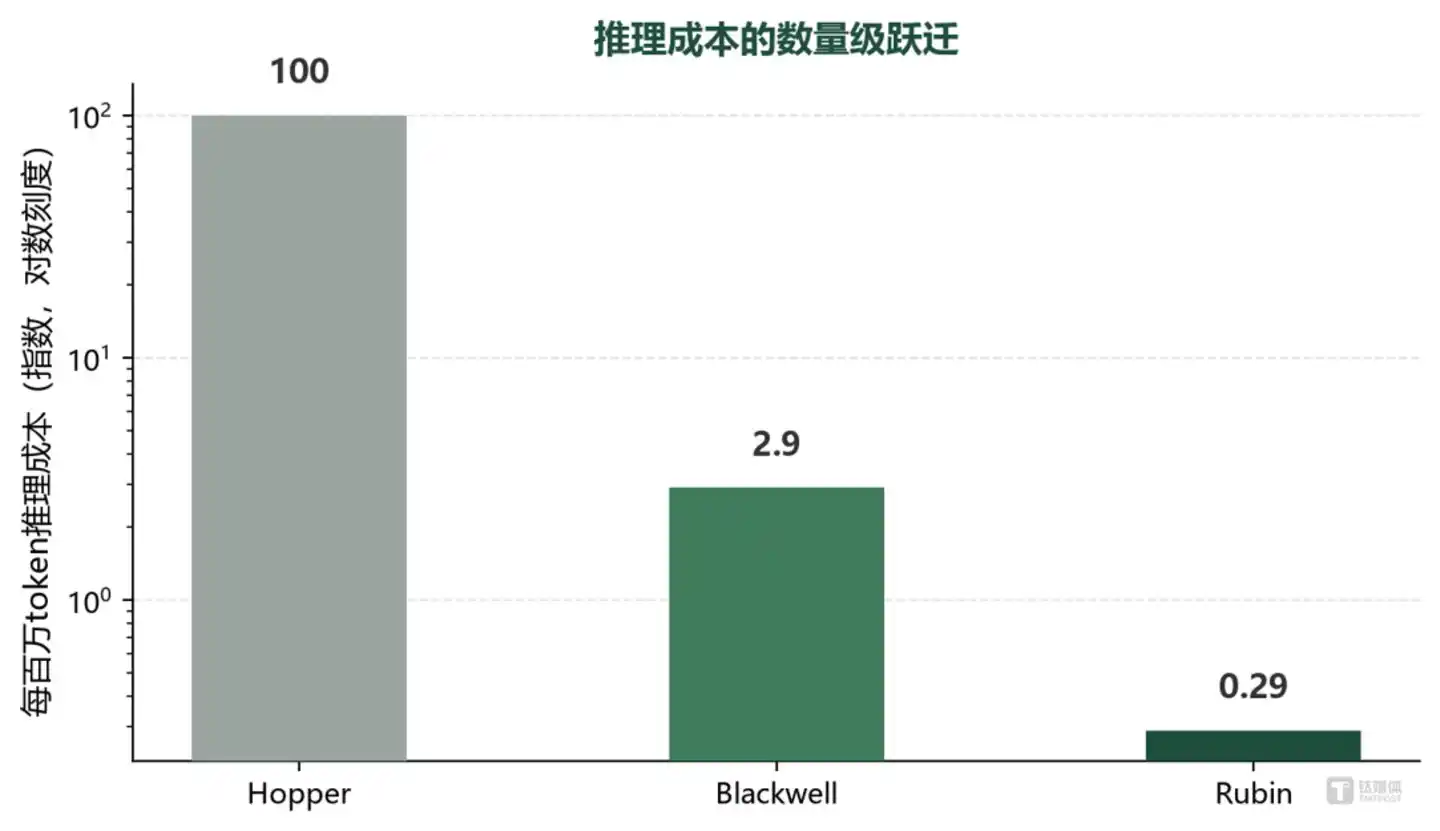
Order-of-Magnitude Leap in Inference Cost (Relative Estimate, Source: NVIDIA Official & Public Research Reports)
Placing the '10x cost reduction' into the industry context gives it clearer meaning: as inference costs drop by orders of magnitude, inference-focused applications previously difficult to scale can achieve commercial viability. Rubin shifts the entire AI industry's production cost curve downward, which is the foundation for Nvidia to maintain its pricing power in the inference era.
The move from Hopper to Blackwell was a 'quantitative' change, while the shift from Blackwell to Rubin is an architectural 'qualitative' change centered on inference workloads. The significance of this qualitative change directly counters the 'ASICs are cheaper' narrative. The iteration speed of the general-purpose platform is precisely Nvidia's confidence in facing competition from custom chips.
Rubin's Execution: From Volume Production to Ramp-Up
The product power is established, but the market cares more about execution—whether Rubin can successfully ramp up and translate paper performance into real revenue.
Regarding production pace, official information indicates the Vera Rubin platform entered volume production and began global delivery in July 2026, with ODM manufacturers like Foxconn confirming shipments will ramp up starting Q4 this year. Institutional forecasts followed suit: Morgan Stanley expects Rubin to contribute approximately $9 billion in revenue in FY2027 Q3; Jefferies forecasts shipments exceeding 13,000 Rubin racks by year-end and over 120,000 for full-year 2027. In terms of revenue, Rubin's share of Nvidia's GPU revenue is expected to quickly rise from around 12% in FY2027 Q3 to over 40% in Q4.
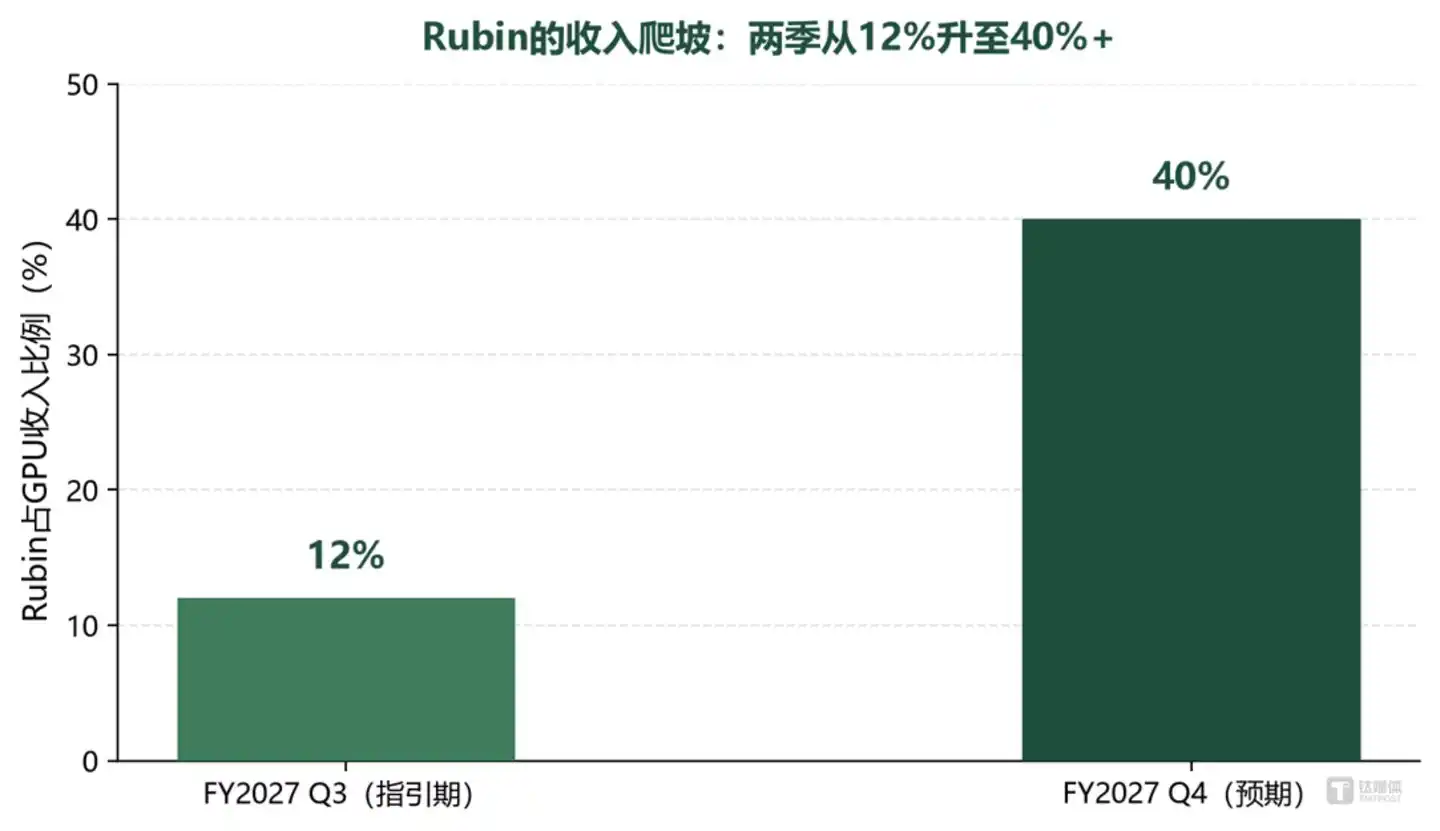
Rubin's Share of GPU Revenue Ramp-Up (Source: Jefferies Forecast)
The core rationale for Jefferies' optimism lies in 'reusability': Rubin continues the 72-GPU rack form factor, which can reuse the liquid-cooled data center infrastructure accumulated during the GB200/GB300 era, suggesting its ramp-up pace will likely be significantly faster than Blackwell's initial phase.
Supply chain signals are also relatively positive: Foxconn's confirmation of Q4 shipment ramp-up is seen as a key inflection point for Rubin's transition from 'volume production' to 'ramp-up.' Rubin's supply bottleneck is shifting from chip capacity to the matching speed of data center infrastructure.
However, cautious voices also exist. TrendForce noted in April that due to geopolitical and supply chain adjustment factors, Rubin shipments might face delays, with Blackwell still accounting for about 70% of high-end GPU shipments in 2026; lessons from the GB200's initial bring-up performance falling short and extended testing cycles remain fresh, and SemiAnalysis also reminds that Rubin is still in its early bring-up stage. The divergence between optimism and caution is precisely the variable most worth watching this earnings night. The fact that one institution measures by revenue and another by racks itself indicates the market's judgment on the ramp-up slope has not yet converged.
Testing cycles and yields are the biggest execution risks for this earnings night. The technological generation gap and ramp-up pace answer 'what Nvidia can build'; demand and competition answer 'who will buy this compute power, and who might replace it.' The latter question requires viewing through a longer-term lens.
Demand and Competition: The Buyers and the Challengers
The intertwined lines of demand and competition together determine how far Rubin can go.
Demand Side: The Compute Buyers Remain Committed
Most attention-grabbing is the deep tie between Nvidia and OpenAI. In mid-August, Nvidia announced over $105.5 billion in financing for an OpenAI data center in Ohio, covering land, power, and infrastructure. The project's initial computing capacity is 4.25 gigawatts, with a planned long-term capacity of 8 gigawatts. This scale is notably more modest than the previously rumored $250 billion guarantee plan, making the 'AI financing model' an unavoidable topic on the earnings call.
Procurement by cloud providers is also intensifying. Goldman Sachs expects global AI investment to surpass $1 trillion in 2026, with the U.S. accounting for over half.
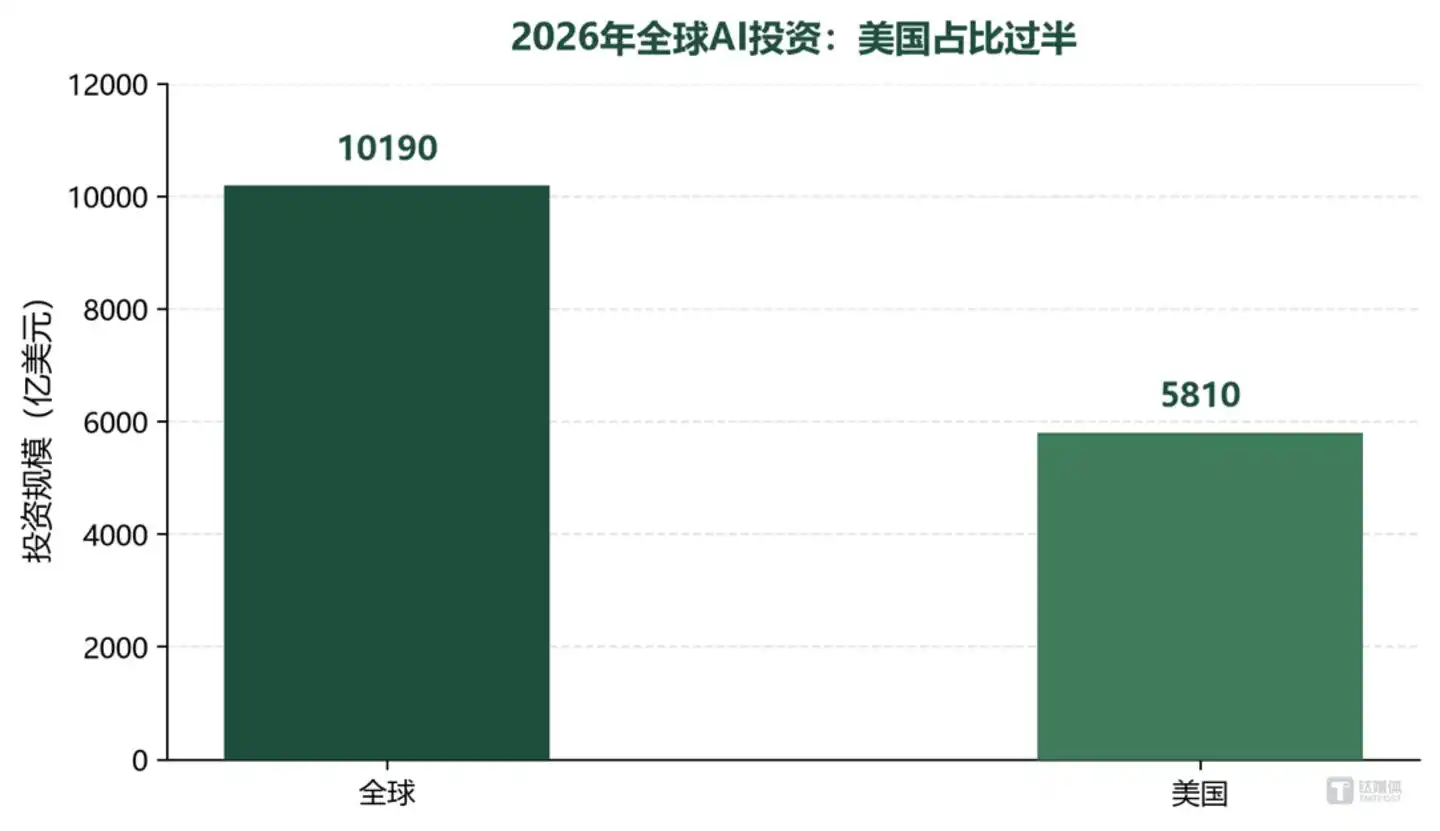
Global AI Investment Structure in 2026 (Unit: $100 million, Source: Goldman Sachs Research)
All four major cloud providers are among the first deployment customers for Vera Rubin. Subtle changes are occurring in the China market: According to the UK's *Financial Times*, H200 has been approved for export to China, with ByteDance and Tencent each receiving around 10,000 H200 chips in recent weeks. Although this revenue is not yet factored into Nvidia's guidance, and the company has explicitly denied plans for a 'special' LPU chip for the Chinese market. Revenue from China declined from $17.1 billion for the full FY2025 to $2.8 billion in FY2026 Q2 (about 3% of quarterly revenue), leaving it unclear whether this is a temporary gap or a structural change.
Another constraint comes from power. The bottleneck for AI data center deployment is shifting from chips to power availability and grid connection timelines. A gigawatt-scale data center often takes years from site selection to power-on, meaning even with sufficient chip supply, the speed at which downstream players 'can get power and build facilities' is dragging down demand realization. It is precisely to hedge against demand-side uncertainty that Nvidia has chosen to underwrite OpenAI using its balance sheet. The sustainability of this model will be a focal point on the earnings call.
Competition Side: Challengers Are Approaching
In June, OpenAI and Broadcom jointly released their first self-developed inference chip, Jalapeño, which they claim is 50% cheaper than Nvidia GPUs and took only 9 months from design to production. Following closely, Anthropic also announced the start of its own AI chip development. Broadcom, with its custom XPUs and long-term commitments to hyperscale customers, is seen by some institutions as a rival that is 'rewriting AI economics.' Over the past two quarters, its AI business revenue has reached the $8 billion per quarter level, growing faster than Nvidia's (albeit from a lower base).
Considering that inference already accounts for over half of Nvidia's Data Center revenue (surpassing 50% for the first time in FY2027 Q1, historically exceeding training), the encroachment of self-developed chips into the highest-margin business is a structural threat that must be acknowledged. Nvidia is not avoiding this, placing the narrative emphasis of Rubin on inference efficiency—using the generational advantage of its general-purpose platform to counter the erosion by custom chips.
On a deeper level, the economic math doesn't fully support self-developed replacement: if self-developed ASICs can only save about 50% in cost, while Rubin's next-generation platform delivers order-of-magnitude reductions in inference cost, then the economic rationale for 'self-developed replacement' will need re-evaluation. This is a race between the iteration speed of a general-purpose platform and the single-point efficiency of custom chips.
Three Key Focus Areas for Earnings Night
Synthesizing the above analysis, the key focus areas for this earnings night can be distilled into three dimensions.
First, Gross Margin. Nvidia guided for non-GAAP gross margin of 75% (+/- 50 basis points), with the market consensus around 75%, essentially aligning with the guidance midpoint. The real pressure lies further ahead: Morgan Stanley expects FY2028 gross margin to fall back to 72.5%, with DRAM, wafers, advanced packaging, and substrate costs being the main drags. Whether gross margin can hold in the mid-70% range will directly determine the market's pricing of the 'Rubin cycle's substance.'
Second, The First Quantification of Rubin in Q3 Guidance. The market awaits not Q2 results, but management's first explicit guidance on Rubin's revenue contribution. Any figure higher than Jefferies' expected 12% would be the biggest positive catalyst.
Third, Outlook for the China Market. Progress has been made with H200 entering China, but it's not included in guidance. Any subtle change in management's tone regarding 'when China will start contributing revenue again' could shift market expectations.
Based on this, a simple judgment framework can be established: If Rubin guidance in Q3 beats expectations and gross margin remains above 75%, the consecutive decline curse will likely be broken; conversely, if guidance merely meets consensus and gross margin is eroded by cost increases, the 'post-earnings decline' could extend to a fifth quarter.
It's worth noting that even if the curse is broken, volatility won't disappear. The market's scrutiny of AI investment is shifting from 'can growth continue' to 'the substance of growth.' Gross margin, financing exposure, and power constraints could each become new points of divergence. Rather than betting on the rise or fall on earnings night, it's better to focus on how these three main themes play out over the coming quarter.
The true significance of the Rubin cycle may not lie solely in Nvidia's single earnings report, but in its role in defining the inflection point of AI compute inflation. As inference costs drop by orders of magnitude with each generation, the competitive narrative about 'who is cheaper' may be rewritten.(This article was first published on Titanium Media APP, Author | Silicon Valley Tech-news, Editor | Jiao Yan)